
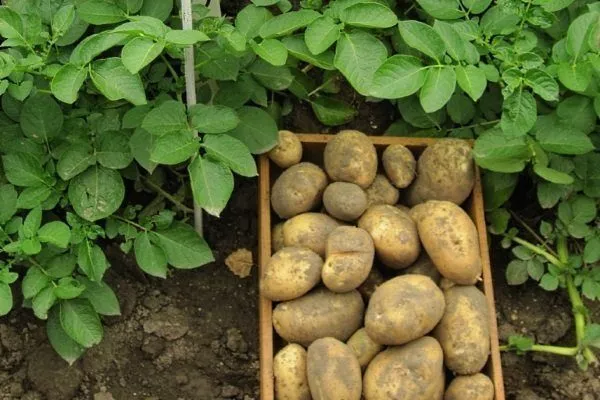
The "Udacha" variety has many advantages, but its main appeal to gardeners is its thin skin and early maturity. This potato, maturing early, produces large, tasty tubers. It is considered one of the best domestically bred varieties. After trying dozens of competitors, many amateur gardeners settle on "Udacha."
Breeding history
The variety's adaptability to weather and climate conditions allows gardeners to be independent of nature's whims and consistently reap high yields.
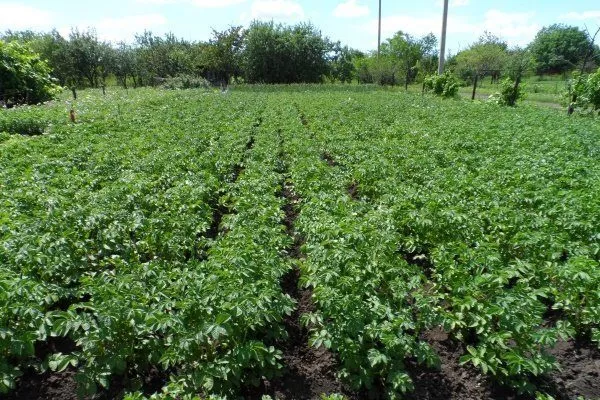
The "Udacha" variety was developed about 30 years ago. Its creators are breeders from the A.G. Lorkh All-Russian Research Institute of Potato Farming. The variety was developed from the "Vilnya" and "Anok" potato varieties. During breeding, the goal was to develop a universal variety capable of growing in any soil and climate. This goal was achieved – "Udacha" produces high yields in the Central Black Earth Region, the Middle Volga and Volga-Vyatka regions, the northwest of the country, and the Far East.
Description of the variety and characteristics
This variety is a table grape and is adapted to a variety of soils. Table 1 lists its main characteristics.
Table 1
| Characteristics | |
| Ripening category | early ripening |
| Ripening period, days | 65-80 |
| Starch, % | 11-15 |
| Weight of tubers, g | 100-150 |
| Number of tubers in one bush, pieces | 10-15 |
| Yield, c/ha | up to 430 |
| Description of tubers | round or round-oval, smooth, with small eyes, clearly visible on the light skin |
| Peel | light beige, thin; can become richer – up to light brown |
| Pulp color | white, turns yellowish when boiled |
| Shelf life % | 88-97 |
| Attitude to diseases | susceptible to late blight, alternaria and golden potato nematode |
| Appearance of bushes | medium height, dense, height - 40 cm |
| Appearance of leaves | matte, rich green |
| Bloom | snow-white flowers with reflexed petals |
| Degree of foliage | strong foliage |
| Regions where the variety shows the highest productivity | Central, Middle Volga, Northwestern, Volga-Vyatka, Central Black Earth, Far Eastern |
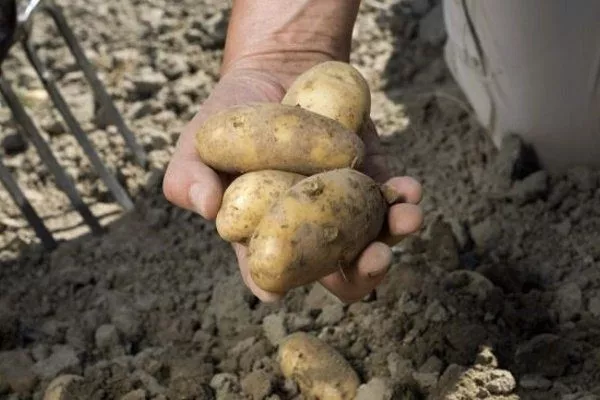
The thin, smooth, uneven skin allows for quick and easy peeling of potatoes, with minimal waste.
Comparison with other varieties
To assess the merits of the "Udacha" variety, let's compare it with other popular Russian varieties. Table 2 shows a comparison of starch content. This factor influences the potato's flavor and cooking time.
Table 2
| Name of the variety | Starch, % |
| Luck | 11-15 |
| Jewel | 10-15 |
| Meteor | 10-16 |
| Farmer | 9-12 |
| Timo | 13-14 |
| Arosa | 12-14 |
| Spring | 11-15 |
| Impala | 10-14 |
| Zoraczka | 12-14 |
| Kamensky | 16-18 |
| Latona | 16-20 |
Table 3 shows a comparison of yield with varieties that are highly productive.
Table 3
| Name of the variety | Yield, c/ha |
| Luck | up to 430 |
| Rowanberry | up to 400 |
| Blue | up to 500 |
| Crane | up to 640 |
| Lasunok | up to 620 |
| Sorcerer | up to 400 |
| Granada | up to 600 |
| Rogneda | up to 190-350 |
| Dolphin | up to 160-470 |
| Kiranda | up to 110-320 |
| Minerva | up to 430 |
Due to the low starch content of the "Luck" potato, diabetics can eat it without restrictions.
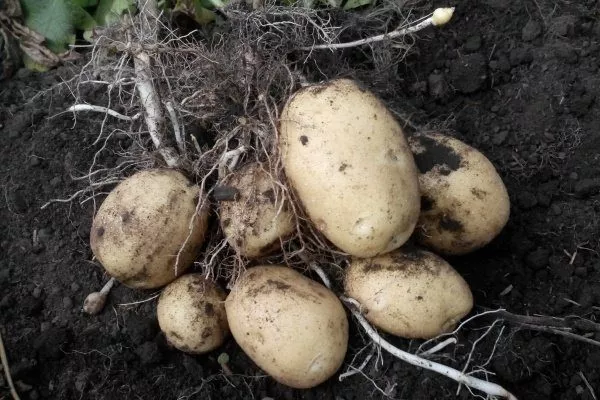
The 'Udacha' cultivar grows luxuriously—spreading and dense. Blooms are short-lived but profuse. When the flowers fade, berries with seeds form in their place. With proper cultivation, the average tubers per bush weigh 1.7 kg.
Advantages and disadvantages
It's clear that this variety, popular with gardeners, has many advantages. Moreover, it has advantages over early-ripening varieties. The pros and cons of the "Udacha" potato are listed in Table 4.
Table 4
| Advantages of the "Luck" variety | Flaws |
| Cold-resistant. Tubers germinate at 10 degrees Celsius. The plant grows well even in cloudy and cool weather. | It is amazing late blight – Regular preventative treatment is necessary. It is also susceptible to Alternaria blight and nematodes. These diseases can cause losses in the quantity and quality of tubers. |
| Rapid ripening. The tubers are ready for eating as early as 40 days after germination—you can dig up the bushes. The harvest is ready on the 60th day. | |
| The tubers have a pleasant taste. The flesh is tender and cooks well. | Poor tolerance to dense rows. |
| Resistant to scab, potato cancer, rugose mosaic, rhizoctonia. | |
| Stores well. Even though this is an early variety, the tubers can be stored safely until the next harvest without losing their marketable appearance or pleasant taste. | If the tubers are planted in unheated soil, development is slow – ripening is delayed by 2 weeks. |
| It's undemanding of soil conditions, producing fruit in sandy and compacted soils. It thrives in chestnut, gray forest, peat, and sod-podzolic soils. It even produces decent yields in salt marshes. | |
| Resistant to mechanical damage. Can be harvested mechanically. Transports well. | |
| Excellent flavor. The flesh holds its shape during frying and baking. |
Preparing for growing
Successful potato cultivation depends, first and foremost, on proper agricultural practices. Avoiding mistakes is crucial at every stage. Growing potatoes begins with preparing the soil and seed.
Sprouting tubers
Seed potatoes are selected immediately during harvest. Medium-sized tubers are selected. They are stored separately from potatoes intended for consumption or sale.
Tuber germination begins 2-3 weeks before planting. Potatoes that have just been taken out of a cold cellar are not suitable for planting—under a layer of soil, they will take so long to germinate that harvesting can be delayed by weeks.
Germination rules:
- Germination takes place in the light. If the room is dark, the sprouts will be weak and thin.
- Seed tubers are placed in a single layer—in boxes or on a spread-out tarp. Greening the tubers promotes plant development and increases resistance to bacterial infections.
- Only healthy, medium-sized tubers are used for planting. Diseased or substandard tubers are discarded. Large tubers can be cut in half. It is important that each half of the tuber has at least 3-4 sprouts.
- Potatoes are planted when strong sprouts 1-1.5 cm long appear.
The tubers need to be cut a week before planting so that a hard crust has time to form on the cut.
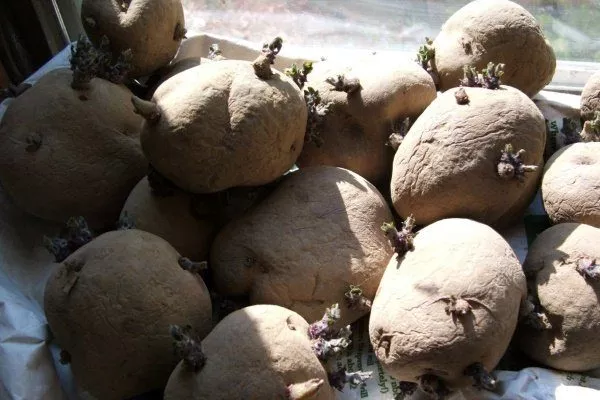
The size of the tubers determines the yield and ripening time of the plant. If you plant small potatoes (up to 30 g), you won't get large tubers. Furthermore, the harvest will ripen 2-3 weeks later than if you plant medium-sized potatoes. Tuber size also influences the depth at which you plant them: medium-sized potatoes should be planted 8-10 cm deep, while chopped potatoes and small potatoes should be planted 5-6 cm deep.
Preparing the land
Soil preparation for potato planting begins in the fall. It is dug over, perennial weeds are removed, and fertilized. Heavy loam soils require more fertilizer than lighter, more fertile soils.
- ✓ The soil should have a pH of 6.0-6.5 for optimal potato growth.
- ✓ The organic matter content must be at least 3%.
Average fertilizer rate per 1 sq.m:
- manure or compost – 5-7 kg;
- superphosphate – 30-40 g;
- potassium sulfate – 15-20 g.
In the fall, you can add fresh manure to the soil, but when planting, you can’t put it in the holes, otherwise the tubers will “burn.”
In the spring, repeat digging is performed. This is especially important for heavy loam soils—digging prevents acidification and promotes accelerated warming. Spring digging is not as deep as autumn digging. During this process, one cup of ash and two tablespoons of nitrophoska are added to the soil per square meter.
Classic potato planting
Planting tubers begins depending on weather conditions, based on soil temperature. It needs to warm to 7-8°C at a depth of 10 cm. These conditions occur at different times in different regions:
- North-West region, Urals and Far East – at the end of May;
- Southern regions – mid-April.
- A month before planting, carry out deep digging of the area to improve soil aeration.
- Two weeks before planting, apply complex mineral fertilizers according to the standards for potatoes.
Preparing the landing site:
- For marking you will need a cord and two blocks 80-85 cm high.
- The stakes are placed at the ends of the row, with a rope tied around them until it is fully taut.
- Dig a furrow along the cord. Fertilize it if you didn't apply any in the fall. It's also recommended to add some onion skins.
- The applied fertilizer is mixed with the soil. The tubers are placed in the furrows/holes, spaced 20 cm apart.
- The distance between adjacent rows is 60 cm.
- After planting the tubers, level the area with a rake. A week later, it's recommended to rake again—breaking up the crust will help the seedlings break through the soil more quickly.
If there's a risk of frost, the beds are hilled—heaped with more soil. A temperature of 1-2°C is enough to freeze the shoots and root shoots.
How to plant potatoes for an early harvest?
Farmers have a method for obtaining early harvests. The method's features include:
- Seed tubers are placed in boxes with sawdust.
- The potatoes are watered every day.
- After 2 weeks, the bushes will be fully formed and can be planted in open ground.
In pursuit of early harvests, it's important to watch out for frost. If there's a risk, it's best to play it safe by covering the plantings with plastic.
A gardener planted the "Udacha" variety for the first time – for an early harvest. The video shows the first digging of the potatoes.
Caring for potato plantings
It's not enough to just bury the tubers; you also need to ensure their growing conditions. Potato care involves three main agricultural practices:
- Watering. If the summer is dry, the potato plantation will have to be watered to avoid loss of harvest volume.
- Hilling. Several problems are solved simultaneously: weed control, improved air exchange, and protection of tubers from the sun.
- Top dressing. To increase the yield, after planting, several additional feedings are carried out - with organic or mineral fertilizers, root or foliar (spraying).
Watering
The "Udacha" variety doesn't require watering in favorable weather. However, during dry summers, it's best to provide artificial soil moisture. Ideally, the water should be rainwater or settled tap water, and it should be warm. Loosen the soil after each watering. The watering schedule is listed in Table 5.
Table 5
| Irrigation number | When to carry out? |
| 1st | the first shoots appeared |
| 2nd | the potato bushes have blossomed |
| 3rd | two weeks before harvesting |
Water should flow between the rows. Drip irrigation is better than sprinkling.
Hilling
Lateral horizontal shoots form tubers, which need to be protected from ultraviolet radiation by hilling. When the plants reach 10-12 cm, they are covered with soil raked from between the rows. The shoots should be 4-5 cm above the soil. The tubers will form in the ridges, and to prevent them from turning green, the soil is periodically raked. potatoes are hilled.
It is recommended to make furrows at the base of the bushes so that rainwater will be absorbed rather than run off.
Top dressing
There are two fertilization strategies: fall-spring and during tuber development. If the soil is well-fertilized in the fall and at planting time, further fertilization is not necessary. If fertilizer is not applied in a timely manner, plants can be fertilized after emergence. Fertilization timing is listed in Table 6.
Table 6
| When to apply fertilizer | Composition of the fertilizer | How much per bush? |
| The first shoots have appeared |
| 0.5 l |
| Flowering begins |
| |
| Flowering period |
|
If there is an overdose of chloride and potassium fertilizers, root crops with pulp prone to darkening are formed.
How to protect potatoes from pests and diseases?
The "Udacha" variety has strong immunity to many potato diseases. However, there are some diseases and pests it cannot combat on its own.
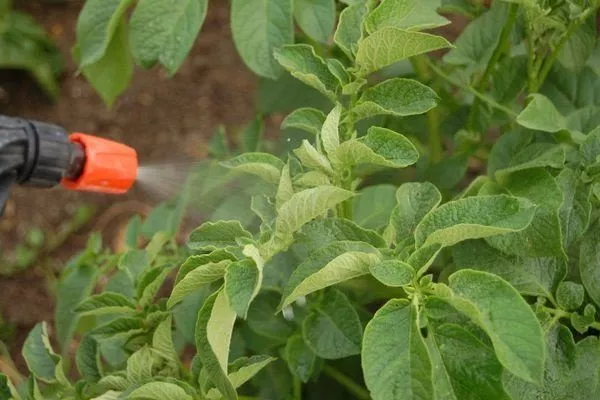
Diseases and pests of the ‘Udacha’ variety, as well as measures to combat them, are in Table 7.
Table 7
| Disease or pest | Signs | Prevention | Methods of control |
| Late blight |
|
|
|
| Wireworm | Tuber passages |
| Treating bushes with a mixture of Actellik, water and acetone - take 15 ml, 80 ml and 200 ml, respectively. |
| Stem nematode |
| Add 1 tbsp of wood ash into the hole when planting. | Digging up and destroying affected plants. |
| Mole cricket | Depressions in tubers |
| Treat the planting with a solution of laundry soap - take 2 bars per bucket of water. |
| Colorado beetle |
| Planting fragrant plants near potatoes:
|
|
Many gardeners use traditional methods to combat the Colorado potato beetle. Their main advantage is that they pose no harm to humans.
Here are some options:
- Ash. 2 kg of ash are dissolved in a bucket of water and a bar of laundry soap is added.
- Sagebrush. Dissolve 300 grams of wormwood in a bucket of hot water, add a cup of ash, let it steep for 3 hours, and then spray the bushes.
- Soda and yeast. Mix 300 g of baking soda and the same amount of yeast in a bucket of water. Treat the bushes weekly.
- Poplar. Half a bucket of poplar leaves is poured with water and boiled for 15 minutes. Add water to bring the total to 10 liters and leave to steep for 3 days.
- Colorado beetles. Fill a 0.5-liter jar with beetles (collected by hand) and pour them into a 10-liter bucket. Add water and close the lid. Let the beetles steep for a week, then use them diluted with water at a ratio of 1:2.
How to properly harvest and store crops?
To prevent the harvest from perishing prematurely, it must be collected and stored properly:
- Before harvesting the tubers – 1.5-2 weeks, the tops are torn off.
- Harvesting takes place in mid- to late August, depending on planting time and climate zone. The signal for harvesting is when the bushes are completely dry.
- Dug-up potatoes shouldn't be stored immediately in the cellar. They are first dried in the sun, then in the shade. The dried tubers are sorted—set aside for seed, food, or sale, and any damaged potatoes are removed.
Rejected potatoes account for no more than 3% of the entire harvest. Damaged tubers are stored separately from quality potatoes and are used first. "Udacha" potatoes store well if provided with the appropriate conditions; the optimal storage temperature is 2-4 degrees Celsius.
Representatives of the gardening company discuss the best potato varieties of domestic and Dutch selection. You can compare the Dutch potato "Gala" with the domestic variety "Udacha":
Feedback from farmers and ordinary gardeners
Anyone who appreciates potatoes and has experience growing the "Udacha" variety is confident that it is one of the best results of domestic breeding. Gardeners are attracted by the yield, ease of cultivation, and flavor of the tubers, while farmers are also pleased with the marketability of the potatoes they grow, their shelf life, and their ability to withstand transportation.
The "Udacha" variety is a favorite among gardeners and summer residents who don't have time for lengthy gardening, as well as farmers hoping for an early and bountiful harvest. This variety combines excellent agronomic characteristics with the excellent flavor of its tubers. If you want to experience the true flavor of a potato, try "Udacha."