
The early-ripening Impala variety is highly valued by both amateur gardeners and large-scale potato farmers. We'll discuss its characteristics, advantages, cultivation technology, and disease and pest control measures in more detail later in the article.
History of the variety
The origins of the Impala variety began in the Dutch capital of Emmeloord. Employees of the international company Agrico, renowned worldwide for its innovative potato developments since 1973, developed this potato variety through selective breeding.
In 1992, following variety testing, Impala was included in the State Register of Plants of the Russian Federation. In 2000, it was added to the State Registers of Ukraine and the Republic of Belarus. In the Russian Federation, cultivation of the Impala potato variety is limited to four regions:
- Volga-Vyatka (Kirov, Nizhny Novgorod and Sverdlovsk regions; Mari El Republic; Perm Krai; Udmurt and Chuvash Republics).
- Lower Volga (Astrakhan, Saratov and Volgograd regions; Republic of Kalmykia).
- Northwestern (Vologda, Kaliningrad, Kostroma, Leningrad, Novgorod, Pskov, Tver and Yaroslavl regions).
- Central (Bryansk, Vladimir, Ivanovo, Kaluga, Moscow, Ryazan, Smolensk and Tula regions).
However, despite this, the Impala variety has become widespread throughout the Russian Federation. In some regions of Russia and Ukraine, it has been given simpler and more familiar names—Kubanka or Krymchanka.
Description of the Impala potato
Bushes. The potato plant reaches 75-80 cm in height. The plants are upright, with 4-5 well-foliated stems on each plant. The leaves are medium-sized, fairly dense, and richly green. Slight wavy edges can be seen along the leaf edges. The flowers are white with a small yellow center.
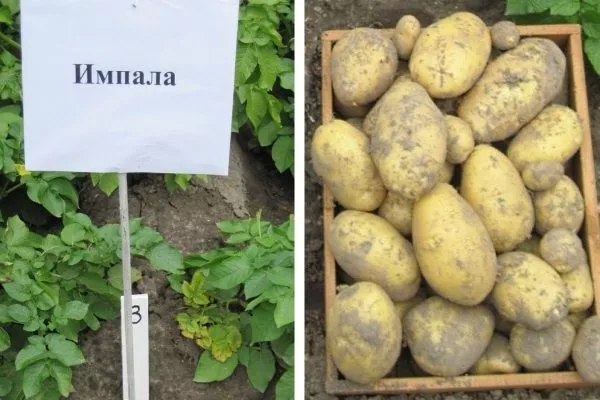
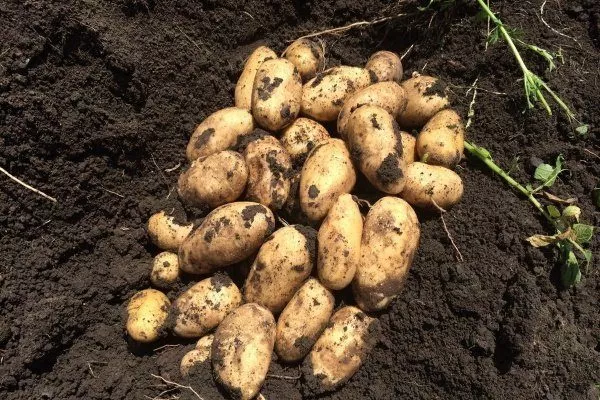
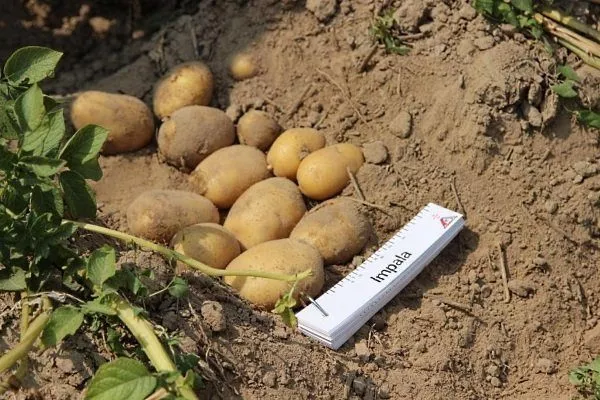
Roots. Typically, each plant produces about 15 tubers. The roots are large, oval, and sometimes round-oval in shape. The tubers gain most of their weight by August, weighing on average 90-160 grams. The skin is yellowish, smooth, and easy to peel due to its loose structure. The number of eyes is moderate. They are very small and located shallowly on the surface of the skin. The flesh is light yellow and creamy.
Characteristics and features of the variety
Let's consider the features and main characteristics of the Impala potato variety according to the following criteria:
- Ripening speed. This is an early-maturing potato variety. The first harvest is ready to be picked just 45 days after planting. Depending on the climate zone, full maturity occurs in 60-70 days.
- Resistance to adverse weather conditions. The Impala variety tolerates both dry and humid conditions well. This characteristic makes it widely grown in various regions.
- Resistance to mechanical damage. The high resistance of root crops to mechanical damage allows them to fully preserve their original appearance after harvesting.
- Soil requirements. Potatoes of this variety are characterized by their undemanding nature regarding the type of soil; however, as practice shows, the best results can be achieved when grown in unprotected soil.
- Keeping quality. Suitable for both consumption and long-term storage. During long-term storage, it retains its properties and appearance well.
- Disease resistance. Impala is resistant to most viruses and diseases that often affect other potato varieties. This is due to its early maturation, which allows it to avoid many potato diseases that rapidly develop in autumn. The table below shows the main diseases and their resistance levels for this variety.:
| High stability | Average stability | Low stability |
| Golden potato cyst nematode | Common scab | Rhizoctonia |
| Potato cancer | Late blight of tubers and tops | Powdery scab |
| Viruses A and Yn |
Productivity and taste
Impala potatoes not only produce high yields but also consistently. Farmers harvest between 180 and 360 centners of root vegetables per hectare per season. Hobby gardeners can get at least 0.5 kg of early-ripening potatoes from a single plant, and between 1 and 2 kg of mature potatoes.
In southern regions, two harvests per year are possible. To achieve this, the bushes are carefully removed from the soil, the tubers are removed, the hole is watered generously, and the bush is replanted with the small remaining tubers. The key is to perform this process in cloudy weather.
A table variety, Impala potatoes are characterized by a relatively low starch content (10-14%). After cooking, they become moderately soft without becoming overcooked or browning. This makes them ideal for any type of cooking (boiled, baked, fried). Due to their excellent flavor, Impala potatoes are suitable for both first and second courses, as well as salads.
Advantages and disadvantages of the variety
The main undeniable advantages of the Impala potato variety include:
- early maturity;
- consistently high productivity;
- drought and moisture resistance;
- high transportability and shelf life;
- resistance to mechanical damage;
- excellent taste of root vegetables;
- unpretentiousness to planting soil;
- versatility in cooking and heat treatment methods;
- attractive presentation;
- compact arrangement of tubers on bushes, which allows for quick and effortless harvesting of root crops;
- high resistance to major diseases.
Among disadvantages We note the following varieties:
- susceptible to damage from the Colorado potato beetle, therefore requires additional pest control treatment;
- seeds are not available for sale in all regions;
- It is necessary to carry out preventive measures aimed at protecting against fungal diseases.
Features of planting and growing Impala potatoes
In order to obtain the highest possible results from growing this variety, you should familiarize yourself with the necessary agricultural practices.
Optimal timing and choice of location
Experts recommend planting potatoes in late April or early May. By this time, the soil has warmed up to the required temperature, and moisture levels are still sufficient. Planting should take place after the last frost has passed. To ensure two harvests per season, in southern regions of Russia, the Impala variety is planted in late February or early March under spunbond.
- ✓ The area should be well lit, without shade for most of the day.
- ✓ The soil must have good drainage to avoid water stagnation.
The key rule in potato cultivation is crop rotation.
Sites previously occupied by winter crops, legumes, and perennial grasses are considered favorable for planting. Avoid planting after crops belonging to the nightshade family (e.g., tomatoes, peppers, and eggplants). Growing potatoes in the same spot for several years in a row is also strictly prohibited. Light to medium soils that are not excessively waterlogged are recommended.
Preparing the site for planting
When planting the Impala variety, as with any other, it's crucial to have fertile and loose soil. To ensure optimal yields, the soil should be enriched with nutrients.
Impala responds well to mineral fertilizers. It's a good idea to add a moderate amount of nitrogen to the soil in the fall, and in the spring, when planting tubers, add wood ash as a good tuber preservative and potassium fertilizer.
Preparing tubers
Germination is recommended to begin in the second ten days of March. Medium-sized tubers (up to 5 cm) weighing 50-80 g and bearing numerous eyes are used as seed material. Larger tubers should be divided so that each half retains some of the pulp and a stocky sprout.
It's essential to select only healthy tubers, free of rot, deformation, or any signs of disease. To increase the number of eyes, girdling is recommended—making a transverse cut around the top of the tuber.
The seed potatoes are then placed in a bright spot in a box for further germination. For the first few days, the room temperature should be maintained between 18 and 25°C, then lowered to 12 and 15°C and maintained at this level for another 30 days. Light levels are also increased. Every few days, the potato tubers should be sprayed with water to maintain high humidity.
It is not necessary to preheat and germinate the planting material, but in this case its maturation period increases.
It is necessary to monitor and discard seed potatoes that have not sprouted or have rotted.
To prevent potential diseases and, consequently, ensure a higher yield, treat the seeds with readily available solutions such as potassium permanganate, boric acid, or wood ash. Once the tubers have fully sprouted, soak them in a special solution for 30-40 minutes. Afterward, air the seed tubers.
The options for preparing a solution for 10 liters of water can be as follows:
- 1 g potassium permanganate;
- 10 g each of copper sulfate and zinc sulfate;
- 50 g of boric acid.
The solution must not be prepared in metal containers.
Chemical treatment is also widely used, but it must be taken into account that it has a rather harmful effect on the resulting crop.
Another simple and inexpensive method for disinfecting and enriching tubers with nutrients is dusting them with wood ash. To do this, add 2 tablespoons of wood ash to each hole dug before planting.
Planting in the ground, planting pattern and depth
When planting tubers, you should follow the basic rules:
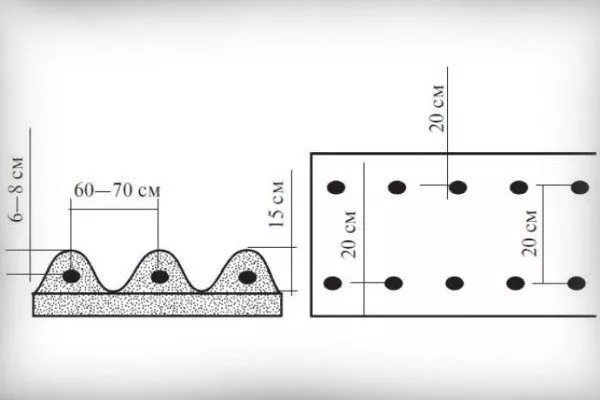
- The depth of the hole is no more than 6-8 cm.
- 200 g of wood ash is added to each hole.
- The tubers are placed with the sprouts facing up.
- The height of the soil ridge raised above the tubers should be 8-10 cm.
- It's preferable to arrange the furrows from north to south, as this will ensure sufficient sunlight reaches the bed. This will increase overall yield and the starch content of the potatoes.
An approximate diagram for planting seed potatoes is shown below:
 In soil warmed to 22…25°C, the first shoots will appear within two weeks. At higher soil temperatures, growth slows.
After the first shoots appear, you should hill up the planted potatoes and apply fertilizer.
Fertilization
To maximize the yield, it's crucial to fertilize the soil. Based on years of experience, a mixture of 700 g of humus with 5 tablespoons of wood ash has proven effective. Place it in each hole. Mineral fertilizers worth mentioning include potato kemira (20 g) and nitrophoska (1 tablespoon). To avoid damaging the potato tubers, apply fertilizer only after watering.
Care
The main requirements include watering, weeding, loosening and hilling.
In dry conditions, water three times per season (one month after planting, during flowering, and 14 days after flowering). The average water consumption should be 40 liters per square meter.
Loosening the soil and weeding the rows are carried out simultaneously after each watering or precipitation.
Hilling carried out when the bushes reach a height of 20 cm, which helps strengthen the root system.
Correct implementation of these agricultural measures allows to increase crop yields by a quarter.
Protection from diseases and pests
To minimize the risk of potato damage from typical diseases and pest infestations, it is necessary to take a number of preventative measures. For example, to combat late blight Treatment with Fitosporin is recommended.
To protect plants from Colorado potato beetles and wireworms, use Actellic, Corado, and Aktara. Onion peels are also an effective folk remedy. Click beetles can be controlled with Bazudin, and mole crickets can be controlled with Medvetox.
More information about potato pests and how to control them – read here.
Harvesting and storage
The harvest can be completed 40-60 days after the first sprouts emerge. Harvesting before this time is not recommended, as the potatoes will have a distinctive, unpleasant flavor.
You can determine whether the tubers are fully ripe using the following methods:
- Count three weeks from the flowering period. This method is not entirely accurate due to possible differences in climatic conditions.
- Dig up one bush and assess the condition of the tubers.
- Pay attention to the overall condition of the bush. If the lower leaves have started to turn yellow and the branches are falling to the ground, you can safely begin harvesting.
After harvesting, potatoes should be dried in a well-ventilated, dry place. Avoid direct sunlight, as this can cause the roots to turn green and spoil the harvest.
Storing potatoesIt is recommended to store the tubers in a single layer in a ventilated area. Check the condition of the tubers periodically. If the tubers are to be harvested as seeds for planting, they should be placed in the sun and allowed to turn green. These measures help reduce starch content and increase sugar and acid content.
The yield you get from planting Impala potatoes can be clearly seen in the following video:
Reviews
The Impala potato variety has become widely popular due to its excellent taste, high yield, and low maintenance requirements. By following simple guidelines, you can not only reap a bountiful harvest but also ensure you have enough planting material for next season.