
The Lasunok potato variety appeared a quarter of a century ago and has already become one of the most popular. This is due to its excellent taste and its ease of cultivation and care. To ensure a good harvest, you only need to know a few rules.
History of the variety
The Lasunok potato was developed in the mid-20th century in Belarus. This variety was developed by workers at a potato and fruit and vegetable center. Lasunok was added to the plant registers of Russia and Belarus in 1988.
Description of the variety
This is a mid-late variety. Depending on the climate and region, the Lasunok potato's growing season can range from 80 to 100 or 100 to 120 days.
| Object | Ripening period (days) | Yield (tons/ha) | Disease resistance |
|---|---|---|---|
| Lasunok | 80-120 | 62 | High |
Escapes
The bushes of this potato variety grow up to 1 meter tall. The tops are strong and robust, and the stems are thick. The leaves are also coarse and thick, covered with a stiff fuzz. During flowering, the bushes are covered with white inflorescences. Even with a 70x40 planting pattern, weeds have no chance of breaking through the densely packed Lasunka bushes. This has another advantage: moisture is retained so well, which is especially important in arid regions.
Roots
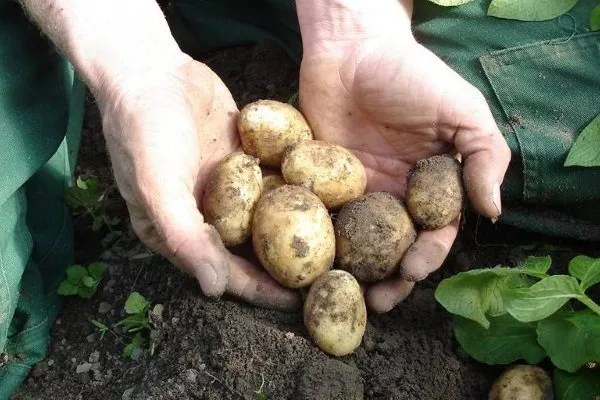
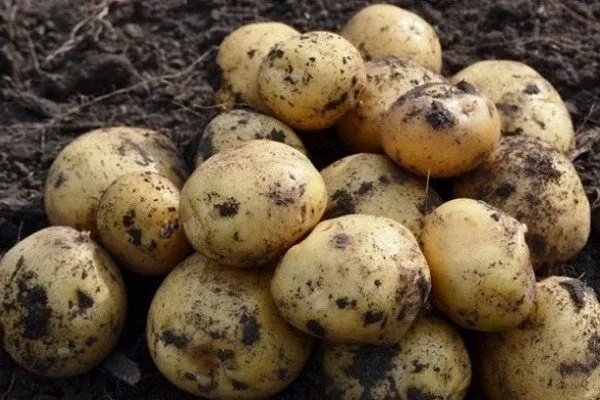
Potatoes of this variety are oval-round and large, weighing approximately 200 grams each. The skin ranges from light yellow to light brown. The eyes on the potatoes are small. The potatoes themselves are cream-colored.
The potato cooks well, with a starch content of 16 to 22%. This makes Lasunok ideal for making mashed potatoes, potato chips, starch, and French fries.
Characteristics and features of the variety
Lasunok is considered the tastiest of all Belarusian potato varieties. However, its flavor depends on the type of soil in which it is grown. Thus, the best flavor is found in potatoes grown in sandy soil.
Let's take a closer look at this variety:
- An important feature of this potato is its high resistance to diseases such as tuber blight, cancer, and viruses S, M, Y, and L. It also has average resistance to diseases such as rhizoctonia, black leg, and scab.
- The potato crop is harvested 3-4 months (depending on the region) after the first shoots appear.
- Flowering lasts for quite a long time.
- Lasunok produces a large harvest. Up to 62 tons of potatoes can be harvested from one hectare of land. A single bush typically produces 8 to 11 tubers.
- Potatoes germinate at temperatures of 5-7 degrees above zero.
- Any type of soil is suitable for growing this potato variety. Lasunok is undemanding in this regard.
Where can Lasunok be grown?
Since this variety is undemanding, it grows well in almost any region. If we consider post-Soviet areas, the following are suitable for cultivation:
- Central District;
- North Caucasian;
- Far Eastern;
- Central Black Earth;
- Northwestern;
- Belarus;
- Polesie;
- Transcarpathia.
Advantages and disadvantages of the variety
This variety has many advantages over others:
- high yield;
- resistance to pests, especially the Colorado potato beetle, which damages most potato varieties;
- pleasant taste;
- high immunity, protecting against fungi and viruses.
But besides the advantages, Lasunok also has some disadvantages:
- the harvested crop does not last very long;
- The potatoes are soft, so they're best suited for boiling. Frying them won't produce a crispy crust.
- Unstable to bad weather conditions: extreme heat and lack of water negatively affect the quality and quantity of the harvest.
How to plant potatoes
You can begin planting potatoes once the soil has warmed up. At a depth of 10 cm, the soil temperature should be 7°C (45°F). This usually occurs in late April or early May. It's best to begin planting in the morning.
- ✓ Soil pH should be in the range of 5.0-6.0 for optimal potato growth.
- ✓ The soil must be well-drained to avoid water stagnation and rotting of the tubers.
In order to get a good harvest, it is necessary to choose the right place for planting potatoes.
Depending on the soil type, you need to choose the planting depth. For example, in sandy loam, tubers should be planted at a depth of 10-12 cm, and in loam, 5-7 cm.
The planting site should be level and well-lit. It's important to remember not to plant potatoes in the same spot too often, as the soil will lose its nutrients. The planting site should be changed every four years. It's beneficial to plant potatoes in a location previously occupied by legumes or winter crops.
Another method that has a positive effect on the harvest is to plant watercress in its place after harvesting in the fall. It grows quickly and nourishes the soil, which is beneficial for the next potato crop.
- In autumn, carry out deep plowing of the area to improve the soil structure.
- Add organic fertilizers (rotted manure or compost) at a rate of 5-7 kg per 1 m².
- In spring, 2-3 weeks before planting, carry out cultivation to loosen the soil.
Soil preparation
The soil surface should be level. You should begin preparing the plot in the fall. It should be plowed and fertilized; manure is best, as it has a positive effect on the quality of the harvest.
Before planting potatoes, the soil needs to be loosened and weeds removed.
It is also possible, but not necessary, to mulch potatoes for the following purposes:
- to protect from frost;
- for uniform distribution of water;
- to protect potatoes from weeds;
- for heat distribution.
Mulching This is done before planting potatoes. First, remove the weeds, then moisten and loosen the soil, apply fertilizer, and leave it for a few days to air out.
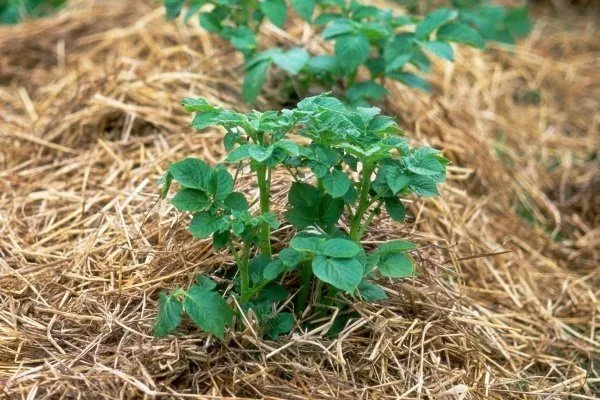
Mulching potatoes with straw provides excellent protection from cold and drought. To do this, loosen the soil and make furrows, leaving about half a meter between them. Place the tubers in these furrows, spacing them 30 cm apart, and then cover with a 20 cm layer of mulch. Once the sprouts reach 6 cm in height, cover the potatoes with another 15 cm layer of straw.
Preparation of planting material
To ensure a good harvest, tubers should be prepared for planting four weeks in advance. To do this, they need to be removed from storage and allowed to sprout. The tubers will need a couple of days to warm up after being cold, and sprouts will appear in two to three weeks.
Before planting, you can divide each potato into pieces, but each piece must have a sprouted "eye." Even small tuber pieces (at least 50 g) will grow into large potatoes.
To get more sprouts and this happens faster, you can use special methods, wet or dry:
- When wet The tubers should be stored in humus or sawdust at a temperature of around 15 degrees Celsius. This method allows the planting material to begin growing very quickly after planting.
- With the dry method The tubers are stored in boxes exposed to light. This causes the potato skins to turn green. Note that these potatoes are not suitable for eating, but they are good for planting, as this preparation will reduce their exposure to insects and diseases.
Planting diagram
When planting Lasunok potatoes, each hole should be 8-10 cm deep in sandy loam soil and 6-7 cm deep in loam soil. Before planting, add half a kilogram of wood ash or compost to the holes. The planting pattern for the tubers is 70 cm by 40 cm.
Caring for potatoes
The Lasunok variety doesn't require much care. It only needs regular watering, fertilizing, hilling, and weeding.
Watering
There's no need to water the potatoes immediately after planting: this is when the plant's roots are just forming. After this, Lasunok should be watered generously, but infrequently. It should be watered at least three times during the entire growing season. Water the potatoes during flowering and on very hot days. The best time to water is morning.
Top dressing
Lasunok requires nitrogen fertilizer to prevent excessive foliage and ensure the potatoes develop well. When the plants are too dense, all the nutrients from the soil go to supporting the foliage, not the roots. As a result, the potatoes remain small.
During the growing season, Lasunok should be fertilized with fertilizers containing phosphorus and potassium. Diammophoska or Nitrophos, as well as mullein, are good choices. About three applications throughout the growing season are sufficient.
Loosening and weeding
Loosening the soil helps the roots receive sufficient oxygen and moisture. This procedure should be performed for the first time a week after planting the potatoes, and all weeds should be removed at this time. Loosening should be done regularly until the hilling period.
Hilling
The first hilling is carried out when the bush reaches 10 centimeters in height. During this procedure, rake the soil between the rows toward the trunks of the bushes and cover them on all sides. hilling needed every 2-3 weeks.
We invite you to watch a video to learn more about why and how to properly hill potatoes:
Protection from diseases and pests
The Lasunok potato has a high immunity. It is resistant to diseases such as late blight, cancer, black leg, verticillium wilt, scab, Alternaria, fusarium, and other diseases and viruses. Furthermore, the Colorado potato beetle does not harm this variety.
However, Lasunok can suffer from a pest called wireworm. To prevent this, you can take preventative measures even before planting potatoes. Since wireworms can seriously damage the harvest, we recommend burying plastic cups filled with potato peels in the soil around the entire plot a week before planting. After three days, the wireworm larvae will collect in them. This procedure can be repeated as needed.
Harvesting and storage
Harvesting takes place in late summer to early fall. Harvesting can be done using specialized equipment or by hand.
Before storing the harvest, allow it to dry in the open air. Then, remove any damaged potatoes, place the healthy ones in wooden boxes, and store them in a place where the temperature is around 2 degrees Celsius, such as a basement. Humidity should be around 70%. These storage conditions will help. save the harvest until the spring period.
The Lasunok potato variety has remained popular among gardeners for many years. And for good reason: it's easy to grow, requires little maintenance, and resists diseases and pests without any extra effort. Moreover, this variety has a delicious flavor.