
Despite the labor-intensive cultivation process, the Zhuravinka potato is one of the most popular crops among gardeners. In pursuit of increased yields, experienced agronomists constantly experiment with potato varieties, and many choose this Belarusian variety.
Characteristics of the root crop
Zhuravinka is a high-yielding, mid-late Belarusian table variety with large tubers. Ripening period is 100-120 days. In 2005, Zhuravinka was added to the Russian Register of Agricultural Crops.
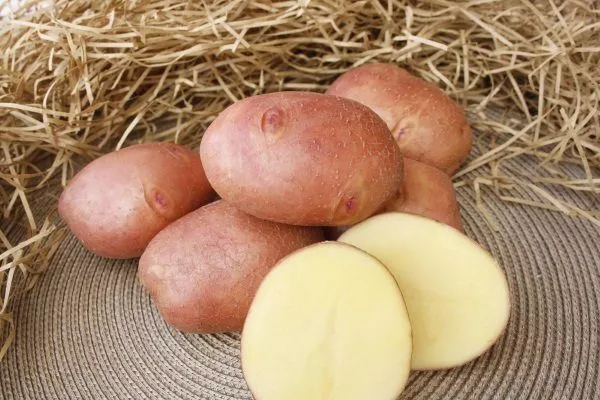
The potato skin is slightly rough, medium-thick, and a vibrant red color. The flesh is light yellow. A subtle, grid-like pattern is visible on the surface, but the pattern is barely visible on smaller potatoes. The soil peels away easily, making harvesting easier, extending shelf life, and creating a beautiful appearance.
Small, spherical eyes are evenly distributed on the surface of the root vegetable, with a reddish-purple base. The small, closed top has a slightly hairy surface.
The fruits are egg-shaped (round) or oval, 70-100 mm long. Each cluster contains 14-18 potatoes, with a maximum of 25. Marketable fruit weight ranges from 90-160 g. Yields range from 178 to 242 c/ha (75 kg/10 sq. m), which is above average compared to other commercial varieties. Marketability is approximately 90%.
During growth, upright, short, and intermediate-sized plants develop. The stems are medium-thick, lightly colored with anthocyanin, with up to six stems per bush. Small, rich green leaves with wavy leaf blades. The inflorescence is medium-sized and small-flowered. The corolla is reddish with purple. The foliage grows quite vigorously, with uniform emergence. This variety is considered medium in tuber formation and tuber growth rate.
The Zhuravinka variety has excellent flavor. It is used to produce starch, chips, crispy potatoes, and French fries (layered with food additives). It is ideal for making potato pancakes and zrazy. When cooked, the fruits soften well, the flesh does not darken, and large grains do not form. It contains 14-19.5% starch.
A positive feature is the potato's significant dormancy period. Under optimal conditions, it stores well until summer (storability rate: 96%).
Planting dates
The quality and quantity of the harvest depend on the time of planting. It's important to monitor the lunar phases and, most importantly, the average daily soil temperature.
If you rush, the tubers will germinate very slowly, and if there's a night frost (which often occurs in early spring in northern regions of the country), they may die completely. Over-growing potatoes is equally dangerous: if soil moisture drops significantly as summer warmth approaches, the quality of the potato's development will be significantly reduced.
According to experts, planting potatoes 14 days earlier (later) than the optimal time reduces yield by 15-20%.
The best conditions for planting the Zhuravinka variety are when the soil warms to 6–8 degrees Celsius. Planting at lower temperatures is pointless. In a cold environment, the tubers will simply lie around and possibly even rot.
- Selection of healthy tubers without signs of disease or damage.
- Sprouting tubers in a bright room at a temperature of +12…+15 degrees for 20-30 days.
- Treating tubers with growth stimulants or a solution of potassium permanganate to increase resistance to diseases.
Please note that the indicated temperature is the minimum allowable temperature, based on a rapid spring warming, and is achieved with an average daily air temperature of approximately 15 degrees Celsius. While the soil settles and the roots begin to grow, the average daily temperature will reach the optimal level. In northern regions, it's best to wait until the soil warms to 10 to 12 degrees Celsius.
Read also the article about favorable days for planting potatoes in open groundto get strong seedlings and a lot of harvest.
You can determine the temperature using a simple air temperature thermometer by burying it at a depth of 8-10 cm and taking readings after a while.
There are folk signs that experienced gardeners use as a guide:
- the beginning of flowering of dandelion or apricot;
- bird cherry blossoms and birch leaves appear (usually 10 days pass between these events, which marks the start of the planting period).
When determining the time for planting, it is worth considering that Zhuravinka does not respond well to either waterlogged or dry soil.
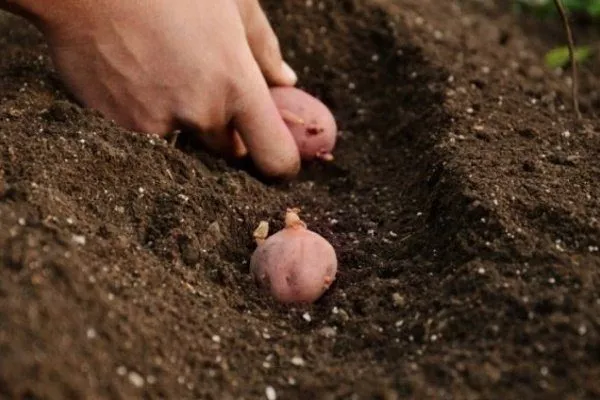
Planting “under film” is carried out approximately 14 days earlier than the described dates.
Late version (for southern regions)
Despite these arguments, some advocate summer planting (July), but this method is far from popular among gardeners. Its proponents cite the superior taste of these vegetables, their excellent shelf life, and the fact that the tubers do not degenerate. After all, the peak heat during flowering (tuber formation) has passed.
Minus – the need for frequent spraying.
Early version
This planting method helps avoid late blight and the massive attacks of the Colorado potato beetle, resulting in savings on pesticides. However, productivity, starch content, and flavor are reduced.
Minus – poor shelf life, sprouts on tubers germinate prematurely and have to be broken off.
Here are the approximate recommended planting times for Zhuravinka potatoes depending on the region:
| Region | Planting period |
| Central | beginning of May |
| Northwestern | mid-to-late May |
| Northern | end of May – beginning of June |
| Central Black Earth | first ten days of May |
| Volgo-Vyatka | first ten days of May |
| Volga region | first ten days of May |
| North Caucasian | beginning of April |
| Ural | the second half of May |
| West Siberian | end of May – beginning of June |
| East Siberian | end of May – beginning of June |
| Far Eastern | the second half of May |
Lunar phases
Long-term observation has allowed us to determine the optimal timing for planting potatoes relative to the satellite's position relative to Earth. Experienced gardeners know that it's not a good idea to plant potatoes during a full moon (or a new moon).
During the waning moon, cuttings and shoots are weakened, so if you plant potatoes at this time, you may not see any sprouts at all. The best time for planting is during the waxing moon. Then, plants quickly form, strengthen, and root.
- ✓ The area should be well lit, without shade for most of the day.
- ✓ The soil must have good drainage to avoid water stagnation.
Soil preparation
Soil composition directly affects potato yield. The most suitable soil for the Zhuravinka variety is light sandy loam, peat soil, and, of course, black soil. If you have a clay soil with high acidity, amend it with wood ash or compost with sand before planting.
Before spring planting, loosen the soil. It's best to do this in dry weather. Loosen the soil to a depth of 12-15 cm. For sandy and sandy loam soils, one loosening is sufficient, while clay soils require two.
Take some damp soil and try to shape it into a cord. Depending on how well you can do this, you can determine the soil composition:
- sandy loam - a lump forms which crumbles when pulled out;
- clay - rolled out into a cord-like strip.
Potatoes should be planted from north to south (northwest to southeast). This orientation will ensure the plants receive full daylight, while the shading in the rows will prevent excessive heat gain at midday.
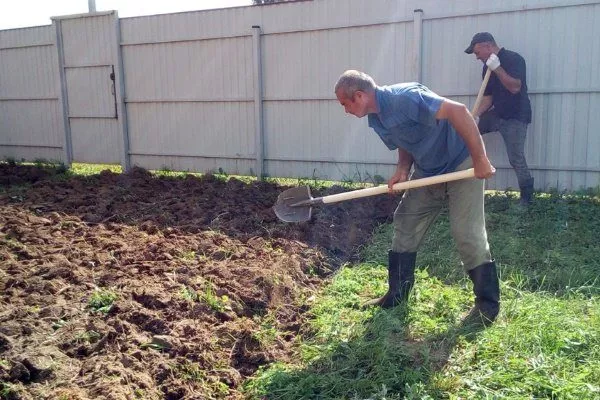
The goal of spring and fall plowing is to create a well-aerated soil layer that will collect and retain the necessary moisture. This preparation is crucial, as no amount of fertilizing or watering can compensate for the lack of oxygen in a compacted layer. Plowing also destroys weed roots and seeds, and incorporates applied fertilizers to the required depth. Hand digging should be done to destroy cockchafer and wireworm larvae, and remove weed roots.
Due to common pests and diseases, it is not recommended to plant Zhuravinka potatoes in a plot where other nightshade crops (tomatoes, eggplants, and bell peppers) were grown last year. Good predecessors include beets, zucchini, cucumbers, onions, carrots, or beans. Experts recommend a 3-4 year crop rotation.
Fertilizer
One of the most important agricultural practices when growing potatoes is fertilization, especially in a single plot without crop rotation. After all, the soil becomes depleted over 3-4 years, and a meager yield indicates the need for nutrient supplementation:
- The most readily available fertilizer for those who use wood-burning stoves is ash. It's rich in phosphorus, potassium, calcium, and a number of other beneficial micronutrients. Approximately 7 kg is applied per 100 square meters.
- Garden fertilizers sold in bags (superphosphate, potassium-magnesium). Apply during spring (pre-planting) plowing to a depth of 12-13 cm. It is extremely important to follow the concentration indicated on the package.
- Compost and rotted manure are among the best nitrogen fertilizers. A proven method involves applying two-thirds of the fertilizer at planting and the remaining one-third before the second hilling.
The Zhuravinka potato plant reacts extremely negatively to the application of fresh (unaged) manure. The fruit may become watery and lose flavor. There is also a risk of late blight and scab.
Approximate rates of fertilizer application per 100 sq. m:
- Fertile soils. 1.5-2 kg of ammonium nitrate, about 2.5 kg of nitrogen fertilizers, 3.5 kg of phosphorus, 2 kg of potassium and 2 centners of manure (compost).
- Average fertility. 2.5-3 centners of manure, 3 kg of nitrogen, 4 kg of phosphorus, 2.5 kg of potassium fertilizers.
- If there is a general lack of organic matter, during planting, add a mixture consisting of a hundredweight of humus mixed with 1 kg of ammonium nitrate and 3 kg of superphosphate.
- An increase in yield on any soil will be achieved by adding 5-10 kg of the wood ash already described.
Moderate application of mineral and organic fertilizers has a positive effect on growth. It is not advisable to exceed the recommended dose of nitrogen fertilizer. Crane does not tolerate excess moisture, especially during the growing season. It reacts poorly to prolonged soil moisture deficits.
Pest control
If other potato varieties are present in the plot, the Colorado potato beetle is indifferent to the Zhuravinka variety. Zhuravinka is resistant to the golden cyst nematode.
Colorado beetleYou can determine the presence of the pest by visually inspecting the bush. Young and adult pests damage the leaves by feeding on them, which (due to disrupted photosynthesis) prevents the potato from receiving sufficient nutrients.
Methods of control and prevention:
- manual collection of larvae and adult beetles;
- use of chemical and biological preparations (Bitoxibacillin, Tsimbush, Dilor, etc.);
- spray with a suspension: dilute 4 g of wormwood juice in 100 g of water (this is a tincture that is harmless to humans and can be used even before harvesting).
The use of pesticides is carried out no later than 28 days before harvesting potatoes.
Mole cricketThe presence of this pest can be identified by its characteristic burrows. Prevention methods:
- When planting potatoes, place pine branches, the smell of which repels the mole cricket;
- a soap solution (dissolve 1 bar of laundry soap in 50 liters of water) is poured into the burrows;
- systematic loosening of the soil to a depth of 5-6 cm.
Potato nematodeYellowed vegetable leaves indicate the presence of this pest. There is no treatment for it. To prevent its spread, dig up the bush along with a clod of soil and burn it.
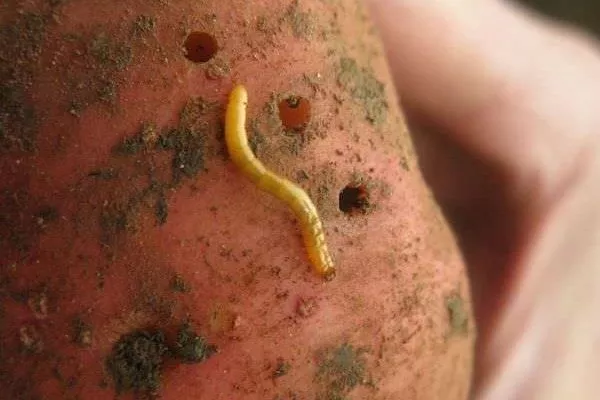
WirewormThis pest often doesn't cause widespread damage. However, affected fruits rot, and damaged stems may turn black. General-purpose pesticides (such as Anometrin) are used for control.
Fighting diseases
The Zhuravinka potato variety demonstrates resistance to potato cancer (pathotype I), black leg, common scab, and viruses X, S, and M. The variety's resistance to diseases such as rhizoctonia, late blight of foliage and root crops, and viruses Y and L is average.
Late blight. It is identified by dark spots on the leaves. The undersides of the leaves develop a yellowish coating. Spraying the bushes with a solution of copper sulfate (15 g per 12 liters of water) and Bordeaux mixture has proven to be the most effective way to combat this disease.
Common scab. A unique fungus that directly covers the fruit. It attacks the tuber buds. It can only be detected by digging up the potatoes. If the disease progresses rapidly, the area should be sprayed with TMTD (5 g per 10 liters of water).
Fungal diseases generally don't have a significant negative impact on potatoes. Most of them can be prevented by proper planting and careful harvesting.
How to store Zhuravinka potatoes?
Growing a great harvest isn't easy, but preserving it without loss is also crucial, and that's a science in itself. Success depends on many factors:
- temperature conditions;
- humidity;
- presence of damage on the fruit;
- keeping quality of the variety.
Therefore, all tubers that you are going to store must be:
- whole;
- dry;
- mature;
- healthy;
- without the presence of sprouts;
- clean.
The entire storage period of potatoes consists of several conventional stages:
- Medicinal. This involves drying, ripening, and healing. After digging, the potatoes are left scattered for 1.5-2 hours to dry. Then, move the harvest under a shelter, where it will remain for about 14 days. During this time, the potatoes "breathe," releasing moisture and heat, which promotes the formation of a dry skin over the damaged areas. This process will protect the fruit from harmful microorganisms.
- Cooling. This involves gradually lowering the temperature of the tubers to +2…+4 degrees Celsius. It is highly desirable to do this gradually. When this temperature is reached, biological and physiological processes within the fruit cease.
From the moment they're dug up until they're put into storage, avoid getting the potatoes wet or washing them. They should be protected from dew or rain.
- Basic. Includes compliance with recommendations for direct storage of potatoes:
- The fruits must be kept in complete darkness, otherwise they will become unfit for consumption.
- The ideal storage temperature for the Zhuravinka variety is between 2 and 4 degrees Celsius. At higher temperatures, the tubers sprout, while at lower temperatures, they spoil. You can lower the temperature in the basement by opening vents. If you store Zhuravinka in a pantry drawer, use plastic bottles filled with ice.
- Humidity in the room should be between 85-90%. Higher humidity will encourage sprouting or cause rot. In dry storage conditions, potatoes will lose water, becoming soft and flaccid.
- Spring. The air warms up quickly, and the main task is to maintain the temperature within the required range (up to +4°C). To do this, open the basement vents (windows) at night and in the morning (while the outside temperature is still low), forcing in cool air.
There are several ways to store Zhuravinka potatoes:
- Storing potatoes in bulk in a basement (cellar). It's best to use this method when harvesting small quantities of potatoes, as just a few spots of rot can ruin the entire harvest.
- In containers. This is an ideal option for farmers who plan to sell their harvest. These specialized containers are designed to hold 0.5 tons of potatoes, have ventilation holes, and can be arranged in several rows.
- Storage in bags made of natural materials is quite common. This method allows for storing potatoes in several layers and is also convenient because the vegetables are separated into small portions, allowing for proper air circulation.
- For small storage volumes, crates are the most suitable. Coniferous wood is preferred, as it inhibits the growth of fungi and harmful bacteria. Plastic containers are also convenient.
Plants that produce phytoncides (fresh rowan leaves, pine or spruce branches) will help preserve potatoes longer.
A video about the Zhuravinka potato
The following video explains the Zhuravinka potato variety, planting guidelines, care instructions, and cooking secrets:
Reviews
The Zhuravinka potato is gaining popularity every year thanks to its low maintenance and excellent taste. Growing this variety is easy; simply follow optimal watering and other care guidelines, and a bountiful harvest is guaranteed.