
Late blight is one of the most common plant diseases. Therefore, it's important to know the causes of the disease, how to identify it, prevention and treatment methods, effective folk remedies, and the triple potato treatment regimen.
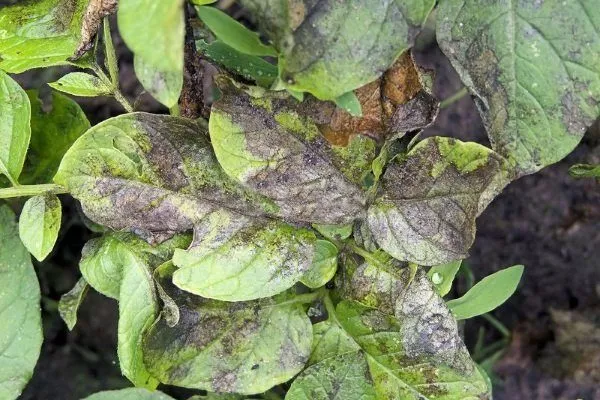
What is late blight and what causes it?
Late blight is a common fungal disease of potatoes and other plants caused by mycelial organisms. The vegetable is attacked by the fungus Phytophthora infestans.
The incubation period of these pathogens is no more than two weeks, which is why the disease progresses rapidly. The mycelium is found in potato tubers previously infected with late blight.
The main sources of the disease:
- contaminated soil;
- remains of diseased plants (tops).
Optimal conditions that promote the development of the disease are identified:
- temperature range +15-25 degrees;
- high humidity – more than 75%;
- dense planting.
The pathogen spreads especially quickly during rainy periods, with a sharp change in day and night temperatures, which is accompanied by the appearance of large amounts of dew and fog.
Hot weather is the pathogen's enemy. Phytophthora spots dry up, and stems are rejuvenated by the growth of new, healthy leaves. The fungus spreads extremely slowly during this time.
Signs of potato blight
The main signs of potato blight:
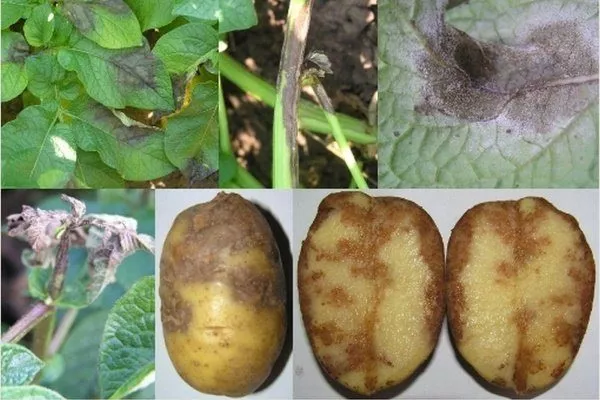
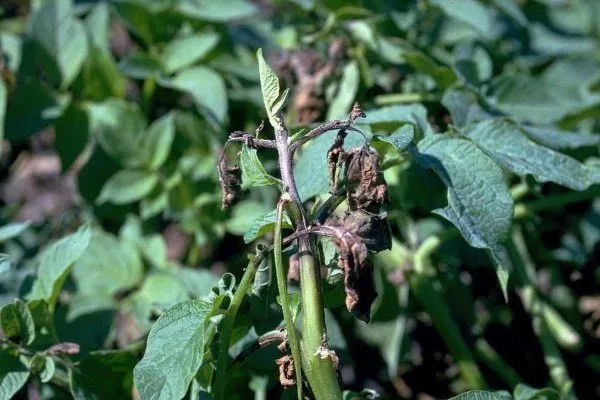
- the above-ground part of the plant acquires a brown color;
- curling and drying of the fleshy part of the leaves;
- the appearance of spots on potato tubers;
- death of the plant, unsuitability of tubers as a food product.
In addition, if you look closely at the back of the leaf, you can see fungal spores that look like a white coating, which will help you accurately identify the disease.
New genotype of late blight
The pathogen, which affected potatoes and was long considered the only genotype, was introduced into Europe in the 19th century. In the late 20th century, new genotypes of late blight began to be discovered, which were designated type A2.
Detecting A2-compatible isolates became a significant challenge due to the greater aggressiveness and virulence of the microorganisms. The new fungus could thrive in conditions that inhibited the older form.
The combined development of the local and new populations results in the appearance of oospores in the infected potato tops. These oospores have a thick, two-layered shell, ensuring their long-term viability (approximately four years) even under unfavorable conditions.
Oospores allow them to withstand both low and high temperatures, overwintering on tubers, plant remains, and in the soil. It was the emergence of a new genotype that defined a new pathway for the fungi to spread (previously, soil could not be contaminated with pathogenic microorganisms for long periods).
The old form of the disease could only affect potatoes in the second half of the growing season. The new type can infect the crop even during the seedling stage.
What is the danger of late blight on potatoes?
Potato losses due to late blight in Russia annually amount to approximately 4 million tons. If the disease is detected in the late stages, the plant will likely die, infecting a large portion of the harvest, making it unfit for consumption.
In addition, new forms of oospores will remain in the soil and can cause a new outbreak of the disease within 4 years if potatoes or other nightshades are planted in the same place.
Treating potatoes with fungicides
The funds in this group are divided into:
- Contact – preparations that help protect plants from infection but do not have a direct therapeutic effect. They are effective only in the area where they are applied.
- Systemic – products that can cure the plant, but only in the early stages of late blight. The effect lasts not only at the site of application but also within the plant.
- Systemic contact – combination preparations that can have both preventive and therapeutic effects, penetrating into the plant.
- Translaminar – agents that can penetrate plant tissue to some depth but are not distributed through the vascular system, which is typical of systemic agents. This effect helps compensate for the uneven application of the fungicide on the plant surface.
| Type of fungicide | Example of the drug | Period of validity | Resistance to washing off |
|---|---|---|---|
| Contact | Anthracol | 7-10 days | Low |
| Systemic | Quadris | 7 days | Average |
| Systemic contact | Ridomil Gold | 14 days | High |
Fungi of the Pythiaceae family easily develop resistance to fungicides acting inside the plant, but are usually always sensitive to those acting externally.
Contact fungicides
Contact fungicides that can effectively combat late blight on potatoes include:
- Anthracol – has a versatile effect, is used against late blight and early blight on potatoes, and is washed away by rainfall. Apply 2-3 times, 7-10 days apart. Stop using this product 40 days before harvest. The application rate is 2 kg per hectare.
- Copper sulfate and Bordeaux mixture(a mixture of copper sulfate in slaked lime). To spray potato tubers before planting, dilute 100 g of the solution in 10 liters of water. It's easiest to place the planting material in a vegetable net and dip the potatoes into the solution.
- Shirlan – an effective preventative treatment with a long-lasting effect of 7 days and resistance to rainfall. Typically, two, or a maximum of four, treatments are required. The first spraying is performed when the plant reaches approximately 20 cm in height, and the next shortly before the potato tops begin to dry out. The application rate is 0.3-0.4 liters per hectare of garden space.
Systemic fungicides
Among systemic fungicides, the most effective are:
- Fundazim – a product with protective, preventative, and therapeutic effects. The product is applied as a dry treatment to tubers before planting, at a rate of 20 g per 40 kg of potatoes.
- Quadris – a broad-spectrum fungicide used to suppress the pathogen when it first appears. Six milliliters of the suspension are diluted in five liters of water. Five liters of the prepared solution is required for one hundred square meters of garden space. The product does not completely kill the fungus, so a repeat spraying may be necessary after a week.
Systemic contact fungicides
This group is represented by the following drugs:
- Ridomil Gold – the most effective and affordable product available today. It's a combined fungicide that provides both internal (the Mefenoxam effect) and external protection (the Mancozeb effect). The first spraying is best done preventatively before the potato tops close. Subsequent treatments should be repeated every two weeks. Three such treatments can be performed per season. The solution is prepared as follows: 25 g of the product is diluted in 10 liters of water. The application rate is 20-40 ml per square meter of planting. Spraying is stopped two weeks before harvest.
- Metaxil Metaxil is a product that provides long-term preventive and therapeutic action (effective for two weeks). This fungicide is characterized by low phytotoxicity. Metaxil is a combination product containing Mancozeb and Metalaxil, with contact and systemic action, respectively. The diluted solution should be applied at a rate of up to 400 l/ha (approximately 2-2.5 kg of dry product per hectare). Typically, spraying is done up to three times per season, with a 10-14 day interval.
Translaminar fungicides
This group can include 2 effective drugs:
- Thanos – also a combination product with a therapeutic effect. Famoxadone forms a film on the surface of plant leaves that acts as a barrier. It is not washed away by rain or irrigation. Cymoxanil interferes with multiple biochemical reactions occurring within the fungus, preventing the fungus from developing resistance to the product. Potatoes are sprayed four times (once at each stage of vegetation): when the tops close, when buds appear, when flowering ends, and when numerous green berries, reminiscent of tomato ovaries, appear. The solution used per spray is 40 ml per square meter.
- Acrobat – a translaminar fungicide containing dimethomorph and mancozeb. The product is extremely effective, as the fungus has little resistance to it. 20 grams of the product are dissolved in 5 liters of water per 100 square meters of soil. Spray twice, spaced two weeks apart. Spraying is not recommended one month before harvest.
Safety rules
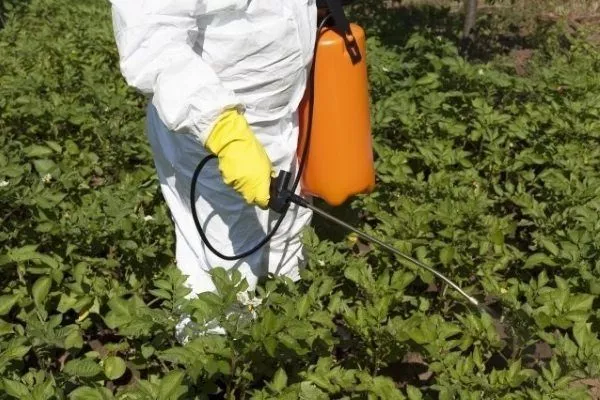
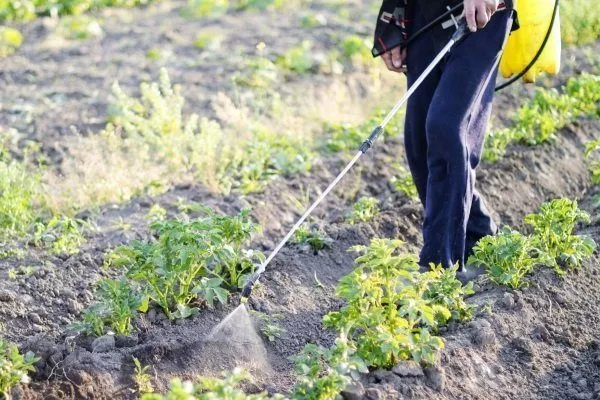
When using fungicides, despite the low toxicity of some, protective equipment should be used:
- special clothing;
- gloves;
- glasses;
- respirator.
If you're using Bordeaux mixture or copper sulfate separately, remember that the containers in which the solution was prepared should not be reused for other purposes. If any unused solution of either of these fungicides remains, dispose of it by burying it outside the garden or vegetable plot.
Fighting late blight with folk remedies
Among the most common remedies used to treat late blight on potatoes are:
- Trichopolum tablets– we dissolve 1 medicinal form of the preparation in a liter of water and can spray the plants with a frequency of once every 2 weeks.
- Wood ash – we can use it not only as a preventative but also as a therapeutic measure. As soon as the potatoes sprout, sprinkle the spaces between the rows with ash. Repeat this process when the plants begin to bloom.
- Milk with iodine – Dilute a liter of milk in 10 liters of water and add 15 drops of iodine. Spray the potatoes with the resulting solution every 2 weeks.
- Whey – an effective remedy that can be prepared by diluting the serum in water in a 1:1 ratio. This remedy is completely harmless to plants, so it can be used more frequently – once every 3-4 days.
- Garlic infusion with potassium permanganate – a solution used for treating potatoes. To prepare, use 100 g of garlic and 1 g of potassium permanganate per 10 liters of water. Before preparing the solution, crush the garlic and add a glass of water to it, then let it steep for two days. Strain the resulting infusion, dilute it with water, and add potassium permanganate before spraying.
Other drugs and medications
Among other preparations and agents used for potato late blight, the following are distinguished:
- HomHom is a copper-containing product used as an alternative to Bordeaux mixture to protect potato crops during the growing season. It is available as a green powder that is dissolved in water and sprayed onto the plants before use. Hom is applied up to five times, at monthly intervals. The solution is diluted in the following proportions: 20 g of powder per 5 liters of water. The solution consumption is approximately 7 liters per 100 square meters of planting area.
- Alirin-B - A biological fungicide used for preventative purposes at any stage of plant growth, before sowing, or at the first signs of fungal infection. The product is characterized by low hazard to humans, plants, and the environment. It is available as tablets that are dissolved in a small amount of water (10 tablets per 200 ml), and then the concentrate is added to 10 liters of water. Add 1 ml of pre-soaked laundry soap to this solution to improve adhesion and prolong the product's shelf life. Plants are sprayed at 10-12 day intervals up to three times per season.
Three-stage potato processing scheme
As the name suggests, this method involves treating the planting three times at different stages of its development:
- From the emergence of seedlings until the tops in the row close, Shirlan is used.
- From the closing of the tops to the opening of the buds - Ridomil Gold, Metaxil.
- From the appearance of flowers to the withering of the tops - Acrobat or Thanos.
- Before planting: treat tubers with fungicides.
- During the growing season: regular spraying with contact and systemic preparations.
- After harvesting: destruction of plant residues.
Prevention methods
There are several methods of prevention:
- choosing a landing site;
- use of disease-resistant potato varieties;
- treatment with special preparations (preventive).
Let's look at each method in more detail.
Choosing a location
It has already been mentioned that contaminated soil containing oospores is one of the possible causes of potato blight. It is best to choose a flat area for planting.
If the area is located in a lowland, then the soil moisture in these places is increased, which means there is a high probability of disease development.
Other factors should also be taken into account:
- looseness of the soil, good drainage;
- lack of shading of the area;
- increased distance between plantings of different nightshade crops (to avoid infection of all plants).
Experienced gardeners also remember that the same crops cannot be grown in the same place for more than 5 years in a row.
Especially for potatoes, you can choose good predecessors, which can be:
- perennial herbs;
- winter crops;
- flax;
- beet;
- corn;
- mustard;
- radish.
The crops are then mown and buried in the soil.
Rotating potato plantings every couple of years can significantly reduce the risk of blight in nightshade crops. This system is called crop rotation. Read more about it. Here.
Resistant potato varieties
Among the varieties resistant to late blight are:
- Good luck – characterized by early ripening fruits. The tubers of this variety are large and resistant to many diseases.
- Reserve – a mid-early potato with small eyes. Tolerates drought and high humidity well.
- Timo – a high-yielding variety that is not susceptible to late blight due to its early ripening.
- Nidu – mid-season, resistant to late blight and nematodes, but is quite demanding in terms of growing conditions (does not tolerate excessive moisture and drought well).
- Blueness – a potato variety with mid-season ripening. Characterized by high resistance to late blight and low temperatures.
- Lugovskiy – mid-season variety. When growing, it requires systematic hillingThe tubers can be stored for a long time.
- Dawn – an early variety that is characterized by resistance to late blight, as well as to many viral and bacterial diseases.
- Nevsky – belongs to the mid-early potato variety. People often prefer it Nevsky variety Due to the excellent taste of the tubers and the low waste, these potatoes also store well.
- ✓ Resistance to late blight.
- ✓ Adaptation to the climatic conditions of the region.
- ✓ Yield and quality of tubers.
Processing
It's important to remember that using infected seed material guarantees a 100% risk of late blight. But how can we identify tubers affected by the pathogen? To do this, warm the seed potatoes for two weeks at 16-17 degrees Celsius. Maintaining these conditions will allow you to spot the first signs of late blight and discard the affected roots.
In the fall, when the planting material is selected, damaged tubers are burned rather than thrown away. The potatoes are then dried and can be safely stored in a convenient location.
To increase the resistance of our selected varieties, we can use fungicides and treatments. These include:
- Immunocytophat;
- Agat-25K, etc.
Mineral fertilizers are also widely used as a preventative measure. Potassium and phosphorus levels increase by 2 and 1.5 times, respectively, at the beginning of crop development. Wood ash is a common fertilizing method used in addition to the mineral fertilizers mentioned above.
Caution should be exercised when applying nitrogen fertilizers, as large amounts of them can cause delayed fruit development, making potatoes increasingly susceptible to late blight and other diseases.
Other methods of prevention
People often thicken potato skins by loosening the soil and mowing the tops. If time is limited, Reglon Super, a product with a similar effect, is used.
During drought or low temperatures, watering plants is carried out only with a hose lowered into the furrows between the beds (the sprinkler method is not recommended).
Crops affected by late blight should be removed and burned as soon as you notice them.
It is also important to promptly remove weeds that create favorable conditions for the development of the disease, become an ideal storage place for fungal spores, or prevent the uniform application of fungicides to the potato tops.
Late blight on potatoes (video)
This video will tell you what late blight is, how it develops, and how to combat it.
Although late blight is a serious disease, there are many methods and means to protect potatoes from this pathogenic fungus. The key is to closely monitor the crop and adhere to all preventative measures.