
Until 1920, the breed was known only in South America. Then, European poultry breeders took a liking to it, spreading and adapting it. In our country, Araucanas are rare birds. They are bred as ornamentals for their appearance and the distinctive color of their eggs, although they present little challenge to breeders. More details about the Araucana breed's characteristics are later in the article.
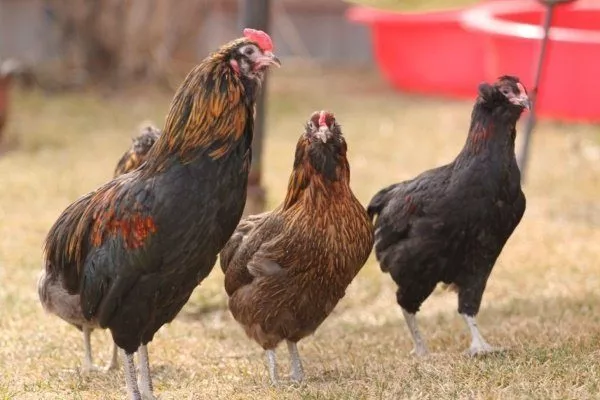
Exterior, characteristics, features
The bird is small and tailless: Araucana roosters weigh 2-2.5 kg, and hens – 1.6-2 kg.
Representatives of this breed have:
- rounded body;
- long back;
- well developed shoulders;
- rounded belly and lower back;
- pod-shaped comb;
- eyes are red-orange;
- The metatarsus is colored in a color that matches the plumage.
According to the standard, the Araucana's head can be "decorated" in one of three ways:
- beard with sideburns;
- tassels, tuft;
- with tassels and a beard.
The British believe that a tail is acceptable for the breed, but only if there is a crest.
There are 12 types of colors:
- cuckoo or hawk;
- wild;
- wild blue;
- blue golden-maned;
- black and red;
- blue wheat;
- silver-maned;
- wheat;
- black;
- blue;
- blue bordered;
- golden-maned.
You can see what an Araucana chicken and rooster look like, their behavior, and some of the breeding nuances in the video:
Egg production characteristics:
- The main feature of the breed is that the hens produce eggs with a blue or greenish shell (during the cold season, the color of the eggs may become less bright);
- hens begin to lay eggs at 5.5-6 months;
- sometimes Araucana hens can be late and start laying eggs only at 10 months (late egg production occurs if the hen belongs to the autumn or spring late brood);
- annual productivity – 160-180 eggs;
- eggs weigh from 56 to 72 g;
- Laying hens are most productive at the beginning of the laying season, as well as in the spring when they are moved outdoors. Relocating hens to a new location can reduce egg production for 2-4 weeks.
For more information on how to choose and properly care for laying hens to obtain the maximum possible number of eggs, read Here.
Pros and cons. Is it worth breeding?
The undeniable advantages of the breed include:
- early puberty and, as a result, egg production;
- they lay eggs well during the moulting period, as in any other period;
- viability of young individuals;
- unpretentiousness and adaptation to living conditions;
- good tolerance to temperature changes;
- good taste of meat;
- original appearance of birds;
- unusual coloring of eggshells.
The following can be highlighted as disadvantages:
- Due to the low prevalence of the breed, Araucana chickens and eggs are expensive;
- poor brooding ability - chickens have lost the instinct to hatch eggs;
- Roosters have a tough temperament;
- problems with fertilization of eggs due to the peculiarities of the body structure.
Most often, the Araucanian is bred to decorate the yard with an unusual bird or to obtain a delicacy in the form of unusually colored eggs.
Content
Birds are undemanding when it comes to housing conditions. They can be kept in coops or outdoors, provided the following guidelines are followed:
- The Araucana chicken coop should be separate from other bird species and other color variants of the Araucana breed. This is because roosters of this breed do not get along with other Araucana breeds.
- Families are formed from 1 rooster and 2-8 hens.
- No more than 4 chickens can be housed per square meter.
- Feeders and drinkers are installed in the poultry house.
- Drinking bowls and feeders are regularly cleaned and disinfected (feeders after each feeding, drinking bowls – once a week).
- They make sure that there is always water in the drinking bowls, which is changed every day.
- In winter, make sure the drinking bowl does not freeze.
- The floor of the chicken coop is covered with straw bedding.
- A perch is constructed in the poultry house at a rate of 30-35 cm in width per individual.
- They equip a nest for 4-5 laying hens.
- It's good if there's access to open range. Araucanas are excellent grazers and find food underfoot.
- The run is enclosed with mesh. Since the birds are not particularly strong fliers, they don't need high fences or a roof. A canopy is erected here to provide shelter from rain and direct sunlight in hot weather.
- Poisonous plants in the yard are removed regularly.
- When keeping chickens in a cage, it is important to equip the chicken coop with good ventilation and prevent drafts in the room.
- Araucanas can easily tolerate frost down to 8 degrees, so it is not necessary to heat the chicken coops unless we are talking about northern regions and severe cold.
Daily routine
To create optimal conditions for birds, you should adhere to the following daily routine:
- Morning rise. Regardless of the time of year, the chickens are woken at 5-6 a.m. To do this, turn on the light and open the coop.
- First meal. Three hours after waking, the chickens are fed. About an hour later, the food is removed and the feeders are cleaned.
- Second meal. Feeding should be evenly distributed between waking hours and daylight hours. For example, in winter, birds are fed at around 3:00 PM, and in summer, around 7:00 PM.
- Dream. At 9 p.m. the chickens are driven into the coop and the lights are turned off.
Nutrition
Araucana should be fed in moderation, as they are small birds, and unlike broilers, don't gain muscle mass, but rather become obese. They need feed supplemented with minerals, which allows the hens to produce high-quality eggs with strong shells.
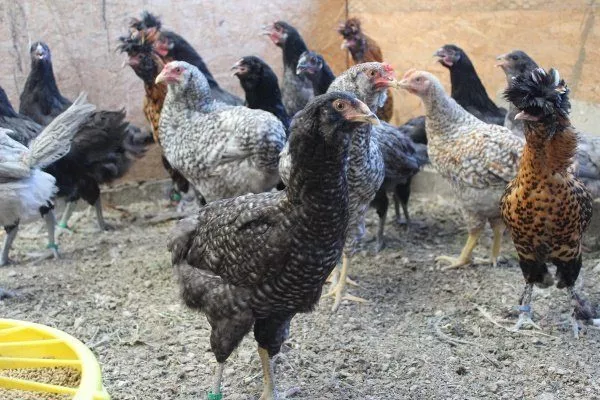
The Araucana chicken breed requires constant nutrition:
- protein (beans, fish scraps, earthworms, bone meal, oil cake);
- foods rich in carbohydrates (cereals, potatoes, carrots, pumpkin, zucchini);
- fats (oats, corn);
- vitamins A, B, D (bone meal, silage, yeast);
- minerals (gravel, shells, wood ash, chalk, crushed shells);
- Greens are a necessary component of the diet throughout the year (for the winter, you can prepare finely chopped pine needles, which are not mixed with other food, but served in a separate bowl, or buy special vitamin supplements).
It is essential to include sufficient amounts of calcium in your diet.
To increase egg production, the diet should be calculated according to the following norms per 1 chicken:
- grain – 130 g;
- potatoes (boiled) – 90 g;
- wet food – 30 g;
- cake – 7 g;
- chalk – 4 g;
- bone meal – 2 g;
- yeast – 1 g;
- salt – 0.5 g.
Another diet option involves seasonal division.
Spring-summer period:
- grains and compound feed – 50 g;
- root vegetables and boiled potatoes – 40g;
- greens – 30 g;
- fish/bone meal, cake – 12 g;
- chalk – 5 g;
- salt – 0.5 g.
Autumn-winter period:
- wheat – 50 g;
- barley – 40 g;
- bran – 20 g;
- corn – 10 g;
- shell rock – 5 g;
- chalk – 3 g;
- bone meal – 1 g;
- salt – 0.5 g.
Laying hens need a slightly different diet to ensure their eggs are presentable and properly formed. More information on feeding laying hens can be found in next article.
Breeding
To produce healthy offspring, families must be composed of tasseled roosters and wattled hens, or vice versa. This is due to the semi-lethal gene, which contains the information for the development of a crest on the head. If both parents in a family carry semi-lethal genes, the chicks will not be viable.
Breeding these birds requires the help of a poultry farmer, as the Araucanas lack not only a tail but also a rump. Poultry farmers trim a few centimeters of down around the vent to increase the fertility of the eggs, which without this procedure is only 60% effective.
Experienced farmers advise starting to breed Araucanos with an adult pair or buying chicks.
When buying young Araucana birds, remember that cockerels and hens only begin to differentiate after 12 weeks. You could accidentally buy only cockerels or only hens, making it impossible to start a family. It's also difficult to immediately determine whether a bird has a semi-lethal comb—you have to wait until the molt, when the wattles and tufts appear on their heads.
Selecting eggs for incubation
Araucana chicks are hatched in an incubator. Brooding by a hen is extremely rare.
Acraucana often exhibit false broodiness – after several days of incubation, the hen abandons the nest.
Eggs from poultry beforeplacing in an incubator Store in a cool, dark place with the pointed end up for 5 to 14 days.
- ✓ Checking for fertility using an ovoscope.
- ✓ No microcracks on the shell when examined under a magnifying glass.
They must meet the following requirements:
- the shape should be natural (not elongated), size - medium - most often chicks hatch from such eggs;
- the homogeneity of the shell should not be disturbed by dents, growths and especially cracks;
- The yolk should be centered - eggs with a displaced or broken yolk, or with too large an air chamber, are rejected.
Otherwise, hatching Araucana chicks in an incubator is no different from hatching other chickens. It involves the following sequence:
- Preparation:
- the incubator is disinfected and turned on to warm up for 24 hours;
- The eggs are brought into the room for 8 hours to ensure gradual and uniform warming.
- Incubation periods:
- 1-11 days – after placing the eggs in the incubator, set the temperature to 37.9 °C, humidity – 66%, turn the eggs 4 times a day, do not ventilate the incubator;
- 12-17 days – the temperature drops to 37.3 °C, humidity – 53%, eggs should be turned 4 times a day, the incubator is ventilated 2 times for 5 minutes;
- Day 18-19 – the temperature remains at 37.3°C, humidity drops to 47%, the eggs are turned 4 times, the incubator is ventilated 2 times a day for 20 minutes.
- 20-21 days – the temperature should be 37.0 °C, humidity – 66%, the eggs stop turning, the incubator is ventilated 2 times for 5 minutes.
- Hatching. After 21 days, the chicks begin to hatch. This process takes several hours.
More details about incubation of chicken eggs are written hereWe recommend that you read this material before you begin hatching chicks using an incubator!
What do Araucana eggs look like, what criteria should be used to select them for incubation, what newly hatched chicks look like, and what signs of healthy individuals can be found in this video:
Caring for chickens
The chicks are not left in the incubator for a long period of time – they are immediately transferred to a special box in which:
- install a heating lamp, preferably an infrared one, at a height of 50 cm above the bottom (you should not try to achieve uniform heating of the entire area of the box; it is better to allow the chicks to move around inside and choose the optimal temperature for themselves);
- the floor is covered with paper - it is not recommended to use newspaper for this purpose, since printing ink contains lead;
- It is better to choose a vacuum drinking bowl;
- install low feeders or use a regular board.
The following is used as feed:
- starter feed – basic, balanced feed for chickens;
- During the first week, eggs mixed with semolina are introduced into the diet at a rate of 1 egg per 50 g of semolina. Cottage cheese or powdered milk can also be added. Do not feed chicks eggs alone. This can lead to death, as eggs are high in protein and fat and lack fiber.
- from the third day, you can add wheat, corn, oatmeal with yogurt to your diet;
- from the fifth - chopped greens (nettle, dandelion, alfalfa, clover).
- First 24 hours: only water with added glucose.
- From the second day: introduction of starter feed.
- From the third day: adding yogurt and cereals.
- From the fifth day: introduction of greens into the diet.
Millet can only be given to chickens when boiled.
Possible problems
There aren't many problems with breeding Araucana cats. Let's look at the main ones.
Diseases
Birds are generally healthy and rarely get sick. If their living conditions are not met, they may be susceptible to the following pests:
- Down eater. The parasite damages the down fibers. Chickens become restless and scratchy. To eliminate the problem, they are treated with insecticide sprays and the coop is disinfected.
- Feather mite. The infestation causes baldness. The problem is that it's impossible to eliminate, so infected individuals are killed.
- Fleas. Infestation manifests itself as frequent scratching by the birds. To eliminate fleas, disinfect the coop and change the litter regularly.
- Helminths. The disease manifests itself as poor appetite and decreased physical activity. The most common cause of infection is contact with wild birds. Treatment involves taking special anthelmintic medications prescribed by a veterinarian.
To avoid spreading chicken diseases, it is recommended to clean the poultry house regularly.
They don't lay eggs well
There may be several reasons:
- Age-related changes. Araucana hens can lay eggs until they are 10 years old, but egg production drops significantly at this age. Peak production occurs at approximately 1-2 years of age.
- Overeating. Obesity reduces egg production. An adult hen should not weigh more than 1.8 kg.
- Parasite infestation. Has a direct impact on egg production, decreasing it.
Where to buy?
The main difficulty when buying is that you can buy mixed breed eggs under the guise of Araucana:
- chickens bred from Araucana and Russian Crested lay blue eggs;
- When crossed with breeds that lay brown eggs, individuals that produce olive-colored eggs are produced.
The gene responsible for egg color is highly hereditary, and eggs from individuals with mixed blood are indistinguishable by eye from the eggs of a purebred Araucana.
It is best to contact the following trusted manufacturing organizations:
- VNITIP "Genofond" in Sergiev Posad near Moscow sells day-old chicks.
- Alexander Ivanovich's private farm in Pushkino, Moscow Region, sells hatching eggs in limited quantities.
- Lukinykh A.N. peasant farm, Chelyabinsk region, Oktyabrsky district, Krutoyarsky village – sells chickens and young animals during the season.
The price may vary:
- from 250 rubles to 1200 rubles depending on the age of the young animals;
- about 100 rubles per egg.
Despite their low maintenance and good health, Araucana chickens are not very popular. The main challenges in breeding them are the high cost of eggs and chicks, as well as low fertility rates due to their body structure. The chickens are distinguished by their attractive appearance and the unusual color of their eggs, which range from blue to green.