
Laying hens can be done for personal use or as a business—the investment quickly pays for itself. It's important to choose the right birds to ensure the desired production volume. Productivity also depends on proper management and feeding of the hens, as well as timely prevention and treatment of various diseases.
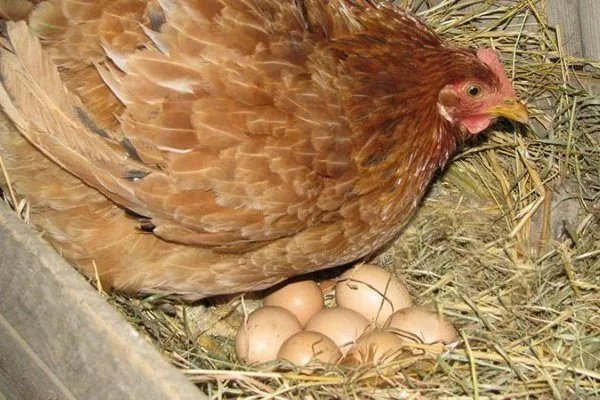
The best breeds of laying hens
| Breed | Productivity (eggs/year) | Egg weight (g) | Beginning of egg laying (weeks) | Disease resistance |
|---|---|---|---|---|
| Leghorn | 250 | 62 | 20-25 | High |
| Hisex Brown | 300 | 65 | 20-25 | Average |
| Loman Brown | 320 | 63 | 20-25 | High |
| Rhode Island | 200 | 58 | 20-25 | Average |
| Zagorsk salmon | 260 | 60 | 20-25 | High |
| Russian white | 200 | 58 | 20-25 | Average |
| Adler silver | 180 | 58 | 20-25 | Low |
| Kotlyarevskaya | 240 | 60-63 | 20-25 | High |
| Pushkin striped-motley | 270 | 58-60 | 20-25 | Average |
| Kuchinskaya Jubilee | 180 | 60 | 20-25 | Low |
| Dominant | 320 | 60-70 | 20-25 | High |
To ensure productivity, it's important to choose the right laying hens. One of the most important criteria is breed. It's best to choose one of the following:
- LeghornProductivity up to 250 eggs per year weighing up to 62 g each.
- Hisex brown and whiteThey produce up to 300 eggs per year weighing up to 65 g.
- Loman Brown. Up to 320 eggs, 63g each.
- Rhode Island. Up to 200 eggs, 58 g each.
- Zagorsk salmon. Up to 260 eggs, 60g each.
- Russian White. Production up to 200 eggs, 58 g each.
- Adler Silver. Up to 180 eggs, 58 g each.
- Kotlyarevskaya. Up to 240 eggs, 60-63 g each.
- Pushkinskaya striped-variegated. Up to 270 eggs, 58-60 g each.
- Kuchinskaya Jubilee. Up to 180 eggs, 60g each.
- Dominant. Up to 320 eggs weighing 60-70 g.
Criteria for selecting young animals
To ensure sufficient egg production, it's important to select the right young. To do this, consider the following criteria:
- Spring is a better time to buy pullet hens (5 months old), as the birds will start laying eggs in a month, and summer is the most productive season.
- The optimal age for purchasing a specimen is 20-25 weeks. This period is characterized by the onset of sexual maturity.
- The weight of a laying hen by 20-22 weeks should be 1.5 kg.
- Chickens should appear clean and well-groomed, with smooth, uniform, and shiny plumage. Bald spots, bald patches, and growths are unacceptable.
- It's important to examine the skin under the feathers. It should be firm and pale pink. Yellowing indicates liver problems.
- Chickens with a late molt lay eggs better and longer.
- If the feathers around the cloaca are dirty and stuck together, then she is suffering from an intestinal infection.
- The hen's comb is important. It should be smooth, red, and medium in size. Proper development of the earlobes and wattles is also important.
- The eyes of healthy chickens should be shiny and bulging, with a lively look.
- It is important to check the nose and beak for dryness and the absence of growths.
- The abdominal cavity should be examined. It should be well defined, firm, but soft to the touch. A sign of health is a level keel and a wide ribcage. A level, wide, and long back and strong legs are important. They should be straight and set wide apart.
- The laying hen's behavior is important. She should be alert and active.
- It is necessary to find out whether the chickens have been vaccinated.
- ✓ Check the bird's activity: a healthy chicken should be active and responsive to its environment.
- ✓ Assess the condition of the plumage: it should be smooth, without bald spots, which indicates good health and the absence of stress.
There are individuals with characteristics of both sexes. So-called intersex hens are unsuitable as layers.
This video explains how to choose the right laying hens:
Maintenance and care of laying hens
It's important not only to choose the right laying hen, but also to properly manage her housing. When setting up a poultry house, the following rules are important:
- The area of the room should correspond to the number of hens. Every 5 chickens require 1 square meter of space.
- Provide lighting (natural and artificial) and ventilation. Windows for natural light should make up 10% of the room's area. When daylight hours are short, artificial lighting should be provided. Ventilation can be achieved using transom windows, but it's better to install exhaust hoods with plugs.
- Provide a waterer and separate feeders for dry and green fodder, as well as supplementary feeding. Narrow wooden or metal boxes are used as feeders. The length should be calculated based on the number of birds—each bird requires 15 cm of space. The waterer should hold 5 liters.
- Provide a walking yard, enclosed with a wooden fence or mesh.
- There should be an additional opening from the chicken coop to the exercise yard. A 35 cm (14 in) side opening is sufficient to prevent significant heat loss.
- The height of the poultry house should be no more than 1.8 m, to make it easier to maintain the optimal temperature for chickens of 23-25 degrees (in winter from 15 degrees).
- The floor can be made of loose material, wood, or clay. It is important to provide dry bedding (straw, hay, sawdust, dry leaves).
- Perches are essential in the chicken coop. For this, use perches or wooden blocks with a diameter of 5 cm. They should be placed opposite a window at a height of about 1 meter. Leave a distance of 40-50 cm between the perches. One chicken requires approximately 0.2 m of perch.
- Nests are made in the chicken coop. Choose shaded areas for this. One nest is needed for every 5-6 chickens. Wooden boxes 30-35 cm on a side can be used. They should be filled with hay, straw, and wood shavings and raised above the floor.
- Regular disinfection of the premises is an essential requirement for keeping chickens. This also applies to the care of feeders and waterers. Ash baths are used to prevent certain parasites.
Read more about how to build a chicken coop yourself in this article.
Feeding
Proper organization of feeding is one of the most important factors affecting the productivity of laying hens. Although these birds are not picky eaters, they do need a properly balanced diet.
Around 60% of the diet should consist of various types of grain. Additionally, birds need to be provided with vegetable and animal fats. Prepared feeds with balanced ingredients can be used. Flax and sunflower seeds, legumes, and meal and oil cakes high in protein and fiber can also be added to the diet.
The bird's diet also includes berries, fruits, herbs, and insects. Chickens require mineral supplements:
- mele;
- ash;
- crushed shells;
- table salt;
- fine gravel.
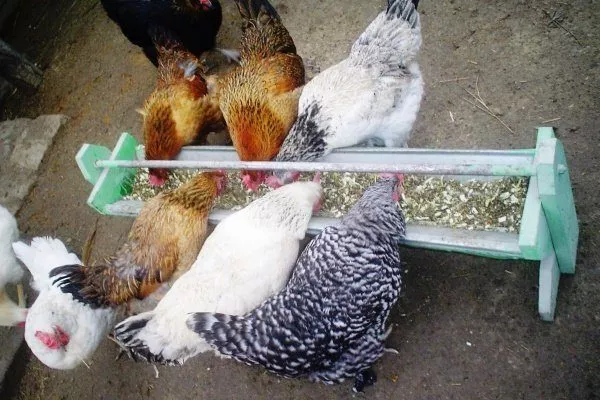
If the feed is concentrated, 20% of the diet should be greens. Chickens can be fed meadow grass, clover, dill, lettuce, and stinging nettle.
Root vegetables that can be fed to chickens include carrots, beets, turnips, and summer radishes. These should be grated. Chickens can also be fed melons and boiled potatoes.
Read more about the daily nutrition of laying hens here.
Symptoms of common diseases, their treatment and prevention
Laying hens are susceptible to a variety of diseases. These can be categorized as non-infectious, infectious, and parasitic.
Non-communicable diseases
This group of diseases is notable for not being transmitted from one bird to another. They are caused by disturbances in the body, often due to improper feeding or husbandry.
The following non-infectious diseases are most common:
- Atony of the goiterIt manifests itself as hardening and sagging. Treatment involves injecting a few drops of vegetable oil into the crop using a probe and massaging it. The chicken should then be turned over and the contents of the crop removed. Prevention involves consuming high-quality feed and following feeding guidelines.
- Gastroenteritis. It manifests itself as lethargy, diarrhea, loss of appetite. Treatment and prevention involve normalizing the bird's diet.
- CloaciteThis is called inflammation of the cloaca. Chickens become lethargic, and the anus becomes red and swollen. Treatment involves rubbing special ointments into the affected area, and adding greens and fresh vegetables to the diet. Prevention involves proper nutrition and good hygiene.
- AvitaminosisIt manifests itself as weakness and feather loss. Treatment and prevention involve including vegetables, greens, vitamins, and minerals in the diet. This is especially important during the fall and winter.
Infectious diseases
Infectious diseases are dangerous because they are contagious. They are caused by a variety of pathogens. The following diseases are most commonly observed in laying hens:
- ColibacillosisSymptoms include lethargy, fever, increased thirst, and wheezing, which worsens with movement. Treatment is with penicillin. Prevention includes proper feeding and housing, and rodent-proofing the premises.
- PasteurellosisSymptoms include fever, lethargy, thirst, ruffled feathers, darkening of the comb and wattles, diarrhea, and mucus discharge from the nostrils. The disease can only be cured in the early stages with an aqueous solution of tetracycline or norsulfazole. Prevention involves neutralizing the carrier, quarantining, vaccination, disinfection, and exposure to sunlight.
- SalmonellosisCharacterized by conjunctivitis, lacrimation, lameness, and breathing problems, it is treated with sulfonamides and chloramphenicol. A vaccine is used for prevention.
- Newcastle diseaseIt progresses rapidly, causing lethargy, refusal to feed, breathing problems, and mucus discharge from the beak. There is no cure, and the bird inevitably dies. All birds that have been in contact with it must be destroyed. Prevention involves vaccination, proper flock management, periodic disinfection, and avoiding contact with wild birds.
- TuberculosisIt usually begins due to poor sanitation. Symptoms include lethargy, rapid weight loss, and a pale comb and wattles. There is no treatment, so the entire flock is destroyed and disinfected. Prevention involves regularly replacing laying hens with young stock and cleaning and disinfecting the premises.
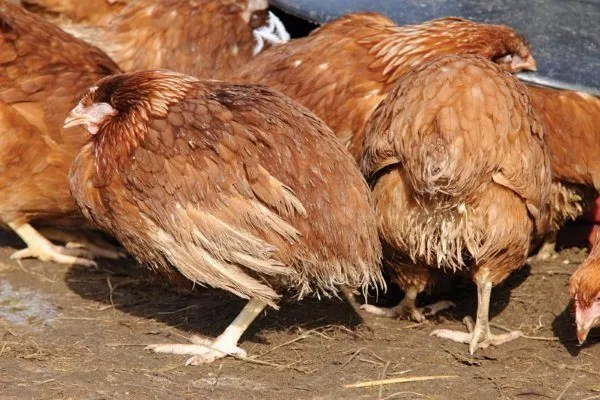
For more information on chicken diseases, look forHere.
Parasitic diseases
Parasites are classified as internal and external. The symptoms and treatment for each group are similar.
Internal parasites include protozoa and helminths. Infection with them can cause the following symptoms:
- weight loss;
- lethargy;
- loss of appetite;
- bowel movement disorder.
To determine the appropriate treatment method, the pathogen is identified through blood and stool testing. Antiparasitic medications are administered not only to the affected chickens but also to all chickens that have been in contact with them.
Many helminths can be transmitted to humans, so preventative measures and timely treatment are especially important. Recommended deworming schedules should not be ignored.
External parasites commonly found in poultry include fleas, lice, skin parasites, and lice. These parasites are often indicated by restlessness and feather loss. These parasites can be detected by examining the bird externally.
To treat the infestation, the entire flock is treated and the premises are disinfected. One preventative measure is the use of wood ash, in which the chickens bathe.
Treatment should be prescribed by a specialist after examining the bird and conducting some tests, if necessary. Many diseases have similar symptoms, so self-medication should be avoided.
Profitability of the laying hens business
To accurately calculate expenses and profits, a well-written and detailed business plan is essential. It's also important to consider the official aspects of the business—if it's registered, you'll need to pay taxes.
A two-week-old chick costs approximately 100 rubles. If you provide mixed feeding, you'll need about 40 kg of feed per year, which costs an average of 10 rubles. Adding vitamins, the cost per chick is approximately 500 rubles. Therefore, the annual cost is 600 rubles.
With proper care and a balanced diet, poultry can produce up to 250-300 eggs per year. Considering that a dozen domestic eggs cost from 60 rubles, this means a profit of at least 1,500 rubles per year.
Thus, the net income will be from 900 rubles per year. It's not a large sum, but chickens are raised in dozens or even hundreds, so the overall profit will be substantial. It's also worth considering that income can be generated from selling manure.
Hens begin laying eggs at six months. It's advisable to keep them for two to three years, as their meat becomes tougher each year and the number of eggs they produce decreases.
Over 2 years, the cost of a laying hen will be 1,100 rubles, and the profit will be at least 3,000 rubles.
A detailed analysis of the costs and revenues of a laying hens business is presented in this video:
When raising laying hens, you need to start with properly setting up the coop and choosing the right breed. The birds need to be housed and fed properly to ensure they achieve the productivity typical of their breed. If all these conditions are met, you can start a profitable business.