
An incubator is a unique box whose primary function is to maintain specific conditions for the hatching of eggs. Incubation is a fascinating and extremely labor-intensive process that requires specific skills and knowledge. Without these, good results and high hatchability cannot be expected.
How to choose and prepare eggs?
For good results, you need to know everything about the proper selection and storage of incubation material, as well as how many days it takes for chicks to hatch. When selecting eggs, follow these guidelines:
- They choose productive and healthy chickens, since poor heredity can be passed on to their offspring.
- The optimal weight is between 56 and 63 grams. Eggs weighing either more or less are rejected. It's also important to keep in mind that the eggs should be placed uniformly in the incubator, as each gram adds between half an hour and 40 minutes to the chick's development.
- Nutrition should be natural.
- If the chickens are laying eggs, then you can collect eggs starting from 7 months, if they are meat chickens, then from 8-9 months.
- The shape of the eggs should be correct - clearly defined ends, smooth transitions.
- You can collect eggs from 7-8 am.
- Only fresh eggs – no older than 3-4 days – are used for incubation.
- ✓ The temperature in the incubator should be stable, without sharp fluctuations, optimally 37.5-37.8°C in the first days.
- ✓ Air humidity should be maintained at 50-60% for the first two weeks, then increased to 70% before hatching.
Eggs that are too large are not suitable for incubation for the following reasons:
- worse ventilation;
- the shell is much thinner;
- low hatchability rate.
Ovocandling
Ovoscopy is considered a reliable method for examining eggs—it helps detect abnormalities that are difficult to see with the naked eye. It involves candling the eggs with a special instrument called an ovoscope. This test is necessary to detect possible developmental abnormalities in embryos.
- ✓ Use an ovoscope with a power of at least 60 W for clear illumination.
- ✓ Conducting the inspection in a darkened room for better visibility of defects.
All eggs containing these defects must be removed. For example, cracked eggs should not be left in the incubator, as even a small crack can promote bacterial growth and egg contamination.
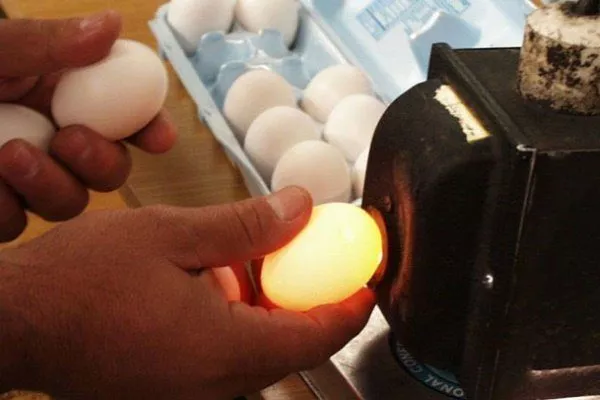
The device itself can be either purchased or homemade, which does not prevent it from being used effectively in the household.
The procedure is carried out in a special room as follows. The egg is held in the right hand and, brought to the ovoscope, rotated along its longitudinal axis. The eggs that pass the test are then placed on trays and sent in an egg transporter to the incubator for disinfection.
Defects to look out for when checking with an ovoscope:
- light streaks as a result of damage;
- dark spots;
- a mottled marbled structure of the shell, which indicates a lack or excess of calcium;
- blood clots;
- foreign objects such as feathers or sand;
- double yolk;
- the yolk broke and mixed with the white;
- the yolk stuck (fixed in one place).
- cracks and growths;
- dimples and pimples.
Storing eggs
When storing eggs, consider a few nuances:
- The presence of a rooster in the chicken coop is desirable.
- Store eggs with the blunt end up.
- Every three days, the eggs are turned over to prevent the yolk from sticking to the shell, moving, and to minimize the likelihood of stretching and tearing off the protein strands that hold the yolk in the center of the egg:
- when placed vertically, the egg turns from the sharp end to the blunt end;
- when horizontal, the eggs are turned 180 degrees.
- If the incubator does not have an automatic turning function, it is recommended to mark the top and bottom for ease of further turning during incubation.
- When eggs are stored for less than three days, the storage temperature should be up to 18 degrees Celsius. If stored longer, the temperature should drop to 8-12 degrees Celsius.
- Maximum shelf life is 6 days.
If eggs need to be stored longer, they are placed in special moisture-resistant and gas-impermeable packaging (hermetic bags made of polyester or polyethylene-polyester). They are stored in rooms with a temperature of 10-12 degrees Celsius. This increases the shelf life to 14 days.
If short-term storage is planned, raw materials can be stored in rooms where the temperature reaches up to 20 degrees Celsius. However, it should be noted that raw materials should not be stored there for more than 5 days. Humidity should be maintained at a sufficiently high level – 75% is considered optimal.
To understand how the hatchability level changes during storage under standard conditions depending on the storage duration of the material, you can use the following table:
| Shelf life, days | Hatchability percentage, % |
| 6 | 92 |
| 10 | 82 |
| 15 | 71 |
| 20 | 23 |
| 25 and more | 15 |
Disinfection of eggs
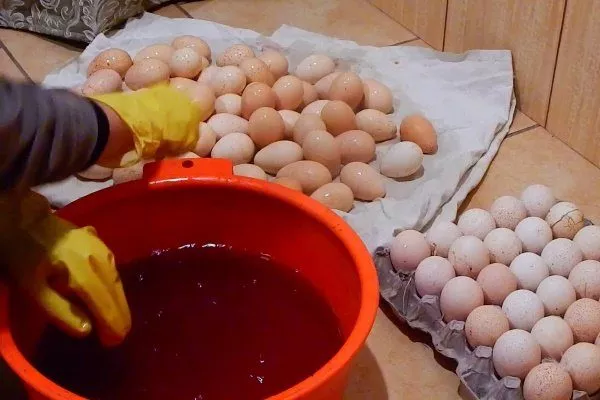
Dirt is washed off the eggs with a cloth soaked in a potassium permanganate solution. Disinfection then begins. For larger batches, formaldehyde vapor is used: 2,530 ml of the substance is diluted with the same amount of water and an additional 30 mg of potassium permanganate is added.
A container with a solution sufficient for one cubic meter of the incubator is placed in the disinfection chamber containing the eggs. A tightly sealed box can be used for the chamber. Disinfection takes up to half an hour.
Wet disinfection is also possible. It uses 25-30% bleach. 15-20 g of the solution is added to a liter of water. A couple of hours before laying, the eggs are placed in this solution for 3 minutes.
There are many conflicting views on whether or not eggs should be washed before being placed in an incubator. Read on to learn more. here.
Choosing an incubator
To ensure high-quality hatching of chicks, it is important to select the correct and reliable device.
According to capacity, incubators are divided into:
- Professional – up to half a thousand eggs.
- Industrial – there's no limit to the number of eggs, it all depends on the room size. The downside of these incubators is that if a breakdown or power outage occurs, the entire brood will die.
- Homemade (farm) – contains from several dozen to one and a half hundred eggs.
The criteria for selecting an incubator are as follows:
- manual or automatic maintenance of humidity levels or temperature conditions;
- body material;
- capacity;
- method of turning over trays;
- is there insulation;
- Is it possible to connect a backup power supply?
The main functions of a quality incubator are:
- maintain the required level of air humidity with an error of no more than 5%;
- maintaining the programmed temperature within the permissible fluctuation range – no more than 0.1 degrees;
- rotating eggs at a set time;
- providing cooling in case of overheating;
- ventilation in accordance with the established program;
- sound signal if the incubator has a technical failure.
Preparation for use
At least 12 hours before the start of incubation, the device must:
- clean;
- wash;
- disinfect;
- heat to the desired temperature;
- install elements that will maintain the required humidity level;
- check the ventilation operation.
For cabinet incubators, disinfection with formaldehyde vapor is suitable. Just before use, the temperature inside the box is checked using a standard clinical thermometer. The incubation techniques and modes are described in the operating instructions.
Laying eggs
You can start laying eggs without taking into account any specific time of day, but most farmers still lay eggs in the evening (around 6 o'clock, since in this case hatching begins in the morning on the 21st day, and by the evening of the same day, the majority of chicks are born).
Eggs selected for incubation should be kept indoors before being placed in the incubator. This is because placing eggs in a heated chamber can cause condensation, which disrupts the incubator's climate and leads to mold growth, which is fatal to the embryo. Therefore, 8-12 hours before incubation, the eggs are kept in a draft-proof room at a temperature of 25°C.
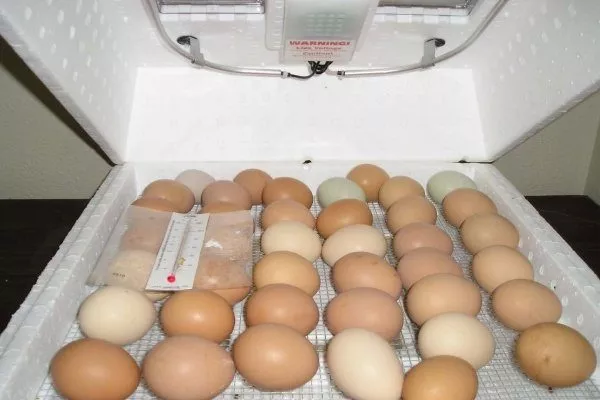
It's best to lay them out horizontally. This ensures even heating. Vertical laying is also possible—lay the eggs in groups at regular intervals (4 hours). First, the large ones, then the medium-sized ones, and finally the small ones.
From the very beginning of incubation until the 19th day of incubation, eggs should be turned 180 degrees every two hours. Only on hatcher trays should turning no longer be necessary.
That is, in general, the bookmarking procedure looks like this:
- the incubator warms up to the required temperature;
- eggs are treated with an antiseptic or disinfected with ultraviolet light;
- are distributed along the tray with the pointed end facing up;
- the tray is immersed in the incubator;
- the doors of the device close tightly.
You will find more useful information about laying chicken eggs in an incubator Here.
Incubation stages and care features
Generally, egg incubation lasts about three weeks. Sometimes it takes longer if temperatures are below acceptable levels, but 25 days is considered the maximum. By default, these three weeks are divided into four periods:
- 1st period – the first to seventh day of incubation;
- 2nd period - from the eighth to the fourteenth day;
- 3rd period - from the fifteenth to the eighteenth day (usually at this time you can hear the squeak of the unhatched chicks);
- 4th period - from the nineteenth to the twenty-third day (this is the final stage, which ends with the hatching of the chick).
During incubation periods, it is important to maintain appropriate temperature conditions and humidity levels, because all of this directly affects the development of the embryo.
To prevent the embryo from overheating, the eggs need to be cooled. Cooling occurs on days six and fourteen, and when the eggs are transferred to hatching trays. Brief daily cooling is also performed by opening the hatcher doors slightly for five minutes.
Let's take a closer look at the stages of chicken egg incubation:
- On the first day, the incubator temperature is set between 37.8 and 38 degrees Celsius, and the humidity is 60%. These parameters should remain constant during the first week, as stable and comfortable conditions are essential for embryo development. It is also important to turn the eggs 4 to 8 times per day.
- Days 8-14. Humidity drops slightly (to 50%), but the temperature remains unchanged. By this time, the embryonic respiratory system should have closed. Eggs should still be turned 4 to 8 times a day.
- During the third stage of incubation, you can begin ventilation, thereby lowering the internal temperature slightly. Ventilation is sufficient only a couple of times a day for 10-15 minutes. And of course, don't forget to turn the eggs. Humidity during this period drops by another 5%, to 45%, while the temperature remains at 37.8-38.0 degrees Celsius.
If development proceeds normally, the air chamber occupies about 30% of the egg, and the border is curved into a tubercle.
- When the fourth incubation period begins, the internal temperature is lowered to 37.5-37.7 degrees Celsius, and humidity is increased to 70%. At this point, slight hatching begins. The eggs should not be turned; the distance between them should be as large as possible, and good air circulation should be ensured.
- On the 21st day, the chick begins to peck—it turns counterclockwise, presses its weight against the shell, and breaks through the shell with about three blows. Once hatched, the chick is allowed to dry on its own, after which it is placed in a warm, dry place.
The chicks' well-being can be determined by the sound of their squeaks – if it's calm and monotonous, everything is fine. If the sound is loud and heavy, it means the chick is cold.
There are the following signs by which you can identify a healthy chick:
- the umbilical cord should be soft:
- tucked-in stomach;
- legs are powerful;
- slightly bulging clear eyes;
- shows activity;
- the beak is short;
- there is a reaction to sounds.
The following indicate abnormalities in the development of the embryo:
- peeling off of the membrane that is located under the shell;
- fetal freezing (determined from the seventh to the fourteenth day of incubation);
- blood rings (death of the fetus during the period from the first to the sixth day of incubation);
- failure of chicks to hatch after incubation is complete, which may be caused by a violation of the incubation regime - temperature, humidity, hypothermia;
- no blood vessels appeared after the sixth day of incubation;
- the white broke and mixed with the yolk;
- mold colonies.
Candling of eggs according to the days of incubation is carried out as follows:
- On the third day, the yolk and air cell at the blunt end are visible.
- On the fourth day, you can see the air chamber at the blunt end, and you can also hear the light heartbeat of the embryo and the beginning of the development of blood vessels.
- On the fifth day, the blood vessels expand to more than half the egg. This indicates active embryonic development.
- On the sixth and seventh days, movements of the embryo are visible, and blood vessels fill almost the entire egg.
- On the eleventh day, the blood vessels are clearly visible, the egg is no longer as translucent as on the seventh day, and has a darker shade.
- Day fifteen – the egg has become even darker, the translucent part has blood vessels.
- Nineteenth day – the egg is almost opaque, the embryo is almost fully developed, the air cell is clearly visible.
Embryo development
It's important to understand how chick development occurs in the embryo. It all begins with the development of the blastodisc—the cytoplasm located on the yolk. Fertilized blastodiscs begin dividing during egg formation, while still in the hen's body. If the egg is laid and placed in favorable conditions, the embryo develops in stages:
- The amnion (a fluid-filled membrane that protects the embryo from physical damage or drying out by regulating the amount of fluid under the shell) and the allantois (the embryonic respiratory organ that lines the entire internal space) begin to form.
- On the third day, the head emerges, and by the fourth day, the rudiments of legs and wings appear.
- From the eighth to the eleventh day, the skeleton is formed, and the rudiments of the beak and claws appear.
- On the 11th day, the allantois completely closes, and the embryo moves along its long axis so that its head points toward the blunt end. The sharp end contains the albumen. Due to the chick's movement, combined with the weight of the allantois, the albumen enters the chick's mouth, which, in turn, facilitates rapid growth and development.
- From the 13th day, the allantois takes all the nutrients it needs for growth from the shell.
- Between the 12th and 20th days, the embryo begins to develop down, and its claws develop a horny layer. The albumen is completely consumed during growth, and the yolk sac is completely retracted.
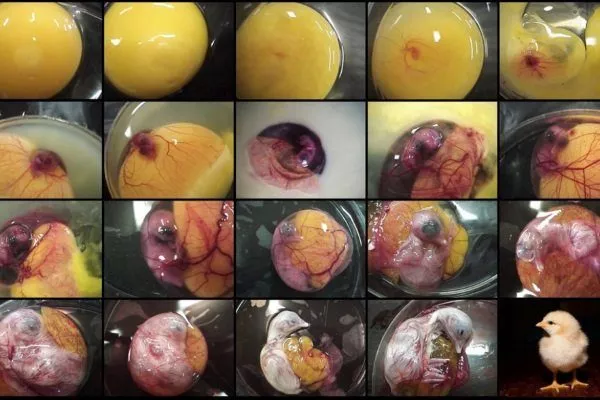
The development of the embryo by days is presented in the following table:
| Development | Day of appearance |
| Formation of the circulatory system | 2 |
| Pigmentation of the pupils | 3 |
| Rudiments of limbs | 3 |
| Formation of the allantois | 4 |
| Setting the beak shape | 7 |
| Feather dorsal papillae | 9 |
| Completion of beak formation | 10 |
| Allantois closure | 11 |
| The appearance of fluff on the head | 13 |
| The appearance of fluff on the body | 14 |
| Completion of protein use | 16 |
| Pulling out the yolk | 18 |
| Moving the neck into the air chamber | 19 |
| Opening the eyes | 20 |
| The beginning of the pecking process | 20-21 |
Possible errors and difficulties
When undertaking a task like incubation, it's impossible to avoid mistakes, especially if you're new to the field. The most common mistakes include:
- Lack of knowledge about how an incubator works. Some people try to hatch chicks without fully understanding how the specific device works.
- There is no egg incubation chart (diary). The chart looks like this (values are entered daily):
Period
Deadlines, days
Temperature, degrees
Humidity, %
Number of turns per day
Ventilation 1
1-7 38.0-38.2 70 4
2
from 8 to 14 37.8 60 4-6
3
from 15 to 25 37.8 60 4-6 2 times a day for 15-20 minutes
4
26-28 37.5 up to 90
- Failure to comply with temperature conditions:
- If overheated, chicks may hatch prematurely, resulting in small, weak chicks with poorly healing umbilical cords;
- at low temperatures, hatching begins later, which is why the chicks have low mobility;
- at high humidity the hatching process is delayed;
- At low humidity the air chamber may increase in size, which leads to premature germination.
- Violation of storage periods. The maximum period is two weeks, the optimal period is up to 5 days.
- Heterogeneous bookmark.
- The eggs do not turn over (which can cause the embryo to stick to the shell).
- Poor preparation. No one checks the eggs, and they are placed in the incubator with defects that shouldn't be there. The incubator itself is not prepared according to the rules.
- Incorrect placement of the incubator (uneven surface, draft).
Incubation of Chicken Eggs (Video Instructions)
This video provides step-by-step instructions for incubating chicken eggs, from choosing the right materials to hatching the chicks. These tips are suitable for both novice and experienced farmers:
Hatching chicks isn't particularly difficult. However, proper egg preparation, selection, and microclimate control throughout the incubation period are crucial. If all the rules are followed, the resulting chicks hatch easily, even at home.