
Many poultry farmers may be tempted to breed chickens and, consequently, increase their flock. Sitting and waiting isn't an option, as the hen may not hatch for the required time, causing the chicks to fail to hatch. There are also many other factors that significantly reduce the chances of a successful hatch. There's only one solution: an incubator.
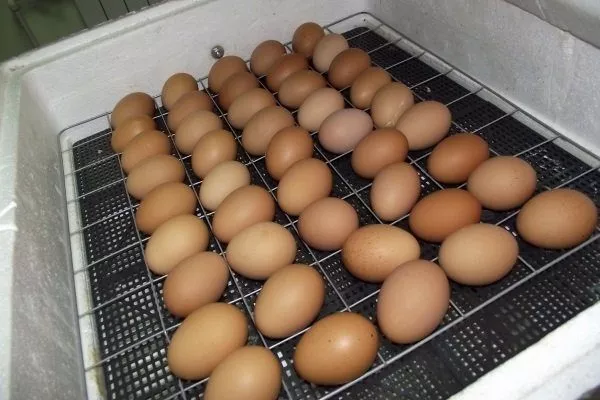
Selection of eggs for laying
Before placing all the eggs in the incubator, a careful selection of the best ones should be made. This selection is accomplished by examining the eggs with an ovoscope, a procedure called candling.
The device itself resembles a regular flashlight, but it's best to buy ovoscopes that use LED lamps. They won't heat the eggs during candling, which is crucial for incubation purposes.
You can also create an ovoscope manually using household items like a cardboard box, foil, and an LED lamp. However, such a miracle device is unlikely to perform its intended purpose effectively, especially since ovoscopes are quite inexpensive these days.
The first thing you should do is turn on the ovoscope and examine the egg very carefully, as the health of the future chick depends on it. It also determines the likelihood of anything hatching from the egg at all:
- the shell must be completely intact, without any damage, even minimal;
- Cracks and other defects in the shell will appear as bright stripes or dots when viewed with an ovoscope (some may be very small, this should be taken into account);
- the air chamber (oxygen compartment) must be strictly at the bottom/blunt part of the egg, completely motionless when turning and/or flipping;
- It is acceptable for the yolk to move slowly inside the egg, but it should never touch the edges of the shell;
- translucent blood lines are analogous to veins, but white ones are cracks in the shell (such eggs are not suitable);
- An egg suitable for incubation should be almost transparent, and the yolk should be barely visible (if the opposite is true, then it is an old egg).
| Criterion | Description |
|---|---|
| Shell integrity | Absence of cracks and defects |
| Position of the air chamber | Motionless, in the blunt part of the egg |
| Condition of the yolk | Moves slowly, does not touch the shell |
| Transparency | The egg is almost transparent, the yolk is barely visible |
The following eggs are completely unsuitable for incubation: they will either fail to hatch or will be defective. Even if you incubate these eggs according to all the rules, nothing good will come of them:
- dirty eggs (can you wash eggs or not? - read here);
- having an irregular shape;
- presence of shell defects or thin shell;
- displaced air chamber (a displacement of no more than 15% is allowed, a “wandering” chamber is unacceptable, it must be absolutely motionless);
- mixing the yolk with the white;
- blood-stained yolk or white;
- affected by mold;
- opaque;
- having dark spots, with blood or other foreign inclusions;
- enlarged air chamber;
- large or dark yolk;
- the yolk is located close to the shell or stuck to it;
- liquid protein, which is why the yolk is very mobile.
It is better not to use such eggs for incubation purposes, since the offspring, if any, will quickly die out due to defects in the chicks.
An example of a good egg and characteristics of eggs that are unsuitable for incubation:
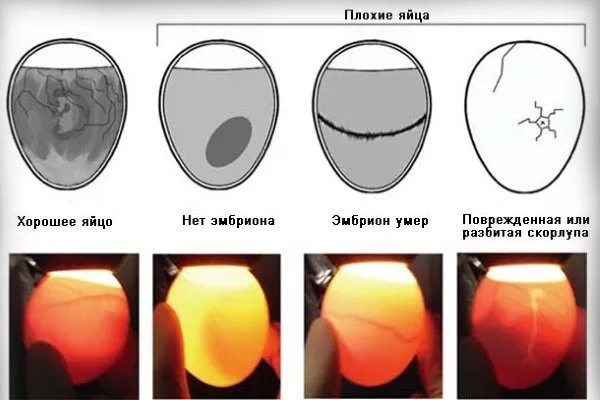
The optimal weight of a good chicken egg for laying is 50-53 grams. Small eggs will produce small hens, while large eggs are more likely to produce defective offspring.
When to place eggs in an incubator?
Depending on when you place your chicken eggs in the incubator, the results will vary. This is influenced not only by the time of day but also by the time of year, which is crucial to consider when setting the eggs.
If you want to ensure your chicks grow as close to natural conditions as possible, you should place eggs in the incubator between late February and early May. At this time of year, the weather begins to warm up, and light levels increase, but it's still not as hot as in the summer months, which is crucial for chicks.
However, selecting chicken eggs for incubation during the summer months is especially not recommended. This should only be done on an industrial scale, in facilities where the correct temperature is always maintained and all necessary requirements are met. At home, this is unacceptable and will result in defects in the future chicks.
The eggs should be placed in the incubator in the afternoon, around 6 pm. This time is ideal for starting the incubation period. This way, on a given day, the offspring will begin hatching in the morning and throughout the day. By evening, all the offspring will have hatched.
- Conduct ovoscopy to select high-quality eggs.
- Keep the eggs at room temperature 25°C for 8-10 hours.
- Ensure room humidity is 75-80%.
- Avoid drafts and sudden temperature changes.
Additionally, the eggs should be kept at room temperature around 25 degrees Celsius (77 degrees Fahrenheit) for some time before placing them in the incubator. It's crucial to avoid drafts (but the room should be well ventilated) and avoid temperature fluctuations of even 2-3 degrees Celsius. The humidity in the room where the eggs and the incubator will be located should be 75-80%. The eggs should be kept in these conditions for 8-10 hours.
During egg collection, eggs should be kept in a slightly cool place for no longer than 10 days. Humidity in this room should also be maintained at 75-80%.
This is crucial to warm the eggs before placing them in the incubator. If cold eggs are placed in the incubator without first warming them to room temperature, condensation will form on them. Drops of water will block the microscopic pores in the shell through which the embryo receives oxygen. Ultimately, the embryo will die from suffocation.
Features of the bookmarking procedure
When selecting eggs, remember that they are rarely all the same size. Some will be small, while others will be larger. The larger the egg, the longer its incubation period, so the order in which the eggs are placed in the incubator will vary.
To ensure that all the chicks hatch more or less at the same time, the eggs should be placed in the incubator in a strict order:
- The largest eggs are placed in the incubator first;
- then - medium sizes;
- the smallest ones are laid last.
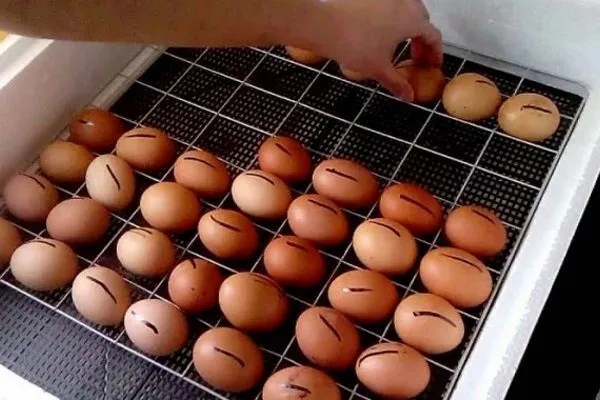
It is important to maintain a period of 4 hours between clutches; this is the optimal time for the previous eggs to warm up and for their future development.
It also matters in what position the eggs are laid:
- medium and small ones must be placed exclusively in a vertical position;
- However, it is better to lay large eggs horizontally: this way, the embryos will develop correctly and without pathologies.
When setting eggs vertically, they should be positioned with the blunt end facing up. This area contains the air cell, which the embryo will use to obtain oxygen during the first days of development. If the eggs are positioned incorrectly, the cell may be damaged, causing the embryo to suffocate. This can also lead to abnormal development, resulting in abnormal chick development.
How to care for eggs during incubation?
After the eggs are laid, the embryos will gradually begin to develop, a process that can be divided into four stages. Each stage requires special care to ensure proper care and avoid damaging the fragile bodies of the future chicks:
1stage
It begins when the eggs are placed in the incubator and ends on the seventh day. During this stage, the embryo begins to absorb oxygen from the air cell and then from the microscopic pores in the shell. Development, growth, and formation of all organs begin. Chicken eggs complete this first stage in exactly seven days.
- ✓ Maintain the temperature at the first stage at 39°C, humidity 30%.
- ✓ Turn the eggs every 2-3 hours, except at night.
- ✓ During the second stage, check the eggs daily with an ovoscope.
- ✓ At the third stage, reduce the temperature to 38.5°C and begin ventilation.
- ✓ At the final stage, set the humidity to 31% and the temperature to 37-38°C.
Throughout this stage, the temperature should be 39 degrees Celsius with 30% humidity. Starting from the first day, the eggs should be turned every 2-3 hours, with a break at night.
To avoid confusion, you can keep a special notebook where you record data on temperature, humidity, time of turning the eggs and the side they were turned on.
2stage
During this time, the embryos' skeletal system and beak begin to develop. This phase ends on the 11th day (if the eggs are chicken eggs). This stage is relatively unremarkable; you still need to turn the eggs and monitor the temperature and humidity as usual.
A key feature is the need for constant (daily) examination of the eggs with an ovoscope. If an egg is damaged or if embryonic defects (dead, spoiled, etc.) are detected, these eggs are called "scramblers." They should be removed from the incubator, as healthy chicks will not hatch from such eggs.
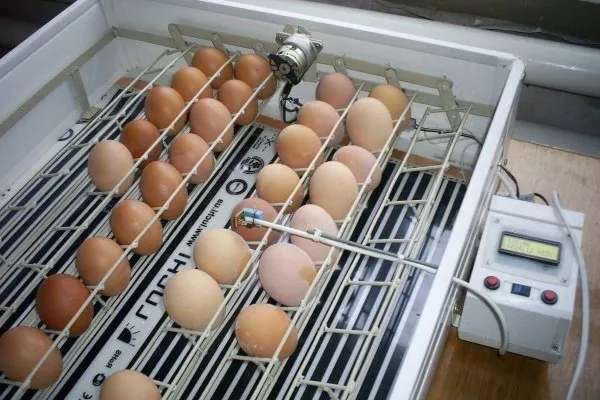
3stage
At this point, the chick's body is fully formed and covered with down. It's possible that the chick will begin to make its first sounds and show signs of life.
This stage lasts from 12 to 18 days. The temperature should be reduced to 38.5 degrees Celsius, after which the incubator should be ventilated (this should not be done before this stage, and if there is a built-in ventilation system, it should be completely closed). Turning the eggs from this stage onward is highly discouraged, as even the slightest movement can cause significant damage to the chicks.
On the 12th day, turn off the incubator heating for 10-15 minutes to allow the eggs to cool slightly. After this, set the temperature to 38 degrees Celsius for 30 minutes, then increase it to the aforementioned standard of 38.5 degrees Celsius.
It is very important to follow these conditions correctly, because during the development of a chicken, temperature fluctuations of even tenths of degrees can be critical.
4stage
This period is called the final stage and lasts from the 19th to the 21st day (by this time, all the chicks should have hatched). During this time, the chicks hatch from the shell (20-21 days), the air humidity reaches 31%, and the temperature drops to 37-38 degrees Celsius.
Once the chicks are completely dry, they are removed from the incubator and the process of growing into adults begins.
This completes the process of laying and caring for the eggs in the incubator. With proper care and setting, the chances of hatching up to 80% of the eggs are excellent, especially if the eggs are laid at home. With a proper approach and careful examination of the eggs, good, healthy chicks will emerge.