
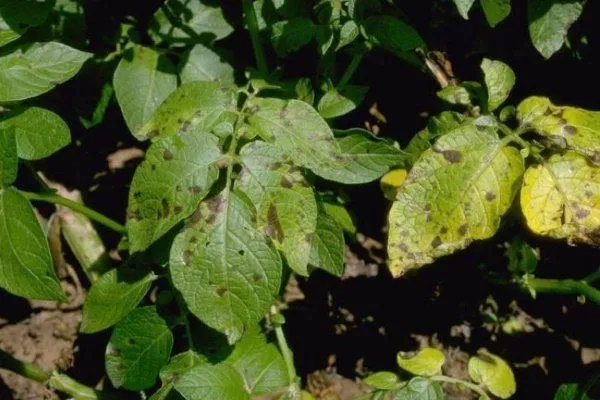
Alternaria wilt of potatoes is a fungal disease that affects stems, leaves, and tubers. In Russia, this disease causes annual losses of up to 5% of the potato crop. The disease typically begins in mid-June and progresses throughout the summer.
General description of the disease
Alternaria leaf spot is a disease caused by the Alternaria fungus. Optimal conditions for the growth of this microorganism include air temperatures between 22-26°C and the presence of dripping moisture for at least two hours.
Alternaria is widespread in Belarus and Russia, especially in the Far East, western and central regions of the European part of the country.
The fungus is active at temperatures between 7 and 12 degrees Celsius and dies at temperatures below -30 degrees Celsius. The pathogenic fungus overwinters in the soil at a depth of no more than 5 cm, on infected plant debris. The viability of this microorganism depends on the temperature and humidity of the surrounding environment.
The disease is particularly active on the lower and middle leaves of the stem in early July. The fungus typically attacks stems and leaves, sometimes spreading to tubers.
Alternaria leaf spot is also known as dry spot. This disease most often affects early-ripening potato varieties, while mid- and late-ripening varieties are much less susceptible. However, yield reduction is much less pronounced in early varieties.
Currently, there is no potato variety fully resistant to Alternaria, but some varieties are known to have increased resistance. These include Adretta, Master, Ogonyok, Lyubava, Filatovsky, Gala, Lugovskoy, Lasunok, Svitanok, Bryansky Delikates, Skazka, Lazurit, and several others.
This disease isn't unique to potatoes: it also affects other plants, including those in the nightshade family. Besides potatoes, Alternaria also affects cabbage, tomatoes, eggplant, zucchini, carrots, onions, sunflowers, and peppers.
Most scientists believe that Alternaria primarily affects weakened plants, but this pathogenic fungus is also found on crops that at first glance appear completely healthy.
Routes of infection, risk factors
The main cause of potato dry spot is the contamination of tubers with mycelium and Alternaria fungal cells. This can occur during planting, when mycelium remaining on plant debris and old tubers comes into contact with the tubers.
Sources of infection: tubers, plant debris, soil, which contain fungal mycelium.
Fungal spores are carried throughout the summer and fall. They fall on potatoes through wind and raindrops. Certain insects also act as carriers.
Infection occurs in this way:
- the pathogen, getting onto the surface of the plant, germinates into it, penetrating through the stomata and damaged epidermis;
- mycelium forms in the intercellular spaces, which, as it grows, secretes acid that has a detrimental effect on the tissues of the above-ground part of the potato bush;
- the destructive process reaches the tubers, the affected area expands.
The pathogenic fungus Alternaria causes necrosis of the foliage, leading to the premature death of the entire plant. Several generations of the pathogenic fungus can develop during the potato's development. Infected plants experience impaired respiratory and nutritional functions.
Factors that increase the risk of developing the disease are:
- lack of minerals in the soil – nitrogen and potassium;
- excess phosphorus;
- insufficient humidity level;
- high air temperature;
- improper preparation of seed material for planting;
- stagnation of water for more than 2-3 hours during watering, natural irrigation (rain);
- infection of tubers with viruses even before they are planted in the soil;
- weakened plant immunity;
- growing potatoes together with other nightshade crops infected with Alternaria (mainly tomatoes);
- the impact of parasites.
- ✓ Soil pH should be within 5.5-6.5 to minimize the risk of developing alternaria.
- ✓ Organic matter content of at least 3% to improve soil structure and its water permeability.
The symptoms of this fungal disease are most pronounced in hot weather, alternating with heavy morning dew and rain.
The incubation period for potato Alternaria blight averages 3-8 days. If weather conditions are favorable for the disease to develop, symptoms appear within 3-4 days. The first symptoms are usually detected on relatively young plants, reaching 15-20 cm in height.
Signs of potato Alternaria blight
The first signs of a fungal disease can be seen when the bush grows 20 cm in height.
Fungal infection is expressed by the following symptoms:
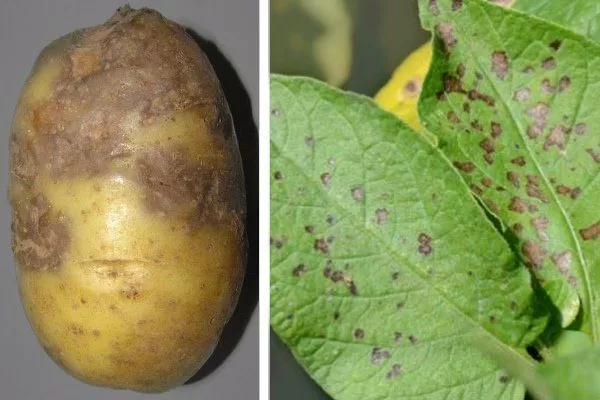
- The formation of small black spots on leaves. They are characterized by the presence of concentric circles and a faint black coating on the underside of the leaves. The spots usually appear three days after infection. Over time, the diameter of the spots increases. These lesions have an olive-colored, velvety coating on their surface. As the disease progresses, the spots merge and can soon cover the entire leaf surface.
- Fragility of leaves, resulting in their death.
- Formation of dark spots on tubers. Potatoes are rarely affected by Alternaria.
- Presence of rotten areas in a tuber cut in half.
- The appearance of deep wrinkles in areas covered with dark spots.
On stems and petioles, the fungal disease appears as streaks that merge to form continuous spots. These spots are 3-5 cm long and slightly embedded in the stem tissue.
Alternaria blight manifests itself on seeds as black mold. The disease negatively impacts seed germination.
If Alternaria infection occurs during harvesting due to contact with infected root crops, symptoms of the fungal disease will appear no earlier than 2 weeks later.
Methods of combating the disease
To combat Alternaria, various chemical preparations are used that fight the causative agent of the fungal disease.
For this potato disease, the following solutions of chemical preparations (0.2-0.3%) are effective:
- Cupricol;
- Profit;
- HOM;
- Novozri;
- Cuproxate;
- Thanos;
- Albite;
- Metaxil;
- Utan;
- Abiga Peak;
- Yunomil MC;
- Oxychom;
- Acrobat MC;
- Penkozeb.
Each product requires a strictly defined dosage. The application method also differs. For example, Acrobat MC is sprayed on potato plants up to three times during the growing season, while Albit is sprayed twice a season, when the plants are closing. The exact dosage is specified in the product instructions.
You can also treat plants affected by fungal diseases with copper oxychloride at a rate of 24-32 g per hundred square meters.
Chemicals are highly toxic, so safety precautions must be observed when working with them. It is important to follow the instructions, wear personal protective equipment, and change clothes and wash after handling the product. Do not smoke, eat, or drink while spraying.
To avoid addiction, it is necessary to alternate the preparations used to treat diseased plants.
It is necessary to treat the fungal disease, since without measures, a significant part of the potato crop can be lost.

Preventive measures
To prevent the development of this disease, it is necessary:
- It is essential to remove any diseased potatoes from the area and then destroy them;
- deeply plow the soil - this promotes the decomposition of infected plant residues;
- observe crop rotation: this means that a certain variety of potato should be returned to its previous planting location after 3-4 years;
- plant only healthy potatoes, inspect each tuber before planting;
- in the autumn, carry out deep plowing of the soil – at least 50 cm;
- Before planting, treat the tubers with special compounds that prevent the development of alternaria: the most popular are Integral, Skor, Acrobat, Baktofit, Agat-25;
- carry out the first spraying of the bushes with an antifungal agent at the stage of closing of the tops in the rows;
- Before digging up potatoes, mow down the tops to prevent the penetration of spores of the pathogen into the tubers;
- plant potato varieties that are resistant to alternaria: Resource, Pobeda, Master, Golubizna, Adretta, Bronnitsky;
- fight against fungal carriers, such as aphids and other insects;
- separate diseased potatoes from healthy ones and do not allow them to be stored together;
- Do not plant potatoes next to tomatoes affected by alternaria.
Throughout the growing season, it's important to monitor the condition of your potatoes and take action at the first sign of fungal infection. The sooner you take action, the greater the chance of preserving your harvest.
Alternaria leaf spot is a disease that affects nightshade crops. It attacks not only the above-ground parts but also the tubers. To prevent the disease from spreading, potatoes should be treated with special preparations. If the disease has already spread, it should be treated with special chemicals as soon as possible.