
Building a chicken coop requires only basic construction skills and a little passion. Building a chicken coop yourself isn't an impossible task, and if you approach the project with the utmost responsibility, the results will exceed all expectations.
Basic requirements and conditions
Before starting construction, it is important to familiarize yourself with the key terms and requirements:
- Chickens are birds, which means they can fly at least a little. Therefore, it's important to provide a minimum enclosure (about 2 meters), or, better yet, a roof.
- Chickens are hunted. Stray dogs, foxes, ferrets, martens, and even rats are potential predators. The structure of the building should protect the birds from any intruders.
A single ferret can destroy a flock of 20 chickens in one night. Therefore, fencing devices must be not only high-quality but also as practical as possible. A reliable solid wooden fence or a corrugated metal fence will provide good protection. Additionally, you can install a chain-link fence, along which you can plant a dense hedge of tall shrubs. Such a barrier will protect the birds not only from other animals but also from people.
- Shrubs. Planting tall shrubs along the perimeter of your homemade chicken coop will protect the birds from sun and wind. Chickens enjoy shade in hot weather and enjoy browsing on leaves and insects that breed among last year's foliage beneath the plants. The presence of insects and worms will also expand the chickens' diet, which is an added bonus.
- Cleanliness. Wherever the chickens are, there's droppings. The coop should be designed for easy cleaning (hinged walls/doors, sliding floor, etc.). To prevent people from suffocating from these odors, it's recommended to build the coop as far away from residential buildings as possible.
- Ventilation deserves special mention: without fresh air, the chickens will die within days. However, ventilation protection must also be adequate, as predators can reach anywhere in search of prey.
- Winter. If chickens will be kept indoors year-round, proper waterproofing should be considered when designing the coop. Winter means ice, and ice means water, meaning increased humidity, which chickens instinctively fear. Consequently, their productivity and egg production will decrease significantlyAdditionally, insulate the chicken coop and ensure there are no drafts (gusts of wind are more common in winter).
- Required space and stocking density. The chicken coop should be designed with a space requirement of 1 square meter per 4 adult chickens (15 chicks). However, if the chickens are kept for egg production rather than breeding, then no more than 2 chickens per square meter should be allowed.
If a small chicken coop is being built, its minimum area should be at least 3 square meters.
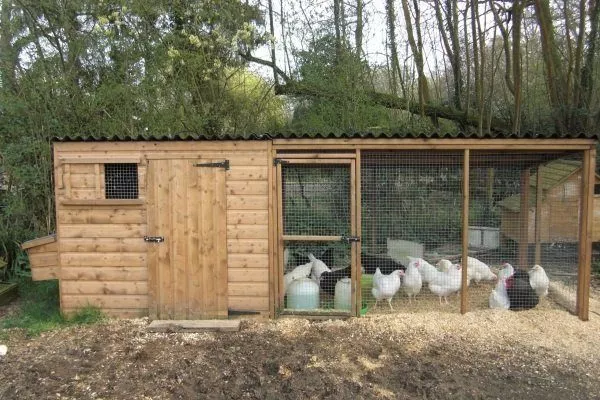
For a homemade chicken coop for 20 hens (19 layers, 1 rooster), the dimensions are 2.5 x 6 m, or 15 square meters in total area. If the coop is for 10 hens, the dimensions can be significantly reduced: 2.5 meters wide and 3 meters long is the optimal size.
For a large number of chickens, you can slightly reduce the overall size of the coop. This is because the hens will compete for space, huddling together in small groups. This allows for a smaller footprint, but only slightly, otherwise the hens will begin to squabble and peck at the weaker ones.
Next to the chicken coop, there must be a run for walking, with dimensions of at least 3 x 3 m. Ideally, the run should have 2 square meters of free space per adult chicken.
To ensure the chicken coop is as comfortable as possible for the birds, it needs to be shaded, protected from predators, and protected from the sun and wind. These are the ideal conditions for keeping chickens in a homemade coop.
Preliminary preparation
Before building a chicken coop, you should carefully consider every aspect of the process and requirements. Start by designing the future structure and deciding on the materials, location, shape, and type of coop.
Designing a chicken coop
Determining the required floor area is key when drawing up a construction plan. This includes not only the chicken coop itself, but also the area for the chickens to run freely.
When developing a project, please pay attention to the following points:
1Location of the structure
The site should never be located in a low-lying area. There are many reasons for this:
- after the rains, water will accumulate there;
- the place itself will always be damp and dry out slowly (atmospheric moisture is concentrated there);
- In the lowlands, morning fog lasts the longest, etc.
It is most reasonable to place the structure on a small hill.
2Chicken coop area
Dimensions are calculated individually. A minimum of 3 square meters should be allocated for every 5 laying hens. Only under these conditions will the normal coexistence and development of the hens be ensured. Therefore, the total size of a hen house for 5 hens, given these requirements, would be 1.5 x 2 meters (excluding the exercise yard).
If the coop is being built for only 2-3 hens, the area can be even smaller. A space of 1 square meter will be more than sufficient.
The chicken run should also be designed based on the number of chickens. For the aforementioned five hens, approximately 6-7 square meters of run space is allotted. The more active the hens are, the higher their egg production will be.
| Content type | Density (heads/m²) | Ceiling height | Required walking area |
|---|---|---|---|
| Layers | 3-4 | 2-2.2 m | 2 m²/head |
| Broilers | 5-6 | 1.8-2 m | 1 m²/head |
| Young animals (up to 4 months) | 8-10 | 1.5 m | 0.5 m²/head |
| Chickens (up to 2 months) | 12-15 | 1.2 m | Not required |
3Protecting the walking area
The exercise area should be protected from the wind. A canopy installed over the run is ideal for this purpose, as it will also protect the chickens from sunlight, rain, and predators.
4Location Features
It's strongly recommended to place the chicken coop on an elevated surface. This can be achieved by creating a mound of sand and medium-sized crushed stone. Besides the stated benefits of such a location, it will also act as a deterrent to predators. A layer of clay mixed with broken glass on top of the mound will provide additional protection.
5Ceiling and windows
Windows or a door provide natural light during the day. A glass door is a smart choice, but it should be installed on the southeast side of the coop—this is where the sun will reach the building the longest.
If the window is separate from the door, it should be installed at a height of 1.1-1.2 m from the floor, and the size should not be smaller than 50 x 50 cm. The ceiling is raised to a height of 2-2.2 m to provide a large volume of air space for the chickens.
6Remote nests
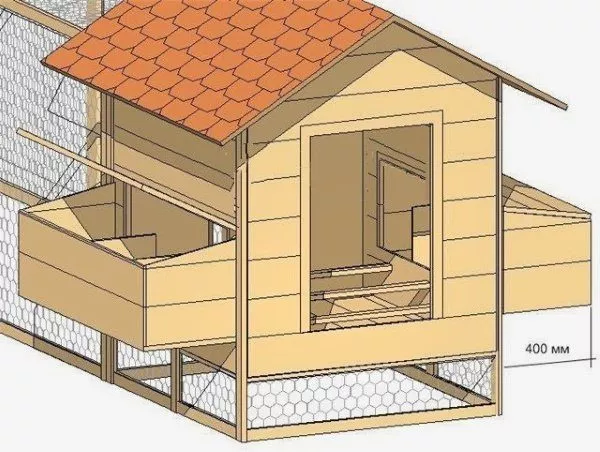
It's best to install nesting boxes outside the coop, extending beyond its boundaries and measuring at least 40 x 40 cm. The lid should be easy to lift, so you don't have to go inside to retrieve the eggs.
Choosing a chicken coop
To build a good structure, you need to choose your chicken coop carefully. This process depends on the following factors:
1Breed of chickens
All chickens are divided into two broad groups: layers and meat hens. Layers require space, light, fresh air, and access to outdoor exercise. Under these conditions, they will lay many eggs practically year-round.
Meat breeds, however, should be kept as close together as possible to prevent them from wandering around the coop and losing weight. These breeds are kept only during the warm season, meaning there's no need to heat the coop.
2Type of walking
There are also two types of exercise areas: open and closed. Enclosed areas, as mentioned earlier, are ideal if the chicken coop itself is located close to a forest or field, meaning areas where there's a risk of predators.
When free-range, chickens leave the coop and roam around a large area, pecking at fresh grass. This improves their comfort, but also increases the risk of illness or injury from weasels, rodents, and other predators.
The choice of chicken coop also depends on this, as the lack of an enclosed run frees up the design. The need for one, on the other hand, forces a more compact design.
3Number of chickens
The more chickens you have, the larger the coop you'll need. Chicken breeding and raising experts recommend allocating 3 square meters of space for 5 chickens. As the number of chickens increases, the size of the structure should also increase. This is especially important, as while it's possible to remodel the roof or walls, expanding the overall area will be extremely difficult.
Every poultry farmer should remember that they should never completely copy a pre-existing chicken coop design, even if it's flawless. Forgetting even one individual, yet important, factor can have significant negative consequences.
Materials and tools
| Material | Thermal conductivity | Service life | Difficulty of installation | Price |
|---|---|---|---|---|
| Foam block | 0.12 W/m°C | 25+ years old | Average | High |
| Tree | 0.15 W/m°C | 10-15 years | Low | Average |
| Brick | 0.56 W/m°C | 30+ years old | High | Very high |
| cinder block | 0.5 W/m°C | 20 years | Average | Low |
For a homemade chicken coop you will need the following materials:
- foam blocks;
- wood;
- old window frames;
- cement;
- crushed stone;
- bars;
- plywood;
- brick;
- cinder blocks or shell rocks.
Foam blocks are the best choice for construction due to their ease of installation. They also retain heat well, but they are significantly more expensive than other materials.
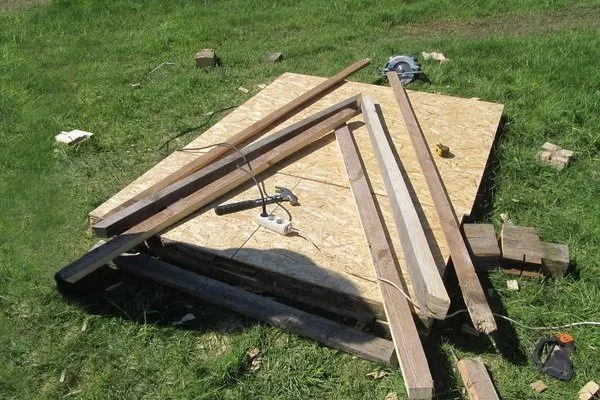
The most economical option is to build a chicken coop out of wood. Moreover, a wooden structure will fit perfectly into a rural setting. Wooden chicken coops are extremely environmentally friendly.
Perches should be sanded. All wooden parts should also be treated with fire, insect, mold, and rot-resistant impregnations. Only environmentally friendly products are used for this purpose.
Brick or cinder block can be used to construct the walls of a chicken coop. These materials are several times cheaper than foam blocks, and their strength and durability are quite satisfactory. The only drawback is that brick chicken coops require additional insulation.
As for the roof, it can be made from:
- slate;
- corrugated sheets;
- metal tiles.
The roof material is completely unimportant for both the chicken coop itself and the chickens. Therefore, you should choose the most economical option that will provide warmth and keep moisture out. For roof insulation, you'll need rolled insulation or expanded clay.
When building a chicken coop, you will need the most standard set of tools:
- hammers;
- nails/screws;
- screwdriver;
- saw;
- shovel;
- roulette;
- axe;
- trowel;
- plane.
All of the above are basic tools that will definitely come in handy. However, it's impossible to say with certainty whether all of this will be sufficient, as each structure is built according to individual needs, drawings, and requirements.
The following additional materials may be useful:
- sand;
- construction rods;
- beams or boards for perches;
- lime for wall treatment;
- foam plastic and sawdust as insulation;
- roofing felt for foundations and roofs;
- ventilation box;
- nest boxes;
- dowels (wooden nails).
Location
The requirements and conditions for the location of the chicken coop were described in detail earlier:
- on a hill;
- in a quiet and peaceful place;
- away from the road (literally as far from the roadway as possible);
- at a distance of more than 3 meters from residential buildings.
Silence is crucial for any chicken coop. Will a hen be able to hatch eggs productively with constant noise? Of course not. And no amount of soundproofing will help, so choose a quiet location during your preliminary preparations.
Step-by-step instructions for building a chicken coop
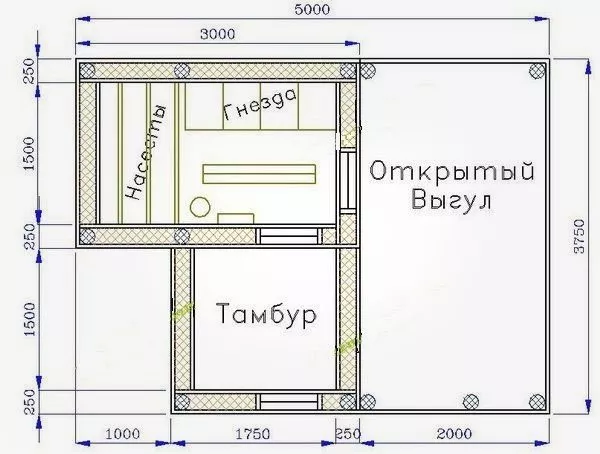
The first step is to draw up a plan for the future chicken coop. This is what a structure for 10 chickens looks like:
Foundation
The creation of the foundation for the chicken coop must be approached with the utmost responsibility:
1Markup
On the site selected for construction, the area for the foundation is marked. Steel rods are driven into the ground at the corners of the markings, connected to each other with rope. The lengths of the sides and the diagonal between the corners are measured to ensure the markings are accurate.
Each corner should be right angles, and the opposite sides and diagonals should be perfectly aligned. If everything lines up, drive in the stakes that will serve as the centers of the future posts. The distance between the stakes is 1 meter.
2Digging a hole
A 50-cm-deep hole is dug along the designated perimeter. A layer of sand is compacted into the bottom. The coarser the sand, the better. Dry sand cannot be used; only wet sand.
3Concrete mortar
To prepare the solution, you need to divide it into 7 parts and add the following materials in certain proportions:
- crushed stone – 3 parts;
- sand – 2 parts;
- cement – 1 part;
- All this is mixed with water - 1 part.
The mixture is poured into the hole to ground level, leveled and left to dry for a couple of days (about 3 days).
4Rise
After the concrete has dried, build up the pillars using cement and bricks (20-30 cm high). The width of the pillars is determined individually, but for a distance of 50 cm, two bricks per row will suffice. Check for levelness with a spirit level.
5Layer bookmark
Once the foundation is fully laid, it will need to be covered with a waterproofing material (such as roofing felt), on which the first row of timber is laid. To ensure a more secure connection, notches are made in the corners. At this point, the foundation is considered complete.
Chicken coop walls
Once the foundation is ready, you should choose the material for the walls. As noted, wood is a good choice. However, you can choose any other material that will perform equally well and meet the key requirements.
First, four load-bearing beams are installed. They are secured to the foundation beams using individual 10 cm square beams, angled at 45 degrees relative to the walls and floor.
The frame beams should be connected with bars and reinforced in the manner mentioned.
The exterior and interior of the coop are lined with chipboard, fiberboard, plywood, and planks, taking into account the space allocated for lighting and ventilation. Insulation, such as mineral wool, should be placed between the layers. When lining, it's critical to eliminate any gaps or unevenness to ensure the coop is as airtight as possible.
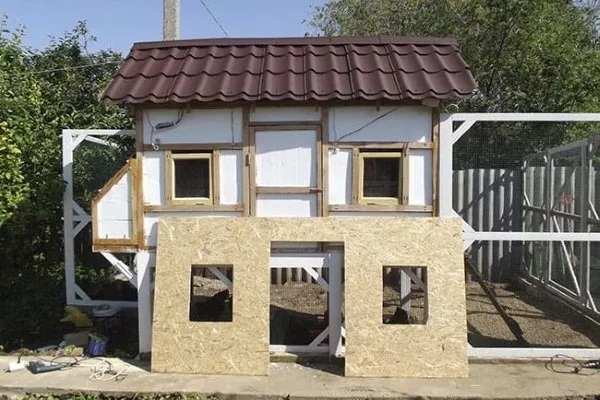
After all these steps, the boards are treated with a special solution. Specialist stores offer a fairly wide selection of these products (for example, MDS mineral sealing solution).
Roof, ceiling and floor
Roof construction begins with laying ceiling beams on the supporting beams. They should be spaced no more than 1 m apart. For this purpose, beams with a cross-section of 15 x 10 cm, laid on edge, are used. Immediately after this, they are covered with cross boards and insulation.
It is recommended to create a gable roof for the structure. This will ensure guaranteed protection from precipitation, even the heaviest.
When creating a gable roof, you should:
- Take care of one more vertical beam right in the center of the short side of the structure.
- Attach rafter holders to them. The angle should be 50 degrees and 35 degrees to create a slope for precipitation drainage.
- The rafters are placed on the holders on each side.
- To equip the roof, you can use slate or similar material.
The floor is laid in a completely identical manner to the ceiling. The only difference is that 15 cm square beams are allowed.
Next, it is recommended to lay a rubber covering on the floor (for sealing), which will prevent the formation of mold and other infections.
Next, floorboards are laid, fastened to the beams with screws or nails (20-35 mm long). All cracks in the floor and around the walls are sealed with a sealant that is completely safe for chickens.
It may also be necessary to install a layer of thermal insulation in the floor to prevent the heat from escaping into the ground during the winter.
Floor insulation procedure
- Waterproofing with roofing felt (2 layers)
- Laying logs from 100×100 mm timber
- Backfill with expanded clay (10 cm layer)
- Installation of subfloor from OSB
- Laying polystyrene foam (5 cm)
- Finished flooring (tongue and groove board)
Cold weather significantly increases the risk of chickens developing arthritis in their legs and other cold-related illnesses.
Ventilation
Good ventilation will help control the temperature and humidity, but to do it correctly, you need to decide on the type of hood.
If the chicken coop is not designed for keeping chickens on an industrial scale, natural supply and exhaust ventilation works well:
- You will need 2 pipes with a diameter of 19-22 cm and a length of 190-210 cm.
- Two holes are made in the roof. The exhaust pipe should be placed above the roosts. The inlet pipe, through which outside air will enter, should be as far away from the chickens as possible.
- The exhaust pipe is installed significantly above the roof, approximately 1.5 m. Only a small portion of it—no more than 30 cm—should remain inside the coop.
- The supply pipe is installed completely the other way around: most of it will be located indoors, no more than 30 cm from the floor.
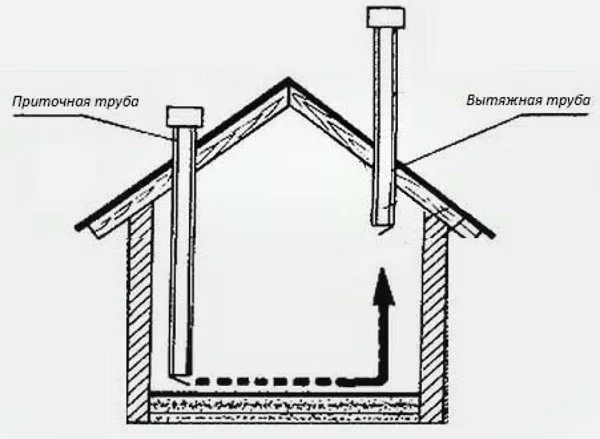
The operating principle of this type of ventilation is comparable to the "communicating vessels" we learned about in school physics classes. Only instead of water, it uses air, resulting in high-quality, natural ventilation of the premises.
More sophisticated ventilation methods are used only on large farms and are impractical for building a homemade chicken coop. This is due to the need for expensive, energy-intensive fans.
Interior decoration
When raising meat breeds (broilers), the interior layout isn't as important as for laying hens. Providing daylight, insulation, and properly constructed perches are the key goals of a chicken coop for laying hens.
Lighting
Agronomists recommend maintaining adequate lighting in the chicken coop for at least 8-10 hours per day. If hens receive 11-12 hours of daylight, the number of eggs laid can increase by up to 25-30%.
It is most appropriate to use additional lighting from November to March.
To save on electricity in winter, you need to provide normal windows with shutters that close from the outside.
To illuminate the chicken coop, it is permissible to use various good lamps:
- fluorescent (40 W);
- incandescent electric lamps (40-60 W);
- energy saving (15 W);
- LED (of varying power, depending on needs).
One 60-watt incandescent bulb can illuminate a 6-square-meter chicken coop (when placed 2 meters above the floor), achieving a good level of illumination (20 lux).
Maintaining warmth
The temperature inside the chicken coop should never fall below 15 degrees Celsius. Failure to do so will cause the hens to consume twice as much feed, and their egg production will plummet.
The above condition applies to all common chicken breeds. However, some can thrive relatively comfortably in lower temperatures (for example, the Cochin or Brahma, thanks to their thick, fluffy plumage).
To maintain an adequate temperature in the chicken coop, the following conditions must be met:
- load-bearing walls with a thickness of at least 15-20 cm (for winter chicken coops);
- external wall insulation;
- roof insulation;
- insulation of floors (concrete) or use of wooden floors;
- make sure there are no holes, cracks or rat holes;
- seal the chicken coop to ensure absolute protection from drafts (for daytime ventilation, it is worth ensuring there are opening windows);
- have equipment for heating the room during frosts.
| Heating type | Consumption | Heated area | Safety | Service life |
|---|---|---|---|---|
| Infrared lamps | 250 W/10 m² | Up to 15 m² | High | 1.5-2 years |
| Fan heaters | 2000 W/20 m² | Up to 30 m² | Average | 3-5 years |
| Water heating | 1500 W/50 m² | Up to 100 m² | High | 10+ years |
| Stovetop | Firewood | Up to 25 m² | Low | 5-7 years |
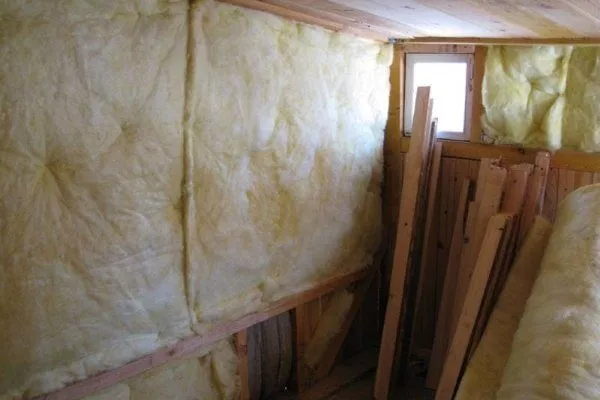
To provide additional insulation, you can follow these recommendations:
- Place small stoves inside the coop with the chimney vented to the outside. This isn't the safest option, but it's still effective.
- Heat the room with fan heaters or electric radiators. The latter should be turned on during severe frosts or at night. They should be turned off at other times (this saves energy and extends the lifespan of the devices).
- Heating can also be provided by a stove with a hot water boiler and a tubular electric heater. During freezing temperatures, the stove is heated with wood. The heated water from the stove is fed to radiators located along the walls of the structure. The water can also be additionally heated by the aforementioned heating element (up to 1.5 kW). This way, the stove burns wood during the day, and the heating element is activated at night.
- You can also heat the coop using infrared lamps. They emit a soft, not too bright light, which will be comfortable for the chickens.
It's important to install lamps out of reach of birds. A fire in a small wooden structure is dangerous not only for chickens but also for people.
Arrangement of perches
Perches are the most important place in the entire chicken coop. They'll be where your chickens will spend most of their time. They sleep and rest on perches, so the quality of these perches must be impeccable:
- 25 cm of the entire beam is provided for 1 individual (if there are more than 20 individuals, the total length of the perches should not be less than 5 m);
- perches are installed either as a ladder or completely horizontally (but in no case one above the other: the upper ones will dirty the lower ones);
- You should decide on a place in the chicken coop - where it will be easiest to clean, and that is where the perches should be, because the main droppings will accumulate under them;
- the width of the beam should be 3-5 cm;
- All edges are planed to ensure the chickens are comfortable and safe.
Nest arrangement
The chicken coop should have nests where the hens will hatch their eggs. Nests can be inexpensive, like an old basin lined with straw. But if you're building a chicken coop from scratch, it's important to take care of the nests just as carefully as the rest of the structure:
- for 4 laying hens you need 1 nest (at least), that is, for 20 individuals you need 5 nests or more;
- a high threshold is set at the exit from the nest: hens are not the most graceful animals and can easily roll an egg out of the nest;
- nests can be installed above perches so that the hens can get there through them (there is no need to fly up);
- When installing nests separately from perches (at least 40-50 cm from the floor), it is worth taking care of perches that provide the chickens with a convenient landing;
- lamps must be turned away from the nests - hens like to lay eggs in a dark and quiet place;
- Separate feeders and water for brooding hens should be installed near the nests.
If your coop space allows, you can install a small ash basin near the nests. The hens will use it to clean their feathers and remove parasites, which will, in turn, improve their comfort and egg production.
Feeding devices
It's best to arrange feeders and waterers around the perimeter of the coop to provide more space for the chickens to roam. Using regular bowls is also not practical.
It's smarter to build feeders out of wood or install a regular pipe with holes through which the chickens can peck. Drinkers can be made from plastic bottles, drainpipes (using the same principle as the feeders), plastic buckets, etc.
While there are many options for feeders, waterers are more challenging. This video shows how to make a semi-automatic chicken waterer from a regular pipe:
DIY Mobile Chicken Coop
If you're looking, you can build a homemade chicken coop "on wheels." It has many advantages over a stationary one, and only a few disadvantages. The most important one is the limited number of chickens you can house.
The structure is created almost identical to a regular chicken coop, but is much smaller in size and without the use of heavy materials:
- First, a blueprint for the portable chicken coop is drawn up. If you start building it right away, you might miss key details, and the structure will collapse under the first load.
- Formation of the chicken coop:
- 2 triangular frames are created from 2 x 4 cm timber;
- connected using hewn boards (with handles for moving the structure);
- the side walls are made from slats with a cross-section of 1.3 x 3 cm;
- a mesh is stretched between the walls;
- the ceiling between the tiers can be made of plywood (a hole is created in it for the chickens, where the ladder will be placed);
- one of the side walls must be removable (entrance to the chicken coop);
- the second wall is created from clapboard.
- The lower tier is divided. One-third of the space is used for perches, while the rest is used as a resting area for the birds.
- Roof construction. It's made of plywood sheets so that in high temperatures the roof can be lifted for ventilation.
A small section of the roof should be completely removable. This will allow for easy cleaning of the coop if necessary.
- Final finishing. The exterior of the structure is treated with varnish. This will protect the wood from insects and excess moisture.
- Interior decoration. In a portable chicken coop, the most important thing, besides perches and nests, is lighting and ventilation. Sunlight can be provided through windows or lamps, and a simple window will do for ventilation.
All other parts and devices are created completely identically to the previously mentioned scheme.
- Foundation. Due to the constant movement of the structure, there is no need to worry about a foundation; a simple but sturdy wooden floor will suffice.
However, metal beams can be installed underneath and wheels can be attached. This will eliminate the need to move the structure by hand.
If you approach the construction of your chicken coop with the utmost care and use high-quality materials, your hens will feel comfortable. The key is choosing the right option. This will translate into good egg production and other benefits.