
The Kyrgyz Gray breed is a relatively new breed, developed by scientists at the Kyrgyz Institute of Animal Husbandry. It quickly gained popularity among farmers due to its low maintenance, high productivity, and attractive appearance.
External signs, character
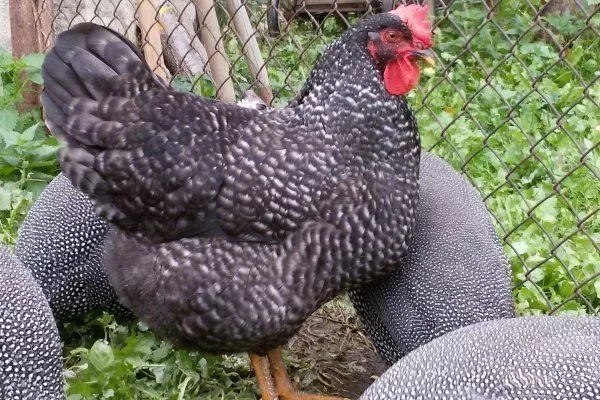
Based on the breed's name, one might mistakenly conclude that Kyrgyz chickens are gray. However, this is not entirely true. They inherited their unusual coloring from their ancestors, the striped Plymouth Rocks: each hen's feather is covered in black and white stripes, while the roosters' plumage has iridescent red hues.
The Kyrgyz grey breed can be distinguished by the following characteristics:
- The body is cone-shaped, large, and well-developed. Females have a prominent round belly and chest. Roosters are more slender, taller, and larger.
- The head is medium-sized and round. Roosters have a prominent red comb, wattles, and earlobes.
- The eyes are large, bright, red-orange.
- Legs are medium in size. Leader roosters have well-defined shanks.
- The beak and feet are yellow-orange.
- Roosters weigh just over 3 kg, and hens – approximately 2.5.
- Newborn chicks have black down. Females have light spots on their bellies. This feature allows one to distinguish the sex of the bird at an early age.
By character, Kyrgyz gray chickens:
- very calm, all their actions are unhurried;
- friendly - they never fight with their relatives and accept other breeds well in the chicken coop;
- not afraid of people;
- They are curious, but rarely leave the hen house.
To learn about the appearance of Kyrgyz Gray chickens and their external characteristics, we suggest you watch the video:
Advantages and disadvantages
The breed is meat and egg, and it no longer belongs to one type or the other, the ratio is 50 to 50.
Positive qualities:
- unpretentiousness in care and maintenance;
- quick adaptation to different climates and temperature changes;
- strong immunity that protects against many diseases;
- high productivity, which does not change with age and amounts to approximately 170 eggs per year;
- the eggs are large, light brown, weighing about 60 g;
- good taste qualities of meat.
Despite many advantages, the Kyrgyz Gray chicken breed also has several disadvantages:
- lack of survival instinct – hens very rarely hatch chicks;
- low precocity – sexual maturity of chickens usually occurs at 6-8 months.
Maintenance and care
Kyrgyz Grey chickens do not require any specific living conditions, but there are a few important points to consider.
Setting up a chicken coop and a walking yard
When setting up a chicken coop, the following are taken into account:
- Location. It should be well-lit, but not exposed to direct sunlight.
- Protect from drafts. Otherwise, the chickens may catch a cold.
- The height of the house should be no more than 1.8 m, so that it warms up well in winter.
- Interior space. Each bird requires about half a square meter of coop space.
- Maintaining a temperature between 13 and 22°C. To maintain this temperature even during the cold season, thick walls are built, and the floor is covered with a 10-cm-thick bedding of hay, sawdust, and sand.
- Lighting. Light is required 19 hours a day, so a window is essential, as is the use of lamps during periods of short daylight hours.
Lighting is very important for egg production in hens. It is often the cause decrease in egg production is precisely the lack of light.
- Exhaust hood. Windows alone may not be enough for ventilation. To cope with moisture, an exhaust hood is necessary.
- Perches. Designed to provide at least 20 cm of free space per hen.
- The lowest perch is located 50 cm from the floor of the chicken coop.
- It is not advisable to place perches one above the other, as the chickens will soil each other, which will have a negative impact not only on their appearance, but also on their health.
- The chicken coop should contain drinking bowls, feeders and baths filled with sand, clay and ash, where the birds clean their feathers.
- Equipment and bedding must be cleaned and changed regularly. Bacteria from dirt and droppings can cause illness and parasites in birds.
A yard for walking should be arranged near the chicken coop.
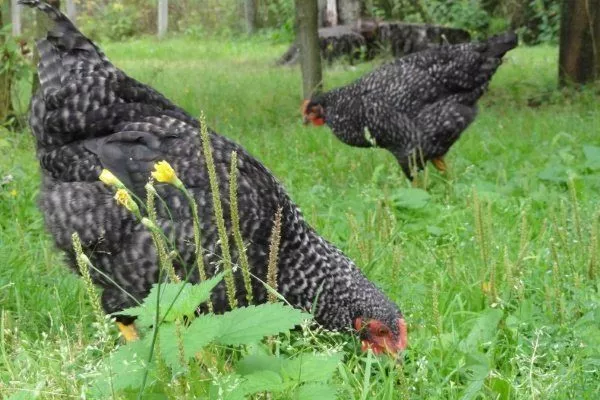
It must meet the following requirements:
- Area. Calculated based on the number of birds: 1 square meter per 1 chicken.
- Free access from the coop during the day. This requires a manhole at least 50 cm wide and approximately 70 cm high connecting the coop and the run.
- Fencing to prevent chickens from escaping and other animals from entering the run.
- The walking area should not have stagnant water during rains, or drafts.
- Here, just like in the chicken coop, feeders, waterers and ash trays are installed.
How to build a chicken coop that meets all regulations – read here.
Feeding
The following rules and regulations are taken into account:
- It is best to choose feeders for Kyrgyz gray chickens with spinners, as they will prevent the birds from climbing inside and scattering the feed;
- the size of the feeders depends on the number of birds (so that all the birds can eat at the same time and not fight for food);
- for drinking bowls, a container no larger than 5 liters is suitable;
- To prevent a bowl of water from tipping over, a stone is placed in the middle;
- water needs to be changed regularly and topped up if it runs out;
- adult chickens eat 4 times a day;
- their diet requires the presence of protein and grain feed;
- potatoes, greens and root vegetables are good for them;
- during cold periods, dry food is mixed with warm broth;
- To strengthen the eggshells, chalk or bone meal is added to the food.
More information on a complete diet for laying hens can be found Here.
Breeding chickens
To successfully hatch chickens, you should take a responsible approach to selecting eggs:
- For laying, select clean oval eggs without cracks; they must not be washed;
- they should be stored for no more than 10 days in a cool place with the blunt end up;
- The selected eggs are rotated around the vertical axis twice a day.
- ✓ Eggs must have a perfectly oval shape without the slightest deformation, which is critical for successful incubation.
- ✓ When candling, the air cell should be clearly visible and located at the blunt end of the egg, which indicates its freshness.
If you have an ovoscope, you can easily determine which material is suitable for breeding:
- the chamber in such eggs is located at the base;
- yolk - bright, located in the center;
- the protein is transparent.
Experts recommend incubating chicks in spring or early summer, so that the chicks can immediately experience warm, comfortable conditions and have access to fresh greens for food.
Sequence of incubator breeding:
- Rinse the incubator thoroughly with hot water and dry completely.
- Place it on a flat, hard surface in a draft-free room and set the humidity to 60% and the temperature to 37.5 degrees.
- Turn on the incubator one day before laying the eggs.
- After this time, place the eggs vertically in the incubator, with the pointed end facing up. More information on placing eggs in an incubator can be found here. here.
- Change the position of the eggs twice a day: alternately tilting each one 45 degrees to the left and right.
On the last day before the chicks hatch, they should be pointed with the blunt end down.
- After 16 days from the moment of laying, the temperature level of the incubator decreases by 0.1 degrees (37.4 degrees).
- After three weeks of operation, the chicks hatch. The process takes approximately six hours.
It is rare for this breed to hatch chicks without an incubator, but they do happen.
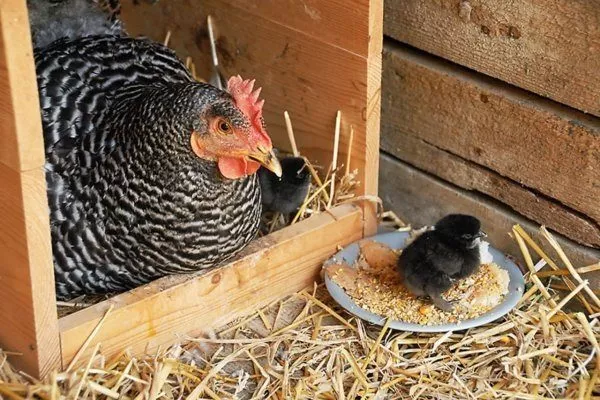
If you suspect a hen is ready to hatch, place a decoy egg near her for a couple of days. If she doesn't move and clucks frequently, she's ready to hatch. Then you can replace the decoy eggs with hatching eggs.
During incubation, certain rules must be followed:
- You mustn't disturb the hen.
- It is necessary to arrange a nest near which there is access to water and food.
- Make sure that the chicken eats, drinks, and goes into the yard for walking on time.
- During the walk, the eggs are covered to prevent them from freezing. This time is also used to check the eggs and nest: remove any cracked ones, clean the brooding area, and check for parasites.
- Once the chicks hatch, it's essential to ensure the hen doesn't abandon the nest. The chicks are left near the hen for several hours.
The chicks almost always hatch healthy and strong, with a 97% survival rate.
The chicks need to be fed 6 times a day, following these rules:
- In the first few days after birth, you should give your baby chopped hard-boiled eggs, low-fat cottage cheese, oatmeal, millet and barley.
- After three days, you can begin adding herbs to your diet: nettles, steamed with boiling water and finely chopped, as well as alfalfa and clover.
- Include vegetables such as beets or carrots. This will support the chicks' immunity and promote rapid, healthy growth and development.
- To help the chickens gradually gain weight, increase the amount of food by 15% daily.
- When feeding food, sprinkle the food with fish meal to ensure good skeletal formation.
- A weak solution of potassium permanganate is added to the water for chicks to protect against infections.
Late hatching of chickens during the cold season requires additional heating in the coop using special lamps. The temperature is maintained at 26°C.
Caring for chicks that are a few weeks old is the same as caring for adult chicks.
Kyrgyz Gray chickens are easy to breed, and caring for them is very simple and straightforward. Furthermore, these birds have strong immune systems and rarely get sick, which is undoubtedly a huge plus. By following the simplest care guidelines, you'll achieve high productivity: good egg production and high-quality, tasty meat.