
There are five main species of guinea fowl. Breeders have developed over 20 domestic breeds of these birds. Each breed has its own advantages and disadvantages. Our overview of these birds will help you choose the best breed of guinea fowl for breeding at home.
9 Main Guinea Fowl Breeds
Guinea fowl are mainly bred for meat at home; many breeds have retained the weight and overall size of wild guinea fowl, but broiler birds are heavier than their wild ancestors.
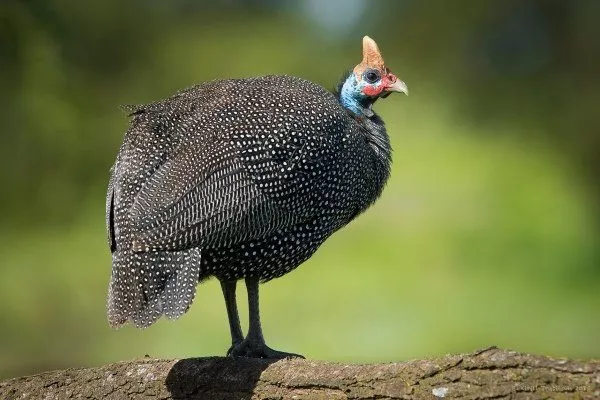
The domestic breeds of guinea fowl are as follows:
- Volzhskaya.
- French broiler or grey speckled.
- White Siberian.
- Blue.
- Yellow.
- Cream (Suede).
- Blue lilac.
- White.
- White-breasted Zagorsk.
| Object | Weight of an adult (kg) | Egg production (pieces/year) | Plumage color |
|---|---|---|---|
| Volga White | 1.8 | 100 | White/cream with dots |
| French broiler | 3.0 | 145 | Gray-blue with inclusions |
| White Siberian | 1.9 | 95 | White |
| Blue | 2.6 | 140 | Gray with a blue tint |
| Yellow | 1.8 | 100 | Light yellow |
| Creamy | 1.7 | 80 | White with spots |
| Blue lilac | 2.4 | 140 | Indigo with dots |
| White | 2.0 | 100 | Pure white |
| Zagorsk white-breasted | 2.0 | 120 | White with spots |
Volga White
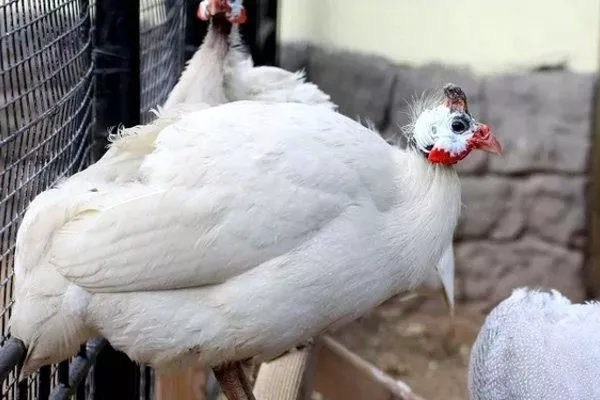
The Volga White Guinea Fowl is an egg-laying breed, capable of producing over 100 eggs per year. Its white body color creates an attractive and marketable appearance.
The following criteria can be used to distinguish the white Volga bird:
- legs are short;
- body shape "compact";
- the head is small in size;
- the beak is colored pink;
- The earrings are also pink in color;
- The feathers are white or cream with white dots.
This bird species is undemanding in its habitat and tolerates temperature fluctuations well. They thrive in cold climates, so it's best to keep them in the North, rather than in hot countries. Their main diet should be 100 g of bird seed per bird. The diet should be varied, including corn, grain mix, compound feed, and fresh greens.
This bird doesn't lay many eggs, and it's difficult to determine the sex of the chicks. Therefore, beginning poultry farmers are advised to first acquire a few guinea fowl after researching them, and then purchase families. It's also better to buy chicks rather than adults; the price difference is small, but the chicks will have time to acclimate to a new environment, diet, and care.
Volga guinea fowl have strong immune systems, so they rarely get sick, compared to, say, chickens or ducks. Their eggs are small, but they can be stored for a long time because their shells are thick and dark.
French broiler (or grey-speckled)
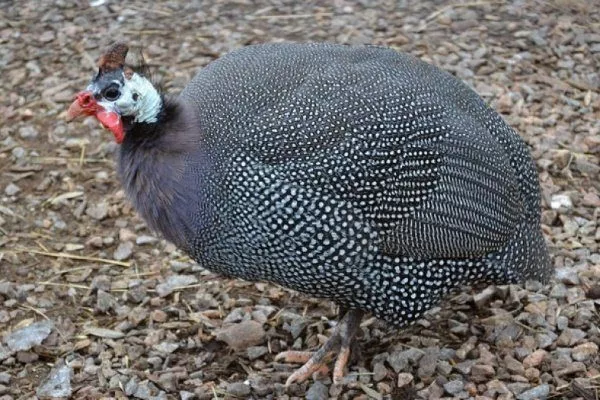
Broiler breed of guinea fowl It was developed through genetic selection by a company in France. They have a large body, and males can weigh up to 3 kg live.
Appearance:
- elongated body;
- the head has almost no feathers;
- the beak is pink in color;
- scarlet earrings;
- there is a blue growth on the head;
- the wings are round and have a good span;
- small tail pointing downwards;
- the plumage on the neck is grey-blue;
- paws are grey;
- There are white spots on the body.
This breed of guinea fowl has three names: silver-gray, broiler, and, accordingly, gray-speckled. This variety was the first to be used for domestic meat-producing birds. However, over time, many other, more productive varieties were bred, and the gray-speckled variety faded into the background.
When guinea fowl walk, they hold their bodies upright. Their skin is so thin that the dark muscles are visible. Their wings are well-developed and muscular, allowing them to fly well and overcome various obstacles. Owners often clip their birds' wings to avoid losing their flocks.
French hens are capable of producing a large amount of lean and tasty meat. Females weigh up to 1.6 kg, while males weigh 1.8 kg. There are virtually no differences between the sexes, but a closer look reveals that males have slightly larger heads and wattles. They are also prolific egg layers, producing 145 eggs weighing 55 grams in 12 months. Their meat has a gamey flavor, rich in hemoglobin.
French guinea fowl need to be fed the same diet as chickens: grains, compound feed, bone and fish meal, peas, and yeast. Thanks to trace elements and vitamins, they gain weight quickly. For every 1 kg of bird, over 3 kg of feed is required. Their productive potential begins to manifest itself at sexual maturity, which occurs at 8.5 months. Speckled-gray guinea fowl are reluctant to sit on eggs until they are two years old. However, once they have the desire to hatch eggs, they take great care of them, keeping them warm, fed, and protected from harm.
White Siberian
This breed is the most resilient in terms of maintenance; the bird is also unpretentious in feeding and produces many eggs per year.
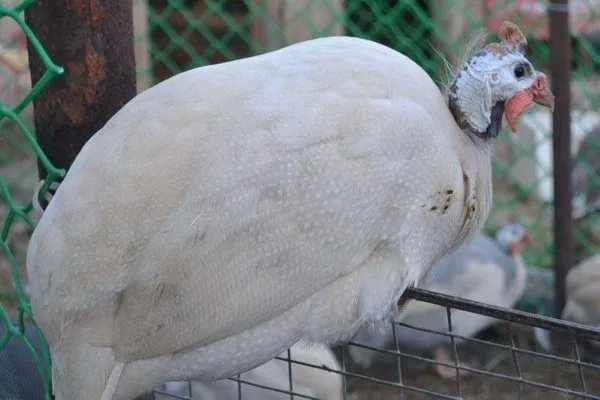
Appearance of the White Siberian Bird:
- the beak is grey in colour;
- metatarsus pale pink;
- matte plumage;
- small head;
- large earrings;
- There are no feathers on the neck.
Guinea fowl tolerate changing weather conditions well, easily surviving frosts. They are friendly and have a calm disposition. The breed's main advantage is its light carcass color, which improves its marketability compared to other breeds with a bluish tint.
Males reach 1.9 kg (4.2 lb) in adulthood, while females reach 1.8 kg (4.8 lb). Each egg weighs 48 grams, and it's possible to lay 95 eggs in 12 months. These birds are calm and friendly, and can be kept with other animals, such as chickens, geese, turkeys, and so on.
The White Siberian Guinea Fowl is one of the best breeds for a beginning farmer, as they are easy to care for, practically omnivorous, and productive. For information on how to properly care for guinea fowl, regardless of breed, see read here.
Blue
This species is rare, so it's virtually impossible to see them on private farms. However, if you decide to acquire blue guinea fowl, their beauty will enhance any yard.
Description of the blue guinea fowl:
- the plumage is grey with a blue tint;
- chest and neck are lilac;
- There are white spots on the tail.
This breed tolerates even the harshest frosts well, making them suitable for breeding in both the North and South. These birds are easy to feed and disease-resistant. Males reach 2.6 kg, while females weigh slightly less at 2 kg. An egg weighs 47 grams, and 140 eggs can be collected per year.
Guinea fowl do not lay eggs in artificial nests. They make their own nests in the grass and under bushes. They can be kept with other birds, as they are not pugnacious and can even subdue those who are. Guinea fowl should be fed a mash, both dry and wet. More information on feeding standards for guinea fowl can be found here. here.
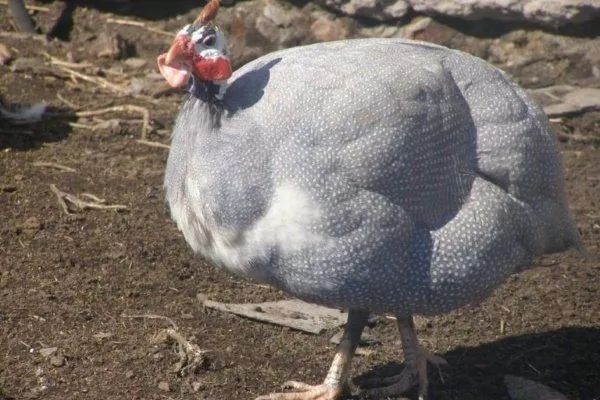
Yellow
The bird's color is light yellow, but lacks the pearly sheen typical of guinea fowl. The breast and neck are reddish-yellow. The productivity and flock sizes are the same as those of white guinea fowl. Yellow guinea fowl have a peaceful and calm disposition and live freely with other bird species. It is recommended to keep them together with turkeys and hens, as they often incubate guinea fowl eggs.
The taste of meat from domesticated individuals is similar to game. The size of one guinea fowl eggs They're slightly smaller than chicken, but the taste is simply superb. They can be stored in the refrigerator for six months.
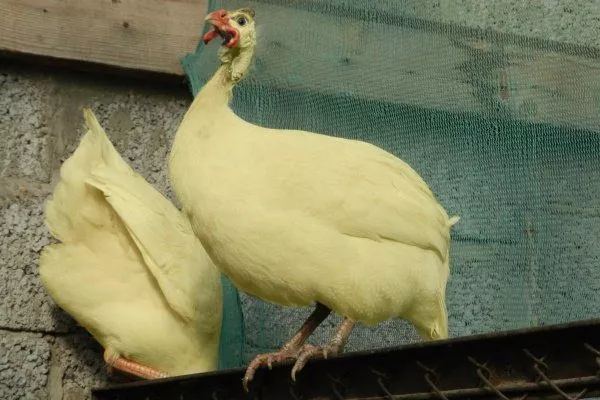
Cream (suede)
The bird's appearance is similar to the Siberian White, differing only in weight and body color. Suede guinea fowl are meat-producing birds, hence their name, broiler guinea fowl. The breed was accidentally created through a mutation of a speckled gray bird.
Appearance:
- the overall size of the guinea fowl is small;
- small head;
- white plumage with pigment spots.
The female reaches 1.7 kg of live weight, while the male weighs 1.6 kg. In one year, the bird can produce about 80 eggs, each weighing 43 grams. The shell can be either white or red. As for egg production, then they are inferior to white guinea fowl.
Cream-colored birds have a remarkable ability to quickly adapt to new habitats and changing weather conditions. They are resistant to virtually all diseases, both infectious and inflammatory.
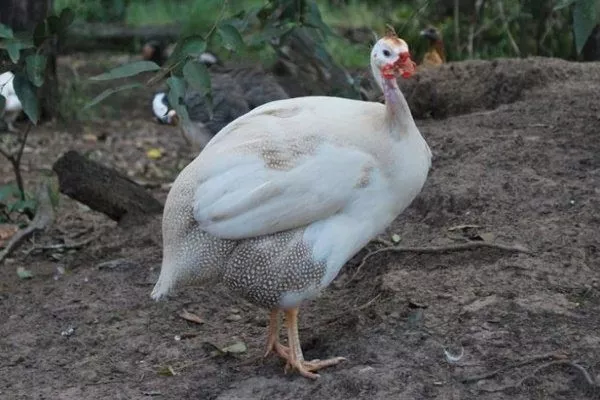
Blue lilac
In terms of bird productivity, the Blue Lilac is almost identical to the Blue variety. The only difference is in the outer coloring. The feathers are indigo with white spots, similar to those of the Blue Guinea Fowl. There is a large feathering on the chest and neck.
A mature female can weigh 2.4 kg, while a male can weigh 2.1 kg. A bird can produce approximately 140 eggs per year, but may lay more depending on care and feeding. The eggshell is hard, and each weighs 43 grams.
This type of guinea fowl doesn't require special attention and can be safely kept with other poultry. As for the chicks, they require special attention, more so than ducklings or hens.
The downside is that they can suddenly stop incubating for unknown reasons, so it's best to place the eggs in an incubator and nurse them there. If kept in cages, birds can't forage for food by wandering, so you'll need to take care of this yourself.
Guinea fowl are active birds, so they shouldn't be cramped. Their cages should be spacious and placed in a warm room. Drafts are avoided. These birds have strong immune systems and are generally unaffected by disease. If a bird does become ill, treatment must be taken seriously. First, the sick bird is separated from healthy birds, then treated, but if there is no improvement, it is slaughtered.
Guinea fowl love to graze, which helps save on feed. In addition to this, they need to be supplemented with compound feed and grain, which is essential for rapid weight gain. Like chickens, they also enjoy crushed shell rock, chalk, and river sand. While outside, they enjoy foraging for worms, mites, slugs, and Colorado beetles.
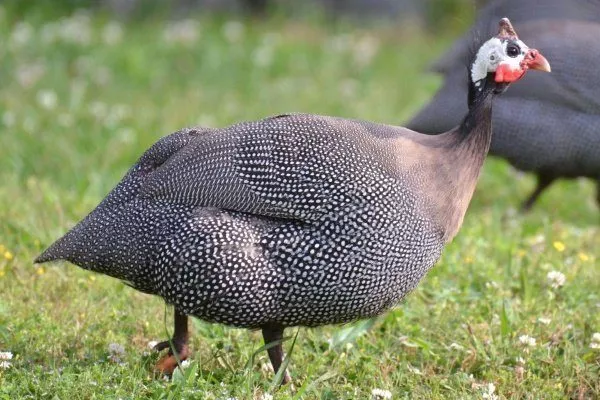
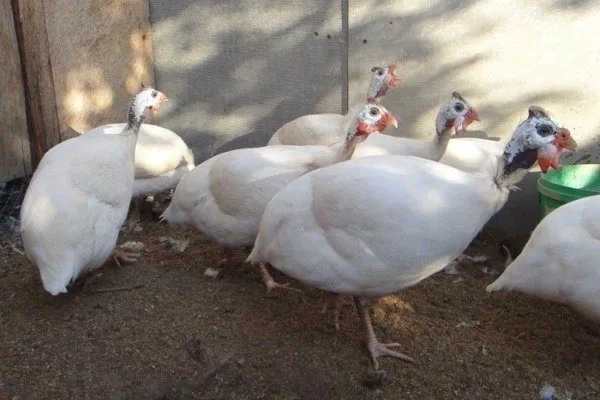
White
What makes this breed of guinea fowl distinctive is its pure white coloring, without any speckles. The wattles and beak have an ombre coloring—bright pink on top and white underneath. The tip of the head changes to gray. Males can reach a weight of 2 kg, while females weigh around 1.4 kg. A single guinea fowl can produce approximately 100 eggs per 12 months, each weighing 43 grams. The shell, like that of many breeds, is hard and light brown with small speckles.
Zagorsk white-breasted
Recently, a new breed of guinea fowl has emerged, known as the Zagorsk White-Breasted. This breed is a descendant of the gray-speckled breed. They have a flat yet high chest, with the females having a fleshier chest and the males having a pointed chest. The beak is powerful and curved downwards. The skin can be either dark blue or gray, depending on the color of the skin. The wings are large and long, and the tail is short. The birds' chests are white, hence their name.
This breed has light spots on its skin, but they are barely visible. The beak is yellow, and the legs are the same color. Young birds weigh 1 kg at 70 days of age. Guinea fowl can lay 115 to 120 pear-shaped eggs per season. They reach sexual maturity at 7.5 to 8 months. The meat has an attractive marketable appearance, and is tender and juicy.
Watch a video review of this breed of guinea fowl below:
Types of guinea fowl
In total, 5 species of guinea fowl are officially recognized in Russia, from which the above-described breeds are derived:
- Ordinary.
- Crested.
- Vulture.
- Dark white-bellied.
- Black dark.
| Object | Weight of an adult (kg) | Egg production (pieces/year) | Plumage color |
|---|---|---|---|
| Ordinary | 1.5 | 140 | Dark with white spots |
| Crested | 1.5 | 140 | Dark with white spots |
| Vulture | 1.5 | 140 | Bright with stripes |
| Dark white-bellied | 2.0 | 140 | Dark with spots |
| Black dark | 1.5 | 140 | Black |
Ordinary
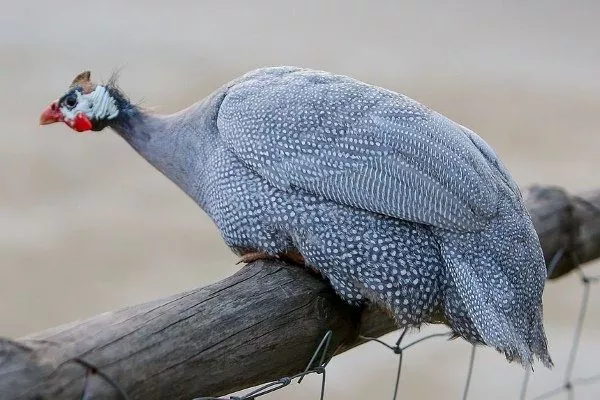
The guinea fowl got its name from the word "royal bird." It first lived in the royal court for show 2,000 years ago. Common guinea fowl inhabit dense, low-growing forests or forests with dense undergrowth and open clearings. The body length itself is 56 cm, and an adult weighs up to 1.5 kg.
The common guinea fowl can run fast and flap its wings rapidly, but it tires quickly and falls. Its wings are short. The birds breed in the fall, building their nests in holes under bushes or in high-growing shrubs.
The female lays about eight yellow-and-white eggs at a time. The chicks hatch 25 days after laying. Initially, the chicks don't fly far with their mother and father, but soon they leave their parents. Their main food is insects, as well as berries, leaves, sprouts, and grains. Over the course of 12 months, the bird can lay 140 tasty eggs.
Crested
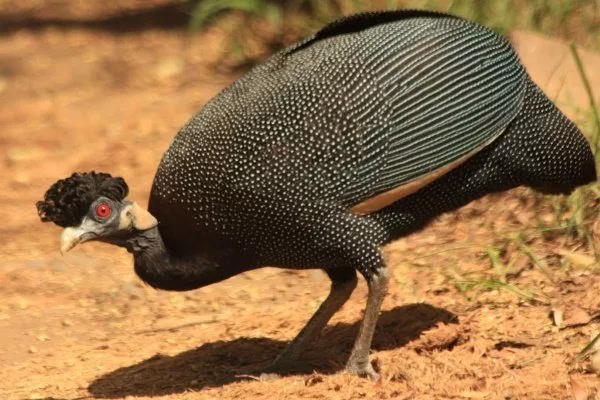
This species of bird has a crest, which gives it its name. This crest, made of curled black feathers, is visible even from a distance, making it difficult to recognize a crested guinea fowl.
Appearance of birds:
- the length of a grown guinea fowl is 50 cm;
- head is blue and featherless;
- the body weight of an adult reaches one and a half kilograms;
- the body is dark with white spots;
- the life expectancy of a bird is 10 years;
- females are larger than males.
The bird is omnivorous, so it is not difficult to create a diet, but there are still some preferences: dandelion, clover, lettuce leaves, snails, worms, beetles, seeds and various berries.
Vulture
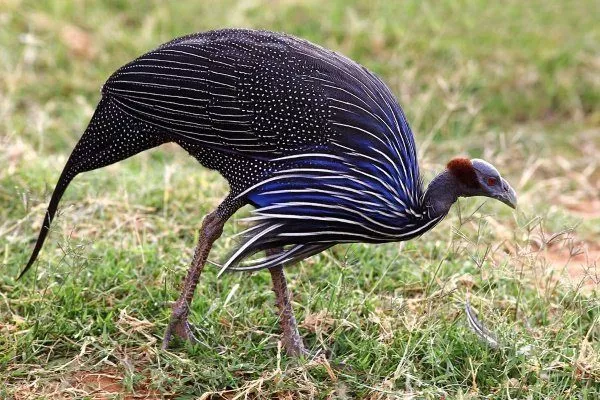
The bird is incredibly beautiful, with vibrant plumage. Vulture habitats:
- Kenya;
- Ethiopia;
- Somalia.
Guinea fowl eat and drink sparingly, and due to their harsh living conditions, they are resilient to any weather, able to withstand both harsh winters and intense heat. Guinea fowl reach a height of 45 cm, with a delicate blue plumage with white stripes. The feathers are lilac with a sheen.
The bird got its name because the vulture's head is shaped like that of this guinea fowl. Its head is featherless, with only a small downy frill visible on its neck. The upper part of its bill is longer than the lower part and more elongated.
Reproduction occurs naturally; a vulture can lay around 10 eggs at a time, which hatch after 24 days. Griffon vultures do not migrate individually, but travel in flocks in search of water. They are shy but do not conflict with other bird species.
Guinea fowl are excellent flyers, reaching distances of up to 480 meters. They feed on nuts and plants, but often forage in thickets. They also eat snails and various insects.
Dark white-bellied
This species has an interesting and unusual plumage pattern: small spots on the back and wings. The chest, neck, and belly are uniformly colored. The white-breasted bird has fluffy feathers, giving the plumage a lush appearance.
The meat tastes like chicken. The carcass is small: an adult female weighs 2 kg, and a male 1.7 kg.
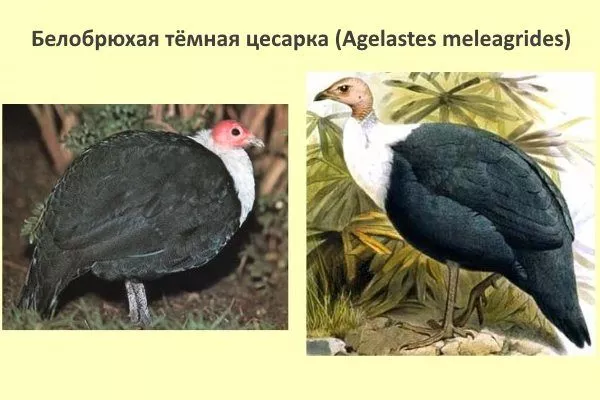
Black dark
There's very little information about the black guinea fowl, as it's not as popular for breeding as other breeds. They also live in the jungles of Africa. Their lifestyle, especially in domesticated settings, hasn't been fully studied. breeding guinea fowl, then this information was not mentioned anywhere.
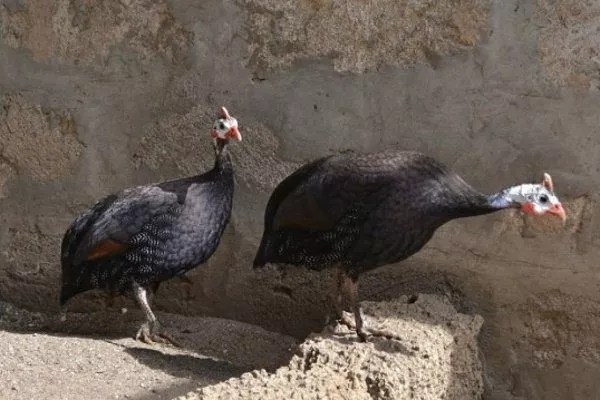
All guinea fowl species are primarily meat and egg producers, and their coats are dark with white spots. They resemble turkeys in appearance, but are smaller in size. Wild guinea fowl have not been domesticated, and they lack productive qualities. Their meat tastes like game. They live exclusively in large flocks of 25-30 individuals. All species have a virtually identical lifestyle.
Guinea fowl thrive in warmth and humidity, so they shouldn't be kept in cold climates. They're also shy, so keep them away from noise. They're good flyers, but prefer a quiet gait. Guinea fowl are the same size as domestic chickens, but their body type is different. They begin laying eggs at eight months, but not year-round. They lay for six months, and then not for the other six months.