
Many farmers note that raising guinea fowl is profitable if they are properly cared for and husbandry requirements are met. With proper care, guinea fowl can be strengthened and the birds' immunity can be increased, resulting in robust, productive birds.
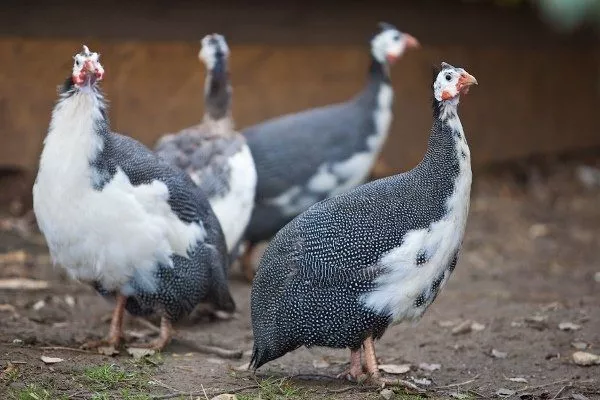
Growing area and walking area
If you have a small area, you'll need to artificially create conditions for the birds that are as close to their natural environment as possible. This will require:
- Build a special room. It is recommended to build the coop on a raised or sloping site. Install windows, glaze them, and cover the inside with wire mesh. Make a floor of planks, with bedding of peat, straw, or sawdust underneath. If housing a large flock, divide the room into sections using fine-mesh wire, securing the bottom edge to the boards to prevent birds from crawling underneath.
- Fence off a part of the garden where trees and shrubs grow. In the heat, the birds will be cool in the bushes, and they will also have the opportunity to feed on forage and insects.
- Enclose the area with a metal mesh fence. Birds can fly, and the net will not allow them to leave the area.
- Install drinking bowls and feeders inside. Guinea fowl should have free access to food and clean water.
- Install perches and nests. Perches are installed 40-50 cm above the floor. They are made of slightly rounded planks. The nests measure 40 x 30 x 30 cm. They are placed against the walls in a secluded corner. There is one nest per 6-8 birds.
- ✓ The groundwater level must be at least 1 meter from the surface to avoid flooding.
- ✓ Availability of natural protection from the wind (trees, shrubs) on the north side.
Not allowing birds outside can lead to health problems. Guinea fowl love freedom, and outdoor play is as important to them as food.
The designated walking areas depend on the number of individuals. They should have enough space to run freely and not jostle. A roof isn't necessary, but an awning would be helpful—it will provide protection from rain or the scorching sun.
Productivity
Guinea fowl are considered heavyweight birds. An adult hen weighs between 1.5 and 2 kg. However, feeding costs are modest, amounting to approximately 3-3.5 kg per 1 kg of weight gain. Egg production varies by variety. However, guinea fowl of any species generally produce no less than 90 and no more than 120 eggs. The average weight of an adult female ranges from 1.5-1.8 kg, while that of a male ranges from 1.8-2.1 kg.
In a small area, birds have little opportunity to run around and therefore lose weight. When fed only grass, guinea fowl lay 20% fewer eggs. Sometimes hens lay fewer eggs due to low temperatures in the coop or poor sanitary conditions in the housing. For these reasons, the barn should be kept at least 12 degrees Celsius. It's also important to regularly clean the barn, remove waste, and change the litter.
A decline in egg production is often caused by low feed nutritional value. Improving the nutritional quality of the feed and providing feed with a high content of valuable amino acids can help restore productivity.
Females reach sexual maturity at approximately 7-7.5 months. The egg-laying season can last from six months to a year. During this period, an average female lays up to 90 eggs.
Read more about the factors that influence a bird's egg production and what to do if guinea fowl stop laying eggs.Here.
Feeding and diet
Guinea fowl are not picky eaters and can consume carrots, fresh chopped grass, food scraps, beets, and potatoes. They are also fed mixed feed designed for chickens. Each bird should receive at least 50 grams of fresh greens per day. The main feed is given in quantities of up to 150 grams.
You can increase egg production by giving the birds water containing yeast.
During the egg-laying season, hens need to be fed calcium-rich feed or supplemented with crushed eggshells. Birds enjoy worms, snails, and some insects, which help fully meet their nutritional needs.
If your chickens are confined to a run, they should be fed regularly cooked fish scraps or chopped cooked meat. Guinea fowl are prone to destroying Colorado potato beetles without harming the crop. However, they should be kept away from cabbage, as they may peck at the heads.
Guinea fowl are fed three times a day. During feeding, the birds must have access to fresh, cold water; in winter, the animals are given only warm liquids to drink.
Feeding young chicks is based on a completely different principle than feeding adult birds:
- Young birds need about 25% protein in their feed, while older birds should have about 15-20% protein. Chicks need green, succulent feed.
- When the chicks are seven days old, young, fresh, chopped grass is introduced into their diet. Clover, cabbage, alfalfa, dandelions, and wild grains are also recommended.
- The diet should be balanced. It should include not only greens but also specialized feed, corn, wheat, and millet. It's advisable to provide young animals with powdered milk and cottage cheese.
- ✓ The ratio of proteins, fats and carbohydrates should be 25:5:70 in the first weeks of life.
- ✓ Mandatory inclusion of vitamin complexes to prevent rickets.
The diet of guinea fowl should include crushed chalk, crushed shells, coarse-grained washed river sand, and crushed eggshells.
Reproduction of guinea fowl
Guinea fowl have a poorly developed maternal instinct and do not incubate eggs. Only a few breeds can incubate eggs, and even these are often met with negative reviews from breeders. Therefore, raising guinea fowl requires an incubator and a brooder.
Although guinea fowl aren't particularly good at brooding eggs, breeding them is usually straightforward. With an incubator and minimal care for the young, you can create a new, healthy flock.
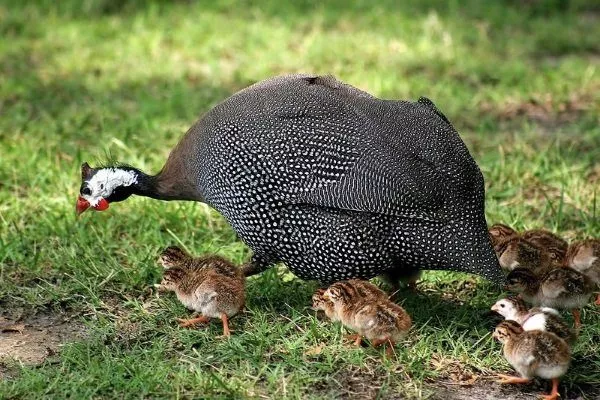
Hatching in an incubator is carried out under strict control. After hatching, the chicks are immediately transferred to a brooder. Keeping the birds in a brooder requires following certain rules:
- There are no more than 15 individuals per 1 square meter.
- The brooder temperature should be around 28 degrees Celsius. Starting 14 days after birth, the temperature is reduced by 1 degree daily until it reaches the optimal temperature for the external environment.
- Daylight hours for up to one month of age are at least 20 hours. When the chicks are five weeks old, daylight hours are reduced to 16 hours.
- Guinea fowl are allowed out for walks no earlier than 40 days after birth.
Adult hens may become aggressive toward new birds in their flock. For this reason, it is recommended to breed birds separately to avoid mixing birds of different ages within a single flock.
Features of natural incubation
Guinea fowl are reluctant to lay eggs in nests, but nest placement in secluded, darkened areas of the house, using nesting boxes, can increase the likelihood of laying eggs. Nest boxes should be spaced at a ratio of 1 per 6 birds, with multiple tiers permitted, as the birds are capable of flight. Ideally, nest boxes should be 30 x 40 cm in size.
A gregarious bird may choose one nest and lay its entire flock there, ignoring other nests. Or, conversely, it may lay eggs in a corner, ignoring the nests.
Caring for young animals
Keeping young birds requires a dry, draft-free coop. Crowding and possible crowding can be avoided by loosely placing the birds. Newly hatched guinea fowl, like other chicks, require a great deal of warmth. Therefore, for the first five days, they are kept near a heater to maintain a temperature of 31-32 degrees Celsius. By the time they are 20 days old, the optimal temperature is considered to be 19-20 degrees Celsius.
A single broody hen can keep up to 16 guinea fowl warm, but the temperature in the coop cannot be neglected. A chicken over two months old requires 8-10 hours of daylight. To increase egg production, daylight hours are increased. However, reducing daylight hours is essential, as it impacts the bird's productive cycles and subsequent egg production.
Perches are essential, starting at two weeks of age. Ideally, they should be placed on slats 45-50 cm above the floor. This height will help keep the birds dry and clean, and their feathers will provide warmth.
How is the parent herd formed?
The parent flock consists of one male and several females. Distinguishing between males and females becomes challenging. They are similar in appearance, and only minor characteristics indicate they are males. Given that the rooster must be older, he is selected from among the chicks from the previous brood.
The search for a male in a flock begins with determining the weight of each bird. Females are typically heavier and larger. This is the first, but not the only, sign:
- Guinea fowl have an upright posture, a proud gait, and an elevated tail. Females, on the other hand, are almost always pecking and searching for food. While doing so, males constantly "talk," while females utter a modest "ooh."
- The head and bill structure of males and females differ. Females have a small, graceful bill, and their heads are always erect. Males have a thick bill with a prominent knob and a curved comb. The neck is short, and the head is elongated forward.
- Guinea fowl have delicate wattles beneath their beaks. Roosters have larger, fleshier wattles. As hens age, their wattles become larger.
- Volga White and Volga Cream Guinea fowl roosters have lighter plumage.
- To determine the sex, you need to carefully take the chick, carefully open the cloaca; if there is a small tubercle, it is a male.
| Method | Accuracy | Age of application |
|---|---|---|
| Visual inspection | 70% | From 3 months |
| Cloacal analysis | 95% | From day 1 |
After finding a male, 5-6 females, about 2 years old, are selected and given a run. Birds are not inclined to mate indoors. Once the breeding flock has been formed, the collected eggs are stored upright, with the blunt end facing the roof of the mouth. They must be clean, as dirt can clog the pores, which inhibits embryonic development. The clutch is collected before 12 noon.
If there's no broody hen among the guinea fowl, the eggs are placed in an incubator for 29 days, turning them regularly. Maintaining high humidity in the incubator will help minimize hatching losses.
Keeping guinea fowl in winter
Keeping poultry in winter requires a special approach. Birds thrive in an unheated coop, but need perches to keep them off the floor. Be sure to change the litter once a month and keep it dry.
The onset of cold weather is no reason to lock your birds in the coop and not let them out for a walk. Keeping the paths clear of snow is key, and your guinea fowl will be safe. In fact, their immunity improves with regular access to fresh air. If, for whatever reason, it's not possible to let your animals out for a walk, ensure the room is well-ventilated.
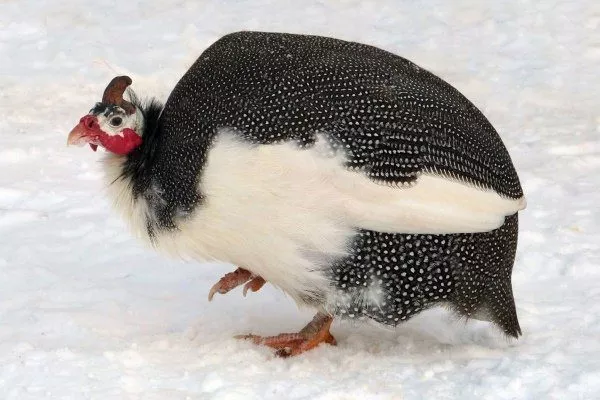
During the winter, farmers must ensure adequate nutrition. Chickens are fed twice a day, with wet mash, compound feed, and grain. Gravel, shells, chalk, and ash mixed with sand are placed in separate containers in the coop.
Poultry diseases, vaccination and treatment
Guinea fowl are considered to be resilient and disease-resistant birds, but this does not always protect them from certain diseases that usually arise due to poor housing conditions.
The table shows common diseases of guinea fowl and methods of combating them:
| Disease | Symptoms | Treatment/Prevention |
| Pasteurellosis | When sick, birds suffer from high fever, become lethargic, and inactive. They produce yellow, gray, or green droppings with bloody discharge. A mucous discharge appears from the nose. | There is no cure. Birds infected with pasteurellosis are culled. |
| Mycoplasmosis | Animals sneeze, wheeze, suffer from suffocation, fluid discharge from the nose, red eyes, and gastrointestinal upset. | The disease is treated with Streptomycin or Biomycin. For prevention, it is recommended to give young birds Enroxil or Baytril. |
| Trichomoniasis | The disease often affects young birds that consume contaminated feed or water contaminated with Trichomonas. It is accompanied by foamy, yellow diarrhea, loss of appetite, intense thirst, inactivity, and drooping wings. A mucous coating appears on the throat and crop, making it difficult to breathe and eat. | Cardinozol and Ipronidazole are used for treatment. All guinea fowl are given antihelminthic therapy. |
| Pullorosis | The bird becomes practically motionless, has poor spatial orientation, and its droppings become white or yellow. | Sick guinea fowl are culled, and the entire flock is treated with Penicillin or Biomycin. |
How long do guinea fowl grow before slaughter?
Guinea fowl gain weight much faster than hens. 3-3.5 kg of feed are consumed per 1 kg of weight gain. After reaching 3 months of age, they weigh an average of 1.1-1.3 kg. At this point, the birds are slaughtered. Muscle gain ceases by 5 months of age, with guinea fowl weighing around 1.5 kg and males approximately 2 kg.
Keeping Guinea Fowl: Pros and Cons
Guinea fowl farming has a few drawbacks, but the benefits far outweigh the disadvantages. It's especially important that raising birds is acceptable not only for personal consumption but also for business development. The advantages of this activity include:
- Guinea fowl lay large eggs almost all year round;
- It is permissible to let birds out for a walk near the vegetable garden: they do not damage the beds, but they cope with various insects that cause damage to crops; broilers can be sent for walking in special areas or in vegetable gardens, pastures, meadows;
- the birds get their own food and when it gets dark, they return home;
- Guinea fowl eggs have high nutritional value;
- birds have good health and increased resistance to adverse climatic conditions;
- Guinea fowl can establish contact with various farm animals; they are housed with chickens, geese, quails, etc.;
- birds do not require special feed or synthetic vitamins;
- adult chickens rarely get sick and are practically not susceptible to common diseases;
- Guinea fowl meat is dietary, tender, like turkey meat, but much better.
Farmers consider poultry meat particularly valuable – it's tender but not fatty. Its flavor is reminiscent of game. Guinea fowl meat is dark burgundy in color. The product contains minimal fat and moisture, has a high dry matter content, and is rich in amino acids, vitamins A and E, and iron.
The owner of a small home farm will talk about the pros and cons of raising guinea fowl in the following video:
Is the business profitable?
Guinea fowl breeding isn't particularly popular in Russia. Rarely do private farms choose to do so. broilers In small quantities for breeding for personal use. If a farmer decides to breed birds on a large scale, they have nothing to lose; on the contrary, they will only gain a significant profit, due to the fact that this niche is practically unoccupied in the market.
There are several advantages of this type of business:
- Guinea fowl eggs are very healthy. They are high in calories and do not cause allergic reactions. Eggs contain many vitamins.
- Guinea fowl adapt well to any conditions. The animals are unpretentious and do not require special equipment for maintenance.
- Minimum start-up costs. A 4-5 week old bird costs around 500 rubles, and the cost of an adult bird varies between 3-4 thousand rubles.
- Benefit for rural residents. Starting a guinea fowl farming business in rural areas is ideal, as there is a large workforce but few employment opportunities.
In addition to selling eggs and meat, farmers can also sell live birds, fertilized eggs for breeding, and guinea fowl feathers. This provides additional income.
Difficulties in breeding
Farmers who start breeding guinea fowl may encounter the following problems:
- breeding of young animals;
- lack of maternal instinct;
- females lay eggs not in a nest, but, for example, in a secluded corner.
Although the birds are undemanding in terms of food and living conditions, hatching young is difficult. This is primarily due to the collection of eggs, which the birds can lay anywhere in the run. Hens are considered poor brooders and can constantly abandon their eggs if frightened. Because of this, an incubator is often used for hatching.
Guinea fowl are easy-to-care-for birds, slightly shy, and occasionally aggressive. However, farmers speak highly of broilers, noting their good productivity, resistance to severe frosts, and robust health. Breeding them can become a primary source of income.