
Crested guinea fowl initially attracted poultry farmers with their striking appearance: the exotic bird is so striking that it was bred as a backyard ornament. But over time, breeding these birds became a profitable business, offering a source of delicious meat and eggs.
Historical data
Africans have been familiar with this exotic bird since ancient times—it's a treasured possession and a local delicacy. The indigenous people have learned to cook it deliciously. Traditionally, African families simmer the bird for an hour over low heat in the presence of all relatives to foster family unity.
Residents of African lands are generally familiar with all the specialties of this bird. For holidays, guinea fowl is prepared tied with a special rope made from a banana leaf. The bird is served garnished with fried eggs, pandan leaves, and peanuts. In the land of the natives, salads containing guinea fowl meat or eggs are equally popular.
Wild birds have been domesticated since ancient times. Exotic crested birds adapt well to any conditions. Guinea fowl lay eggs with hard shells.
Breed Description: Characteristics and Appearance
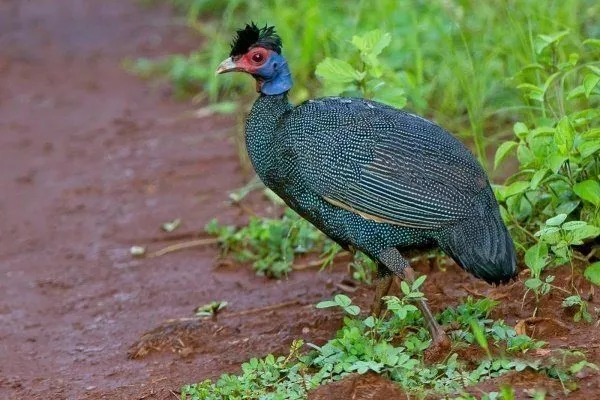
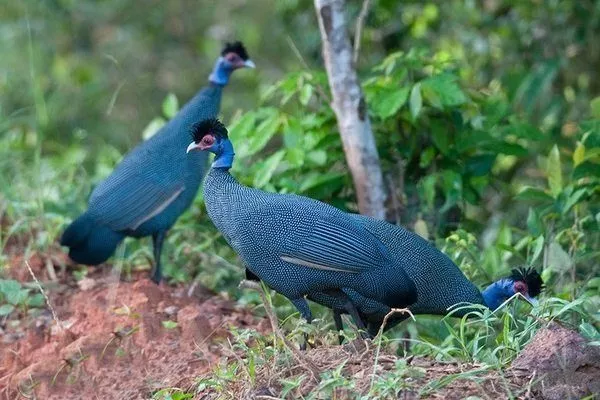
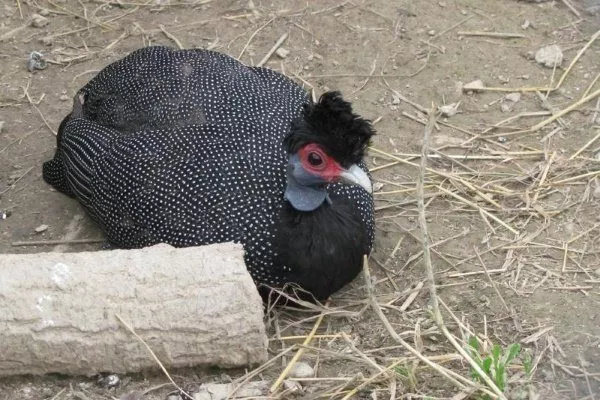
The distinctive feature of the crested guinea fowl is its small crest, which gives the bird its name. The crest consists of curly black feathers that are clearly visible even from a distance.
Guinea fowl range in length from 45 to 56 cm, have a small, blue head, and are featherless. Their dark bodies are marked with white spots. Males are much smaller than females, and can weigh up to 1.5 kilograms. Their average lifespan is 10 years.
Males have a distinctive feature: a thick beak. Furthermore, males are much more vocal than females, producing more intermittent calls with a slight crackling sound.
Where does the bird live (what is its range)?
This African bird does not like dense forests, so it prefers to settle in sparse habitats, and also lives in the savannah in the southern part of the Sahara.
Crested guinea fowl tend to live in flocks, which can contain 40-100 individuals. Guinea fowl constantly migrate in search of food. Due to the unique flavor of their meat, these birds are hunted by local people. Many specialized breeding centers also keep these birds.
The difference between females and males
Although male and female guinea fowl are similar in appearance, they have significant differences. Guinea fowl are larger than males. Males have larger beaks and growths. Both sexes have long projections under the beak (wattles), which are thicker in males.
Many people have noticed that males hold their heads and tails up, act proudly, and have a stately appearance. Females, however, appear much more modest.
Wildlife Nutrition
Crested bats are not picky eaters, enjoying fruits, berries, and plant seeds quite well. They also prefer to feed on various invertebrates, including insects, spiders, centipedes, small mollusks, and others.
Enemies of guinea fowl in nature
Guinea fowl suffer from predators in the wild. They have to fear attacks from various predators, including carnivorous birds native to Africa. They are also frequently attacked by large felines, such as servals. Guinea fowl are often hunted by poachers.
Reproduction
The wild crested guinea fowl is a monogamous bird, forming long-term pair bonds. In their habitat, the mating season occurs during the rainy season. Courtship displays begin with males offering gifts to the females—they bring them something "tasty" to win their attention.
Guinea fowl build their nests on the ground, hiding them well in dense vegetation. They lay 6 to 10 pear-shaped eggs with yellowish shells. Guinea fowl incubate the eggs for 28 days, practically never leaving the nest. The male remains nearby at all times, guarding and protecting the future offspring.
The parents care for the hatched offspring together. Almost immediately after hatching, the guinea fowl follow their mate everywhere, and after 12 days, they begin to flutter freely, sometimes even flying up into tall bushes. By the time the birds are one month old, their bodies are completely covered with feathers.
Domesticated crested guinea fowl become polygamous: in April, males mate with some females, while the majority remain unfertilized. Therefore, it's important to keep in mind that there should be no more than six females per male, and the male guinea fowl should be several months older.
Birds mate during long walks. In domestic guinea fowl egg production The breeding season lasts for six months. The farmer's main goal is to remove the eggs on time, otherwise the birds will stop laying and begin to sit on them.
Is it possible to keep a bird in captivity?
Like common chickens, crested guinea fowl can be kept in any room, but it must be bright and dry. Weather permitting, they are allowed out for a walk, and in the evening, all the birds return to their roosts in the coop. They reach sexual maturity at 6-7 months, provided certain husbandry requirements are met:
- maintaining an optimal humidity level – no more than 60%;
- the length of daylight hours is 16 hours;
- The optimal temperature in the poultry house is 14 degrees.
It is recommended to use sawdust, sand, peat, or wood shavings as bedding. These birds are also kept in cages, which must meet certain requirements. The recommended dimensions are 180 x 45 x 45 cm. Containers for collecting and disposing of bird droppings are mandatory. The cage should be divided into four nests.
The cage should be equipped with waterers, feeders, and egg trays. Each compartment should accommodate one family of birds: four females and one male.
Content Features
Guinea fowl are not fussy about their living conditions. Any room can be chosen for housing them, as long as it's dry and protected from direct sunlight. African guinea fowl enjoy being outside, so it's recommended to provide a designated area for them to enjoy the fresh air.
During intensive egg production, the temperature in the poultry house should be around 14 degrees Celsius. Daylight hours can be increased to 16 hours if necessary. Humidity should be kept low.
Farmers note that during the summer, guinea fowl begin to hide their eggs and attempt to incubate them. This should be avoided, and if you need to increase the number of birds, it's best to use an incubator. Guinea fowl lay eggs for about six months, sometimes longer.
There's no point in keeping birds for a second year, as their productivity drops significantly. A hen lays about 100-150 eggs per season. If a crested guinea fowl stops laying, it's best to dispose of her, as well as five-month-old males, if they're no longer needed in the flock.
Read more about the care and maintenance of guinea fowl here.
Home feeding
In the wild, crested guinea fowl consume insects, leaves, plant seeds, stems, and greenery from various vegetation. Their diet often includes animal food, usually small mice.
Guinea fowl prefer to nest near bodies of water—it's difficult for these birds to survive for long periods without water. However, if moisture is in short supply, the birds' bodies can absorb it from the food they consume.
At home, you can feed your chickens a wide variety of foods, including table scraps, potatoes, carrots, and chopped grass. In the first few days, it's best to feed chicks fresh cottage cheese, bran, and boiled eggs. Whey and milk are also beneficial.
Young birds must be fed at least eight times a day. As they mature, four times a day is sufficient. Guinea fowl have a good appetite thanks to their fast metabolism.
During the laying season, hens should receive additional protein-rich feed. In summer, they can forage for food on their own among the bushes in meadows, where there are plenty of greenery and fruits. Dandelions and burdock are considered the most nutritious. In agricultural fields, birds enjoy foraging for various weeds and seeds. Guinea fowl that are fed rich feed while out foraging often refuse to eat in the evening.
In winter, it is recommended to replace green fodder with hay dust and dry grass. Poultry farmers should also ensure that the birds have constant access to clean water. More information on proper feeding of guinea fowl can be found here. Here.
Breeding
Breeding crested guinea fowl at home is generally straightforward. However, a poultry farmer needs to know a few important details:
- fertilization of females occurs in the spring, more precisely in April;
- eggs laid in May are selected as incubation material;
- The chicks hatch 4 weeks after incubation, which is a week longer than with hens.
- ✓ Eggs must be fresh, no older than 7 days.
- ✓ The shell must be free of cracks and deformations.
- ✓ The egg weight must comply with breed standards (at least 45 g).
Guinea fowl are rarely good brooders; they don't tend to finish the job, so they may give up halfway through. Therefore, it's best to use an incubator for hatching chicks. Many farmers have learned from experience that this offers a better chance of increasing their guinea fowl population. Read more about incubating guinea fowl. Here.
You can read more about guinea fowl breeding here.
Caring for guinea fowl
Guinea fowl chicks are fully capable of independent survival after hatching. They only need a few hours to recover. One characteristic of day-old chicks is that they rarely get sick.
Their diet should include greens, garlic, chopped nettles, and green onions. It's important to provide the chicks with vitamin supplements during this period. The chicks are fed at least six times a day.
For up to two weeks, the young are kept in a separate enclosure, after which they can be released into the wild. Once free, the guinea fowl may wander quite far from the house, but they will always return in the evening.
It's not advisable to introduce young birds to adult guinea fowl, as they will inevitably be bullied. It will take a long time for the adult birds to recognize the young.
Benefits for humans
Guinea fowl are a useful bird for humans and are commonly used in farming. Even in ancient Greece, it was common to use guinea fowl to help humans. The birds hunted insects and fed on virtually any scraps. The same thing happens today.
Guinea fowl are considered easy-to-care-for birds, with leaner meat than chicken. Breeding them is also inexpensive and straightforward, even if you're starting a poultry farming business in a rural area. These animals offer numerous advantages. Besides being attractive, they provide their owners with fresh, nutritious meat and healthy eggs.
The crested guinea fowl is a useful bird native to African forests. It is considered a close relative of the common chicken. Guinea fowl are used for breeding because of their undeniable benefits to humans. Proper housing and care will ensure the birds' robust health.