
Because guinea fowl are poor brooders and their maternal instincts leave much to be desired, farmers prefer to hatch chicks using an incubator. However, this process requires a responsible approach, as improper temperature or humidity control can ruin all your efforts.
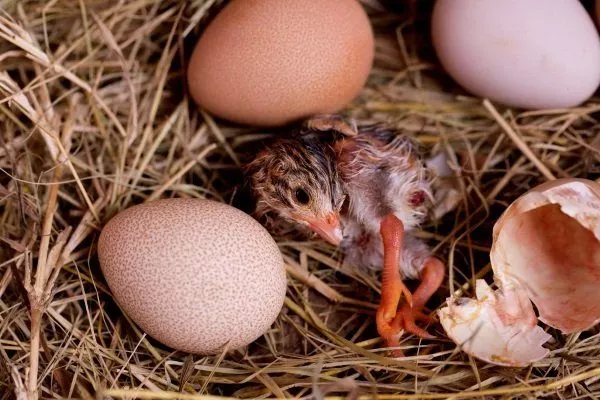
Basic requirements
There are a number of specific requirements that must be met during incubation. Initially, it's important to know how to select the right eggs, as not all are suitable for hatching. There are also certain requirements for the incubator.
Egg quality
Guinea fowl normally lay eggs for six months, but if provided with good lighting and a constant temperature, this period can be extended to 8-9 months. 70-80% of eggs hatch, and they fall into several categories: small, medium, and large.
The main requirement is to select eggs of a uniform size. This means you can't incubate medium and large eggs, or small and medium eggs at the same time. Other requirements are practically the same as those for raising other birds:
- Select intact and pre-disinfected eggs. Farmers typically use a quartz lamp for irradiation. At home, a weak solution of potassium permanganate or an alcohol-based iodine solution can be used. After this procedure, rinse the eggs with warm water and wipe them dry. Collect the eggs in the morning before 10-11 a.m. Criteria for selecting eggs for incubation
Criterion Description Form Pear-shaped, with a pointed end Size Same for all eggs in a batch Shell No defects, growths, or damage Internal content One yolk, no blood impurities Weight Not less than 35 g - Eggs must meet the standard: be pear-shaped, have a pointed end, and be free of unevenness and defects.
- Immediately upon placing the eggs in the incubator, it is necessary to first keep them at room temperature (for several hours) - this promotes gradual heating.
- Eggs are collected only from females that are at least one year old. For this reason, egg collection does not begin until May.
- It's best to choose eggs that your guinea fowl lays no earlier than three weeks after laying. This is because early eggs are often infertile.
- Eggs are selected based on typical criteria: very small and excessively large ones are set aside. The presence of an embryo in the egg can be determined using an ovoscope.
Incubator requirements
The eggs must be maintained at the correct temperature and humidity levels for 28 days. Even the slightest deviation from the schedule can cause the embryo to freeze. The power supply must be equipped with a battery that will switch over to the mains supply in the event of a power outage.
Humidity in the chamber must be maintained by an evaporator and automatic controls, and wet- and dry-bulb thermometer readings must be monitored. The incubator must also be protected from overheating. Even a one-minute temperature increase can kill the entire brood. Regular air exchange in the thermostat is essential; it has holes to ensure air circulation.
During incubation, each guinea fowl egg produces 3.5 liters of carbon dioxide and absorbs 4 liters of oxygen. If the incubator features automatic egg tray turning, the poultry farmer must ensure that the trays are placed with the blunt end facing up. When manually turning the eggs, they are placed sideways.
Which eggs are unsuitable?
Before placing eggs in the incubator, the farmer must carefully inspect and check them. Not all eggs are suitable for incubation. The following eggs are not considered "safe":
- weight less than 35 g;
- there is contamination;
- there are defects, growths, damage on the shell;
- there are two yolks inside;
- When viewed through the X-ray, blood impurities are visible inside.
Suitable eggs are stored in a cool, dark place at the correct temperature and humidity. Rejected eggs are not placed in the incubator.
How to prepare incubation material for laying?
The incubator must be installed in a room with a constant temperature of at least 20°C (68°F). Several hours before setting, the eggs should be left in the room where the equipment is located. Before placing the eggs in the incubator, warm it to 38°C (100°F).
Many poultry farmers note that it's better to choose incubators with automatic egg turning. If this feature isn't available, that's okay; you'll just have to spend a little time turning the eggs manually. For convenience, it's recommended to label the eggs. It's also a good idea to draw up a chart with notes on egg turning. After setting the eggs, they shouldn't be touched for 12 hours. This means the first time the eggs are turned is half a day after they're placed in the incubator.
The eggs are then turned six times a day to prevent the embryos from sticking to the shell. This ensures uniform heating throughout the eggs, significantly increasing hatchability and the percentage of healthy chicks.
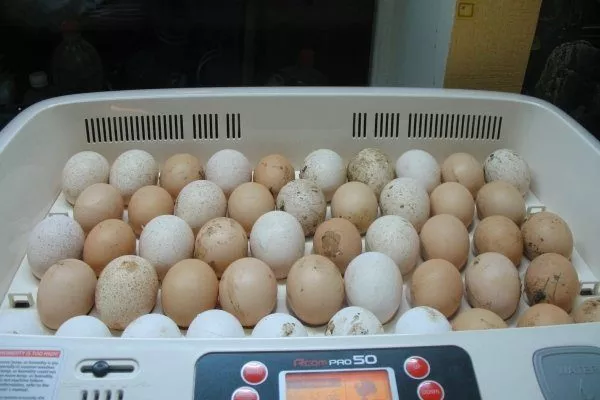
You can set eggs at any time of day, but experienced poultry farmers recommend doing so in the evening. Before setting, be sure to sort the eggs by weight. Each group, depending on their size, is placed in separate trays.
Incubation modes
To ensure successful incubation, it's essential to establish the correct temperature and humidity conditions from the very first hours. For the first few weeks, the incubator temperature should be 37.8 degrees Celsius, with a humidity of 60%. If the incubator doesn't have automatic humidity control, a container of water can be placed inside.
On the sixth day, begin cooling the eggs. To do this, lift the incubator lid once a day and leave it open for 5-6 minutes. Two weeks after setting, reduce the temperature by two degrees. Humidity should be kept at 50%. Continue turning the eggs at least six times a day. Open the lid for 10 minutes at a time.
Three days before the end date, stop turning the eggs, but the temperature and humidity should remain the same as when they were first set. Do not open the incubator lid.
The table shows in detail at what time, what the temperature and humidity should be:
| Term | Temperature | Humidity level | Number of coups | Ventilation |
| from day 1 to day 2 | 38 degrees | 65% | 6 | — |
| from day 3 to day 14 | 37.5 degrees | 60% | 4 | 5-6 minutes |
| from the 15th to the 23rd day | 37.5 degrees | 55% | 3 | 10 minutes |
| from day 24 to day 25 | 38 degrees | 65% | — | — |
| from day 26 to day 28 | 37 degrees | 68% | — | 7 minutes |
Compliance with all conditions will ensure the health and well-development of the young. This process must be approached with the utmost care.
Checking embryo development and candling eggs
During the incubation period, guinea fowl embryos must be checked and their development monitored at least four times. It's important to promptly discard unsuitable eggs if the embryo has frozen. This will prevent rotting, shell cracking, and the release of infected material. The embryos are first checked on the eighth day after hatching. This is when the embryo's first stage of development ends.
- Conduct the first ovoscopy on the 8th day.
- The second ovoscopy should be performed on the 15th day.
- The third ovoscopy should be performed after 24 days.
- Remove eggs with frozen embryos after each check.
If no changes are detected during the first ovoscopy, then most likely the eggs were not fertilized and should be removed from the incubator.
During the first candling, it's important to assess the egg quality and the development of the embryo's circulatory system. When examining the egg, the blood vessels approaching the sharp end should be clearly visible; the embryo should not be visible. In this case, the egg will have a pink tint.
If the blood vessels are completely healthy, they won't be very visible, and they extend slightly beyond the center of the shell. This may indicate that the embryo's chances for normalization are not completely lost.
If the embryo is close to the shell, it may be developing poorly. The egg will be predominantly pale, with blood vessels barely visible and absent in the sharp part.
You can easily make an ovoscope yourself using a small cardboard box and a 60-watt light bulb, which is placed in the bottom of the box. Cut an oval-shaped hole in the lid of the box, slightly smaller than the size of an average egg.
The second candling is performed 15 days after the second stage of development is complete. Eggs with visible blood spots on an orange background are removed. The third candling is performed 24 days later. At this time, it is easy to see where embryos have died and where they are developing well. All eggs with frozen embryos should be removed from the incubator. After the first hatching occurs, sprinkle the eggs with water to increase humidity.
Step-by-step instructions for the entire process
Incubation is a painstaking process that requires adherence to certain rules. A poultry farmer must know how long eggs stay in the incubator and what to do during this period:
- Before transporting the incubation material, keep it in a cool room for a while to prevent condensation from forming on the eggs after the incubator is turned on. Otherwise, mold may form on the eggs, which will cause them to spoil. Eggs should be placed in a room with a temperature no higher than 12 degrees Celsius. There should be no drafts or direct sunlight.
- Eggs of the same size are placed on one tray, starting with the largest eggs. The laying process should take no more than four hours.
- The humidity in the incubator should be around 65%, and the temperature should be 37.8-38°C. Disinfection with formaldehyde vapor will ensure high-quality hatching of guinea fowl in the incubator.
- During the first days, the temperature should be maintained at 37.6 degrees, humidity at 60%.
- Incubation of guinea fowl eggs involves turning them three times a day. This ensures the eggs are supplied with the necessary nutrients.
- After a week, all eggs will need to be checked for embryos using an ovoscope. This will help to remove any embryos that have stopped developing or those containing bacteria.
In the following video, poultry farmer Elena Krylova shares her personal experience hatching guinea fowl in an incubator:
Ways to increase humidity levels
If a poultry farmer initially acquired an expensive, programmable incubator, he will not have any difficulty setting the desired humidity level, temperature, and number of egg turnings per day.
But if your incubator is older, you'll have to try a little harder. To increase humidity, we recommend misting the eggs. This is only possible if you have an external fan. However, misting requires opening the incubator.
If the model is semi-automatic and has a built-in fan, misting the eggs is dangerous, as water could enter the electrical system. In this case, it's essential to insulate the incubator, isolating it from the outside environment. However, raising the humidity to 80% is impossible.
Homemade incubators that lack an automatic humidity indicator calculate humidity using a table, taking into account the temperature difference between the dry and wet bulb thermometers. The wet bulb thermometer has a cloth wick wrapped around the bottom of the thermometer. The other end of the wick is immersed in a container of water.
If the incubator is large, you can increase the humidity by adding a container of hot water. However, this will also increase the temperature, which can negatively impact the chicks.
When do chicks appear after laying eggs?
On the 27th day, sometimes earlier, pecks may appear on the eggs. It will take about a day for the guinea fowl to fully develop and hatch. If there were no incubation irregularities, the hatching may be uniform. However, everything depends on the chicks' development; some may rise almost immediately and attempt to walk, while others may remain inactive and recover.
Chicks that try to run immediately after hatching should be caught and transferred to a brooder. Guinea fowl are active little creatures and can easily get caught in any opening and become stuck. Calm chicks should be left in the incubator for a while to gain strength.
Day-old chicks and their examination
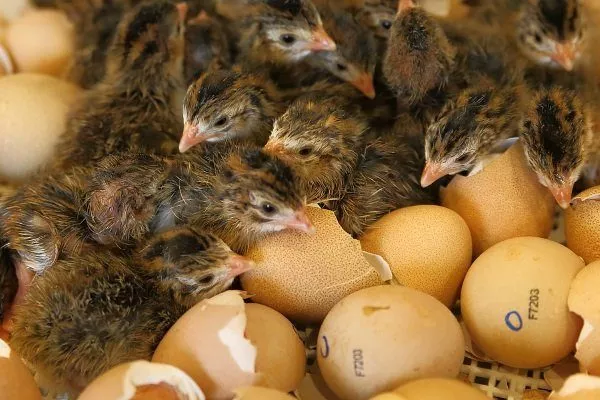
The hatching process itself occurs in several stages. When the chick breaks through the shell, it can often be seen, followed by a squeaking sound. The second stage is the complete hatching of the chick, which takes several hours. The weight of the chicks can be used to accurately estimate the approximate weight of the egg:
| Weight of the chick | Egg weight |
| 38-40 g | 23-27 g |
| 41-43 g | 27-29 g |
| 44-46 g | 30-32 g |
| 47-55 g | 33-35 g |
It is considered normal for a chick to lose 14-15% of its weight during the entire incubation period.
To objectively evaluate a chick after hatching, it's necessary to wait 12-24 hours. A healthy chick is usually alert and active, and has a good appearance. These chicks have a clear, lively gaze, bright, slightly bulging eyes, a fully retracted umbilical cord, and bright orange feet. Healthy guinea fowl have a soft belly and a body covered in soft, shimmering down.
Transferring the chicks to the brooder is permitted only after they are completely dry. It's important to immediately select the strongest guinea fowl and discard any weak or sickly chicks. It's believed that the healthiest chicks are born within 17-20 hours of hatching.
Selecting chicks to start a flock
The larger the eggs were when placed in the incubator, the stronger the offspring will be. Guinea fowl are removed from the brooder for rearing after 8-12 hours of hatching. At this point, a typical chick can stand firmly on its feet and respond to taps on the box. The strongest chicks are retained to form the parent flock and continue the family line.
A healthy chick production rate of 60-65% of all eggs set in the incubator is considered normal. Optimal hatch rates are achieved when setting eggs from birds that are around two years old.
Is it possible to speed up the process of hatching guinea fowl?
Beginning poultry farmers are interested not only in the timing of guinea fowl egg incubation but also in the possibility of accelerating hatching. Generally, guinea fowl egg incubation lasts 27-28 days. If everything is done correctly, all chicks should be born on the 28th day after placing the eggs in the incubator. High humidity can delay embryo development.
As for whether it's possible to speed up the hatching process, the answer is a resounding no. The first chicks won't hatch until at least the 27th day. To make it easier for the chicks to peck through the shell, lightly moisten it with water using a spray bottle—this will not only make it thinner but also softer.
Common mistakes made by beginning poultry farmers
Beginners who decide to hatch chicks in an incubator often encounter difficulties due to their inexperience. The most common mistakes in this process are:
- Incorrect turning of eggs. Often, poultry farmers leave long intervals between turning eggs, which causes the embryo to stick to the shell.
- Incorrect temperature determination. This could be due to the thermometer being placed in the wrong place. The thermometer should be level with the eggs.
- Lack of moisture. Guinea fowl are birds that prefer humidity. It's essential to closely monitor humidity levels. If necessary, mist the incubation material.
- Overheating of eggs. This can lead to the chicks hatching earlier than expected. This means the chicks will be born underdeveloped and, consequently, will have a short lifespan.
- Underheating of eggs. If the incubation material isn't properly warmed, the hatchlings will not only be born late but also have some abnormalities. There's also a risk of a reduced hatch rate.
Selecting high-quality eggs for incubation is a responsible process that requires the right approach. Incubation of guinea fowl eggs will result in healthy chicks if you properly monitor the embryos' development and carefully care for the young.