
The Scrub potato is a mid-season variety that is disease-resistant and easy to care for. However, to achieve high yields and avoid unfavorable conditions and pests, gardeners employ a few tricks. This helps ensure uniform, marketable tubers. This article provides detailed recommendations for growing Scrub potatoes.
History of the variety's origin
The Skarb potato was bred in Belarus by Z.A. Semenova, L.I. Pishchenko, E.G. Ryndina, and A.E. Zuykov. The breeders developed the variety at the Research Institute of Potato and Fruit and Vegetable Growing in 1997.
In 2002, the variety was officially included in the Russian state register. It was now permitted to import it into the country, grow it, and sell planting material. The tubers are best planted in the Ural, Volga-Vyatka, Central, and Northwestern regions of the Russian Federation. The Skarb potato is also popular in Belarus, Moldova, and Ukraine.
Description and characteristics
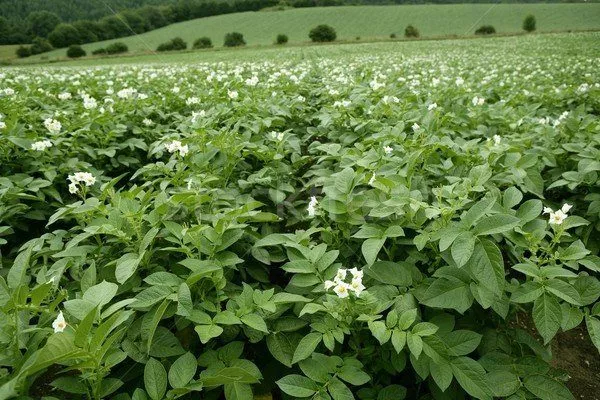
The Skarb variety is a mid-season variety. Ripening occurs within 80-90 days from the first shoots. The bushes are compact and medium-height. They are very strong and formed from thick shoots. The stems bear a few dark-green, oval-shaped leaves with smooth edges.
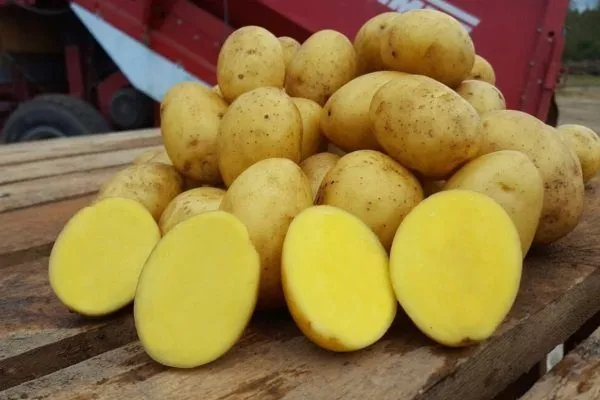
A distinctive feature of potatoes is their excellent taste. The root vegetable does not overcook or darken when cooked. The skin is light golden, smooth, and even. It has small, shallow eyes, evenly distributed over the entire surface.
Gardeners harvest 12-18 potatoes from a single plant. The average weight of a single tuber reaches up to 200 grams. A hectare yields 50-60 tons of potatoes. The potatoes are oval and resistant to mechanical damage. The flesh is bright yellow, tender, and uniform. Potatoes contain approximately 17% starch.
| Detailed characteristics of the variety | |
| Name | Treasures |
| Ripening period | 80-90 days |
| General characteristics | mid-season variety with good yield and excellent taste and marketable appearance |
| Productivity | up to 650 c/ha |
| Number of tubers in a bush | 18-20 |
| Weight of commercial tubers | up to 200 g |
| Starch content | 12-17% |
| Shelf life | 93% |
| Pulp color | yellow |
| Peel color | yellow |
| Disease resistance | The bushes are highly resistant to all major nightshade diseases. |
| Preferred growing regions | suitable for growing on all types of soil |
The plant is undemanding and can grow in areas with a wide range of climatic conditions. It tolerates drought well, but does not respond well to overwatering. This is especially dangerous if the plants receive too much moisture during the early stages of development.
Advantages and disadvantages
The Skarb potato variety has many advantages and disadvantages. Before planting, gardeners should always review these, taking into account all potential difficulties that may arise during cultivation and care:
| Pros | Cons |
|
|
Preparing for landing
Potatoes are best planted in sandy and sandy loam soils, as this variety produces the largest yields. Skarb potatoes do not tolerate stagnant water in the spring, so they are not recommended for growing in lowlands or on heavy clay soils. It is best to plant potatoes in well-lit areas, protected from northerly and easterly winds. Preferably, they should be planted in level areas or with a slight slope to the south or southwest.
- ✓ The site must be protected from northern and eastern winds, which is not mentioned in the article.
- ✓ The soil must be well-drained to avoid water stagnation, which is especially critical for the Scarb variety.
The planting field begins to be prepared in the fall. The variety prefers well-aerated soil. Gardeners dig the soil to the depth of a spade and turn it over. Before this, 200 grams of wood ash and 5-10 kg of manure or compost are spread per square meter of the plot. If organic fertilizer is unavailable and to save money, it is added to the planting holes in the spring (20 grams of ash and a handful of compost are required per plant). In the spring, after the soil has dried, the plot is loosened with a rake.
- In the fall, dig up the soil to the depth of a shovel blade, turning the layer over.
- Add 200 g of wood ash and 5-10 kg of manure or humus per square meter.
- In the spring, after the soil has dried out, the area is loosened with a rake.
Potato tubers are brought into a warm place 3-4 weeks before planting. Small potatoes are selected for seed in the fall. It is not recommended to use cut, large potatoes for planting, as this may delay sprouting.
It's important to inspect each potato, eliminating infected tubers or severely damaged roots. Treat the selected seeds with the following preparations as a preventative measure:
- copper sulfate (1 teaspoon per bucket of water);
- "Prestige" (dilute with water in a ratio of 1:20);
- "Hom" (40 g per 10 liters of water).
Place the seed potatoes in several layers in boxes or scatter them on the floor in a bright room with a temperature of 18-25 degrees Celsius. Turn the potatoes weekly and spray them with water to prevent them from wilting.
Planting potatoes
Potatoes are planted at a depth of 8-10 cm and spaced 30-35 cm apart. Leave at least 60 cm between rows for ease of care. Potatoes are planted by digging holes or trenches. Rows are arranged in a south-to-north direction to ensure optimal warmth and light exposure.
If the area hasn't been fertilized since fall, add organic matter, superphosphate, and potassium salt to each hole. Then, place the tubers sprout-side up in the holes or trenches and cover with a layer of soil.
Care
Once the first shoots appear, potato plantings require proper care, as the yield and quality of the root crops depend on this.
Loosening and weeding
During the growing season, the soil is loosened only three times, combined with weeding. About a week after planting, the potato bed is raked. This will eliminate young weeds.
Then, after the sprouts appear, the area between the rows is loosened again - this facilitates the access of water and air to the potato roots.
Watering
The Skarb potato variety requires adequate and thorough watering. This is especially important during the growing season and when tuber formation begins. Water the plants twice a week. Watering is stopped approximately two weeks before harvest.
Hilling
Hilling is the process of covering the lower part of the plant with fresh, loose soil. This can increase yields by 20%. Hilling is done early in the morning or in the evening after rain. The weather should be cloudy or overcast. This process lasts for the entire season. hilling of potatoes is carried out three times: after the seedlings reach a height of 10 cm, a few weeks after the first procedure, during flowering.
Hilling is essential for the better formation of new roots and tubers. It provides the soil with sufficient oxygen, which enhances root growth.
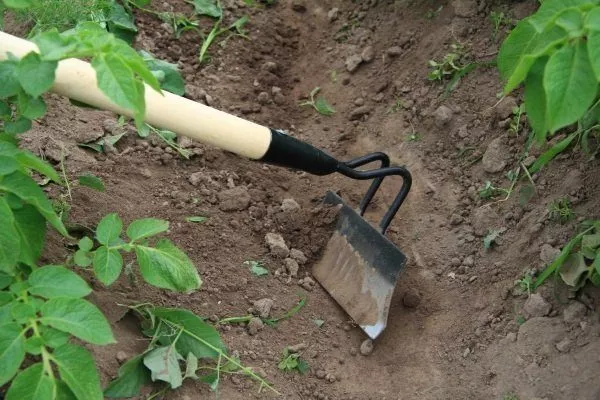
You might be interested to know how to make the process of hilling potatoes easier using manual hiller.
Top dressing
The above-ground portions of the plants are sprayed or fertilizer is added to the planting holes. This procedure is performed three times during the growing season:
- Formation of tops. Prepare a solution of 300 g of ash per 10 liters of water. Spray the plant. Alternatively, prepare an infusion from the weeds and water the plants with it.
- When buds are forming. Potatoes are watered with a solution of 60 g of ash and 20 g of potassium sulfate, diluted in 10 liters of water. This is enough for 1 square meter.
- During flowering. Apply 40 grams of superphosphate under each bush. The plants are also watered with a solution made from 40 grams of nitrophoska and 200 grams of mullein, diluted in 10 liters of water. 500 ml of fertilizer is required per plant.
When applying dry fertilizer, the bush is hilled. After watering or rain, the mixture will dissolve in the soil. Proper and timely fertilization increases potato yield and disease resistance.
Pest and disease control
The Skarb potato is highly resistant to certain diseases. However, it often encounters late blight, scab, and leaf curl. To avoid crop losses, gardeners use preventative measures and treatments:
| Disease | Symptoms | Prevention and treatment |
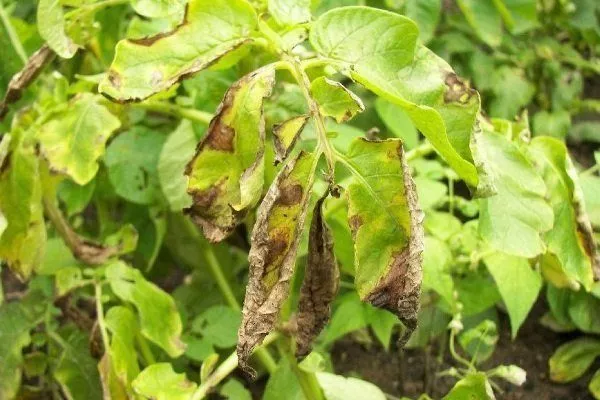
| Late blight | Dark spots appear on leaves and stems. Over time, the above-ground parts of the plants turn black and dry out. Brown, rough spots appear on the tubers. Potatoes should not be eaten. The disease spreads rapidly during rain and warm weather, or with artificial sprinklers.
During winter storage, the fungal disease may not manifest itself, but as soon as the tubers get into warm conditions, they will immediately begin to turn black. | It is important to observe crop rotation and not grow potatoes in the same area for more than three years in a row.
The seeds are inspected twice: before germination and before planting. If planting potatoes in the same area where the root crop suffered from late blight last season, pre-spray the young plants with a copper sulfate solution at a rate of 20 g per 10 liters of water. Repeat the treatment after 7-10 days. Fungicides are used for prevention and treatment:
Prevention is carried out during the budding period. Treatment begins at the first signs of disease. Repeat the procedure every 7-10 days. The final treatment is carried out 20 days before harvesting. In autumn, remove small tubers and tops from the field and burn them. |
| Common scab | The disease begins on the tubers, with ulcers enlarging and covering the entire surface. The flesh remains unchanged in appearance, but its flavor becomes less pleasant. Starch content decreases. During winter storage, infected tubers become susceptible to dry and wet rot. | Crop rotation is essential, as is the cultivation and plowing in of green manure crops such as lupine, mustard, vetch, and clover. Acidic fertilizers, such as ammonium sulfate (600 g per 100 square meters), are also used.
Gardeners should discard infected tubers and treat the remaining tubers with "Maxim" (4 g per 10 kg of potatoes) before planting. During the growth period, they should be treated with "Fito Plus" (1 packet per 3 liters of water). During the budding phase, spray the plants with the growth stimulant "Zircon" (13 drops per 10 liters of water). |
| Leaf curl | The lower leaves not only curl but also become stiff. The upper foliage becomes deformed. The plant appears weakened and limp. A cross-section of the tuber reveals reticular necrosis. Seeds take a long time to germinate, and the sprouts are thin. Yields drop by up to 50%. | Crop rotation and pest control are required.
It is important to provide the potatoes with proper care, creating the conditions that the variety requires (do not over-water, loosen the soil, and allow it to germinate for a long time). There's no point in fighting the disease with chemicals or biological treatments—they're ineffective. Diseased bushes are dug up and removed from the area. |
Harvesting and how to store it properly?
Fifteen to 20 days before harvest, stop watering the plants and mow down the above-ground portions, leaving short stems bare of green matter. The tops are collected and burned. Harvesting is recommended in warm, dry weather.
The potatoes must be thoroughly dried and sorted. Tubers with mechanical damage or roots showing signs of disease are set aside. The selected potatoes are placed in a dry room for several weeks to fully ripen.
Next, the tubers are transferred to a room where the air temperature is +2-5 degrees Celsius and the humidity is 80-85%. Potatoes for planting are placed in separate wooden boxes.
For more information on how to properly store potatoes for winter consumption or for planting tubers in the spring, look for here.
Feedback from farmers and gardeners
You can find many reviews of the Skarb potato variety online. Some are positive about it, while others believe there are other, more suitable varieties.
The "Skarb" potato earned its name for a reason; many consider it a true treasure. This variety is easy to care for, as long as all the important procedures are taken care of promptly. Furthermore, it yields an excellent harvest per hectare. The fruits have a long shelf life and can withstand long-distance transportation without losing their marketable appearance.