
The "Rodrigo" variety embodies all the qualities prized by vegetable growers and amateur gardeners. This mid-early variety boasts large tubers, high yields, and ease of cultivation. It is popular with both home gardeners and commercial potato farmers.
History of the variety's appearance
Rodrigo is a highly successful variety of German origin (often listed in catalogs as "Rodriga"). It was developed by Solana GmbH & Co. KG (Germany). Despite its European roots, the variety quickly took root in Russia.
Growing it proves particularly profitable in the Middle Volga region, where the favorable combination of soil and climate conditions allows the crop to achieve its maximum yield. However, "Rodrigo"'s fame isn't limited to the Volga region; gardeners from across Russia successfully grow German potatoes and rejoice in the harvest.
Advantages and disadvantages of the Rodrigo variety
This variety has deservedly become a favorite among our gardeners; it's hard to find an analogue that combines so many advantages:
- High yield. One bush produces up to ten large tubers. Up to 0.6 tons of root vegetables are harvested per hundred square meters, and about 200 tons per hectare.
- Large tubers. The average size of pink tubers is 200 g, which exceeds the average.
- High starch content – approximately 15%.
The higher the starch content in potatoes, the tastier and fluffier they will be after cooking.
- Tolerates transportation well. Safety after transportation – up to 90%.
- Low rejection rate during storageIf potatoes are provided with optimal conditions, culling will be no more than 5%. Even damaged tubers can be stored for a long time – they do not turn black or rot.
- Good resistance to diseases and pests. The variety has genetic resistance to fungal and viral diseases.
- Unpretentiousness to cultivation conditions – soil and weather conditions. It tolerates high temperatures and droughts.
- Maintains varietal characteristics for a long time – 6-7 years.
- The tubers are beautiful and taste excellent.The potatoes have an excellent marketable appearance, which is important for farms.
- Versatility – tubers are suitable for boiling, frying, adding to salads.
This variety has no drawbacks that would discourage cultivation. The only drawback that some might find undesirable is the premature spreading of the bush, which complicates hilling. However, this can actually be considered an advantage, as the thick foliage protects the root system from the scorching sun.
Description of the variety
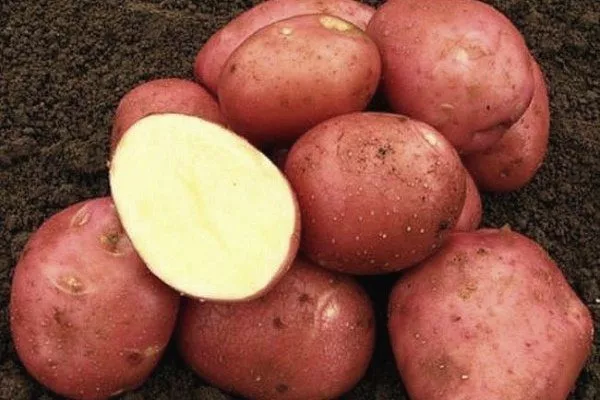
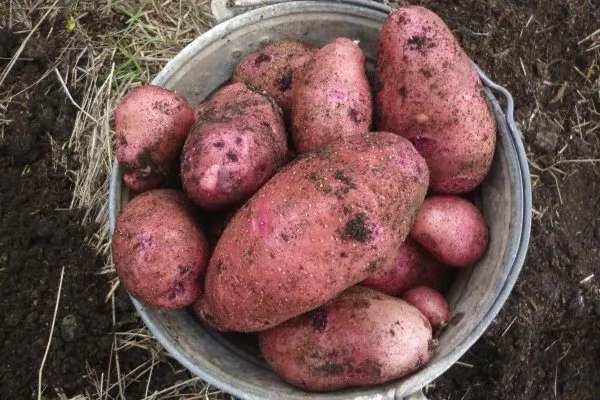
The skin of the 'Rodrigo' variety tubers is thin and easily peeled. Ripe fruits have a thick, dark pink skin. The tubers are very appetizing – smooth, pinkish, with a yellow center.
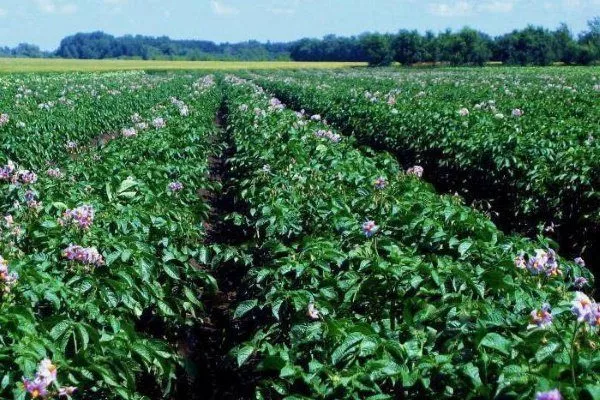
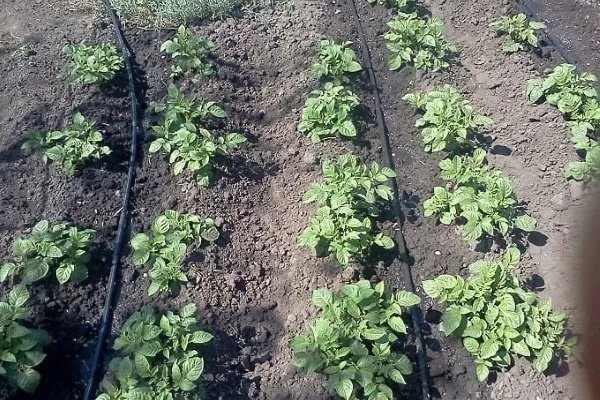
The eyes are small and smooth, making the tubers easy to peel. The bushes are spreading—a Rodrigo plantation looks like a green carpet, with its branches completely covering the surrounding soil. A bush typically has 3-5 shoots, initially spreading and vigorous, but drooping with age. The leaves are large, with wavy folds. Flowers are few during flowering. New potatoes can be harvested as early as 60-70 days after planting by digging under the bushes.
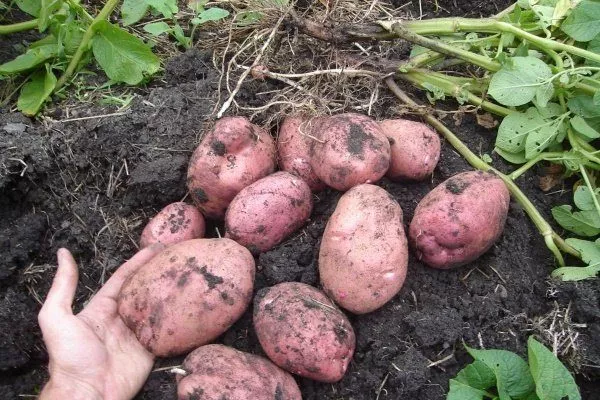
Root vegetables are stored after reaching technical maturity—at this point, they develop a firm skin and store well. Potato tubers, however, can be eaten earlier, when they reach the required maturity.
The main characteristics of the Rodrigo variety are summarized in Table 1.
Table 1
| Characteristic | Description |
| Ripening category | mid-early |
| Food accessories | dining room |
| Average/maximum weight of tubers, g | 200/800 |
| Ripening period, days | 70-85 |
| Starch, % | 13-15 |
| Number of tubers in a bush, pieces | 7-10 |
| Growing regions | Middle Volga, North Caucasus, Volga-Vyatka, Central and Far Eastern regions |
| Yield, c/ha | up to 450 |
| Features of cultivation | It is recommended to germinate |
| Shelf life (storage safety) | 95% |
| Tuber shape | oval-elongated |
| Peel color | pink |
| Pulp color | yellow |
| Bush height, m | 1.2 |
| Leaves | medium size, color - dark green |
| Flowering time | 90 days after planting |
| Flowers | purple-red color |
Comparison with other varieties
To evaluate this variety, let's compare some of its characteristics with popular competitors. Table 2 shows tuber weight and starch content, and Table 3 shows shelf life.
Table 2
| Variety | Starch content, % | Weight of tubers, g |
| Rodrigo | 13-15 | from 200 to 800 |
| Mozart | 14-17 | 100-140 |
| Grenada | 10-17 | 80-100 |
| Beauty | 15-19 | 250-300 |
| Aladdin | up to 21 | 100-185 |
| Lemon | 8-14 | 75-150 |
| Gala | 14-16 | 100-140 |
| Riviera | 12-16 | 100-180 |
| Innovator | up to 15 | 120-150 |
Table 3
| Name of the variety | Shelf life, % |
| Rodrigo | 95 |
| Ariel | 94 |
| Bryansk delicacy | 94 |
| Sheri | 91 |
| Cast iron pot | 95 |
| Serpanok | 94 |
| Elmundo | 97 |
| Milena | 95 |
| League | 93 |
| Queen Anne | 92 |
| Sifra | 94 |
About the taste of "Rodrigo"
This variety boasts excellent nutritional qualities. Today, in pursuit of weight, yield, and disease resistance, breeders often sacrifice nutritional and flavor characteristics. This new German variety stands out against this backdrop – its pink tubers are excellent in any form:
- boiled - do not overcook;
- puree – soft, airy, due to the high starch content;
- fried - does not fall apart when fried, holds its shape well.
How to choose a landing site?
The variety is demanding in terms of light—it requires plenty of sun. A lack of ultraviolet light negatively impacts the crop's appearance and yield—the shoots become thinner and the tubers shrink in size.
- ✓ The area must be well lit by the sun throughout the day.
- ✓ The soil should be loose and fertile, with good water permeability.
- ✓ Avoid areas with high groundwater levels.
When growing Rodrigo, the following crop rotation rules must be observed:
- You cannot use the same place for planting for more than 2-3 years in a row.
- It is undesirable for the predecessor to be a plant from the nightshade family.
- The variety grows well after corn, beets, spinach, radishes, and legumes.
Soil preparation
The Rodrigo potato can grow in any soil, but gardeners and farmers are interested in high productivity. To ensure high yields, it is necessary:
- Plant tubers in loose, fertile, well-drained soil. Heavy or sandy soils are unsuitable, as the tubers will not thrive.
- Before planting, amend the soil with humus or a complex mineral fertilizer. Dig over the soil, removing any remaining vegetation and weed roots.
- Ensure moderate soil acidity. Potatoes of any kind grow poorly in highly acidic soils. The ideal pH is between 5.5 and 7. If the soil is too acidic, add lime (slaked), chalk, or dolomite flour to the soil before tilling. Crushed eggshells also reduce acidity.
When growing, herbicides should not be used; they must be applied before planting or weeds must be removed manually.
Landing dates
It's important not to be late, but also not to rush the planting. Timing depends on climate conditions:
- In the southern regions, planting can begin from the last ten days of April until the beginning of May.
- In regions with harsh climates, the timing shifts by 2-3 weeks – for example, in the Volga-Vyatka region, planting takes place in mid- to late May.
When determining planting time, it's best to use average temperatures as a guide. Potatoes can be planted if the temperature has not dropped below 18°C for 5-7 days, and the soil at a depth of 8-10 cm has warmed to 10°C.
If you're confident you can protect your plantings in the event of frost, look for the birch leaves to emerge and the dandelions to bloom. Where frosts are common, don't rush – postpone planting. The safe period begins when the bird cherry blossoms have finished blooming and the lilacs have begun to bloom.
According to the lunar calendar, potatoes should be planted during the waning moon, close to the full moon. The worst time is the new moon and a few days before it.
If the weather is favorable, seedlings appear 8-14 days after planting; if it is cool outside, after 20 days.
Preparation of seed material
Preparations for sowing begin a month before the scheduled date. The timing may need to be adjusted if the weather is cool. For planting, select tubers the size of a chicken egg or slightly larger. Only healthy tubers are needed. To discard poor-quality seed, a urea solution is used to soak the tubers to be tested. The solution is prepared at a rate of 1.5 kg of urea per bucket of water. Any tubers that float to the surface are unsuitable for planting.
- Select tubers the size of a chicken egg or slightly larger.
- Testing tubers for suitability using a urea solution.
- Sprouting tubers in a warm, bright room.
- Treatment of tubers with bio-fungicides before planting.
The root vegetables selected for planting are placed in boxes in one or two layers. They are placed in a warm, well-lit room. The optimal temperature is 15°C. The seeds must be carefully monitored—if any rotten potatoes appear, they must be removed immediately.
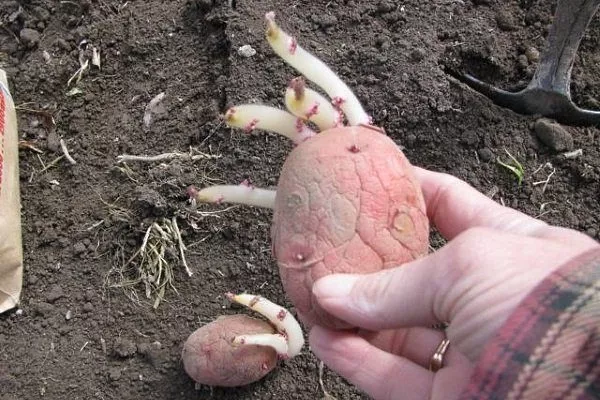
To prevent tubers from wrinkling, it is recommended to spray them with water every 3-4 days.
Root crops can be cut—this is done if there isn't enough seed material. What you need to know when planting tubers cut into pieces:
- cutting is done 7-8 days before planting;
- the cutting knife is treated with a solution of potassium permanganate;
- each cut piece should have at least 2-3 full-fledged sprouts;
- Before planting, the cuts are sprinkled with fine wood ash;
- Do not plant cut tubers in waterlogged soil.
It is recommended to treat the tubers with copper sulfate (1 tablespoon per 6-7 liters of water), a solution of potassium sulfate and superphosphate (a tablespoon per 12 liters of water).
It's recommended to treat tubers before planting. Their surface may harbor pathogens of various diseases. Biofungicides are used for this treatment:
- Fitosportin;
- Baksis;
- Binora;
- Planriz.
Planting seeds – diagram and depth
Features of planting potato tubers:
- recommended depth – 10 cm;
- traditional planting pattern – rows;
- to ensure that the rows are even, use the “cord” marking;
- using two pegs and a cord, mark rows at intervals of 70 cm and dig grooves;
- tubers or their parts are laid out in grooves at intervals of 30 cm;
- the cut parts are placed with the sprouts facing up;
- carefully fill the grooves with soil - the resulting mound is from 5-6 cm high (if the soil is heavy clay) to 10-12 cm (if the soil is light sandy);
- water and mulch the beds with peat chips or straw.
When planting, do not scatter fresh manure over the holes - it gives off heat, and the tubers will simply “burn.”
In damp areas, such as lowlands, ridges are made rather than furrows, 15-20 cm high. The interval remains the same: 70 cm. Tubers are planted at the top of the ridges.
Caring for potatoes
The Rodrigo variety is not demanding, but if you want to get a high yield—that is, make the most of your land, time, effort, and resources—you need to provide the planting with proper care.
Watering
Watering is not necessary when growing this variety—the plant is spreading, so the soil retains moisture for a long time. See Table 4 for watering recommendations.
Table 4
| Irrigation rates for the Rodrigo variety | |
| Depth of moistening, cm | 15-20 |
| Preferred methods | drip irrigation and sprinkling |
| Additional requirements | needs water during flowering - if there is no rain for 15-20 days and the weather is hot |
The plot should be regularly cleared of weeds. The crop also responds well to deep loosening. If the soil between the rows is compacted, it should be loosened to ensure good air access to the roots.
Hilling and mulching
Hilling – an important step when growing 'Rodrigo', which involves covering the lower parts of the bushes with moist, finely lumpy soil. See Table 5 for hilling instructions.
Table 5
| Features of hilling for the Rodrigo variety | |
| Number of hillings per season | 2-3 times |
| First hilling | after emergence |
| Second hilling | when the stems reach a height of 12-18 cm |
During the initial hilling, the emerging sprouts are completely covered with soil. It's a good idea to loosen the soil after each rain or watering—this will also remove weeds that thrive in damp soil.
You can read everything about soil mulching here. here.
Fertilizer and feeding
Fertilizers are applied to the soil in the fall. Potassium sulfate and urea are suitable, for example. The following fertilizers are applied per square meter of area:
- nitrogen – 25-30 g;
- potassium – 10-15 g.
The variety responds to any fertilizers:
- organic – you can fertilize the soil with urea or wood ash;
- mineral - superphosphate, potassium chloride, ammonium nitrate.
We recommend applying calcium nitrate to the roots. Fertilizing involves applying nutrients during the growing season. Three applications are recommended; fertilizer application rates are listed in Table 6.
Table 6
| Feeding number and time of application | Fertilizers applied per 10 liters of water |
| the first one is when the tops appeared | 500 ml of cow dung |
| the second is the middle of the growing season | 15 g of potassium sulfate or 1/2 cup of ash |
| the third - 20 days before collection | 30 g of superphosphate or 250 ml of manure |
Fertilizer application rate: 500 ml per plant. Fertilizing is recommended after soil moisture has been applied, either naturally or artificially. Fertilizer application rates are listed on the packaging.
Diseases and pests
The "Rodrigo" variety is virtually immune to disease—this is a genetic trait. It is resistant to nematodes, late blight, canker, and scab. The only insect that can seriously damage the crop is the Colorado potato beetle. To combat this insect, preventative treatment with special preparations is recommended:
- "Prestige";
- "Aktara";
- "Commander";
- "Regent";
- "Taboo";
- "Tanrek" and others.
Chemical treatments can be started no later than 15 days before harvest. Treatments are also limited during the flowering period.
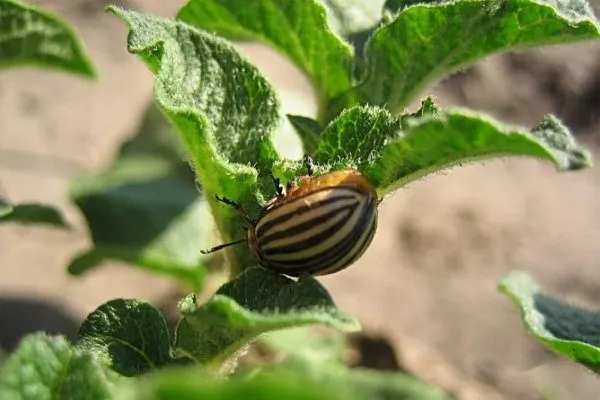
The most accessible method of protecting potatoes from pests is planting garlic and calendula between the rows.
Wireworms and mole crickets also interfere with normal growth of tubers and bushes. Among diseases, 'Rodrigo' may be susceptible to late blight. Late blight is one of the most serious plant diseases. It is caused by a fungus. Without preventative measures, you can lose half your harvest. Late blight is promoted by prolonged dampness. To prevent the disease, it is recommended:
- sprout the sprouts in advance;
- Treat the soil with copper sulfate mixed with lime.
Preventive measures against diseases and pests are presented in Table 7.
Table 7
| Name | Signs | Preventive measures | The essence of the struggle |
| Phytophthora | Dark brown spots on tubers and leaves. |
| Treatment with copper-containing preparations – as soon as the first signs appear on the leaves. |
| Colorado potato beetle | The foliage is eaten away. The leaves are covered with bright orange larvae and striped beetles. |
| As soon as the larvae appear, spray with a special preparation, including the back of the leaves. |
| Mole cricket | An insect that lives underground. Length: up to 8 cm. Damages roots and tubers. | Apply granulated Barguzin during planting. | |
| Wireworm (click beetle larva) | Hard, worm-like larvae that gnaw passages in tubers. |
Harvesting and storage rules
'Rodrigo' is a mid-early variety, so it shouldn't be kept in the ground for long—potatoes should be dug up as soon as the tops turn yellow and dry out.
Collection and storage features:
- Harvested tubers are dried for 24 hours. If long-term storage is planned, drying is extended to 2-3 days.
- After drying, the potatoes are cleaned of dirt.
- Tubers that are supposed to be planted in the spring are left to grow green for 5-7 days in the sun, and only then are they stored in the cellar.
- Clean potatoes are placed in a room under the following conditions:
- temperature – +3…+5°С;
- presence of ventilation;
- humidity – 75-85%.
- 'Rodrigo' can be stored alongside other potato varieties.
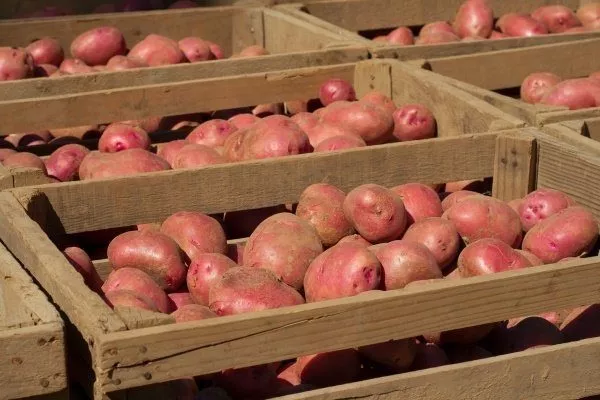
This variety doesn't require any special storage conditions. Store the tubers clean and dry, preferably in a cool, dark place.
- temperature – about 3°C;
- humidity – moderate;
- ventilation – regular.
'Rodrigo' keeps well until spring, and only begins to sprout just before the onset of warm weather.
Alternative growing methods
New ideas for growing potatoes often appear online. Many of them are met with disbelief. Let's explore whether it makes sense to use unusual techniques when growing productive varieties like 'Rodrigo.'
Growing from seeds
Seed producers spread rumors that potatoes need to be periodically “renewed” and “improved” by growing from seeds rather than from tubers.
However, propagation by seeds makes sense if:
- Selection work is underway to introduce new varieties;
- Planting material is grown for the rapid propagation of new varieties – this is done by specialized companies.
Varieties like 'Rodrigo' retain their varietal characteristics well, so replanting is not necessary. Regular crop rotation and proper selection of tubers for planting are all that is required to prevent variety degradation.
Disadvantages of seed propagation:
- Labor intensity. You have to grow seedlings, pick them, transplant them, and cover them with plastic. Neither experienced gardeners nor farmers will make such unnecessary sacrifices.
- Plants do not grow identical. If you collect seeds yourself, you cannot maintain the purity of the variety due to cross-pollination with varieties growing nearby.
- It is impossible to obtain marketable tubers immediately. In the first year, you can grow small tubers—these are called sets. To preserve them until spring, you need to create favorable conditions—they don't keep well.
- Doubtfulness. When purchasing seeds, there is no guarantee that a representative of the promised variety will grow.
Growing under straw
Another trendy method promoted online is growing under straw. This technique promises to free gardeners from digging and hilling, leaving them simply to harvest. While there's some truth to these promises, the proposed method also has its fair share of drawbacks.
Growing potatoes under straw was invented in the 19th century. The method was used in the northern regions and northwest Russia—areas with cool and rainy summers.
The method involves placing the tubers on the soil. Instead of soil, they are covered with hay or straw. The layer is 20 cm thick. When it rains, the lower layers begin to rot, creating a favorable environment for root growth. Disadvantages of the method:
- This creates a fire hazard situation – the method cannot be used near buildings.
- If the soil is heavy and clayey, the roots will not receive enough nutrition, and the tubers will grow to the size of nuts. Light, loose soil is needed.
- Tubers located on the soil surface can be eaten by mice, woodlice, snails, and slugs; hay or straw will not protect them.
- Weeds that are difficult to eradicate – sow thistle, couch grass, etc. – easily grow through the straw.
- The straw may be treated with poisons that will kill the sprouting shoots.
A gardener talks about growing the Rodrigue variety under straw:
More information on growing potatoes under straw – read here.
Reviews from gardeners
Judging by the reviews posted online, gardeners and farmers have rated Rodriga as:
- drought resistance;
- early ripening and size of tubers;
- stable yields, unpretentiousness and adaptability to almost any growing conditions;
- excellent taste and crispness when boiled;
- disease resistance and good keeping quality.
This variety from German breeders is worthy of the attention of our vegetable growers – it guarantees a harvest even under marginal conditions. And with proper care and crop rotation, maximum productivity can be achieved. "Rodrigo" is a reliable and productive variety that can be safely used even in risky farming areas.