
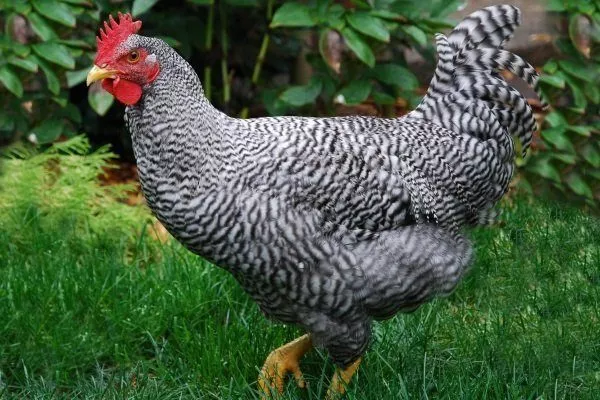
Amrox is an American chicken breed. Their ancestors were black Dominican, black Javanese, and Cochin chickens. This breed grows large, lays large eggs, and is easy to care for. In addition to excellent meat and egg production, these chickens have a beautiful appearance.
Description and standards of the breed
Amrox chickens are a medium-heavy breed, producing both meat and eggs. A hen can weigh up to 3 kg, and a rooster up to 4 kg live weight. Amrox chickens are excellent layers, as are their mothers. These birds have a lively temperament, but they can also get along well with other birds.
Rooster standards
The rooster's head is medium-sized, and its comb is large. Its short, yellow beak is slightly curved at the tip. The comb is red, erect, and simple in shape, with 5 to 6 teeth. When viewed from the side, the comb should form a smooth arch.
The earlobes are red, with medium-length, oval-shaped earrings. The earlobes are elongated with a smooth base. The eyes are large and dark red.
The neck is medium in length and fully feathered. The body is slightly raised, broad, and elongated. The chest is muscular and deep. The loin and back are wide. The body, neck, and tail curve smoothly upward. The back is level throughout, and near the loin, the line merges into the tail, which is carried vertically. The belly is full and wide.
The wings are held close to the body, medium in length, and broadly feathered. The legs are medium in length, with thick feathers on top. The metatarsus is yellow or pink with a stripe. The toes are rich yellow, with light-colored nails. The tail is carried at a 45-degree angle, wide, and of medium length.
Chicken standards
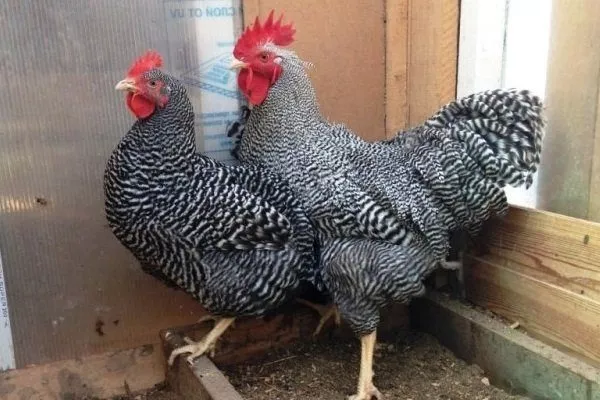
Amrox chickens differ from roosters in the following ways:
- wider and deeper body;
- the neck is thinner;
- the tail feathers barely protrude from the body with feathers;
- the beak is yellow with black stripes;
- metatarsus yellow.
Amrox chickens are exclusively cuckoo-colored, with either white or black stripes on their feathers. The feather pads are striped, with black tips. The stripes on the rooster are of equal width, while the black stripe on the hen is much wider.
History of origin
The breed itself originates from Germany, developed in the mid-20th century and only included in the standard in the 1950s. Amrox chickens are rare on poultry farms, as they breed fast-growing chickens (which is not the case with this breed), but they are well-suited as genetic material for crossbreeding and creating new breeds.
The new chicken breed soon became popular in Western Europe. Initially, this breed was favored by small farmers and those who kept their own farms. However, industrial chicken factories showed no interest.
Amrox Productivity
Amrox breed birds have a high survival rate:
- young animals 95%;
- mature age 92%.
They grow quickly, with hens reaching 2.5 kg and roosters 4 kg by six months of age. After that, growth slows, but continues until they are eighteen months old. Sexual maturity begins at six months, at which point egg-laying begins.
Hens begin laying their first eggs at six months of age. Initially, egg production is 220 eggs, but later, the number drops slightly to 180. The shell color is cream or light brown.
Amrox chickens have a dwarf variety. Adult males reach 1.3 kg, while females reach 1.2 kg. Annual egg production is 140 eggs.
Advantages and disadvantages
The advantages of the Amrox breed include the following:
- high productivity;
- rapid adaptation to weather conditions and new habitats;
- high survival and hatching rate (about 100%);
- high meat taste characteristics;
- Even roosters have a calm disposition.
As for the disadvantages, they are as follows:
- there is no proportionality in the broods; more cockerels are born than hens;
- There is a risk of early puberty; if egg laying begins early, the eggs will be small and of poor quality.
Exterior defects
The exterior defects of Amroxes include:
- beautiful skeleton;
- narrow or short body;
- narrow back;
- the chicken has an empty stomach;
- elongated and thin beak;
- small deep eyes;
- eye color any except dark red;
- short or, conversely, long legs;
- elongated toenails;
- rough scales;
- there is no black coloration on the tail feathers;
- there are no stripes on the fluff;
- very thin stripes on feathers;
- the presence of a different color on the feathers;
- low egg production;
- poor survival rate.
Culled birds are not used for breeding this breed of chicken—we're talking about factory-farmed birds. If culled birds end up on a farm, they aren't discarded, as the quality of their eggs and meat remains unchanged.
The character of the bird
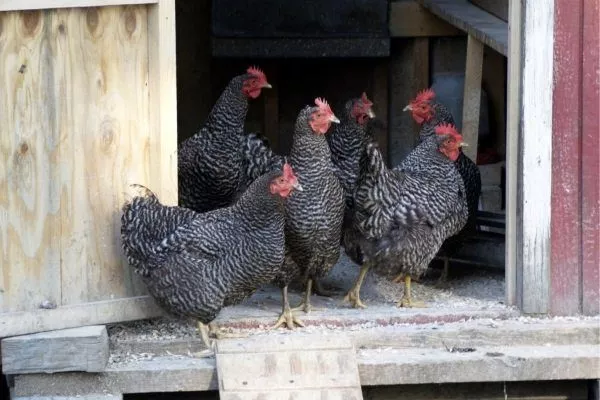
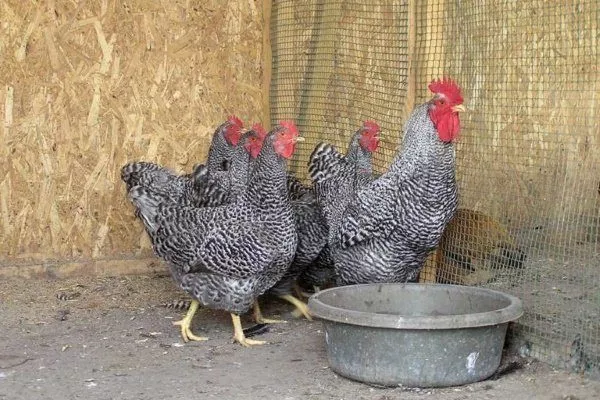
Amrox chickens are calm and peaceful, and do not exhibit aggression toward other birds or animals. Conflicts within the coop are extremely rare. Roosters are friendly toward their owners. Therefore, this breed is recommended for large households.
Maintenance and care
There are two options for raising poultry: free-range and indoor. In the first option, the chickens are kept outdoors all the time, while in the second, they are kept indoors. Free-range is, of course, preferable because they gain weight faster. The same applies to the quality of meat and eggs; free-range chickens contain more vitamins and other nutrients.
This chicken breed is not fussy and doesn't require much in terms of living conditions. It's important to know the following care guidelines:
- A chicken coop housing chicks and growing hens must be well-ventilated to prevent mold growth. Dryness is also important, as excessive humidity can be detrimental to the birds' health.
- The room should be filled with ample ash and sand, both summer and winter. Chickens bathe in this mixture, effectively combating parasites that infest their down.
- Amrox chickens need space, although they are friendly birds, but still, small premises are not suitable for keeping them.
- Birds do not tolerate cold well, so it is important that the chicken coop is warm at any time of the year.
- The room must be regularly cleaned, the bedding changed and ventilated.
- It is essential to disinfect the chicken coop by whitewashing the surfaces with peat and lime.
- Lighting should be controlled: turn on artificial light in the evening, and stay windowless during the day.
- An hour after eating, you should wash the feeders, and once a day, the drinkers.
- Before winter, the thickness of the bedding needs to be increased.
- ✓ Humidity levels should be maintained between 60-70% to prevent respiratory diseases.
- ✓ Temperature conditions: not lower than 16°C in winter and not higher than 20°C in summer to ensure the comfort of the birds.
Arrangement of premises
The coop can be built separately or occupy part of the farm building. It's recommended to install windows facing south in the Amrox chicken coop to save on lighting. The coop should be free of cracks and leaks. A duct is recommended for ventilation.
When building, the floors are raised by 35 cm to protect the birds from rodents and small predators. Additionally, thick boards of at least 20 mm thickness can be used.
The flooring can be made from:
- straw;
- peat;
- stones.
Next, set aside corners where feeders, waterers, and other equipment will be placed. Above, poles are installed for the birds to perch on, along with a ladder leading to the perch.
Since chickens dislike noise, the house should be built in a quiet location or soundproofed. This is especially true when hens are laying eggs, as they are very sensitive to various sounds. Stress can lead to a decrease in productivity.
The room temperature should not exceed 20°C or fall below 16°C. The room's dimensions are calculated based on the number of chickens. One square meter is required per chicken. A 2x10 m run for 10 chickens should be built near the coop. This area should be fenced with 1.5-meter-high mesh. This run should have plenty of grass and shelter from the sun and rain.
How to make a chicken coop with your own hands is written in this article.
Feeding
These chickens don't require any special nutrition, which is good for raising large numbers. Crushed grain and boiled, chopped eggs are suitable for the chicks. Millet can be fed instead of grain. When the chicks grow a little, chopped vegetables can be added to their diet. After a couple of months, you can introduce crushed corn, which is important for rapid growth. Feed them small but frequent meals, otherwise they may become obese, which is not good for them.
To quickly gain weight, chickens can be fed compound feed and other growth supplements. It's important to add the necessary vitamins to their diet. If the birds are free-ranging, they will obtain all their own nutrition. An adult chicken consumes approximately 150 grams of feed per day.
The table shows food varieties and feeding types.
| Feed | Products | Type of feeding |
| Corn | Millet (wheat), barley, oats, sometimes buckwheat | Wet mashes based on water or whey. In winter, fish broth |
| Legumes and vegetables | Potatoes with skins, carrots, beets, corn, and peas. Occasionally cabbage. | Served boiled and chopped together with mash |
| Green | Clover, dill, tops, nettle, dandelion | Give in crushed form along with grain or add to porridge |
| Protein | Fish dust, egg white, cottage cheese | Boiled and chopped with porridge |
| Supplements | Chalk, eggshells, bone meal, yeast, fish oil, salt, pebbles, gravel | In a separate container or together with mash |
During the egg-laying period, hens are supplemented with grain and calcium, and roosters are supplemented with protein. Learn more about proper feeding for laying hens – read here.
Breeding
Amrox chickens reproduce well, and there's no need to buy chicks every year, as they can hatch eggs themselves with a high survival rate. If you don't want to set a hen on the eggs and wait for the chicks to hatch, you can place the eggs in an incubator. The survival rate in this case is 80%. You can read more about incubating chicken eggs here. here.
While brooding, hens are provided with a nest made of a basket, wooden crate, or simple box. A thick layer of straw is placed on the bottom, but it must be soft. A ladder should be provided to allow the hens to easily reach it, as they cannot fly.
A hen incubates her eggs for 21 to 24 days, and it's important that she emerges to feed during this period. If she's reluctant, she needs help—carrying her to the food and then returning her. In the first few days after hatching, the chicks only need to be fed, and the new mother will handle the rest.
Chickens
The chicks have dense, tightly fitting plumage, a dark red color, and small white spots on their bellies. The chicks hatch from the hatching egg on time, weighing 40 grams. The weak chicks initially require acclimatization and adaptation to their new environment. This can take 10 to 12 hours. Then they should be fed, watered, and moved to their new habitat.
The advantage of this breed is that it is possible to distinguish between hens and cockerels within the first day and separate them by sex from the first days.
For the first three days, chicks should have constant light, then gradually reduce it to two hours a day, and then to five hours a day. Regularly changing the litter and keeping the room dry are essential.
Diseases and prevention
This chicken breed is virtually disease-free, but preventative measures are still a good idea. If infectious diseases are missed, parasites can infect them. Feather mites, fleas, and ticks can damage feathers, which can lead to bacterial and infectious diseases. Damaged feathers can also lead to hypothermia or, conversely, overheating.
| Method | Efficiency | Frequency of use |
|---|---|---|
| Ash baths | High | Weekly |
| Colloidal sulfur | Very high | As needed |
To prevent this, create ash baths and place them in a corner of the room, adding wood ash and sand in a ratio of 0.5:0. If your bird has mites, it's recommended to add colloidal sulfur to the bath.
To prevent infectious diseases, antibacterial agents, available at your veterinary pharmacy, should be used. It's also crucial to keep your pet up-to-date on all necessary vaccinations.
Molting and pause in egg laying
If there are no eggs in the nest in mid-autumn, don't panic right away. This indicates the onset of molting, which means no more eggs are laid. There's nothing to do about it, other than reduce daylight hours and feed the "unsightly" hens.
Exhibition preparation
For show chickens, it's important to carefully select hens: they should have clear, even stripes, a wattle, and yellow tarsi. Pay attention to the comb, which should be even, erect, and beautifully bright. The tail shouldn't be too long for show chickens.
If exposed to the sun for too long, the stripes begin to yellow, making these chickens unsuitable for show. For this reason, chickens should be kept in the shade before show time.
Prospects for breeding in Russia
This chicken breed is ideal for homesteads and small farms, as they are easy to care for and feed. Amrox chickens are especially suitable for beginning poultry farms.
This breed could also be used in large-scale farms, as productivity is quite high. However, poultry farms still prefer high-yielding layers and early maturing broilers.
Acquisition of the breed
It's best to purchase both Amrox hatching eggs and hatching eggs from specialized stores. They can be found online, picked up in-store, or delivered.
The most popular sellers are:
- LPH "Ryaba Chicken". Location: Moscow and Moscow region.
- Ecofarmer-Shop. Location: Saint Petersburg and Leningrad region.
- Zoomir. Location: Moscow and the region.
You can also buy good quality birds at shows. Don't risk buying chickens from someone, as there's a risk of defective or sick birds.
Hatching eggs cost between 60 and 100 rubles each. A day-old chick costs between 150 and 190 rubles. Young chicks are not cheap, as they cost between 1,500 and 2,000 rubles per chick.
Amrox chickens are ideal for those who need high-quality eggs and meat. Both beginners and experienced breeders can handle these birds. They can be both helpful additions to the family and a significant source of income through product sales.
Amrox reviews and breeder comments
Breeders' comments:
- Laying hens' feet become lighter as they age, as the pigment is used to form eggshells. Brightly colored feet are a reason to reject the hen.
- Some individuals like to lay eggs directly on the floor. During puberty, their behavior should be monitored, as they will rake the straw toward a specific location.
- The number of eggs decreases during frosts and extreme heat.
- The productivity of birds decreases after 2 years from birth.
- In summer, eggs become smaller, but their quantity increases. This can be corrected by adding protein to the diet.
- Eggs may have no shell or a thin shell. In this case, phosphorus and calcium should be added to the diet.
Below are reviews from real people about the Amrox chicken breed.
Amrox chickens are a profitable and enjoyable breed to keep on a homestead or small farm. It's important to be very careful when purchasing this breed, as you may be buying a mixed breed or sick bird. These chickens are easy to care for, maintain, and feed, making them suitable for even beginners.