
Siberian white guinea fowl are birds distinguished by their attractive appearance, excellent productivity, and low maintenance. Breeding this breed on your own property is considered both profitable and exciting. This article discusses the breed's characteristics and breeding requirements.
Origin of the breed
The breed's name itself suggests that the bird's homeland is Siberia. It originated in the city of Omsk. Initially, in Russia, these birds were considered ornamental animals, and their meat was not commonly used for food due to its dark color. Furthermore, guinea fowl's egg production was significantly lower than that of chickens, making breeding them completely unprofitable.
After World War II, several research institutes, including the All-Union Poultry Research Institute, the Institute of General Genetics of the USSR Academy of Sciences, the Siberian Scientific and Technical Institute, and the Siberian Research Institute of Agriculture, decided to breed Siberian White Guinea Fowl. The scientists wanted to develop a breed with light skin and high productivity. Some of them succeeded in achieving this goal.
The light color of the guinea fowl was recessive, meaning it didn't appear when crossed with other birds of normal color. Securing it required long and painstaking work, using birds with a delicate creamy-white hue, a natural mutation, for crossbreeding. The breed was officially registered in 1978.
Description and characteristics of the bird
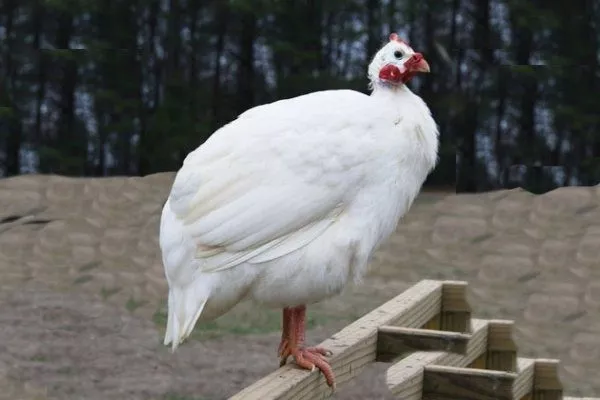
Siberian white guinea fowl differ from their gray-speckled relatives not only in plumage color. They have very light, pink-tinged legs and skin. In a sense, the birds are considered albinos.
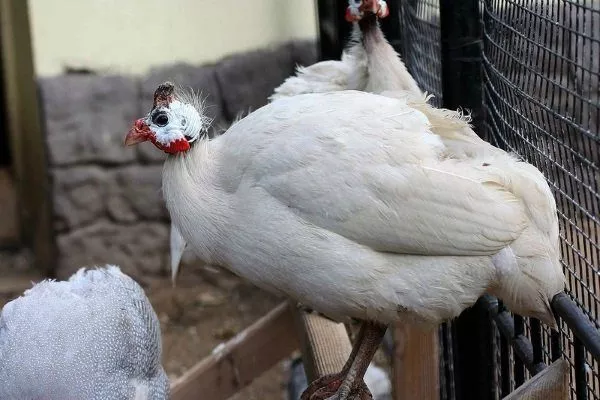
The birds have a small white head with blue speckles. A purple pouch (called a "beard") is located under the chin. Guinea fowl have large, dense, fleshy, pale pink wattles. The head is supported by a long, sparsely feathered neck. A distinctive feature is the small, gray bill, slightly curved downward at the tip.
The massive body rests on short legs with pale metatarsus. The body is elongated, reaching 45-50 centimeters in length. The chest is muscular and well-developed. The back flows smoothly into a short, inconspicuous tail, carried downwards. The Siberian guinea fowl has small wings that lie close to the body.
Productive qualities
The Siberian white guinea fowl is known for its excellent productivity. It is particularly renowned for its high egg production, as the number of eggs laid by other breeds bred in our country exceeds that of other breeds by more than 25%. Not only do the birds grow quickly, but they also gain weight rapidly.
A single female lays approximately 80-90, sometimes 100, eggs weighing 50 grams per year. Fertility is 75-90%. A weakness of the breed is the high mortality rate among chicks, reaching up to 47%.
The weight of an adult bird varies around 2 kilograms. At 2.5 months, a young guinea fowl weighs about 900 grams. During this time, it feeds on feed, consuming a little over 3 kilograms.
Siberian guinea fowl has tasty, nutritious, and tender meat. A guinea fowl carcass contains 10-15% more meat than a chicken. Guinea fowl meat is low in fat and high in iron, a deficiency of which can lead to decreased hemoglobin levels.
Character and lifestyle
Siberian guinea fowl are non-confrontational animals. Most breeders note a positive quality of Siberian guinea fowl – their calm and even temperament. These birds are able to coexist with other breeds and establish rapport with all other poultry inhabitants.
- ✓ Increased aggressiveness or, conversely, apathy.
- ✓ Refusal to eat or drink.
- ✓ Rapid breathing or wheezing.
Farmers note the bird's main drawback: its extreme timidity. Guinea fowl often react to extraneous noises and strangers, screaming and acting hysterically. The animals take a long time to get used to a new environment, react poorly to any changes in their living conditions, and dislike change.
The Siberian guinea fowl is hardly tame. If you try to pick it up, it transforms from a calm animal into an aggressive beast: it begins to struggle, hiss angrily, and even scratch. If the owner attempts to hold the bird by its feathers, it will not spare itself and will try to escape at all costs. This personality trait can negatively impact the hatching of eggs, which is why experienced breeders tend to use an incubator or laying hens for this purpose.
Care and maintenance
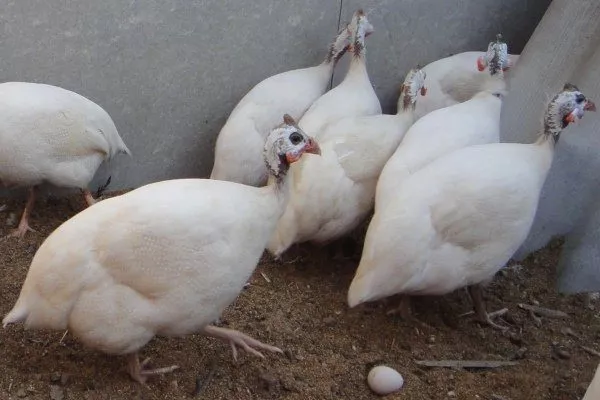
Siberian guinea fowl are considered unpretentious birds. They can survive in virtually any conditions. They have a calm disposition, are hardy, and resilient. They are not afraid of cold and temperature fluctuations, are undemanding in their diet, and can be kept outdoors, indoors, or even in cages. These and other qualities make this breed valuable to farmers.
You can also find the rules for caring for and keeping guinea fowl on our website – here.
Requirements for the premises
Any space is suitable for raising Siberian guinea fowl. In the summer, a simple barn can serve as a home for the birds, but for year-round winter keeping, a well-insulated chicken coop with all the necessary conditions is essential:
- To ensure that the birds survive the winter well, it is necessary to provide deep litter in the poultry house using hay, sawdust, peat or shavings.
- Install perches in the poultry house at a height of 50-70 cm from the floor. Per guinea fowl requires 25-30 cm of perch length.
- Birds usually choose secluded places to lay eggs, so installing nests is useless.
- A 30x30 cm hatch must be installed in the poultry house. It must open outward to allow the animal to freely escape, and to prevent the farmer from accidentally injuring the animals when opening the hatch.
A bath filled with wood ash or fine sand is placed in the poultry house. Bathing in the ash is a favorite pastime of guinea fowl.
Walking yard
Siberian birds thrive in enclosed coops and cages, but providing a range allows them to forage for food, significantly reducing feeding costs. Guinea fowl enjoy eating Colorado beetles, locusts, caterpillars, weevils, butterflies, and other pests, even small rodents. Furthermore, the birds don't rake up the garden, damaging plant roots.
An aviary should be built next to the poultry house, enclosing the area with a net at least 2 meters high. The birds are strong fliers, and the netting will prevent them from escaping. The size of the aviary depends on the farmer's purpose for keeping the guinea fowl. To ensure high-quality fertilized eggs, each bird requires at least 15 square meters of space.
In winter, birds walk through the snow, often causing frostbite on their feet. To prevent this, lay hay or straw in the yard.
Feeding and routine
Siberian white guinea fowl are also undemanding in their diet. They can eat any plant or animal food. When preparing a diet for this breed, follow the same guidelines as for laying hens.
The specific composition and amount of feed depends on the bird's living conditions, including whether it has access to the outdoors or is kept indoors. If the bird is left to graze outdoors throughout the day, it will obtain most of its green food and protein-rich foods (various insects) on its own. In this case, it will only need to be fed once a day, in the evening.
It is recommended to feed various dry grain mixtures or wet mash. Some breeders prefer to save time by feeding high-quality compound feed to their guinea fowl. In addition to food, the birds should have constant access to clean, fresh water—warm liquid is added to their drinking bowls.
If guinea fowl are not allowed outside, they need a complete and balanced diet. The main components of their diet are fresh greens and various insects. Vegetables, mixed feed, and food scraps should also be included. Mineral supplements are also important. It's recommended to feed the birds crushed shells, river sand, chalk, and fine gravel. These foods not only provide calcium and beneficial minerals but also improve digestive function.
For a guinea fowl to gain 1 kilogram of live weight, it requires 3-3.3 kg of feed. The various feeds in the diet are distributed roughly according to the system suggested in the table:
| Type of feed | Percentage content in the diet | Amount of feed per individual per year |
| Mineral supplements | 4% | 2 kg |
| Green grass | 20% | 10-12 kg |
| Root vegetables and other vegetables | 9% | 4-5 kg |
| Food of animal origin | 7% | 3-4 kg |
| Grain and feed | 60% | 30-35 kg |
Birds kept indoors require feeding at least three times a day. Young birds require more food and are fed four times a day. Considering that any changes in their living conditions can cause guinea fowl to become skittish, they must be fed at strictly consistent times. More information on proper feeding of guinea fowl can be found in next article.
Can guinea fowl be kept with other birds?
Thanks to their peaceful nature, keeping guinea fowl in the same room with other birds is usually not a problem. In any poultry community, the introduction of new birds can initially lead to conflicts. This is especially true for roosters, who are accustomed to asserting their dominance. Guinea fowl are very friendly, so they stick together in a flock and resist any attacks.
It's best to introduce the bird at night and monitor its aggression for several days. Any birds that start a conflict are isolated. Birds introduced to other breeds as chicks tend to be calmer. Guinea fowl chicks hatched by a hen also thrive in the community.
Keeping guinea fowl together with chickens has many advantages:
- Both types of birds can be fed the same food, which significantly saves time and eliminates the need to waste time on animal care.
- In winter, such a large number of birds are much warmer; they work together to guard their chicks.
- Guinea fowl are poor brooders. Hens happily hatch the guinea fowl chicks.
But it is not without its negative aspects:
- Guinea fowl can sometimes be too loud, which can cause the animals' cries to frighten the hens that are hatching the eggs.
- Crossbreeding can occur between birds of different species.
- Roosters and male guinea fowl are prone to regular conflicts.
- Guinea fowl are accustomed to laying eggs in different places. Hens may follow suit and lay eggs not in their nests, but instead lay them alongside the guinea fowl's eggs.
A chicken coop requires additional nesting boxes, but a poultry house housing guinea fowl doesn't require them. Otherwise, the setup is essentially the same. The same applies to diet, range, and housing.
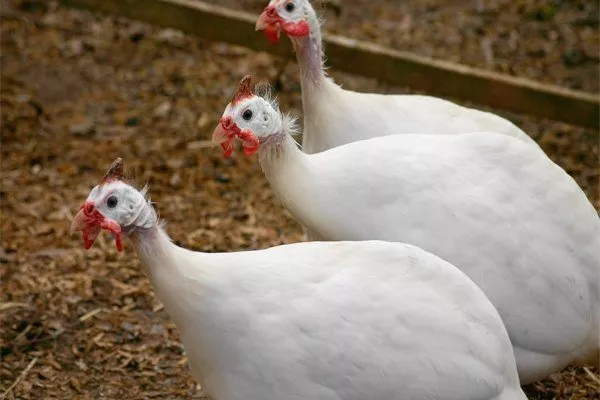
Unlike chickens, guinea fowl require daily exercise, so when introducing guinea fowl to chickens, it is necessary to add an enclosure next to the poultry house, protected from northern winds and bad weather.
Is it profitable to breed Siberian guinea fowl?
If there's an existing outbuilding on the property, the cost of fitting it out will be around 10,000-15,000 rubles. This amount covers the purchase of wooden items, including lintels, crossbars, and nest boxes. Feeders and waterers are made from scrap materials.
A single guinea fowl costs around 60-70 rubles, so a farmer will need to shell out 6,000-7,000 rubles for a hundred. Feed costs range from 3,000-3,500 rubles per month. A grain crusher, costing 5,000 rubles, is also essential.
- ✓ Eggs must be fresh, no older than 7 days.
- ✓ The optimal egg weight for incubation is 45-50 grams.
- ✓ The shell must be free of cracks and deformations.
To start breeding guinea fowl You'll need to spend around 24,000-33,500 rubles. If you buy an incubator, the costs will be significantly higher, as a 96-egg incubator costs 4,000-6,000 rubles. Read more about incubating guinea fowl eggs. here.
Profit is generated from the sale of meat, feathers, down, and eggs. However, it will take at least 4-4.5 months to recoup costs and realize a profit from raising guinea fowl. For example, the average price of 1 kilogram of meat is 500 rubles. Selling 100 guinea fowl weighing 2-2.5 kilograms will result in a profit of 100,000-125,000 rubles, including the sale of feathers and down. This figure also includes the sale of eggs.
With a proper and serious approach to breeding Siberian guinea fowl, it can become a profitable business, generating a healthy profit, enough for expansion and a comfortable life. But first, a farmer will need to understand the breed's characteristics, how to properly feed the birds, and how to care for them.
Reviews
Today, farmers speak positively about Siberian guinea fowl, giving preference to this breed.
Siberian white guinea fowl are attractive birds, usually calm in nature, and easy to care for and feed. They rarely cause any problems, except when they become frightened, which can cause a lot of noise. Otherwise, raising guinea fowl is a profitable business.