
Removing bees from their wintering house is a crucial event, affecting the health and honey production of each buzzing colony. It's crucial to consider every detail, as it's during the period leading up to the removal that weak colonies die. To get a good start to the season, it's important to choose the right time for removal, the right location for the hives, and understand the intricacies of the process.
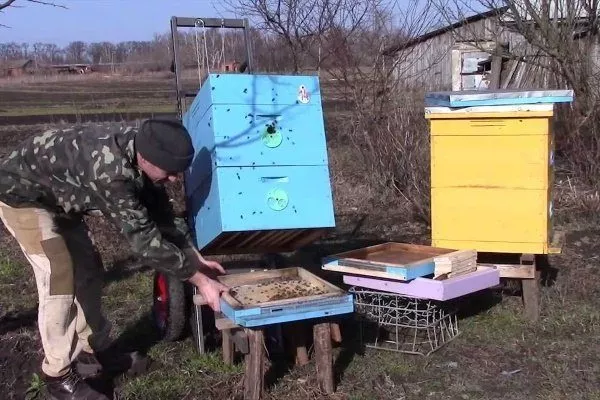
When should you put out the hives?
There's no specific date or single sign to use when removing hives from the moss house (winter house). To determine the best time, consider the following factors:
- the weather outside and the characteristics of the bee breed;
- conditions in the winter hut;
- health condition of bees.
- ✓ The level of activity of bees inside the hive before the exhibition.
- ✓ Availability and quality of food supplies in the hive.
The snow melts and rivers open up, which is usually considered a sign of the right time for beekeeping to begin. These events occur at the end of March, but there's no need to rush to remove the hives—the weather is still unstable, and there aren't many flowering plants.
If there are no problems with the climate in the wintering house or the health of the bees, it's best to wait until mid-April—the time when the vines and hazelnuts are in bloom. The optimal temperature is considered to be 8-12 degrees Celsius.
The optimal temperature varies for different bee species. For example, Italian bees and the yellow Caucasian ones love warmth, and the Central Russian ones Ukrainian steppe beescold-resistant.
- ✓ Italian bees require warmer conditions for their first flight.
- ✓ Central Russian bees can make their first flight at lower temperatures.
Another factor that influences the start date of the apiary season is the climate in the wintering area. If for some reason the room temperature remains at +5°C (while up to +2°C is considered ideal) and the humidity exceeds 70%, the moss house is no longer a comfortable place for winter rest. On the contrary, this situation can lead to the death of the bees.
In some cases, the removal of the bees can be delayed by cooling the room. Some beekeepers open the doors at night: this normalizes the temperature without exposing the bees to light, which could disturb them.
Another factor that influences the hive removal date is the bees' health. If they are restless, buzzing, and flying out of the hives, leaving fecal stains, they are likely unwell. Failure to carry out a cleansing flight promptly can result in significant damage. This is especially important if sufficient quality food has not been prepared, the honeydew content exceeds 5-10%, and the colony has entered winter weakened.
If the bees have been taken out and the weather outside that day is not warm enough, it is not critical to leave the hives in the apiary for 2-3 days.
Selecting a location, preparing and removing hives
If the apiary has been in operation for many years, it's best to place the hives in their original locations—this will help the bees find their way around. If for some reason this isn't possible, a good location should be selected before the start of the working season.
Choosing a location
The location should be well protected from winds—winds are undesirable in both summer and the off-season. It's best to place the hives among shrubs or trees—low enough for the bees to easily fly around them.
It's important to avoid nearby factories, highways, wax-related industries, or large livestock farms. If such proximity is unavoidable, the apiary should be fenced with a two-meter fence.
The apiary site should be sunny: this will help maintain optimal temperature and humidity in the hives. Furthermore, the sun will ensure early blooming of snowdrops, dandelions, and coltsfoot right in the apiary.
Experienced beekeepers recommend positioning hives so that they are exposed to the sun in the morning and evening, and shaded by bushes or trees at midday—this will prevent the bees from overheating in the summer.
It's good to have a garden or field with honey plants nearby so the bees don't have to fly far for nectar and pollen. It's true that they can fly 3-5 kilometers, but if they have to do this regularly, many bees will die. Furthermore, from such a distance, they can only bring back 30% of the nectar.
You should also think about water—prepare drinking bowls in advance. A stream or small river nearby is a good option. However, it's best not to place hives near wide rivers and lakes—the bees might try to cross them and die.
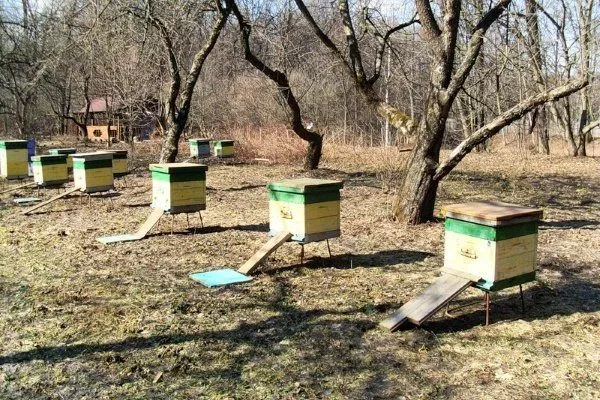
Preparation
If a site already exists, it needs to be prepared. First, remove any snow that hasn't completely melted yet. Areas that can't be cleared are covered with ash or roofing felt to speed up the melting process.
Next, you need to install the stands—they differ for each type of hive. They should be installed in groups so that you can quickly place the hives. Keep in mind that the hives should have a slight slope toward the entrance (approximately 2%).
The ground around the stands and the area where the hives will be should be covered with straw, sawdust, or a sheet of plywood. This is important because if a weakened bee can't reach the hive and falls to the ground, it will immediately freeze.
Rules for placing hives
There are several ways to arrange hives. Some simply arrange them in rows, others in a staggered pattern.
Crowding similar hives together makes it very difficult for bees to find their own. This is a problem, as some bees are aggressive toward strangers. Furthermore, colony mergers can occur: this happens especially often in early spring, when bees are simultaneously out foraging for nectar. Then, weak colonies merge with stronger ones. As a result, the strong colonies become even stronger, while the weaker ones become completely weakened.
If space permits, it's best to place hives in groups of three. Hives within a group can be spaced half a meter apart. Such groups are best spaced 6-8 meters apart. When placing hives, consider surrounding vegetation, shade, and light.
If it is not possible to group hives into groups, care should be taken to ensure that they have different colours.
Removing the hives
This procedure should be carried out with the expectation that the first flight will take place during the warmest time of day, and the bees need to calm down beforehand. Therefore, for a small apiary, it's best to begin the removal early in the morning to complete the flight before 10-11 a.m., assuming the first flight will take place at 12-1 p.m.
If you have a large number of hives, it's best to start removing them in the evening. The advantage of removing them in the evening is that the bees will calm down overnight, and the flight will proceed more smoothly.
Before removing the hives, the beekeeper enters the wintering house and tightly covers the entrances with a block or a bundle of straw to prevent the bees from attacking people while they are moving the hives. It's also worth inspecting the hives for damage.
To remove the bee hives, you need a stretcher: two two-meter poles with cross-ropes that support the hive under the bottom to prevent it from falling out. The entrance always faces backward: firstly, this helps prevent the combs from swinging violently, and secondly, anyone walking behind will immediately notice if the bees have an opportunity to escape.
When carrying out the hives, proceed slowly, stepping quietly, without jostling or making noise, so as not to disturb the bees further. After installing the hive house, don't open the entrance immediately; wait until the bees have calmed down. This will be audible: the disturbed buzz will subside.
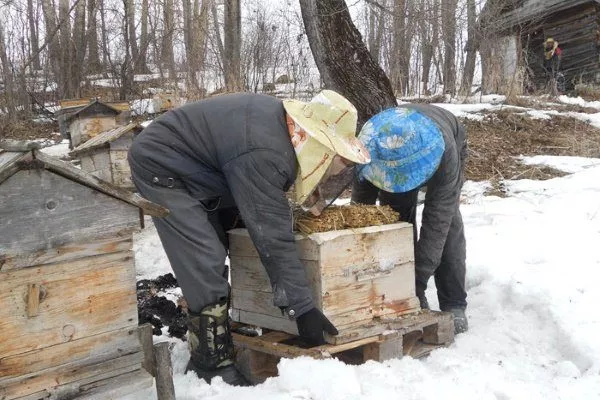
You can't release all the bees at once, otherwise they'll mix. Firstly, this could lead to the colonies merging. Secondly, the first cleansing flight is a demonstration, and each colony should be observed separately.
Features of early hive exhibition
If the temperature and humidity in the wintering house are inadequate or there are signs of bee diarrhea, an early removal may be necessary—that is, removing the hives before the snow melts. For this, select a site on the south side of a building. It's important that this location be sunny and windless. Measure the daytime temperature in advance—it can be 5 degrees higher than outside the corner. When the thermometer reaches 10 degrees, an early flight is ready.
Preparing the site is similar: clear the snow, cover with ash, and lay down plywood. To speed up the flight process, widen the entrance and remove the cover. The sun and warmth will lure the insects outside.
While the bees are cleaning themselves, you need to remove debris from the hive, fix any problems (if any), and add food or CandyAfter the cleansing flight, it will be easier to help the affected colony. The hive with the weakened colony should be brought into the wintering house before the evening cold snap.
Some beekeepers practice early flight for healthy colonies. There are several reasons for this:
- the temperature in hives with such families is higher, since there is more offspring in them;
- the first flight sets the bees in a working mood and further increases reproduction;
- In some areas, honey plants begin to bloom early, before the onset of stable warmth.
Early flight itself doesn't have any negative consequences. On the contrary, it makes it easier to identify and help sick colonies, and strengthen the strong ones even more. It's much worse to keep insects in a warm, damp, and stuffy room.
However, for early removal to be truly beneficial, it's important to ensure ample food supply, as bees won't be able to find sufficient food from outside. Furthermore, the hives should be insulated with some kind of synthetic covering—straw and sawdust are best avoided, as straw attracts rodents, and sawdust quickly becomes damp. Ventilation should also be considered.
The first spring flight of bees
The cleansing flight is a beekeeper's work holiday. During this time, observation data is recorded in the apiary log, which helps plan future actions.
There are signs that require special attention:
- a putrid smell and traces of diarrhea - probably nosematosis;
- bees crawl weakly with swollen abdomens - an infectious disease or excessive dampness in the hive;
- the bees do not fly, but spread their wings and fall to the ground and crawl - probably acarapidosis;
- the insects don’t even try to fly, they crawl sluggishly – the family is starving;
- The bees are running restlessly along the landing board, they are active, but they are not flying away - there is no queen in the family.
The fact that bees are reluctant to fly doesn't necessarily mean they're in trouble. Sometimes the opposite is true: the climate in the hive is good and there's plenty of food. In that case, they might fly within a day or two.
This video explains in detail how bees are transported from the wintering house to the apiary:
The exhibition of bees from a wintering house will be successful if you select a dry and warm location for the hives, carefully move them, and, if the exhibition is early, provide them with sufficient food. If the colony flies harmoniously and for a long time, it means it has successfully survived the winter.