
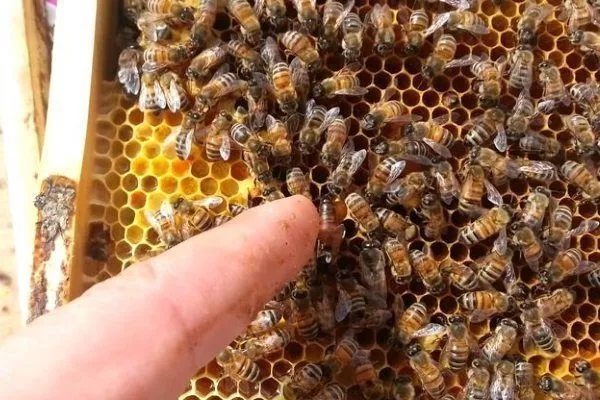
The queen bee is the progenitor of the entire bee family. She is easily recognizable—she is twice the size of the other inhabitants of the hive. Each bee colony has only one queen bee—the queen of the hive brooks no competition. By killing all the other queens with her sting, she becomes the sole egg-laying queen.
Description and characteristics of the queen bee
The queen bee reaches 2-2.5 cm in length—1.5-2 times larger than a worker bee. Features of the external and internal structure:
- The body is elongated. The shape is torpedo-shaped. The abdomen is much longer than the wings.
- The eyes are smaller in size than those of other inhabitants of the hive.
- The internal structure differs in only one nuance: it has well-developed ovaries.
- The queen bee has a stinger, which she, unlike other bees, can use repeatedly without harming her life.
- ✓ The egg production level must be at least 2000 eggs per day to ensure a strong bee colony.
- ✓ The queen's age should not exceed two years to ensure high productivity.
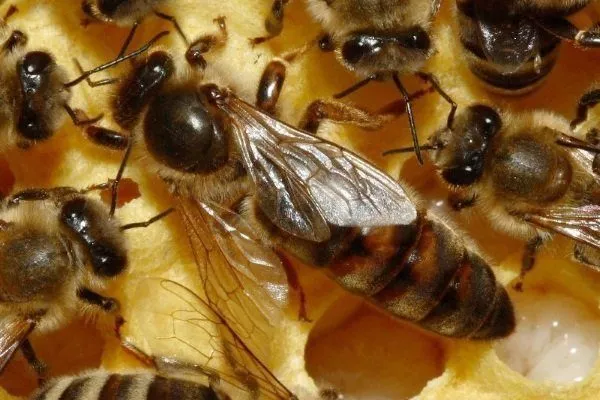
The "queen mother" is phlegmatic in nature, moving slowly and almost never leaving the hive. She only emerges on two occasions: mating and swarming.
Swarming is the flight of sexually mature bees during which the colony divides. A group of bees, including the queen, separates from the colony. Catching swarms is difficult, so beekeepers try to prevent this process.
Queens are:
- Infertile – those that haven't mated with males. They weigh less than fertile ones – 170-220 mg. Compared to fertilized queens, they move faster.
- Fruitful – females become queens after mating, which occurs during the mating flight. The weight of a fertile queen is 180-330 mg.
The value of a queen bee directly depends on her egg-laying ability. A good queen bee can produce at least 2,000 eggs. Fertilized eggs are the source of worker bees and future queens, while unfertilized eggs hatch into drones.
A female lives for about five years. But her reproductive capacity weakens after just two years. Her egg production becomes increasingly modest. Furthermore, the longer she lives, the more drones she produces than workers. This leads to a weakening of the bee colony, and honey production declines. To prevent this, beekeepers don't keep queens in the hive for longer than two years; they replace them with new ones.
Role in the bee colony
The entire life of the swarm revolves around the queen bee—she is cared for and fed. The queen doesn't eat honey, but a special diet rich in proteins and lipids— royal jellyThe queen bee reigns supreme in the colony. Any emerging competitor is immediately destroyed by the queen herself or her "subjects."
Functions of the queen in the hive:
- laying eggs;
- maintaining order in the hive;
- family unification.
Ultimately, the productivity of the bee colony depends on the queen.
According to scientists, certain behaviors and physiological behaviors of bees are due to the queen bee. Thanks to pheromones secreted by the queen, all bees in a colony have a uniform scent. By scent, insects distinguish their own from others.
Types of queen bees
There are several types of queen bees, depending on their breeding method. Beekeepers have no control over the emergence of swarm and emergency queens—they emerge naturally. However, humans can, if necessary, induce the emergence of a silent successor queen.
| Name | Type of withdrawal | Egg production | Peculiarities |
|---|---|---|---|
| Swarmers | Natural | High | They appear between the end of May and mid-July |
| Rescue or fistula | Natural | Low | They are excreted after the death of the queen. |
| Quiet shift | Natural/Artificial | High | They are bred without stress for the family |
Swarmers
To breed the swarm queen bee colony It comes into play when the number of young bees exceeds the "vacancies" in the hive. This usually occurs between late May and mid-July. When swarm cups appear, the beekeeper can notice preparations for swarming—the bees are laying them on the edges of the comb. Read on to learn how to prevent swarming. here.
Having established swarm queen cells, the colony stops raising larvae and does not build comb. The first swarm to emerge contains an old queen, who has lost her former egg-laying capacity. Her ovary volume and weight decrease, so she can fly (while laying eggs, the queen is incapable of flight).
A swarm queen cell contains cells containing future queens. There can be several swarms. As soon as a young queen emerges from the queen cell, the next swarm is ready to leave the hive along with the barren queen. When the swarming ends, the bees, having removed the queen cells, return to their normal activities.
On the third day, the swarm queen, having emerged from the cell, begins a flight. She makes several flights, each time moving further away from the hive. The queen memorizes the area, the hive, and its location so that after mating she can return to her home hive. The flight can last several minutes or several hours.
Rescue or fistula
If a queen dies, the bees quickly notice the loss—a loud, howling buzz erupts. They drop everything and rush to find the queen. Realizing the queen is gone forever, the bees quickly begin raising a new queen. They begin feeding the larvae exclusively on royal jelly. Regular larvae receive it for only two days, after which they are fed a mixture of honey and bee bread.
After 16 days of fattening, approximately two dozen queens hatch. The first thing they do is sting each other. Only one—the strongest—should remain. Queens hatched this way are called emergency queens. Their drawback is low egg production. Beekeepers usually replace emergency queens with swarm queens or silent replacement queens.
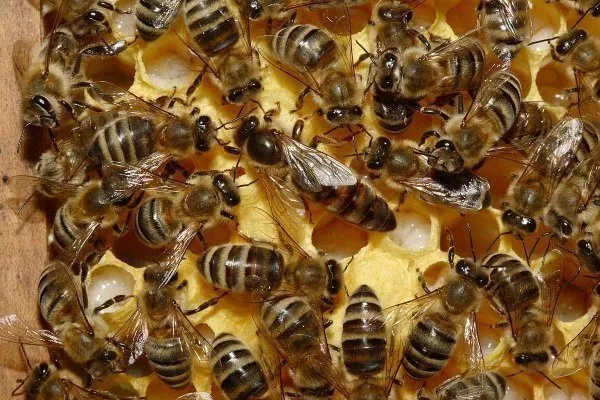
Queen bees develop in cells that are too small (5.5 mm in diameter) rather than in special, spacious queen cells (9 mm in diameter). It's possible to "thin out" the larvae by merging adjacent cells, but this is extremely labor-intensive and rarely attempted by beekeepers.
Quiet shift
The old queen quietly, without causing unnecessary noise or stress to the bee colony, prepares her replacement. After laying an egg in a special cell, the queen resumes her peaceful life, and the bees continue their normal activities.
After 16 days, a new "queen" emerges. Without a moment's hesitation, she immediately kills her parent. The emergence of a silent successor queen occurs in two cases:
- the situation is provoked by the beekeeper;
- the queen bee is old or sick.
The queens of the silent replacement are of high quality – they are the most worthy mistresses of the hive.
What breeds are there?
Beekeepers can add queens of a specific breed to a hive. In the former Soviet Union, Central Russian and Carpathian queens are particularly popular. The choice of breed depends on the local climate and honey flow.
| Name | Weight of the fetal uterus (mg) | Egg production (thousand eggs) | Frost resistance |
|---|---|---|---|
| Central Russian | 210 | 2 | High |
| Ukrainian | 200 | 2 | High |
| Buckfast | 260 | 3 | Low |
| Carpathian | 205 | 2 | High |
| Gray Mountain Caucasian | 200 | 2 | High |
Central Russian
This breed is the most popular choice among beekeepers. Queen bee weight is 210 mg. Advantages of Central Russian bees:
- unpretentious and undemanding in care;
- disease resistant;
- productive - queens are distinguished by high egg production, and worker bees are hard-working;
- not prone to swarming;
- are not susceptible to low temperatures and can remain in a wintering area for up to seven months.
The disadvantage of the breed is that the bees are determined to collect honey from only one specific honey plant.
More information about the Central Russian bee breed is available here. here.
Ukrainian
As hardworking as the Central Russian bees. The weight of a fertile queen is 200 mg. Breed characteristics:
- moderately calm and non-aggressive character;
- they protect the hive well from robber bees;
- high frost resistance;
- high fertility of the uterus;
- not prone to swarming;
- they take nectar only from honey plants with a high sugar content;
- resistant to diseases.
Buckfast
Buckfast They are bred primarily in Belarus and Ukraine. A queen bee weighs 260 mg. This is a productive breed; a queen can lay a colossal number of eggs, so their colonies are always large and never experience a shortage of workers.
Buckfast bees are beneficial when honey flows are located significantly away from the apiary. This breed is distinguished by its ability to fly long distances. Buckfast bees are willing to travel "to the ends of the earth" for nectar.
The breed's drawback is its sensitivity to low temperatures. It is not recommended for breeding not only in northern latitudes, but even in central Russia.
Carpathian
Carpathian breed Bred in Ukraine. Queen bees weigh up to 205 g. Breed characteristics:
- unpretentiousness;
- cold resistance;
- can collect honey in the rain;
- honey has a low sugar content;
- Egg-laying continues not only in spring and summer, but also in autumn – a large family needs food.
Gray Mountain Caucasian
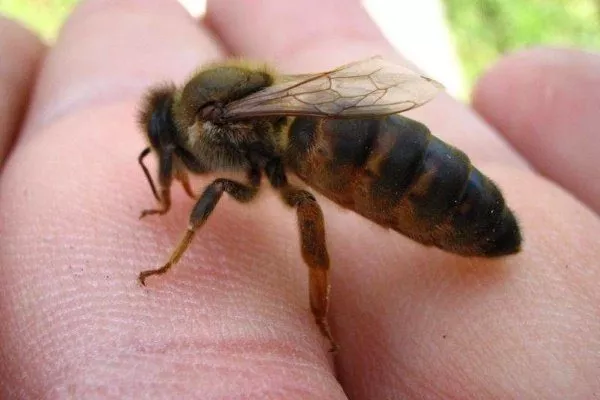
Gray mountain Caucasian bee breed As the name suggests, this breed is common in the Caucasus and its foothills. A queen can weigh up to 200 g. Advantages of the breed:
- high immunity;
- non-aggressive towards the beekeeper;
- low swarming rate;
- high frost resistance;
- They collect nectar from any, even the weakest, honey plants.
Flaws - steal honey, do not tolerate prolonged wintering well and do not build honeycombs well.
Life cycle
If a bee colony lacks fertile eggs, it inevitably dies, as the bees are deprived of the opportunity to raise a new mother. For a colony to acquire a "queen," the queen goes through the following stages of development in the hive:
- Egg laying. The old queen lays an egg in a cup attached to the honeycomb. This is where the hive's most important larva will grow and develop.
- Removal of the queen from the fertilized egg (brothers are removed from unfertilized eggs).
- Once the larva hatches, it is fed intensively with royal jelly. The queen cell is removed from the dish and sealed on the seventh day. But before sealing the queen cell, it is filled with food—royal jelly.
- The larva, feeding on royal jelly, transforms into a pupa, and then into a queen. On the 16th day of her "imprisonment," the future mistress of the hive chews through the queen cell and emerges to freedom.
Beekeepers collecting royal jelly for sale find it most convenient to obtain it from sealed queen cells.
It is useful for beekeepers to know:
- The darker the lower part of the queen cell, the older it is.
- The queen that emerges first will destroy all remaining queen cells.
- By monitoring queen cells and queen emergence, it is possible to prevent swarming and predict the timing of swarm emergence.
The stages and features of the queen bee’s development are presented in Table 1.
Table 1
| Day | Stage of development |
| 1-2 | the egg is laid in a bowl |
| 3-6 | the larva has hatched and is actively eating royal jelly |
| 7 | the mother liquor is sealed |
| 8-12 | the larva sits in the queen cell and prepares to become a pupa |
| 13-16 | is in a pupa state |
| 17 | the emergence of a barren queen bee from the queen cell |
Fertile queens live up to 5 years, but are usually replaced with young queens after 2 years. If the queen doesn't fly, the hive will become overrun with drones, and the colony will die. The drones must be removed promptly and replaced with a fertile queen.
Pairing
Queens emerging from their queen cells are divided into fertile and drone-laying queens. Fertile queens become fertile after a week-long flight, during which they mate with drones.
- ✓ The air temperature must be at least 19°C to ensure successful flight and mating.
- ✓ The time from 2:00 PM to 4:30 PM is considered ideal for mating due to optimal lighting and temperature conditions.
The queen bee is ready to mate with drone On the 7th day after emerging from the queen cell. If mating does not occur within a month, the queen will become a drone—her eggs are unfertilized and will produce only drones.
For a colony to produce worker bees and drones, fertilized and drone eggs are needed, respectively—only a fertile queen can lay them. First, the worker cells are completely filled with eggs, and only then does the drone's oviposition begin.
If food is plentiful, a new queen can lay up to 2,000 eggs per day. The weight of a clutch can equal her own body weight. Over the course of a season, a queen will lay approximately 150,000 eggs. The queen carefully examines all the cells in which she lays her eggs. If a cell has any defects, such as being uneven or dirty, she skips it and moves on to another cell.
The queen feeds every half hour. During this time, she can lay up to 50 eggs.
Feeding and wintering of queens
If there's an overabundance of queens during swarming, there's often a shortage in the spring—preserving them is quite difficult, as there's only one queen mother per colony. Queens are usually destroyed before wintering, as overwintering them is expensive—keeping them in the nuc requires wasting honey.
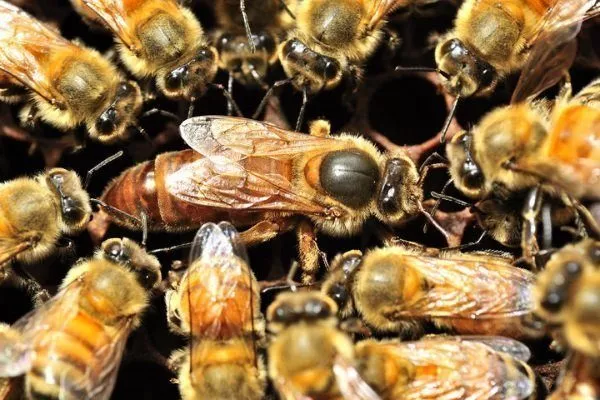
A cost-effective wintering method has been developed that allows for the preservation of queen bees. However, it is only suitable for the southern regions of the country.
Features of wintering:
- Queen bees are kept in special wooden cages measuring 80 x 80 x 80 mm. The cage is ventilated with slits. Two honeycombs measuring 60-76 mm are placed inside the cage. One is empty, the other is filled with honey. They are secured in place with tape.
- Honey is stored starting in the summer. After disinfecting and cutting the light-brown honeycombs into honeycombs, they are taped along the edges. They are placed in a nest frame and given to a good colony to fill with honey and then seal.
- In the fall, a queen and a hundred bees are placed in a cage from the nucleus as support.
- The cages are placed in a warm room, on shelves. The temperature should remain between 17 and 20°C.
- When half the bees remain in the cages, the "escort" bees are replaced with bees from a regular colony, which has gathered for the winter. But first, they are exposed to cold—placed in a box and left outside—where the temperature should not fall below -5°C and not rise above +6°C. A cage with "hardened" bees is placed under the cage with the wintering queen. A piece of paper with a hole in the center is placed between the cages—the bees use this to reach the queen, who has been left for the winter. The cage with the queen and bees is closed. From time to time, food—small honeycombs—is added to the cage.
How are queens bred?
Queens are raised in parallel with drones, which will be needed for fertilization. Rules that are useful to know when breeding queen bees:
- A good honey harvest is the key to a fertile queen.
- The best queen will be one raised from a large larva rather than from a small one.
- For hatching, larvae are used, the lifespan of which is 12 hours.
There are two methods for queen rearing: natural and artificial. In natural rearing, bees construct a queen cell, into which the old queen lays an egg.
There are two artificial technologies:
- The queen and exposed brood are removed from the hive. Only fresh eggs and larvae are left. The combs must be trimmed from the bottom to ensure that the eggs hatch into reproductively capable individuals. The cut queen cells are placed in the hives, and the queen is returned to her original position.
- The second option is more complex and is therefore rarely used. The method involves placing the larvae in wax sacs. Here, they are intensively fed with royal jelly. However, this technique allows for the introduction of the most fertile queens.
Drone queens
Queen bees that lay only unfertilized eggs, from which only drones hatch, are called drone bees. The following factors can trigger the emergence of drone bees:
- Unfavorable weather conditions prevented the flight and fertilization.
- Damage to the wings.
- The queen appeared too early - before the drones were hatched.
A drone queen can become a drone queen, even an old one, due to illness, ovarian exhaustion, or damage to the spermatheca. If the drone queen is not replaced promptly, the bee colony will die.
Uterine implantation
If the old queen is removed from the hive, the bees, after searching for her for a while, begin to breed a new one. But it's not necessary to rely on natural processes. Beekeepers often replace a queen by ordering her from a special breeding nursery. This ensures that the queen is 100% high-quality.
A special cage is usually used to introduce a new queen. The queen is placed in it and then placed in the hive. The old queen is first removed from the hive. Once orphaned, the bee colony readily accepts the "introduction."
When is it time to change the queen bee?
It doesn't make sense to keep a queen bee, even a high-quality one, in the hive for more than two years. The advantages of young queens:
- large egg laying;
- they survive the winter easier and die less often;
- more responsive to anti-swarm measures.
The more eggs a queen lays, the faster her body begins to fail. Some egg-laying queens need to be replaced after a year. A bee colony is best prepared to accept a new queen during the following periods:
- biological maturity;
- active honey collection.
During the honey flow, most worker bees are busy, and the young are quite accepting of the hive's new owner. However, during the period when biological development is not yet complete and the colony is strong, the bees are extremely unfriendly—and introducing new bees is not recommended.
The easiest time to introduce bees is in August or early September. It's not recommended to introduce bees in late autumn, as the colony needs to prepare for winter with a young queen.
When the queen is replaced in the fall, there is a short break in egg-laying. It's important that this break doesn't affect honey flow:
- If the honey flow is short, the queen is added a week before the start of the flow.
- If the honey flow is long (more than a month), it is better to replace it 2-3 weeks after the end of the flow.
An unscheduled queen replacement may be necessary if she becomes ill, injured, or is laying eggs poorly. Experienced beekeepers advise against replacing queens in colonies that have entered swarming mode or have established "quiet replacement" queen cells.
Developmental abnormalities in queen bees
Various deviations may be observed during the queen's development. For example, the standard maturation period for the queen in the cell may change—be delayed or, conversely, advanced by several hours. This occurs due to the microclimate within the hive.
Sometimes, the queen emerges from the queen cell a day later than usual. Beekeepers believe that temperature changes are to blame.
Other reasons for delayed exit:
- weak bee colony or division – it is not possible to create the proper climatic conditions in the hive;
- the breeding season came later - the female makes her mating flight only in favorable weather conditions;
- influence of the beekeeper - if the bees are disturbed within 10 days before leaving the queen cell, the mating flight will be postponed;
- If the bee colony is preparing to swarm, mating will also be postponed.
Theoretically, the uterus develops in 26 days. However, in reality, due to the prolongation of the stages, development time can increase to 30 days or more.
Useful information
Anyone who wants to control the hives and the entire apiary must appreciate the importance of the queen bees. What else is useful to know about queen bees:
- Unlike worker bees, the queen's legs do not have pollen baskets.
- To hatch a large individual – weighing about 200 g, the cells should be 2.2 cm high.
- Identical eggs laid by a queen can hatch into different bees due to differences in nutrition during development. The royal jelly fed to drones, worker bees, and queens varies in protein, sugar, vitamin, and mineral content. Queen larvae receive royal jelly with a lower protein content, while drones are fed a high-protein diet.
- Queens emerging from the nest do not touch the remaining royal jelly. After leaving the cell, they can remain without food for 16 hours. If the cell is filled with jelly, this is a sure sign that the female will be fertile.
- The queen, the first to emerge from the cell, kills her rivals because her instinct for self-preservation dictates it. She gnaws through the queen cells and uses her venomous sting. But even if the queen doesn't do this, the "subjects" themselves will deal with her rivals.
- The queen's weight can fluctuate. It decreases during mating and swarming periods. Maximum weight loss is 15 and 20 mg for a barren and fertilized queen, respectively.
- The larger the female, the more fertile she is, and the stronger her offspring.
- Ideal conditions for mating occur between 2:00 PM and 4:30 PM. If it rains or the temperature drops below 19°C, the flight is postponed.
- To be productive, the queen needs special conditions, including food supplies in the hive – 2-3 kg of bee bread and 8-10 kg of honey.
- Active egg-laying begins on the 10-14th day.
- Studies have shown that a queen mates with more than one drone during her flight. Half of the queens fly 2-3 times and have "relationships" with 5-10 drones. A fertile female returning to the hive can be identified by a white clot covering the tip of her sting—this is a substance secreted by the male.
- Sometimes, the queen mates late in the fall, delaying egg-laying until spring. This can happen if the fall is warm and temperatures rise above 23 degrees Celsius.
- The eggs of a single female can vary in size. In June, before the main honey flow, they weigh 0.13 mg, in July – 0.14, and in August – 0.16 mg. Young females lay larger eggs than older ones.
The well-being of a bee colony and the beekeeper's income directly depend on the quality of the queen, her health, her management skills, and her egg-laying ability. By introducing and replacing queens in a timely manner, you can avoid losses in honey yield.