
Bees can produce new queens without human intervention: this occurs when the previous queen ages or dies. However, to be profitable, beekeepers must be able to raise queens themselves, as it's significantly cheaper than increasing the swarm's size with package bees.
Basic rules for breeding queens
Before moving directly to the practice of breeding, a beekeeper needs to acquire a theoretical basis: how the queen differs from other bees, as well as what kind of future queen bee family a colony requires, and how it should be prepared.
To ensure that the process of breeding queen bees is successful, the following rules must be followed:
- Only healthy individuals with high productivity should participate in the process of breeding queens;
- To breed, it is necessary to maintain optimal conditions - maintain humidity and temperature at the proper level;
- begin the process of breeding new queens only when there are sealed drone broods (otherwise both queens and drones will appear at the same time);
- Follow the schedule prescribed for each withdrawal method.
| Parameter | Meaning |
|---|---|
| Temperature | 32-35°C |
| Humidity | 75-90% |
| Lighting | Natural, no direct sunlight |
How to distinguish a queen?
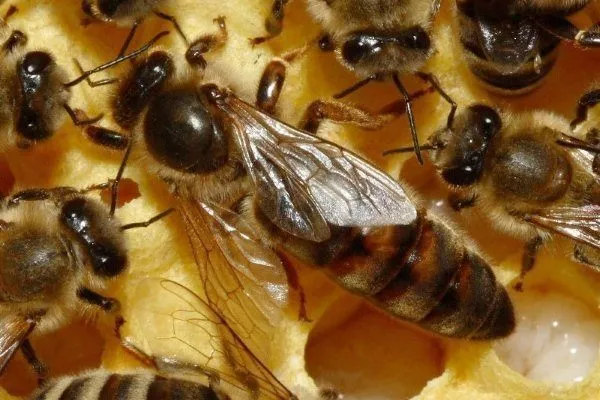
The uterus has a number of visual features that distinguish it from dronesDistinguishing a queen from other bees is quite simple; simply examine the hive carefully and pay attention to the following signs:
- The queen bee is always larger than other bees. Her body is wider and longer than that of other young queens, drones, or worker bees.
- The queen bee's abdomen has a pointed end that projects backwards.
- Bees have serrations on their stingers that can be seen with a magnifying glass. The queen's stinger is smooth and straight.
- The queen bee's legs are positioned almost perpendicular to her body and spread out. In other bees, the legs generally point forward and backward, rather than laterally.
- The other bees treat the queen and her kind with respect: they gather around her or move aside, making way for her when she goes somewhere.
Family Choice
Queen bee breeding begins with the selection of parent colonies, as the traits of a given queen and her drones determine the future offspring they will produce. Furthermore, future queens are responsible for the productivity and strength of the colonies they lead. Therefore, it's essential to select only the strongest, most resilient, and healthiest.
The following list of requirements is presented to the family:
- Maximum honey production is a critical requirement for a beekeeper;
- the family must be strong and resilient throughout the year, especially during the winter period;
- The health of the family and resistance to disease are key criteria for the viability of the future queen and all the offspring she will produce.
If the apiary is owned by a person who is extremely responsible and conscientious about beekeeping, then all this information about the families can be found in the registration log.
Preparing the family
Preparations for hatching should begin no later than a year before the expected date. At this time, the selected colonies can be recuperated by providing them with all the necessary resources for overwintering and implementing health-improving measures.
- Disinfect the hive.
- Provide sufficient feed.
- Insulate the hive.
List of preparatory activities:
- Check the quality of the honey being produced. If it critically fails to meet the requirements, it's best to choose a different honey family.
- It is highly recommended to clean and disinfect hives to prevent nosematosis.
- Give a stimulus top dressingIn addition, bees must be supplied with non-crystallizing food on a regular basis.
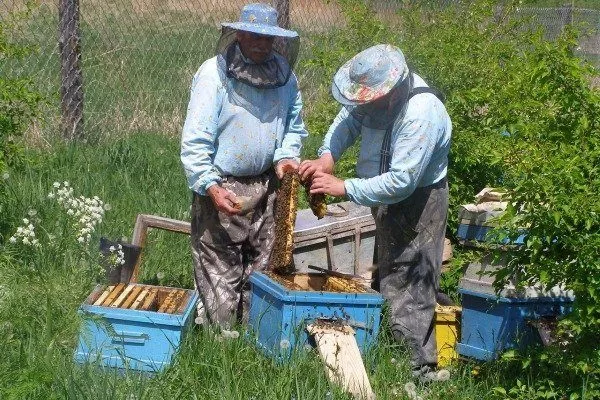
If queen bee rearing is planned for the spring season, the procedure itself should only be performed after the overwintered bees have been completely replaced by newly hatched young. Typically, this process is fully completed by the second third of May. In cases where the beekeeper needs to begin the process earlier, a series of additional measures must be taken:
- bees need to be fed with carbohydrate and protein supplements;
- make the insects' lives comfortable, in particular, insulate and protect the hive from the wind;
- You will need to take the hive out of the wintering house a little earlier than usual.
The formation of colonies that will raise future queen bees should begin immediately after the replacement of old bees with new ones. Such a nursery colony should contain at least 2 kilograms of bees, 4 frames of bee bread, and 10 kilograms of honey.
Methods of breeding queens
Queen rearing can be done both naturally and artificially. The choice of method depends on the beekeeper's experience, time, and resources available.
Natural
The first natural way of breeding queen bees, which is also the simplest and most common among novice beekeepers, is natural reproduction of bees, also called swarming.
This method received its name because it requires the selected colony to transition to a swarming state. This primarily requires suitable, comfortable conditions in the hive:
- 3 frames with brood are placed in the hive, the entrance is covered;
- It is also necessary to ensure that there are no brood-free frames in the selected hive;
- Next, you need to wait until the queen cells are laid, after which the divisions should be formed on them and the new frames.
It's impossible to accurately predict when the queen cells will be established, which is an undeniable drawback of this method. Furthermore, the quality of the queen cells leaves much to be desired.
And the second, natural method of breeding, which is popular among beekeepers, is emergency queen beesThe main advantage of this method is the ability to predict the emergence of queens, resulting in the production of new queens at the right time:
- the bees must lay emergency queen cells;
- subsequently, a strong, prepared family is selected, the queen from which must be transferred to a new hive with two frames of brood;
- bees from several other frames (also from a strong family) are shaken into the same hive;
- thus, a ready-made colony is obtained, which will eventually be transferred to a new, permanent, hive;
- Meanwhile, the bees from the old hive, having lost their queen, will lay emergency queen cells, and the beekeeper's job is to ensure that they are only on mature larvae.
| Method | Withdrawal time | Complexity |
|---|---|---|
| Natural (swarming) | Unpredictable | Low |
| Fistulous uterine cells | 16 days | Average |
| Extra | 14 days | High |
Queens obtained by this method will be stronger, more fertile and healthier compared to the previous method.
Artificial
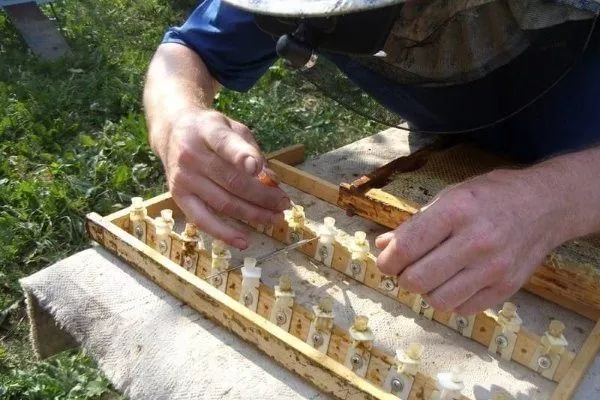
Along with natural methods of breeding queen bees, there are also a number of artificial ones: the emergency method, using an isolator, the Kashkovsky method, using the Nikot system, the Tsebro method.
Artificial methods are more complex, but more productive compared to natural ones due to the fact that they take into account the life processes of bees.
Emergency method, perhaps the simplest and fastest among artificial ones:
- A frame of brood is taken from the strongest and most prepared colony. However, it must be shaken free of bees to avoid accidentally transferring the local queen.
- The bottom walls of the frame, which should hold two larvae, are removed and then installed in the new home. The frame is then placed in the home of the colony that has lost its queen.
- As a result, in one hive the queen will create a new generation of bees, and in the other, from two larvae, the bees will soon create new queens to replace the transferred one.
- If the queen cells have not been found, it means that the queen is still present in the hive, and it is necessary to look for the reason why she stopped producing offspring.
When using method with an insulator, it is extremely important to use the queen hatching calendar:
- a strong queen from a selected prepared family is placed in a so-called “isolator” (made of two frames and gratings), installed in a well;
- the frames that make up the isolator are a frame with brood and an empty one;
- the main rule of the method is that the queen should not even have a chance to escape from the structure;
- as soon as the queen bee has laid brood, she must be returned back to the larvae;
- meanwhile, a nucleus is created - a frame with honey, dried bees and freshly made brood;
- several bees from other frames and the queen herself are placed there;
- The freshly obtained brood, at high humidity and temperature, is cut off at the lower border and placed in the same case from which the queen was first taken;
- queen cells are cut and placed in a nucleus;
- All that remains now is to wait for new queens to appear.
The next artificial method is more advanced and requires the use of auxiliary devices for its implementation, in particular, it is necessary to purchase (or make yourself) Nicot system.
Methodology of the method:
- the cassette is installed in the center of the frame;
- then a grafting frame is made;
- the cassette must be thoroughly cleaned;
- the queen bee is transferred to the finished structure;
- a raising family is formed separately;
- The grafting frame is placed next to this family.
In the future, it is only necessary to monitor the progress of the queen formation process.
Kashkovsky's method involves the following activities:
- from the very beginning of the honey flow, it is necessary to make a colony where frames with bees, a local queen, sealed brood, bee bread, wax foundation, dried bees and honey are transferred;
- a small number of worker bees are also shaken off there;
- the cuttings are left in a warm place for a month;
- Meanwhile, when the bees are actively creating new queen cells in the hive, the beekeeper needs to cull them, leaving the largest and healthiest larvae;
- After some time, the old queen is removed and a young one is added.
According to method Tsebro To breed queen bees you will need:
- Two-day-old eggs. The graft containing the eggs is placed in the upper body of the hive, where two to three frames of brood and two frames of food should already be installed.
- In the spring, it's also possible to stimulate bee reproduction. To do this, simply add an additional hive box to the hive, pre-installing two feeding frames and young brood.
Read more in the article: methods of bee reproduction artificially and naturally.
Stages, cycle, and timing of uterine development
The breeding of queen bees consists of several stages:
- Sowing. A larva emerges from the fertilized egg, which the other bees carefully protect and feed with royal jelly. At the same time, the queen bee can also feed on food intended for bee larvae.
- Sealing. On the seventh day, the bees fill the queen cell with food and seal it.
- Doll. While in a sealed queen cell, the larva grows quite quickly (within a few days) and becomes a pupa.
- Young uterus. After 2-3 days, the pupa transforms into a practically full-fledged young queen bee.
- Infertile uterus. Eventually, the female matures and leaves the queen cell, becoming a barren queen. This occurs on average on the 16th day of egg development (or the 9th day after the queen cell is sealed).

Thus, the process of breeding a queen bee takes about 15 days. Soon, the newly hatched, infertile queen will fly around, mating with drones, and within three days, she is capable of producing a fertile brood.
How to breed a queen without a larva?
The Zander method, or queen rearing without larval transfer, is currently considered the closest to perfection in beekeeping. The method has been refined over the years, eventually losing its original name.
Today, the breeding of queens without larvae has become widespread due to its cost-effectiveness and simplicity:
- a brown honeycomb sprinkled with honey syrup is placed into the nest of a strong family prepared for breeding queens;
- as soon as the laid eggs appear in the honeycomb (usually this happens within three to five days), the queen is removed and placed in a nucleus;
- the placed honeycomb is removed from the nest;
- in the honeycomb, make triangular cuts (windows) with a sharp knife, 20 centimeters in height and 5-6 in width;
- in the top row you need to thin out the larvae: 1 larva remains, 2 are removed;
- the frame is installed in the nest between frames with open brood;
- after three days, the fistula queen cells (if any) are removed;
- on average, after five days the bees seal the queen cells;
- after ten days, mature queen cells must be removed and placed in cages previously filled with honey;
- the cells are placed in a nest with brood;
- Queen bees emerging from queen cells can be used to create colonies or replace old queens.
Growing the queen
Although queen bees live a long time and their resilience to adverse conditions is enviable, they also require care.
Basic rules of care
First of all, the queen needs to be provided with the same comfortable living conditions as the bees:
- maintain optimal temperature and humidity levels;
- provide food in sufficient quantities;
- expand hives as needed;
- carry out disease prevention;
- carefully prepare hives with queens for wintering.
Although there are no specific care requirements for queen bees, existing ones require special attention. Failure to follow these care guidelines can lead to illness and even death, which can cause significant damage not only to the entire colony but also to the honey yield.
Keeping a family with two queens
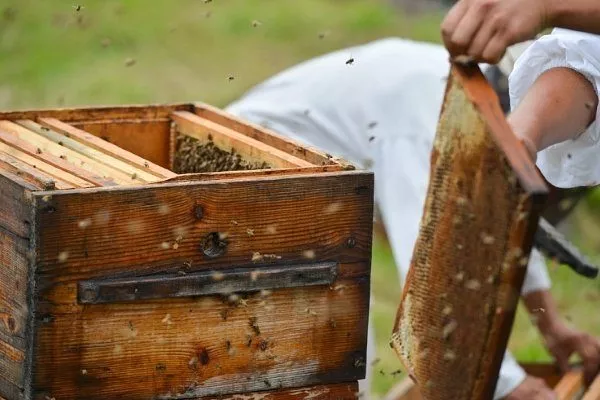
The so-called dual-queen system involves organizing bee colonies so that individuals from one brood nest have access to another brood nest, which already has its own queen. This can be accomplished using two separating bars, which prevent the two queens from meeting and engaging in combat.
Competition is an integral part of queen bee nature. The weaker bee is always eventually killed by the stronger one.
With this type of colony management, individuals move between nests using shared parts of the hive—a super or a hive body. The result is a single hive, but with paired nucs. This type of management can yield twice as much honey as a hive with only one queen.
In multi-body hives
Many beekeepers resort to using multi-hull hives. This method allows for maintaining a large colony capable of supporting two queens. The only requirement is to ensure the maximum possible distance between the hives, preventing the two queens from meeting.
Queen bees living in multi-hull hives also produce more offspring, which ultimately leads to an increase in the amount of honey produced.
In the sun loungers
Keeping queen bees in horizontal hives is often even simpler and more convenient than in other types of hives due to the fact that:
- a horizontal hive is much more difficult to overcool, and queen bees are very sensitive to temperature changes;
- This type of hive allows for easy separation of bees, thus providing the opportunity to keep either several bee colonies or one large one, but with several queens;
- easier to transport and move;
- the optimal choice for artificial breeding of queens.
| Characteristic | Description |
|---|---|
| Thermoregulation | Retains heat better |
| Flexibility | Easily adapts to different maintenance methods |
Raising queen bees is a long and labor-intensive process, requiring increased attention and sometimes painstaking work. But the results are not long in coming: following these tips, you can have more resilient bees and more honey next year.