
One of the most valuable and expensive beekeeping products is royal jelly. This nutritious, beneficial, and phenomenal ingredient is found in cosmetics and is also used in folk medicine. Let's explore what it is and how to harvest it yourself in your own home apiary.
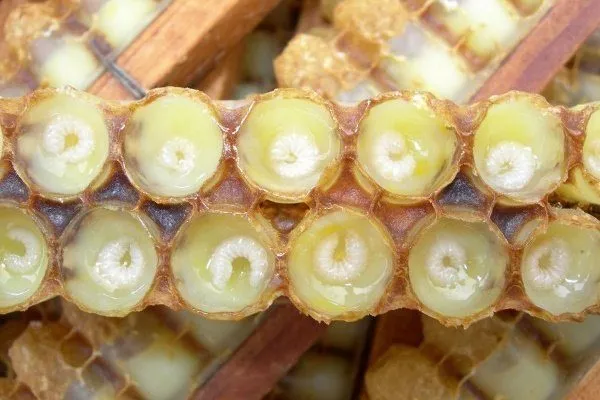
What is this?
Royal jelly, or natural milk, is a food source for bee larvae. Produced by the hypopharyngeal and maxillary glands of young bees, it is a creamy or white jelly-like substance.
Compound
The value of this milk stems from its unique composition. In total, the nectar contains approximately 400 active substances. It's 70% water, but the remaining 30% is made up of highly beneficial solids:
- proteins that are similar in properties to blood serum proteins;
- carbohydrates (fructose, sucrose, glucose);
- fats (phospholipids, sterols, glycerides, decenoic acids);
- vitamins B, A, C, D, E;
- enzymes;
- hormones (estradiol, progesterone, testosterone);
- amino acids;
- minerals;
- phytoncides;
- essential fatty acids;
- immunoglobulins;
- neurotransmitter acetylcholine;
- 57-kDa protein (royalactin);
- 10-hydroxy-2-decanoic acid.
100 g of the product contains 139 kcal.
Beneficial properties
The product has a positive effect on the body:
- increases the body's overall resistance, strengthening the immune system;
- improves the functioning of the gastrointestinal tract, as it affects the enzymatic composition of gastric juice, intestinal peristalsis and the secretion of bile;
- normalizes blood sugar levels;
- has an antiviral effect;
- lowers cholesterol levels;
- normalizes blood pressure;
- has a regenerating effect on tissues;
- increases endurance levels, maintains activity, promotes muscle growth, and is therefore used by athletes and exercise enthusiasts;
- increases libido, normalizes hormonal levels;
- increases lactation and activates the mammary glands;
- strengthens nails and hair;
- smoothes wrinkles;
- normalizes the functioning of the central nervous system, improves attention, concentration, and memory.
| Component | Concentration (%) | Biological role |
|---|---|---|
| Squirrels | 10-18 | Building material for cells, immunomodulation |
| Carbohydrates | 9-15 | Energy substrate |
| Lipids | 3-8 | Synthesis of hormones, protection of cell membranes |
| Minerals | 1.5-2 | Electrolyte balance, enzymatic activity |
| Water | 60-70 | Solvent, transport of substances |
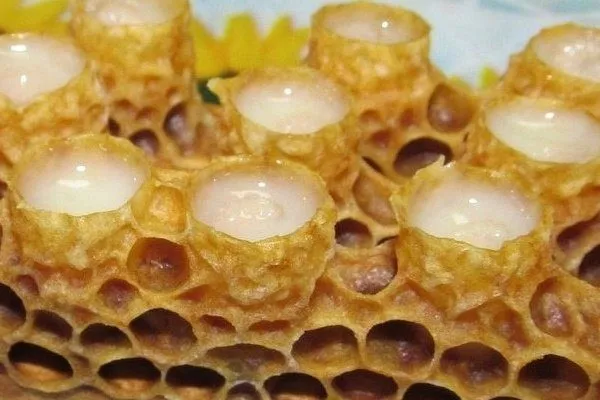
How does it appear?
The process of royal jelly production is simple. It is produced by bees 6-15 days old while consuming bee bread or bee bread.
Perga - this is flower pollen collected and processed by bees, placed in honeycomb cells and covered with honey.
When nurse bees consume bee bread, they produce a substance in their maxillary and pharyngeal glands, which they use to fill a special wax cell called a queen cell, where they place the egg intended to become the future queen. Thus, the larva that emerges from the egg is bathed in the royal jelly, which not only nourishes it but also protects it from bacteria.
Safety rules for milk extraction
They boil down to the beekeeper's compliance with special sanitary and hygienic standards:
- Before carrying out any work with raw materials, put on sterile clothing and a four-layer gauze bandage, and disinfect your hands with an antiseptic;
- sterilize instruments and containers for storing products;
- use containers made of glass or aluminum.
- ✓ Hand treatment with 70% ethanol before work
- ✓ Sterilization of instruments with dry heat (180°C, 60 min)
- ✓ Use of a Class II laminar flow cabinet for industrial collection
- ✓ Disinfection of surfaces with 3% hydrogen peroxide
- ✓ Prohibition of work in case of skin diseases of the hands
All raw material extraction work must be carried out in a separate room, similar to a laboratory. It is important to disinfect the room, exclude direct sunlight, and ensure the correct temperature (25–27°C) and high humidity.
Traditional mining methods
In the wild, bees produce very little of this valuable product. The queen herself receives the largest amount, for whom the bees construct queen cells. There are three classic methods for obtaining this valuable secretion:
- Silent change of uterusOnly a couple of cells are used, from which a small amount of product is collected. Therefore, it is used extremely rarely.
- SwarmingIn this case, the bees pull out many queen cells, but experienced beekeepers try to avoid this method, as there is a high risk of losing bees.
- Orphanhood of the familyThis is the most popular and effective traditional method, in which bees lay numerous queen cells. The exact number depends on the bee breed. Gray mountain bees from the Caucasus produce the most queen cells—an average of 50-60 at a time.
| Method | Number of queen cells | Product yield (g) | Risks |
|---|---|---|---|
| Quiet shift | 2-5 | 0.5-1.2 | Low productivity |
| Swarming | 10:30 | 3-7 | Loss of bees |
| Orphanhood | 40-60 | 10-15 | Weakening of the family |
To orphan a family, experienced beekeepers follow these instructions:
- A strong bee colony is divided into two halves. To do this, place a solid partition (a dividing grid) in the hive, so that the smaller half of the hive faces the queen. As a result, one half remains with a queen, and the other without. It is this orphaned half, following instinct, that seeks to "acquire" its own queen and secretes royal jelly.
- In the orphaned part, introduce several frames of food and one frame of one-day-old brood, which the bees will use to build cells. Leave as much of the brood as possible here, as this will allow for the creation of many nurses in the future.
- On the 6th to 8th day of a colony's orphanhood, remove the frame and install a new one. If you do this too early, the bees won't have time to feed the larvae the required amount. If you remove it too late, the developing larvae will consume more food, resulting in a less valuable product.
- Instead of a frame with brood, you can use cut honeycomb, attaching it to the bottom of an empty frame or hanging it in strips in several rows. The bees will use these to form cells in which to collect the harvested product. Another option is to buy artificial cups and transfer the larvae into them (genter comb), then raise them with a colony to create queen cells. This way, you can reuse a single colony several times.
- Reunite the used family with the separated part of the family and breed a new “queen” (mother) in it.
It is recommended to collect royal jelly from the orphaned portion of the colony for a month. During this time, you can introduce new larvae to the colony four times and create queen cells.
A seasoned beekeeper shares his experience of organizing a colony's orphanage by creating a small colony:
New mining methods
Beekeepers resort not only to traditional methods, but also to newer ones:
- MillerFour triangles of wax sheets are attached to the frame, 5 cm above the bottom bar. This structure is placed between two frames of brood. It works like this: the bees draw out the wax foundation, and the queen lays larvae. Then the frame with brood is removed, thinned, and placed in a strong orphaned colony. The bees begin drawing queen cells, and after three days, the first royal jelly can be collected, and then a new frame can be installed.
- Transferring larvae in wax cupsThey are made independently. A wooden blank 8-10 cm in diameter is used. It is first cooled in the refrigerator. Next, pure wax is melted in a double boiler. The cooled blank is dipped into the wax a couple of times, and after cooling, it is rotated to form a bowl. Larvae are transferred into this bowl using a spatula. After three days, the queen cells can be removed and new bowls placed.
- GenterA beekeeper discovered that royal jelly can be extracted without transferring the larvae. The method involves using plastic combs—a plastic cap containing the larvae is removed and attached to the hive frame.
Wax cells should be stored in an airtight container in the refrigerator. The optimal temperature is +3°C. They can be stored this way for up to a year, but all the beneficial properties will be lost!
How to assemble correctly?
The product can be extracted from the queen cells immediately, or after 6-7 days. The harvesting process is challenging, requiring the beekeeper to possess certain skills and adhere to hygienic standards. First of all, it is necessary to have the following equipment:
- a new scalpel, blade and knife - for cutting off the queen cells;
- glass plastic rods, syringe - for collecting the product from the mother liquors;
- a special glass container for storing the product;
- lighting fixtures, as the product immediately loses its properties when exposed to direct sunlight.
Having prepared all the equipment and selected a frame with queen cells, the beekeeper can perform the following actions:
- Disinfect your hands and sterilize the containers for storing milk.
- Preparing a sterile box with a UV lamp
- Express analysis of queen cells (rejection of darkened ones)
- Extraction of larvae using a vacuum aspirator
- Filtration through a 100 micron nylon filter
- Packaging in inert syringes of 5 ml
- Place the frame on a wooden surface previously wiped with alcohol.
- Remove the queen cells and larvae from the combs using a heated scalpel. Act quickly.
- Place the milk in an airtight container and put it in the refrigerator.
Step-by-step collection technology
In the following video, a home beekeeper will explain and demonstrate how to collect and package the product in question:
How long and how can it be stored?
Extracting royal jelly isn't a popular pastime among beekeepers, precisely because it spoils quickly. Pure royal jelly, without any additional precautions, can be stored for only two hours. Expired royal jelly is perfectly safe, but it has no beneficial properties!
If certain rules are followed, the shelf life can be extended to 2 years. To do this, you can use the following methods:
- AdsorptionIn this case, a mixture consisting of 98% lactose and 2% glucose is added to 1 part royal jelly. The mixture is ground to a thick, homogeneous consistency and sealed tightly in an opaque glass bottle. The shelf life is extended to 2 years at -18°C.
- LyophilizationUsed in industry. First, the product is frozen for 3 hours at -35-40°C, then sublimated using a vacuum. The process lasts 2 days. After dehydration, royal jelly retains 2% moisture. The product's shelf life in this form is 2 years at temperatures up to +20°C.
| Preservation method | Temperature | Term | Loss of active substances |
|---|---|---|---|
| Fresh | +4°C | 24 hours | Up to 40% |
| Adsorbed | -18°C | 24 months | 15-20% |
| Lyophilized | +20°C | 24 months | 8-12% |
| Alcohol extract (1:10) | +8°C | 12 months | 25-30% |
Some people add honey or alcohol to royal jelly to extend its shelf life, but nothing is known about the beneficial properties of such mixtures!
Royal jelly should be stored in an inorganic glass container that is hermetically sealed, as this also affects its shelf life.
GOST requirements
According to GOST 28888-90, pure royal jelly is a perishable product. It is permitted to be stored only in glass containers of 300-500 g, sealed with wax. Storage temperatures range from -10°C to -6°C. The shelf life is no more than two hours.
Thus, extracting royal jelly is a complex process that requires adherence to a number of rules. Although modern beekeepers know the most effective methods for collecting the secretion, it remains the most valuable and expensive beekeeping product.