
Pig farming is a popular activity today for both farms and private breeders. The primary goal is to select genetic material that will be maximally effective in a short period of time. One of the latest such pig breeds, developed through a complex selection process, is the Red Belted.
- ✓ Consider the breed’s adaptability to the climatic conditions of your region.
- ✓ Check documentation on the origin and health of the piglets’ parents.
History of the breed and its description
Work on creating this pig breed began back in 1976. The entire selection process took three stages:
- 1976-1993During this period, the search for initial forms, determination of the desired body type, study of various breed variants and their compatibility, formation of the genealogical structure, preparation of herds, and other initial processes took place.
- 1993-2000During this time, the herd size was increased, new lines and families were formed, specialized meat breed pigs were prepared for probation, and other standard procedures were carried out.
- 2000-2006During this period, daughter herds were created, the livestock population was increased, breed testing was conducted, herd certification was carried out, further breeding programs were developed, and all preparations for the official presentation of the new breed were completed.
In November 2006, the Red White Belted pig breed was officially approved. It surpassed all domestic counterparts in all its characteristics. Its development involved various crosses between breeds such as the Poltava Meat, large white, Hampshire, Landrace And Duroc.
The resulting breed has high productivity, for which it is especially valued by all pig breeders.
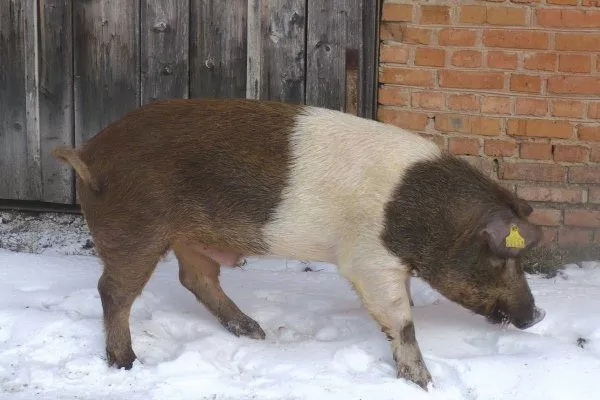
The red white-belted breed is often called the "Red Belted" pig; this is the popular name given to the pig - it sounds simpler and is easier to remember.
The characteristics of the breed are:
- resistance to severe weather conditions;
- strong physique and strong immunity of the body to various diseases;
- good appetite, ensuring increased growth rates.
The Red Belted pig breed has a red coat and a distinctive white stripe running near the shoulder blades. The breed has a calm, friendly disposition.
Pigs of this breed have a proportional body, a long torso, and a small head. They are unpretentious in their diet and require no special housing conditions. The most important factors in terms of optimal living conditions are dry bedding and protection from drafts. Pigs adapt easily to new environments. Due to their strong innate immunity, this breed can survive without vaccinations.
Productive characteristics
| Name | Average weight, kg | Body length, cm | Number of piglets in a litter |
|---|---|---|---|
| Red-belted pig | 220-320 | 165-180 | 10-11 |
Although the breed is quite young, in many respects it can easily compete with many foreign breeds.
The productivity indicators of red white-belted pigs are as follows:
- three-year-old stud boar: Average weight – 320 kg, body length – 180 cm.
- three year old sow: average weight – 220 kg, body length – 165 cm, third litter – 10-11 piglets, weight of a two-month litter – 182 kg.
- young animals: Average daily weight gain is 680 g, gain of a centner of live weight is 188 days, cost per 1 kg of weight gain is 3.5 units of feed, meat yield at slaughter is 60%.
The breed's meat is tender, with a thin layer of fat. Carcass yield can reach 65%, with a fat thickness of 20-25 mm.
Advantages and disadvantages of the breed
Like every breed, Red Belted pigs have their positive and negative qualities. Among the positive ones, it's worth highlighting:
- Rapid weight gain is rightfully considered the breed's main advantage. Compared to other breeds, this breed requires significantly less feed to achieve the same weight gain.
- High adaptability to various conditions. This breed can be raised in both northern and southern regions due to its climate tolerance and ability to quickly acclimatize.
- They are easy-to-eat. Rapid weight gain in these pigs can occur with a wide range of feeding options, making them suitable for many private households.
- High fertility. Sows of this breed demonstrate excellent results in this regard.
- Ease of maintenance. Representatives of this breed do not require frequent walks or bathing.
Of the negative characteristics, it is worth noting only a couple:
- The need for a dry floor. Without dry bedding, pigs can become irritable, making it difficult for them to be housed together and digest food.
- Fear of drafts. This breed is known for its frequent colds.
Despite the numerous advantages, Red White Belted pigs have only two minor drawbacks. Therefore, many farmers choose to raise this breed.
Selection of piglets
Due to the specific color of the breed, it is quite difficult to make a mistake when choosing piglets.
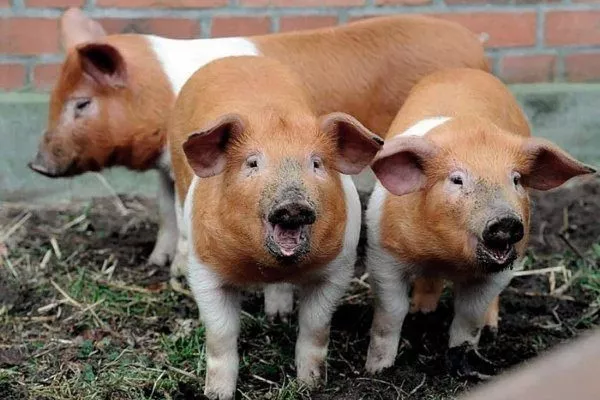
When choosing healthy piglets, you need to pay attention to the following signs:
- ActivityMany farmers believe this is the most important factor when selecting young pigs. Low activity in pigs most often indicates health problems.
- Skin condition and cleanliness of the animalIf bald spots, ulcers, and other skin problems are present, it's logical to assume the animal is infected with a fungal infection or external parasites. If the pig is dirty, this may indicate poor living conditions, which likely led to the animal becoming infected with various parasites and diseases.
- Stool and anal conditionA lot can be learned about the health of any animal from its feces. This can be revealed not only by laboratory analysis of feces, but also by a simple visual inspection. A high concentration of mucus and a liquid consistency in the feces may indicate an intestinal infection. Furthermore, worm-like parasites are also excreted along with the feces. Inflammatory processes or ulcers in the sphincter area can also indicate health problems.
- Tail conditionMost pig breeders are convinced that a curled tail in a piglet is a clear sign of its excellent health.
Based on the above characteristics, you can quickly determine whether the proposed piglets are worth purchasing. If the animal meets these criteria, you can confidently purchase it.
Care and maintenance
The process of raising these pigs is not particularly difficult. They are perfectly happy with standard barns. They tolerate limited exercise space and infrequent bathing. Low temperatures, which are unsuitable for other breeds, are not a particular problem for mature pigs.
Conditions
Housing the Red Belted pig is no different from other breeds of pigs. Cleanliness and adequate lighting are crucial factors. Dry bedding and the elimination of drafts are also essential. Poorly maintained housing increases the risk of a weakened immune system, which can lead to stress in pigs, leading to weight loss.
For optimal conditions, a dry, clean room with a temperature of 18-20°C and protection from drafts is required. The material used to build the pig pen is not critical. When laying the flooring, a slight slope should be created. It is best to use a floor made of tightly fitting boards. There should be no empty space under the floor.
When constructing a brick or concrete floor, place a wooden board over the area where the animal's den will be located. The interior walls of the enclosure should also be lined with meter-high wooden planks.
The pig pen must be separated by a board placed on its edge. For fattening pigs, the total area of such a pen should be at least 4 square meters, and for sows, at least 5 square meters. A nearby exercise yard is advisable. It is best to house piglets in pairs, as pigs are herd animals. This will help them maintain an excellent appetite and maintain weight gain.
Feeding
Red Belted pigs can be fed a variety of feeds. Today, there are two main feeding methods: traditional and modern. In the former, pigs are fed a mash of household waste and root vegetables, while in the latter, they are fed dry feed and various commercial mixtures. The modern method, according to many farmers, produces better results.
To produce the best quality meat, pigs should be fed barley, sugar beets, green fodder, pumpkin, rye, and carrots. Good results are achieved with concentrates. It is recommended to feed almost all feeds raw.
- ✓ Inclusion of barley and sugar beet in the diet to improve meat quality.
- ✓ Eliminate corn and oats to minimize fat deposits.
It is better to exclude corn and oats from your diet, as they lead to fat deposition.
Here are the basic rules for feeding this breed of pigs:
- grain crops must be pre-crushed;
- root vegetables should be boiled and served in small portions;
- give food in small quantities and always fresh;
- when using dry feeding, it is essential to have water in the drinking bowls at all times;
- The presence of proteins in the diet is extremely important.
Newborn piglets need to be fed sow's milk in the first few days of life, and can be gradually supplemented from the fifth day of life. It's a good idea to supplement their diet with compound feed mixed with premixes. This will accustom their stomachs to coarser food and provide excellent nutrition for their young bodies.
Of the many external factors affecting pig growth and well-being, feeding conditions and feed composition are fundamental. For example, insufficient feed and a poor diet directly impact reduced weight gain and prolong the fattening period.
The influence of feed on the quality of meat at the output can be roughly divided into 3 categories:
- Positive. It's good to feed pigs rye, wheat, millet, carrots, broad beans, barley, beets, peas, mixed silage, clover grass, alfalfa, skim milk, and whey. With sufficient amounts of these nutrients in the diet, the harmful effects of other feeds are minimized.
- Negative. Wheat bran, potatoes and potato pulp, corn, beet molasses, and buckwheat. The negative impact of these feed ingredients is less noticeable if they make up no more than half of the diet, but the other half should consist entirely of Category I feed.
- Extremely negative. Food waste, oilcakes, soybeans, distillers grains, oats, fish, and fishing industry waste. The negative impact of these feeds is due to their high vegetable fat content and specific odor, which affects the consistency and flavor of the finished meat. Feeds in this category should only comprise a third of the total pig diet, and they should be completely eliminated from the diet two months before slaughter.
When fed correctly, red-belted pigs produce excellent results, and their meat is highly valued due to its high quality characteristics.
We also recommend reading the article: How to properly fatten a pig for meat.
Breeding
This breed also stands out among other breeds as a breeder. It has been observed that crossing sows with Red White Belt boars significantly increases the number and quality of piglets in the litter. These sows can produce up to 12-15 piglets at a time.
Piglets of this breed reach sexual maturity at 8 months, and gestation lasts an average of 115 days. The day before farrowing, prepare the bedding, limit feed intake, and provide sufficient fresh water. Heating the farrowing room is also essential if farrowing occurs during cold weather. It's advisable to have someone knowledgeable present during farrowing, as any problems may require assistance or a veterinarian.
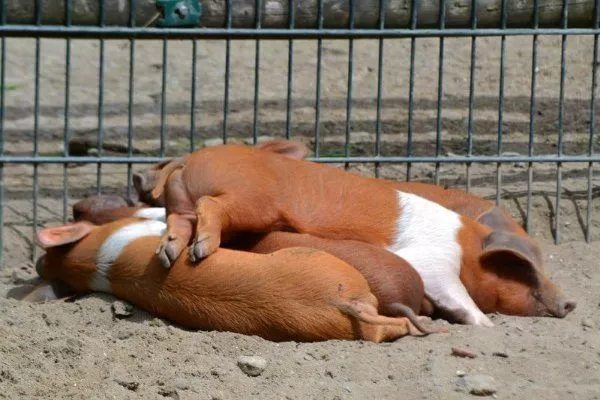
The imminent farrowing is indicated by the enlarged size of the sow's reproductive organs and mammary glands.
The process of preparing for farrowing and the birth itself is an extremely important part of pig breeding, so it must be approached with the utmost responsibility.
The features of this period of time are worth considering in detail:
- Three to four days before farrowing, the daily feed ration is reduced by half. This is necessary to avoid overloading the gastrointestinal tract and reduce milk production in the udder. During this period, the sow should have constant access to drinking water.
- A sure sign of impending labor is the appearance of colostrum in the sow's teats. By this time, you should have dry bedding, clean burlap, and a special piglet weaning box ready. You'll also need a 5% iodine solution, scissors, and sterile silk thread.
- To avoid missing the onset of farrowing, it's important to closely monitor the sow. A couple of hours before farrowing, the sow becomes restless and disturbs the bedding, creating a nest for the unborn piglets. Without bedding, the sow can even break open the wooden floor and make a nest between the broken boards.
- A newborn piglet is covered in mucus, and some are born with a birth sac. In these cases, the sac should be quickly torn off, the piglet should be dried with a clean towel, and its nostrils and mouth should be cleared of mucus.
- Next, they begin treating the umbilical cord. A newborn piglet has a very long umbilical cord, so it is tied 3-4 cm from the abdominal wall and cut 0.5 cm below the ligation site, after which it is lubricated with iodine tincture. If necessary, the umbilical cord can be severed. To do this, firmly pinch the umbilical cord with the fingers of the left hand 5 cm from the piglet's abdomen. With the right hand, grasp the remaining cord, twist it two or three times around its axis, and then tear it off. Twisting and tearing constricts the blood vessels, preventing bleeding. The severed site is treated with iodine tincture. The treated piglet is placed in a box with ample bedding.
- After farrowing, the placenta is removed and the bedding is changed. The sow should not be allowed to consume the placenta, as this may be one of the reasons she eats the piglets. The sow's perineum and teats are washed with a pale pink solution of potassium permanganate (1 g per 10 liters of water), and the piglets are placed under it. The weakest piglets are placed on the front, milkiest teats, and the largest piglets on the rear teats.
Newborn piglets are sedentary, so their mothers often crush them. To prevent this, a barrier of wooden blocks or metal pipes is installed along the walls of the pen, 20 cm above the floor and 15 cm from the wall.
Reviews of the breed
More and more private households and large livestock farms are beginning to raise this breed, as it stands out among other pig breeds for its superior performance. Farmers face no particular difficulties in raising and raising it, further testifying to the excellent work of breeders and pig breeders.