
The Large White pig breed is the most widespread worldwide. It's no wonder they outnumber other breeds, as they are highly productive and grow quickly to large sizes. Furthermore, the selective breeding process hasn't lost any of their best qualities.
| Breed | Average weight of an adult, kg | Number of piglets per farrowing | Early maturity, months | Disease resistance |
|---|---|---|---|---|
| Large white | 270-400 | up to 12 | 6 | High |
| Landrace | 300-350 | up to 10 | 7 | Average |
| Duroc | 350-450 | up to 9 | 8 | Low |
History of the breed's origin
The Large White pig originated in England. Initially, long-eared pigs were bred, and then regularly improved, creating favorable conditions and ensuring careful animal care. This is how the Leicester pig breed was developed.
In the 19th century, English pig breeds were increasingly improved. Local pigs were crossed with foreign breeds on many farms. These crosses resulted in numerous new breeds, but their genetics were not stable.
Later, in the 1830s, a British livestock scientist finally developed a robust pig breed whose major advantage was rapid maturation. However, they were small in size. Another obvious drawback was that the animals were very demanding in terms of care and living conditions. This breed was not widely used in farming.
However, just 20 years later, farmers crossed this breed with Leicester pigs and presented this crossbreed at an agricultural exhibition. This breed already boasted good fertility, excellent meat quality, and one of its main advantages—easiness in terms of housing conditions.
The breed was named Yorkshire after the place where it originated. It became very popular, and in 1885, a unified standard was developed to prevent the breed from becoming extinct. Since then, the breed has been known as the Large White.
These pigs were brought to European countries in the late 1880s. However, due to the war, the breed almost completely disappeared in Russia.
The Large White pig breed was again exported to Russia in the 1920s. Six hundred purebred animals were imported. These became the foundation for the country's breeding of pedigree domestic pigs, which were soon further improved. As a result, today's pigs differ significantly from their earlier breed. They are even more fertile, larger, and well adapted to any weather conditions and almost any climate.
Currently, the Large White breed accounts for 80% of all pigs in Russia. The remaining 20% also carry genes from this breed.
Description, characteristics and productivity of the Large White breed
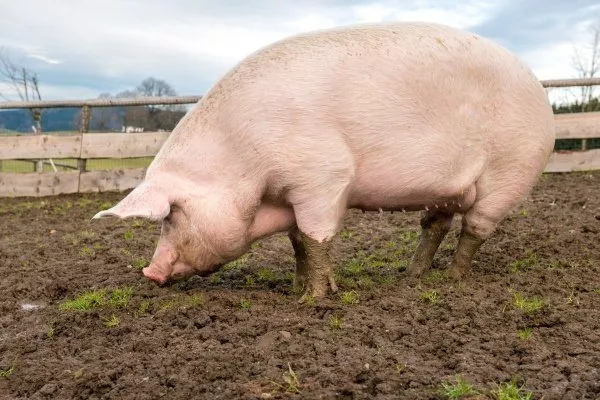
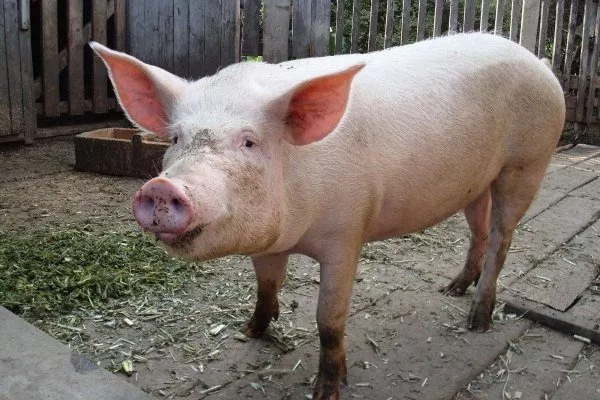
The Large White pig breed is classified as a meat and fat breed. These pigs are large, with a medium-sized head of an irregular shape and a light weight. The forehead is broad, and the snout is quite small, despite the neck being thick and long. The back is wide and arched upward. Their ears are small, firm, and pointed upward rather than drooping.
The body and chest are long and fairly wide. Males can reach a body length of 2 meters, while females reach 1.70 meters. The loin is also wide, blending into the sacrum, and the ribs are rounded. The sides and belly are not sagging. Sows have at least 12 teats. The hooves of this breed are straight and very strong. The pigs' skin is soft and free of wrinkles. Overall, this breed is very distinctive and difficult to confuse with another. The most important difference is the large size of the animal.
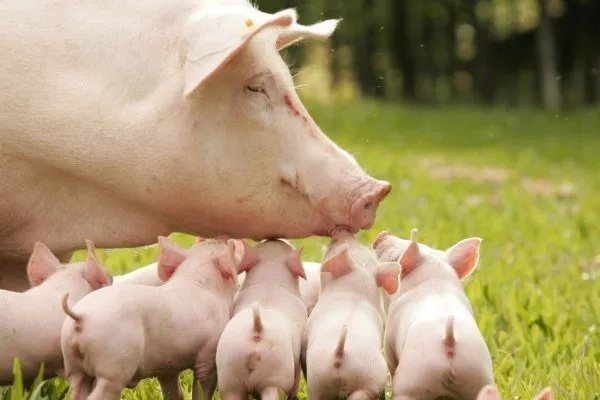
The sows' milk production reaches 90%. The animals have a calm, non-aggressive nature; they are also good mothers and carefully care for their offspring. A piglet weighs approximately 25 kg at 2 months, 100 kg at 6 months, and adult animals weigh 270 kg for sows and around 400 kg for males. Naturally, only healthy, properly cared-for animals reach this weight.
Sows usually give birth to up to 12 piglets at a time.
We invite you to see what a large white pig looks like and learn more about its characteristics in the video:
The main advantages and disadvantages of the breed
The breed has many advantages:
- animals are well adapted to climate change;
- the early maturity of pigs is one of the most important advantages of the breed;
- sows are very fertile;
- animals are unpretentious in their choice of food;
- Pigs have a flexible genetic structure.
However, the breed also has its disadvantages:
- Animals often suffer from obesity.
- Pigs have white fur, so they suffer from the scorching sun in some regions. Farmers must carefully monitor this, providing fresh air and ventilation in the barns. A shelter is essential during grazing to prevent the pigs from getting sunburned or scorched.
- They don't tolerate frost very well.
How to choose a piglet when buying?
To choose healthy piglets, pay attention to their height: they are taller and heavier than other piglets if they have been well cared for. If you reach out to a piglet, a healthy animal will run away, squealing. If a piglet doesn't respond to touch, this is an indication of illness.
- ✓ High height and weight compared to littermates
- ✓ Active response to touch
- ✓ Good appetite
- ✓ Weight of at least 20 kg at 2 months
When purchasing a piglet, make sure it has a good appetite and is very active. If you're buying a 2-month-old piglet, keep in mind it should weigh at least 20 kilograms.
Before purchasing, be sure to check with the seller what feed, formulas, and vitamins the animals have been eating to avoid the possibility of piglets refusing to eat and losing weight.
The price for a large white piglet starts at approximately 3,500 rubles, depending on the seller and place of purchase.
How to keep pigs?
A pigsty for Large White pigs should be warm, well-ventilated, and well-lit. The floor should be equipped with drainage channels for waste removal. There should also be a place for the pigs to bathe and exercise.
Three square meters of space is sufficient for young piglets, four for a sow, and six for a nursing sow. The pig structure must be sturdy and durable, as a weak fence could cause the pigs to break through and escape.
The breed also requires access to pastures to stay healthy. Furthermore, fresh air and exercise will help pigs avoid obesity and obtain essential vitamin D.
Feeding
Adult pigs should be fed three times a day, and don't forget to provide water. Pigs' drinking water should be at a temperature of 20 degrees Celsius to prevent stomach upset.
Pigs' food must be rich in vitamins and minerals. This is the only way to ensure their health and resilience to changing weather conditions. Good vegetables include carrots, potatoes, beets, and radishes; fruits include pears and apples; and dairy products, barley, wheat, oats, peas, and rye. Zucchini, corn, beans, and cabbage are also essential for a complete nutritional intake.
How to properly fatten a pig for meat – read here.
Breeding
Pigs reach sexual maturity at six months of age. However, experts recommend mating pigs for the first time at eight months of age.
The healthiest offspring are produced by sows that weigh about 120 kg at the time of mating.
For the best mating results, it's important to check the sows' readiness for mating. Only then will the mating be successful, as the sow will not run away from the male. The moment of arousal in a large white sow can be determined by the following signs:
- The animal becomes restless and squeals.
- Decreased appetite.
- The external genitalia become red and swollen.
- Some minor bleeding occurs.
- At the peak of sexual activity, the female stops moving and calmly allows the male to approach her.
The gestation period for large white sows lasts approximately 100 days and two weeks. You can tell a sow is about to give birth when her reproductive organs become intensely red and swollen, and her abdomen becomes lowered.
During labor, the sow requires human assistance. Newborn piglets need their snouts, ears, and mouths cleaned of mucus. The umbilical cord should also be cut and coated with iodine, and the piglet should be wiped dry. No more than 40 minutes after birth, the piglets should be introduced to the mother's breast. This provides the piglets with colostrum, which provides them with immunity, and helps ease the mother's labor pains.
Raising offspring
Piglets should be fed three times a day with boiled root vegetables, supplemented with plant foods, wheat with whey, and 10 grams of salt per day. Approximately 2.5 kg of feed per piglet should be consumed per 24 hours.
After the sow has given birth to her piglets, they need to be warmed, regardless of the season or weather. This can be done using special lamps, a fireplace, or a heater. The air temperature for the piglets in the first hours after birth should be at least 28 degrees Celsius (82.5 degrees Fahrenheit) to prevent them from catching a cold or getting draughts, as newborn piglets have weak immune systems and are highly susceptible to disease.
After birth, during their first feeding, piglets should be held by their snouts, guiding them toward their mother's teats. After feeding, they should be placed in a separate room from the sow and brought in only for feeding. Large White piglets gain weight fairly quickly.
From the third day after birth, the babies can be fed foods other than their mother's milk, gradually introducing adult food into their diet. They can also be let out into the paddock for exercise. The first foods to introduce are boiled potatoes and wheat with whey.
Prevention and treatment of diseases
Large White pigs have relatively strong immune systems. However, they can also suffer from diseases such as pneumonia, mange, and helminths.
To eliminate and prevent worms, deworming treatments should be carried out promptly. Separating piglets from adult pigs is also a preventative measure, and the pigsty should be cleaned regularly.
To prevent pigs from contracting scabies, keep the premises clean and feed the animals only the right food. Pigs also need to be bathed every season. If an infestation does occur, anti-scab solutions can help treat the animal.
Because the Large White pig breed is particularly sensitive to cold weather, these animals often suffer from pneumonia. At the first sign of illness, be sure to consult a veterinarian, who will administer injections and prescribe the necessary medications. Avoid choosing medications yourself, as this can cause harm to the animal.
This disease has visible symptoms:
- cough;
- tears;
- high temperature;
- increased salivation;
- heavy and rapid breathing.
Pneumonia is especially dangerous for piglets; they have a high risk of death from this disease, so at the first sign of symptoms, you should contact a veterinarian immediately. Until the veterinarian arrives, you can give the pig paracetamol to reduce the fever by crushing the tablet and mixing it with water. Do not exceed 1 gram per day. Subsequent treatment will be determined by the veterinarian.
If you notice stress or depression in your pig, it could be a sign of overheating. This condition is very dangerous for this breed of pig. Other signs of illness include ignoring irritants, a change in gait, uneven breathing, and a rapid pulse.
If the condition is extremely severe, convulsions, vomiting, and foaming at the nose may occur. Be sure to administer first aid before the veterinarian arrives. In case of heatstroke, move the animal to a cool room, open windows, if available, to let in fresh air, and give it water to drink (temperature should be around 23 degrees Celsius). Splash the pig's head and chest with the same water. If the condition worsens, administer a caffeine-glucose solution.
Read more about pig diseases.
Is it profitable to have a large white breed?
To obtain high-quality products, it is necessary to properly care for animals, which is possible both in a pig farm and in private production.
The Large White pig breed has become the most sought-after in Russia, and experts believe it can replace all other breeds, given its exceptionally good characteristics.
The pig's fertility and early maturity are a huge advantage for farm-raising. Piglets grow quickly and are ready for slaughter after just six months, as they are sufficiently heavy. The product has excellent characteristics, with a good meat-to-fat ratio. This, naturally, allows farmers to reap higher profits without spending large amounts of money on suitable conditions and animal feed.
For your own breeding, the advantage is that the animals are very easy to keep, as they are undemanding in terms of both care and climatic conditions.
Farmers' reviews
Caring for pigs on a farm is simple. The Large White breed is easy to maintain. The animals are cheerful and very friendly. By following basic care, feeding, and housing guidelines, you can easily raise large animals, ultimately yielding delicious meat and lard.