
Duroc is one of the most popular meat breeds of pig. It has some distinctive appearance characteristics. To produce high-quality products, certain feeding, housing, and care guidelines must be met.
Origin of the breed
The Duroc breed originated in America. It was officially registered in 1883. Selective breeding began in the early 19th century, when European settlers brought a large number of different animals.
The Duroc pig owes its origins to Red Guinea and Berkshire pigs. Today, this breed is widespread throughout the world and is quite sought after for its qualities.
The breed was originally called the Jersey Duroc, as the Jersey breed is very similar in characteristics to this variety. The breed name was later shortened, largely for convenience.
General characteristics
Currently, the Duroc breed ranks a respectable second in terms of numbers. Its popularity is also high. These animals are especially common in Europe, America, and China.
This meat breed is a bacon breed. It exhibits good live weight gain, but this can only be achieved with proper nutrition and housing. The meat products are attractive for their high quality.
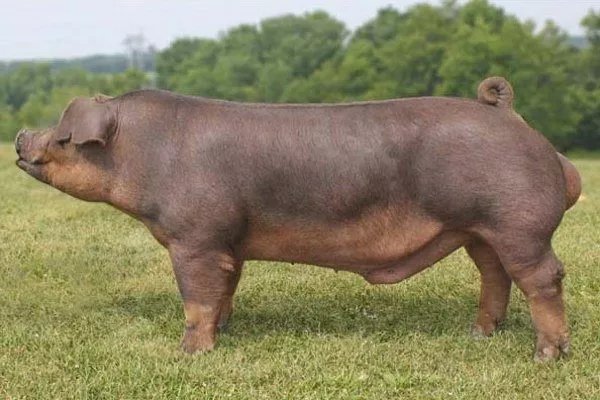
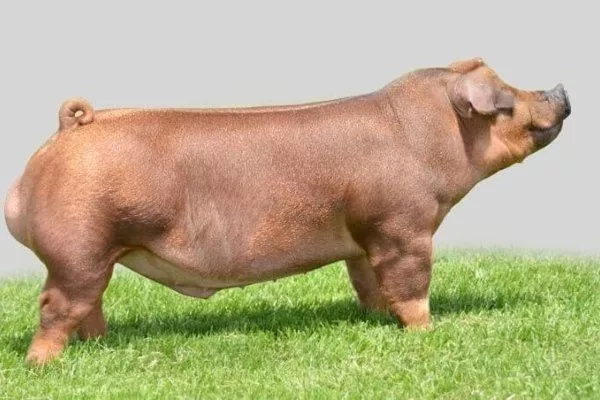
The Duroc breed is distinguished by its unusual coloring, known as red. It can range from dark red to lighter, even golden. Some individuals have tan markings, but no white is present.
Comparative indicators of productivity of meat breeds
| Breed | Average daily weight gain (kg) | Feed costs per 1 kg of weight gain (feed units) | Slaughter yield (%) |
|---|---|---|---|
| Duroc | 0.8-0.9 | 3.75 | 75-80 |
| Landrace | 0.7-0.8 | 3.9 | 72-75 |
| Large white | 0.6-0.7 | 4.1 | 70-73 |
Representatives of this breed have a distinctive appearance. They are large in size and have a strong constitution. The length of females and males is approximately the same. Females can reach 180 cm, while males reach 185 cm. Females weigh an average of 250-300 kg. Males weigh more, reaching 300-350 kg.
Duroc pigs are characterized by an arched back and strong, high legs. The hams are sharply defined and well-developed. The head is small and slightly arched, and the ears are long and hang forward.
Sows have seven teats on each side, spaced widely apart. They are well defined and functional.
Duroc pigs are attractive for their hardiness and excellent adaptability to pasture management. In some cases, they are used as genetic material to produce commercial hybrids.
Duroc pigs are not known for their high fertility. An average litter size is 10 piglets. The sows have excellent maternal instincts and a calm disposition. The piglets receive excellent care and nutrition.
Duroc is a precocious breed. Newborn piglets weigh an average of 1.1-1.6 kg. Average daily weight gain can reach 0.8-0.9 kg. Within two months, a litter's weight can reach almost 200 kg.
If piglets are given a control fattening, they can reach a live weight of up to 100 kg within six months. Approximately 3.75 feed units are required for each kilogram of weight gain.
The slaughter yield is up to 80% pure meat. It is attractive for its low fat content, nutritional value, and low percentage of fat relative to the meat layer. The meat has excellent flavor and juiciness.
In addition to low fertility, the breed's shortcomings include its high protein food requirements and high susceptibility to atrophic rhinitis.
Conditions for keeping Duroc pigs
The breed is widespread, but acquiring purebred specimens can be problematic, as the animals are often used for crossbreeding. This can result in pigs that have the characteristic Duroc appearance, but may differ in quality.
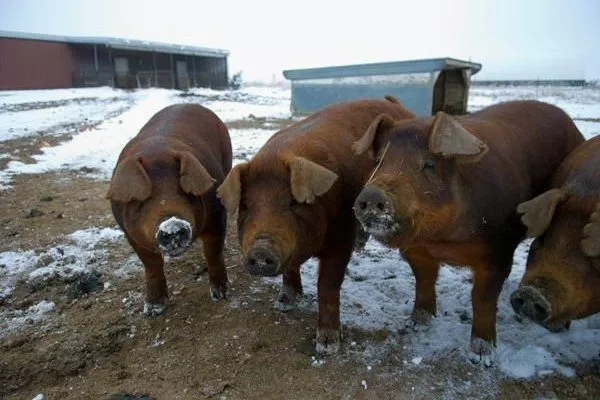
It's best to purchase young animals from a specialized breeding farm to ensure certain guarantees. Keeping Duroc pigs isn't particularly difficult. The following conditions must be met:
- Provide the animals with a walk-in area. This can last until the first hard frost. The walk-in area should be located next to the pigsty. If there is free access to the pen, there is no need for additional pens or shelters.
- You can let the pigs out into the fresh air as early as early spring.
- While grazing is permitted, animals can be kept in an outdoor pen. These conditions increase their appetite, leading to rapid weight gain. Meat quality also improves.
- An active lifestyle guarantees excellent meat quality. Therefore, the exercise area should be spacious enough.
- Pigs should be housed in a barn. Standard living conditions should be maintained.
- The pigsty must be clean and dust-free.
- The Duroc breed is quite adaptable to various climates, but does not tolerate severe frosts. This is due to the warm climate in their country of origin. The pigsty should be insulated, and in particularly cold weather, additional heating sources should be used. However, pigs are sensitive to drafts, so the room should be free of them, but a supply of fresh air should be provided. Pigs also do not tolerate overheating.
- When organizing the machines, one must take into account the number of animals, their size and gender.
- Boars and large pregnant sows require individual quarters. These should be 4-5 square meters in size. A wooden platform should be installed and lined with straw or hay. To avoid unpleasant odors, it's best to concrete or asphalt the floor. A layer of straw or hay should be placed on this surface.
Critical Content Errors
- Lack of ventilation with hermetically sealed insulation (risk of overheating)
- Concrete floors without underlay (frost damage in winter)
- Crowding of young (tail cannibalism)
Feeding
When feeding piglets, their increased protein requirements must be taken into account. Animals that have reached two months of age are selected for fattening.
The goal is to reach 100 kilograms of live weight. This can be achieved in the shortest possible time if the fattening regimen is followed and the feed is well-balanced.
The Duroc breed's diet can consist of a combination of silage, potatoes, legumes, and oilcake. Cereals can also be used. For fattening piglets, it is beneficial to include the following in their diet:
- beets (fodder and sugar varieties);
- bone and fish meal;
- meat and fish waste;
- milk and dairy products;
- reverse.
Standards for the introduction of protein components into the diet
| Age group | Fishmeal (% of diet) | Dairy products (l/head/day) | Legumes (%) |
|---|---|---|---|
| Piglets up to 2 months | 3-5 | 1.5-2 | 10-15 |
| Fattening young animals | 5-7 | 1-1.5 | 15-20 |
| Sows | 4-6 | 2-2.5 | 20-25 |
Piglets need to be fed solid grains to promote dental development. They are introduced to solid feed as early as the fifth day of life. Supplementary feeding is necessary even when piglets are sufficiently fed on their mother's milk. Supplementary feeding is important for preventing rickets.
Fattening begins at 2 months of age. Animals require a combination feed consisting of:
- potatoes;
- combined silo;
- oil cake;
- peas;
- reverse;
- bone-fish meal.
The presence of large amounts of corn, oats and barley in feed can cause obesity and loss of meat quality in pigs.
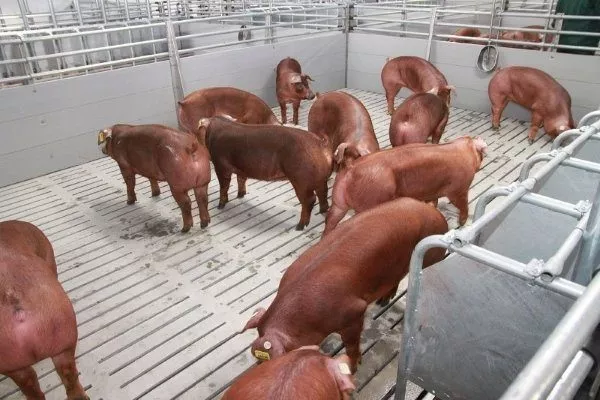
During the summer, feedings are given twice a day. In winter, an additional third feeding is introduced.
Breeding and raising young animals
The Duroc breed is characterized by low litter sizes, so raising piglets for commercial purposes is impractical. In this case, keeping the animals simply won't be profitable.
Duroc pigs show no distinctive signs of heat. It can be identified by nervous behavior, refusal to eat, and reddened genitals. Heat lasts about two days, but it's best to wait until the second day to perform the mating. For effectiveness, it should be performed twice.
It's best to not breed a sow before she's 10 months old. Pregnancy occurring earlier can cause significant harm to the sow's health. This often leads to exhaustion.
The piglet survival rate for sows is approximately 93%. Providing high-quality feeding is essential for the expectant mother to ensure healthy offspring.
During farrowing, it's important to monitor the room temperature. It should be at least 25 degrees Celsius.
If Duroc sows are bred commercially, matings should be scheduled. Typically, two boars mount one sow. A 12-hour interval is maintained between matings.
Duroc sows have a small litter size, so it is important to make every effort to maintain pregnancy and the health of the piglets.
The Duroc breed is well suited for crossbreeding. Large White and Landrace cattle are well suited for this purpose. The resulting breeds show good performance.
Adults are quite unpretentious, but piglets need to be provided with special conditions:
- the temperature in the barn should not be lower than 25 degrees;
- uninterrupted feeding;
- complementary feeding from the first days of life;
- sufficient amount of vitamins, iron, copper;
- dry bedding;
- warmth and no drafts;
- cleanliness in the premises.
Piglet vaccination schedule
- Days 3-5: iron supplements (Ferranimal 2 ml)
- Day 30: Erysipelas vaccine (VGNKI)
- Day 45: Plague vaccination (CS)
- Day 60: Revaccination against erysipelas
If piglets are growing poorly and slowly, they should be washed with soapy water, dried, and placed in a warm room. They should be given milk, adding an antibiotic if they have diarrhea. Piglets should be given fresh water three times a day. The recommended fluid intake is 0.2 liters per kilogram of body weight.
Raising young animals requires standard conditions. The main thing is to provide the animals with access to fresh air. Shelters can be provided to protect them from inclement weather. The sows themselves provide the necessary care for the young animals.
Common diseases
Duroc pigs are susceptible to colds if they are not provided with proper living conditions. The disease is accompanied by pronounced rhinitisIn this case, animals' eyes become red due to developing conjunctivitis. If the condition doesn't resolve within a week and a half, the animal requires treatment.
In cases of colds, a veterinarian is often avoided. Hard crusts are removed from the snout and lubricated with Vaseline. Piglets are treated with inhalations, using turpentine or ichthyol. A solution of potassium permanganate or an antibiotic can be placed in the nose.
In cold and damp climates, pigs often suffer from atrophic rhinitis. A major drawback of this disease is that it is virtually impossible to cure.
Preventive measures against atrophic rhinitis
- Humidity control in the pigsty (not higher than 70%)
- Use of bedding with antiseptics (sawdust + ash)
- Introduction of vitamin A into the diet (15,000 IU/head/day)
Another common disease is swine fever, which is of viral origin. It is difficult to treat, so in most cases (90%) the animal will die. The disease can be detected by loss of strength, lethargy, and elevated temperature. The incubation period can last up to 7 days.
The Duroc breed is susceptible faceThe danger of this disease is that even humans can become infected. The causative agent is a highly resistant bacterium that remains viable in soil for a long time, even after the death of the animal.
Erysipelas is most common in animals between six months and one year of age. The disease manifests itself with fever, vomiting, and intestinal atony. If the disease is acute, the animal dies. In subacute cases, recovery occurs within 12 days.
Another possible disease is viral gastroenteritisThis is an inflammatory process characterized by fever, vomiting, and diarrhea. The incubation period is 5 days. The causative agent is a coronavirus. Treatment is with antibiotics. It is essential to maintain cleanliness in the area and quarantine.
Read more about pig diseases in this article.
The Duroc breed has been around for about a century and a half. It is renowned for its excellent production quality and rapid weight gain. To get the most out of this breed, proper feeding and good living conditions are essential.