
The Kalmyk cattle breed is one of the earliest breeds of Asian origin. It was brought to the Caspian steppes in the 17th century. Today, it is the best beef breed. This breed was developed by nomads in the harsh conditions of China and Central Asia. They were greatly influenced by weather conditions, lifestyle, and harsh climate, as well as the daily confinement of cows.
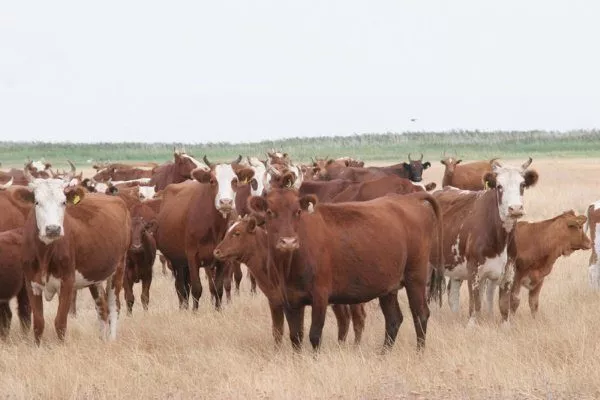
Description of Kalmyk cows
As early as 400 years ago, the Kalmyk breed of cattle became widespread in Siberia, the Volga region, and the Don coast. The main distinguishing features of this breed are its longevity, endurance, and robust body structure. Both males and females have a comb on the back of their heads—this is the main distinguishing feature from other breeds. The animals were strictly selected based on their nutritional value, with the best cows selected and the worst culled. The cattle were trained to withstand the harsh climate and were kept on pasture daily.
The animals are red with white spots, and their coats are red, red-and-white, or brown-and-white, with crescent-shaped horns. An adult cow can weigh as much as 500 kilograms, and a bull can weigh up to 1,100 kilograms. A newborn calf weighs approximately 25 kilograms.
The Kalmyk breed can also be recognized by the following characteristics:
- horns resembling a crescent moon;
- strong constitution;
- the lower back is elongated;
- agility;
- the ribs are widely spaced;
- the neck is fleshy;
- the head is not heavy;
- the dewlap and breast are well formed;
- the belly is round and slightly drooping;
- prominent udder;
- withers are wide;
- the skin is quite thick;
- hair is long;
- back straight;
- legs are straight and massive.
This breed is often crossed with other bull breeds to produce new types of beef or beef-and-fat cattle. The Kalmyk cattle possess excellent genetic material. All breeds crossed with the Kalmyk cow inherited its ability to withstand weather conditions and any climate, gain weight quickly, and graze from dawn to dusk.
Volga region farmers crossed Kalmyk cattle with Shortland and Simmental breeds to improve the cows' performance. But even after this crossbreeding, they realized that the pure breed still had superior qualities to the crossbred.
In the Volga region in 1928, when breeders had 1,200 heads of cattle, they identified and noted the following qualities:
- adaptability to the Russian climate;
- rapid weight gain, 600 kilograms for females and 1 ton for males;
- high percentage of slaughter meat;
- juiciness of meat.
Today, this is the practice of farmers who keep their cows in the dry steppe conditions. Only 90% of all animals thrive in the intensely sunny steppes. This is because other breeds are not as adapted to such harsh climates, and their productivity declines.
The Kalmyk breed is most popular in the following regions of Russia:
- Lower Volga region;
- Kalmykia;
- Stavropol Krai;
- Rostov region.
Somewhat later, they began to be bred in Kazakhstan, Turkmenistan, and Uzbekistan. In these foreign countries, Kalmyk cows have no competitors.
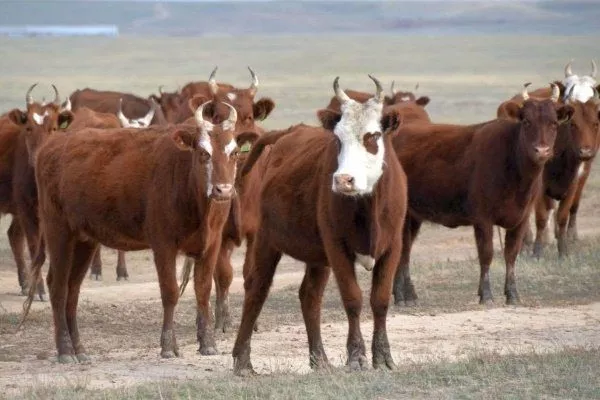
In captivity, a bull can be raised to 900 kilograms live weight, and calves with good nutrition and proper care weigh 450 kilograms by the age of eighteen months. With proper feeding, the slaughter weight percentage is 66%, much higher than other cow breeds. The slaughter weight of an eighteen-month-old bull is 60%. The carcass weighs 200 kilograms.
Farmers often keep Kalmyk cattle because their meat is tender, yields a large amount of it at slaughter, and produces excellent-tasting fat. They also start producing early, are good mothers, and fatten up quickly, gaining weight rapidly. Kalmyk cows and bulls tolerate a variety of weather conditions well and quickly adapt to new climates.
Important features of cows
A distinctive feature of the Kalmyk breed of cattle is their positive weight gain. During the winter, Kalmyk cattle lose between 30 and 100 kilograms, but even so, they look plump before they go out to pasture in the spring. During a single pasture season, cows can gain between 50 and 60 kilograms of fat.
In this breed, fat accumulates not only under the skin but also between the muscles. In winter, when the animal lacks grass and nutrients, and when the diet is poor, this fat reserve serves as energy.
Because the animal is 75% fat, which is also located between the muscles, their meat is unique and delicious. Kalmyk cattle (compared to others) are resilient to temperature fluctuations, thriving in both severe frost and unbearable heat. Scientists have discovered that this is due to their unique structure: the sebaceous glands have multiple outlets for the sebaceous glands, while other dairy breeds have a single opening.
Therefore, fat lubricates the fur well, allowing them to easily withstand wind, frost, and heat. Fat deposits protect the animal from overheating in the summer and, conversely, from frostbite in the winter.
This breed is often crossed with others to obtain meat quality dairy and meat and simply dairy breedThe Kalmyk cow is a source of excellent genetic material; it was this breed that contributed to the creation of the Kazakh breed and the polled Russian cattle. The resulting breeds, like the Kalmyk cattle, are hardy in all climates, particularly in extreme cold and heat. They also fatten well and gain weight quickly, possessing a valuable biological basis.
Productivity of Kalmyk cows
As for milk, this breed isn't particularly valuable, yielding between 1 and 1.2 tons per year. Some individuals can produce up to 3 tons per year, but this only occurs when the calf is bottle-fed. The milk's fat content is 4.5 percent.
The Kalmyk breed is prized for its marbled meat, which has an excellent flavor and aroma, despite its bright red color with yellow veins. Bulls of this breed are ready for slaughter when they reach a weight of approximately 500 kg, which occurs at approximately one and a half years. An adult bull weighs approximately 600 kg, and in some cases, bulls can weigh as much as 1,000 kg live. Since the animals can graze all day in pasture, their constant movement prevents them from accumulating fat.
Cows of this breed are noted for their high productivity and well-developed maternal instincts. They handle calving themselves without any intervention. Soon after calving, cows are able to graze and be bred again. Minor weight loss during the winter does not affect the health or weight of the calves. In the spring, they quickly regain the weight lost while being kept on pasture.
Slaughtering cattle in winter is unprofitable, as they lose 40 kilograms of weight, as cows always lose weight during this period. Summer is the most suitable time for slaughter, as cattle gain weight well, having received all the necessary nutrients from the pasture.
This breed has several characteristics that make it unique. Females gain fat even on the cheapest and lowest-quality feed. In a single season, both males and females can accumulate approximately 70 kilograms of fat, which serves as warmth during the winter.
How to care for and keep Kalmyk cows?
Cows of this breed don't require constant attention; even with long, continuous journeys, the cattle gain weight well. A herd of Kalmyk cattle can travel approximately 50 kilometers per day, but they require a mandatory six-hour rest period.
Care
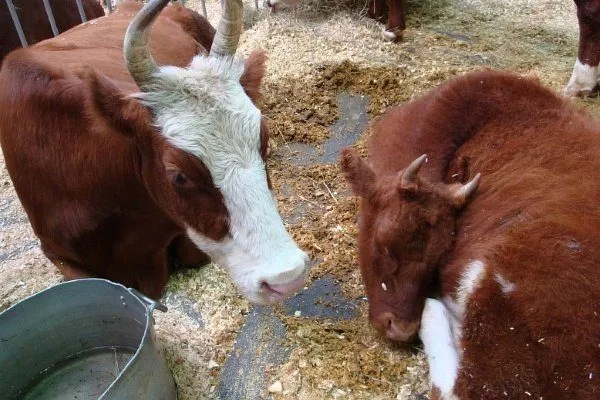
The barn where the cattle are kept should always be well-lit, with large windows and well-equipped stalls. The building should be well-ventilated. Insulating the barn is not required unless the temperature drops below -40°C (-40°F); straw bedding is sufficient.
The herd thrives even in temperatures as low as -45°C (113°F) and as low as -40°C (-104°F), making this breed suitable for breeding anywhere in the world. The cow owner must regularly clean the stall, provide clean water, and administer the necessary vaccinations. To quickly fatten Kalmyk cows, they should be fed. Bulls reach their desired weight within five months, and mature animals within three months.
Diseases
Kalmyk cows are disease-resistant; if they receive the necessary vaccinations, they rarely get sick. If there are infectious outbreaks, cattle can become ill. leukemia, leptospirosis, or actinomycosis. If all hygiene rules are not followed, cows can become infected with helminthiasis.
At the first sign of symptoms, seek immediate medical attention from a qualified veterinarian. During treatment, the sick cow should be kept isolated, both in the stall and in the pasture, to prevent infection of other animals.
- ✓ Availability of a variety of herbs, including cereals and legumes, to ensure a balanced diet.
- ✓ Access to clean water in sufficient quantities, taking into account the increased need for water in hot conditions.
- ✓ No marshy areas to avoid hoof diseases.
Feeding
In summer, cows forage for themselves in the meadows; there's no need to feed them with concentrated feed. They can graze on any meadow and eat any soft grass, as long as it's tall.
Even in winter, animals can get their own food in the pasture, getting it from under the snow.
Cows must have access to water, which must be provided four times a day. Calves weighing less than 250 kilograms will require 40 liters of water. Those weighing between 250 and 350 kilograms will require 50 liters, and those weighing more, 60 liters per day is sufficient. If the air temperature is high, 20% more water is needed.
| Type of feed | Weight gain (kg/month) | Cost (rubles/kg of weight gain) |
|---|---|---|
| Mixed-grass silage | 30-40 | 25-30 |
| Corn silage | 35-45 | 20-25 |
| Haylage | 25-35 | 30-35 |
Although animals can graze year-round, improved housing and the addition of feed to the diet will still have a positive effect on weight gain, especially for:
- mixed grass silage, as well as corn silage;
- haylage;
- vegetables and tubers.
From April to June, it's best to graze on cereal, feather grass, or fescue fields. Beginning in August, feather grass and wormwood fields should be preferred. During the grazing season, cows can accumulate about 60 kilograms of fat, which they use to maintain vital energy during the winter, when natural vitamins are scarce.
Caring for calves
Calves born to Kalmyk cows are healthy. They calve spontaneously, rarely requiring human assistance. The calf survival rate is 99% or even 100%, sometimes reaching 96%. Their strong immune system allows them to be kept anywhere in the world, even in unsanitary conditions.
Their birth weight is 25 kilograms. They are a late maturing breed, growing a little slower than others. meat breedsFrom the first days, they graze with their mothers, feeding on her milk. The calves develop quickly and gain one and a half kilograms daily.
They adapt to new living conditions within a week. Their immunity is still weak, so it's important to vaccinate against serious illnesses during this period.
After birth, calves are placed in a separate cage on straw directly in the barn, where there are no drafts and the air temperature is 13°C. They are fed colostrum approximately five times a day; on the second day of life, the calf can be given a small amount of warm water from a bottle. The cow produces colostrum for the first five days, after which regular milk is produced. From 10 days of age, water should be given three times a day, after which they are offered hay and succulent feed.
Feeding the young:
| Feed | 9-12 months | 13-16 months | 17-20 months |
| Bean hay | 1 kg | 1 kg | |
| Cereal hay | 2.7 kg | 3.5 kg | 4 kg |
| Straw | 1 kg | 1 kg | 3 kg |
| Corn silage | 8 kg | 10 kg | 14 kg |
| Beet | 2 kg | 3 kg | |
| Concentrated additives | 2 kg | 2.2 kg | 1.5 kg |
| Salt | 45 g | 50 g | 50 g |
| Phosphate | 35 g | 45 g | 40 g |
| Sulfur | 6 g | 8 g | 5 g |
Learn more about feeding calves from birth – read here.
How are Kalmyk cows bred?
The Kalmyk breed is often crossed with existing breeds and to develop new breeds of cows due to their endurance, early maturity, rapid weight gain, and excellent taste of meat products.
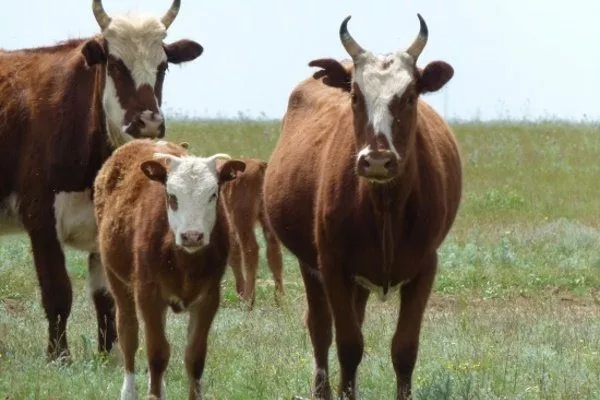
Today there are two varieties of Kalmyk cattle:
- Early maturing cattle with low body weight.
- Late maturing, but high body weight, high meat yield.
A cow is ready to breed at one and a half years old and can give birth to calves for 10 to 15 years. Heifers are only allowed to breed with Kalmyk bulls once they have reached a weight of 3 centners. Human assistance is not required during fertilization and birth of the calves; pregnancy is easy, and newborn calves weigh 22 kilograms.
Cows are excellent mothers; they don't allow anyone near their calves, becoming aggressive. Therefore, the calf is left with its mother until it grows up. The calf survival rate is high, at 95%; there are 90 calves for every 100 cows in the herd.
When a calf reaches 8 months of age, they stop suckling; by this age, thanks to their mother's milk, they weigh 180-240 kilograms.
By breeding Kalmyk cows on private farms, there's great potential for increasing their herd size. However, for grazing, they need a large area with a variety of grasses. They can only graze in one place for a week, after which they must be moved to another location.
Advantages and disadvantages
Kalmyk cows have many positive aspects:
- high endurance;
- excellent taste of meat products;
- early maturity;
- they fatten up quickly;
- a coat of moderate thickness can protect the animal from frost;
- easy to care for and maintain;
- cows are unpretentious in food;
- high survival rate of calves;
- high-fat milk.
Farmers' reviews
Farmers of this breed of cows report only positive results in terms of productivity and quality. Even those with no previous experience with cattle can raise them, as they require little maintenance.
Kalmyk cattle are profitable to breed because they are easy to care for and feed. They can also graze on pastures year-round. Regardless of the quality of feed, the animals gain weight well. The meat of this breed has excellent taste compared to other beef breeds.