
The birth of a calf is an important event on a farm. The newborn must be cared for not only by its mother, the cow, but also by humans. To ensure the animal grows strong and healthy, it is crucial to provide it with adequate nutrition in the first days, weeks, and months of life.

Feeding rules for calves from birth
The farmer should remember the following feeding features:
- A newborn calf should have access to the udder within the first 60 minutes of birth – this will reduce the risk of disease by 70%.
- The first portion of food should not exceed 6% of the newborn's weight.
- If a cow doesn't have enough colostrum, she can supplement her calf with semolina porridge. To prepare it, use 4 tablespoons of semolina per 3 liters of milk.
- The daily feed requirement on the first day of life should be no more than 20% of the calf's body weight. Subsequently, this requirement is increased to 24%.
- In the first days, a newborn eats 6 times a day, no less.
- On the sixth day, the baby is given 1 liter of warm water, two hours after feeding. From the third week, unlimited access to water is provided, poured into drinking bowls. Water can be replaced with pine or hay infusion.
- Weaning begins on the 6th or 7th day. Only fresh grass is used. The mixed grass should be free of coarse or dry particles. A bundle of grass is tied to the stall, 10 cm above the calf's back, or simply placed in the trough. Feeding is gradually increased; by three months, the animal should be receiving a 1.5 kg portion.
- By the time the calf is two weeks old, the number of feedings should gradually be reduced to three.
- The introduction of other feeds is carried out according to the following schedule:
- carrots – on the 15-17th day;
- concentrates and compound feed – from 14 days;
- boiled potatoes/apples – on days 20-21;
- table salt and chalk – from 21 days;
- fodder beet – from day 30.
Feed introduction plan- Carrots – on days 15-17.
- Concentrates and compound feed – from 14 days.
- Boiled potatoes/apples – on days 20-21.
- Table salt and chalk – from 21 days.
- Fodder beet – from day 30.
- Violation of nutritional rules or sudden changes in diet lead to illness and developmental delays.
- The diet changes as the calf matures.
Feeding methods
For feeding newborn calves, either of two feeding methods can be used:
- Drinking bowl. This method is commonly used by livestock farms during the first three weeks of a calf's life. It requires special drinking bowls with nipples filled with colostrum. The calves' feed is heated to 37°C.
- Sucking. This option involves direct feeding from the udder. The advantages of the suckling method:
- the calves are growing healthy;
- the food is already “ready”, there is no need to heat it up, pour it into a drinking bowl, or perform any other manipulations;
- meals are served in small portions - food is better absorbed;
- young animals grow 30% more intensively.
When suckling, the cow's udder must be washed to prevent infection from entering the calf's body.
Stages of feeding newborn calves
Feeding young animals is conventionally divided into three stages:
- Colostrum – from birth until 10-15 days.
- Milk – from 2 weeks to 4-6 months.
- Post-milk – from 4-5 months to the age of 16-18 months.
- Colostrum – from birth until 10-15 days.
- Milk – from 2 weeks to 4-6 months.
- Post-milk – from 4-5 months to the age of 16-18 months.
Colostrum period
A calf's birth weight is 30-40 kg. A calf's first food is colostrum. The mother cow provides it to the newborn during the first days of life. The composition of this product is very different from regular cow's milk. The characteristics and benefits of colostrum include:
- the amount of highly digestible protein is 6-7 times greater than in milk;
- supplies the calves’ body with protective antibodies that “build” the animal’s immunity and prevent infection;
- 2-3 times fatter than milk;
- several times more vitamins and useful minerals, for example, magnesium, which prevents intestinal problems.
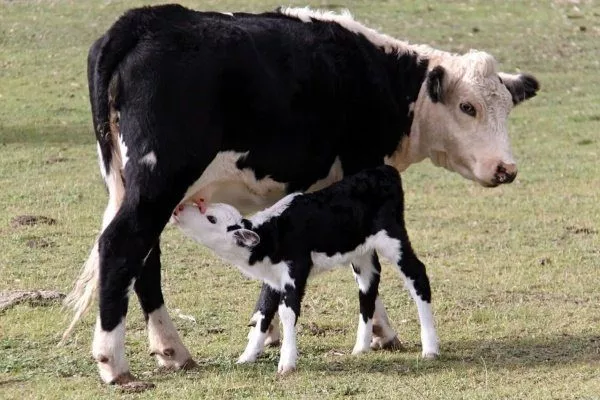
The colostrum that a cow produces within 5-7 days after the birth of a calf is almost identical in composition to milk.
In the first few days, a calf consumes approximately 1.5-2 liters of colostrum per feeding. Weakened calves receive 0.75-1 liter. It is preferable for a calf to feed colostrum directly from its mother. Overfeeding should be avoided, as this can cause digestive upset. A calf's daily intake of colostrum is approximately 8 liters. If a cow doesn't have enough colostrum, farmers often prepare a supplemental feed. In a clean bowl, mix the following:
- cow's milk – 1 l;
- chicken eggs – 4 pieces;
- table salt – 3-4 g.
- fish oil – 15 g.
The calf is given 1 liter of this mixture at intervals of 3-5 hours.
Milk period
After colostrum feeding is complete, the lactation period begins. The calf receives milk or whole milk replacer (WMR). For proper development, the following is necessary:
- choose the right milk replacer;
- observe feeding norms and intervals;
- provide free access to hay and water.
Milk replacer (MCM), used during the initial feeding period, provides the calf with a full range of nutrients. There are three groups of milk replacer:
- Highest qualityThey are based on skim milk (at least 50% of the substitute volume).
- Average qualityBased on dry milk whey.
- Low qualityBased on dry whey and vegetable proteins.
When preparing a milk drink, it is important to adhere to the proportions specified by the manufacturer of the substitute.
The use of zero substitutes leads to low weight gains and can even provoke diarrhea in calves, since their digestive system is not yet adapted to digesting non-dairy proteins.
The nutritional requirements of the substitutes are given in Table 1.
Table 1
| Nutritional value, % in 1 kg of milk replacer | Microelements and vitamins in 1 kg | ||
| Crude protein | from 20 | Copper | 4-5 mg |
| Crude fat | 15-20 | Iron | from 30 mg |
| Lysine | from 1.45 | Vitamin A | from 12,000 IU |
| Crude fiber | up to 3 | Vitamin D | from 15,000 IU |
| Calcium | from 0.9 | Vitamin E | from 20 mg |
| Phosphorus | from 0.65 | ||
| Raw ash | from 10 | ||
During the weaning period, the calf continues to be accustomed to different types of feed. The animal's diet should include:
- Hay.
- Dairy food.
- Top dressing from concentrates.
Only fresh ingredients are used for feeding, and any leftovers must be removed from the feeder—stale food can cause digestive problems. Hay and vegetables are the basis of the diet, but they cannot completely replace milk. Milk supplements can be prepared as a supplement. See Table 2 for the recipe.
Table 2
| Product name | Weight, g |
| Milk | 1000 |
| Meat and bone meal | 10 |
| Table salt | 10 |
| Chalk | 10 |
The above formula replenishes vitamins, phosphorus, and calcium. It is also recommended to feed the calf skim milk—4-6 liters per day. The calf's diet and feeding rates from two weeks to six months are listed in Table 3.
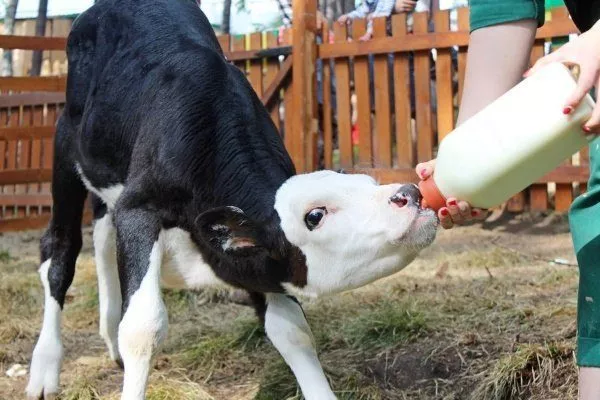
Table 3
| Age of the calf | Average weight, kg | Daily intake, kg | |||
| Whole milk | Concentrated feed | Succulent food | Meadow hay | ||
| Week 3 | 40-45 | 6 | — | — | — |
| Week 4 | 50-55 | 6 | — | — | — |
| 1st decade | 7 | — | — | — | |
| 2 | 7 | — | — | — | |
| 3 | 6 | 0.1 | — | 0.1 | |
| Total for the 1st month | 59 | 200 | 1 | — | 1 |
| 4 | 4 | 0.2 | 0.1 | 0.1 | |
| 5 | 1 | 0.5 | 0.3 | 0.2 | |
| 6 | — | 0.8 | 0.5 | 0.2 | |
| Total for the 2nd month | 81 | 50 | 15 | 9 | 5 |
| 7 | — | 0.6 | 0.5 | 0.5 | |
| 8 | — | 0.6 | 0.5 | 0.5 | |
| 9 | — | 0.6 | 1 | 0.5 | |
| Total for the 3rd month | 103 | — | 18 | 20 | 15 |
| 10 | — | 0.6 | 1 | 0.8 | |
| 11 | — | 0.6 | 2 | 0.8 | |
| 12 | — | 0.6 | 2 | 1 | |
| Total for the 4th month | 126 | — | 18 | 50 | 26 |
| 13 | — | 1.3 | 3 | 1 | |
| 14 | — | 1.3 | 3 | 1 | |
| 15 | — | 1.3 | 3 | 1 | |
| Total for the 5th month | 148 | — | 39 | 90 | 30 |
| 16 | — | 1.5 | 3 | 1.5 | |
| 17 | — | 1.5 | 4 | 1.5 | |
| 18 | — | 2 | 4 | 2 | |
| Total for the 6th month | 170 | — | 50 | 110 | 50 |
As Table 3 shows, starting at 2 months, the proportion of concentrated feed in the calf's diet increases. The calf can be fed:
- wheat;
- oats;
- barley;
- cake;
- bran.
It is advisable to soak hay in salt water before feeding - this will minimize the likelihood of parasites developing in the animal's intestines.
Weight gain increases with compound feed, and they continue to feed skim milk. Carrots or beets can be used as succulent feed. In addition to milk, calves can be given oatmeal jelly in the first month of life. Here's how to prepare it:
- Take 80 g of oatmeal and 1 liter of water.
- Pour boiling water over the flakes, cover the pan with a lid, and let the mixture steep for 15 minutes.
Feeding standards for oatmeal jelly are presented in Table 4.
Table 4
| Age of calves, days | Average daily intake, g |
| 10-16 | 200 |
| 16-19 | 400 |
| 19-21 | 600 |
| 21-25 | 700 |
| 25-30 | 900 |
| 30-32 | 1200 |
| 32-36 | 1800 |
| 36-60 | 2400 |
When animals reach two months of age, oatmeal jelly is replaced with concentrated feed.
A specialist explains how to prepare a complete milk replacer for calves:
Post-milk period
During the post-weaning period—from 6 months to 16-18 months—calf diets are selected based on their physiological needs and the intended use of the animal. If a calf is being fattened for meat, its daily diet consists of:
- chopped vegetables and root vegetables – 8 kg;
- hay – 3 kg;
- compound feed – 5 kg;
- fresh grass - to your heart's content.
The feeding standards for a six-month-old calf are listed above. These standards increase gradually. Table 5 presents rations for heifers.
Table 5
| Feed, kg | Age, months | Heifers aged 6-9 months | |||||
| 6-9 | 10-12 | 13-15 | 16-18 | 19-21 | 22-24 | ||
| Average daily gain, g | |||||||
| 550-600 | 450-500 | ||||||
| hay | 2.5 | 2.5 | 2.5 | 2.5 | 3 | 3 | 3.5 |
| silage | 6 | 6.5 | 10 | 12 | 12 | 12 | 12 |
| haylage | 3 | 4 | 4 | 4 | 5 | 6 | 7 |
| straw | — | 1 | 1 | 1 | 1 | 1 | 1 |
| concentrates | 1.1 | 1.1 | 1 | 1 | 1 | 1.1 | 1.5 |
Table 6 shows the diet of bulls fattened for meat using different types of feeding:
- haylage;
- silage and haylage;
- combined.
Table 6
| Stern | Live weight, kg | ||||||||||||||||
| 380 | 450 | 500 | |||||||||||||||
| Age, months | |||||||||||||||||
| 6-12 | 12-16 | 6-12 | 12-16 | 6-12 | 12-16 | ||||||||||||
| Average daily gain, g | |||||||||||||||||
| 750 | 750 | 900 | 900 | 950 | 1000 | ||||||||||||
| Hay feeding type | |||||||||||||||||
| Hay, kg | 1.5 | 2 | 1.5 | 2 | 1.5 | 2 | |||||||||||
| Silage, kg | 8 | 10 | 11 | 13 | 11 | 15 | |||||||||||
| Concentrates, kg | 2 | 2 | 2 | 2.5 | 2.5 | 3 | |||||||||||
| Feed phosphate, g | 40 | 50 | 50 | 50 | 50 | 60 | |||||||||||
| Table salt, g | 30 | 40 | 40 | 40 | 40 | 50 | |||||||||||
| Silage-haylage type of feeding | |||||||||||||||||
| Hay, kg | 2 | 2 | 2.5 | 3 | 2.5 | 3 | |||||||||||
| Silage, kg | 10 | 12 | 12 | 13 | 14 | 15 | |||||||||||
| Haylage kg | 4 | 5 | 6 | 6 | 6 | 7 | |||||||||||
| Concentrates, kg | 2 | 2 | 2 | 2.5 | 2.5 | 3 | |||||||||||
| Feed phosphate, g | 40 | 50 | 50 | 50 | 50 | 60 | |||||||||||
| Table salt, g | 30 | 40 | 40 | 40 | 40 | 50 | |||||||||||
| Combined feeding type | |||||||||||||||||
| Hay, kg | 2 | 3 | 2 | 3 | 2.5 | 4 | |||||||||||
| Silage, kg | 5 | 5 | 5 | 5 | 5 | 5 | |||||||||||
| Silage, kg | 8 | 10 | 9 | 10 | 10 | 11 | |||||||||||
| Root vegetables, kg | 5 | 6 | 5 | 6 | 5 | 6 | |||||||||||
| Concentrates, kg | 2 | 2 | 2 | 2.5 | 2.5 | 3 | |||||||||||
| Feed phosphate, g | 40 | 50 | 50 | 50 | 50 | 60 | |||||||||||
| Table salt, g | 30 | 40 | 40 | 40 | 40 | 50 | |||||||||||
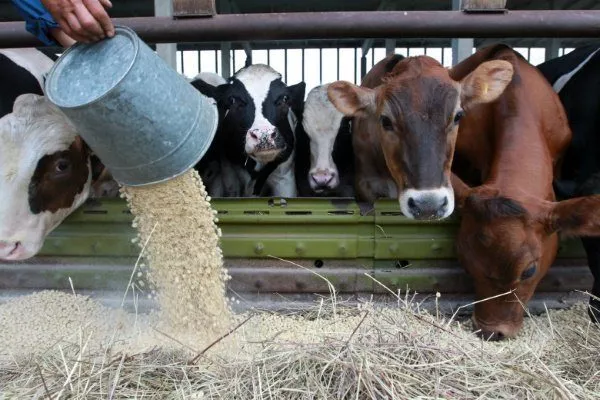
What should I feed a calf?
Calves can be given the following drinks:
- Sweet milk or milk drinkIt is fed in portions, unacidified. Temperature: 38-39°C.
- Warm sour milk or fermented milk drinkIt differs from sweet milk by its slightly acidic nature, with a pH of 5-5.5. Acidification improves the coagulation of milk in the rennet.
- Cold sour milk or fermented milk drinkFormic acid is usually used for acidification. The pH level is from 4.2 to 4.6. The temperature is 15-18°C.
Containers containing sour milk must be securely closed to prevent the drink from becoming contaminated with the smells of the barn.
Benefits of fermented milk drinks for feeding:
- pathogenic bacteria do not develop as actively in fermented milk drinks;
- casein, a milk protein, coagulates better in the rennet;
- Because of the sour taste of the drink, calves drink it in small portions;
- the quality of digestion of nutrients improves.
Vitamin supplements
Most vitamins should be supplied to a calf through food. However, feed alone doesn't always cover all its needs. If a certain vitamin is deficient, the animal will weaken and become ill. This is especially true during the winter. It is recommended to supplement calves' diets with vitamin supplements, such as:
- "Trivitamin." Add 4-5 drops to food. The dosage depends on age and is indicated in the instructions.
- "Eleovit".
- "Biovit-80".
These supplements are recommended for use in pets' diets from the third week of life. There are also medications administered intramuscularly, such as Nucleopeptid or Gavryusha. Consult a veterinarian before using these supplements.
A folk recipe for replenishing vitamins:
- Place 1 kg of spruce or pine needles in a deep pan.
- Pour 5 liters of hot water over the needles and boil for half an hour.
- When the mixture has cooled, the needles are removed and the juice is squeezed into a saucepan through cheesecloth.
This results in a vitamin-rich feed that is given to calves starting at two weeks of age. It is served warm, with a little salt added. The calf is given 50 grams of the infusion per day. Gradually increase the dose, reaching 1 liter by two months.
What is strictly prohibited to feed?
All feed given to calves must be of the highest quality. Cleanliness must be maintained during feeding—the cow's udder must be washed, and the calf's eating and drinking utensils must be kept clean. Feed calves only those foods that are part of their diet, with no unnecessary ingredients. Specifically, the following should not be fed:
- Poor quality hay showing signs of spoilage and mold.
- Bakery products.
- There should be no poisonous plants in the pasture - henbane, datura, buttercups.
- A mixture of potatoes and beets can cause bloating.
A balanced diet is not only the key to high calf weight gain but also a guarantee of their future health. A proper diet will help prevent calves from becoming sick or dying, and their owners from suffering losses.