
If a cow is purchased for milk production, then a dairy breed is essential. There are certain criteria for selecting such cattle. There are many dairy breeds, but each has its own characteristics. To choose the best option, it is necessary to familiarize yourself with the characteristics of each breed.
Criteria for selecting dairy cows
The ideal option is to purchase livestock with the appropriate documentation. A veterinary passport and documents confirming the animal's breed are required. A veterinary certificate and a document from the local government may be required for transporting the animal. It would also be a good idea to formalize a contract with the seller.
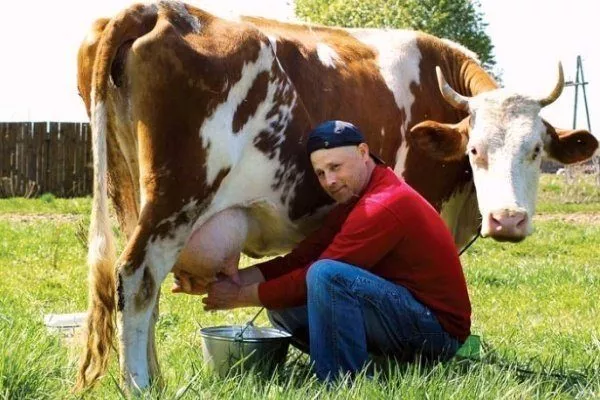
In addition to the documentation, when purchasing a cow, it's important to pay attention to its appearance. One of the most important factors is the udder. It can be cup-shaped, tub-shaped, or goat-shaped. The former is preferred. The udder should be large enough but not too pendulous, otherwise it will make it difficult for the animal to move and increase the risk of injury.
All quarters of the udder should be developed and free of deep grooves. It's important to palpate the udder, as looseness and graininess are indicators of quality. If the udder is fleshy, it's underdeveloped. The correct teat shape is cylindrical, and the optimal length is 60-80 mm. They should be smooth. Scratches, cracks, or ulcers are a bad sign.
The milk veins are important – they can be seen on the udder and on the lower abdomen. A sign of quality during a visual inspection is their thickness and elasticity, indicating their development.
In addition to the udder, when choosing a cow, you should also pay attention to the following factors:
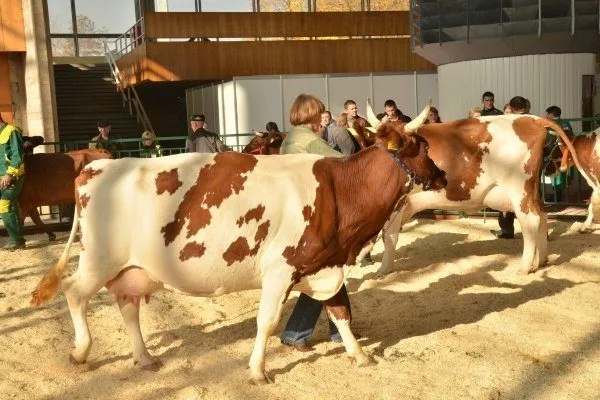
- The animal's body should be barrel-shaped, elongated, but not pendulous. The head should be light, elongated, and with a minimum of flesh. A well-developed neck, abundant folds of skin, and proportionality to the body are important.
- It's important to pay attention to the horns. They should be thin and properly positioned.
- The skeleton should be strong, but not coarse.
- The muscles are relatively weakly developed, but the legs should be straight, strong and wide apart.
- Pay attention to the shape of the chest. It should be wide and deep, indicating proper heart and lung development. The space between the ribs should be wide, and the ribs should be positioned at an angle to the spine—a sign of a properly developed digestive system.
- It's important to pay attention to the animal's hindquarters. They should be wide and level. The width of the rump is crucial for an easy calving.
Udder evaluation parameters
| Criterion | Optimal indicators | Undesirable characteristics |
|---|---|---|
| Form | Cup-shaped | Goat, pendulous |
| Nipple size | 60-80 mm | Less than 50 mm or more than 90 mm |
| Skin condition | Flexible, no damage | Cracks, ulcers, scars |
| Milk veins | Thick, sinuous | Thin, poorly defined |
- The thinness and length of the tail, which should reach the hock joint, are important.
- Pay attention to the vertebrae. For high milk production, they must be elongated.
- When choosing a cow, feel its skin. A good cow's skin should be easily folded but still elastic. There should be no subcutaneous fat to the touch.
- The cow should be milked to determine how easy the process is. It's important to examine the animal after milking, as the udder should have significantly shrunk and become more elastic. Folds of skin should appear on its back surface. If the cow produces little milk, the udder will remain virtually the same after milking.
- It's important to know the animal's age, whether it's pregnant, and the number of lactations (if any). Cows perform best in the fourth or fifth lactation. The approximate age of the animal can be determined by counting the rings at the base of the horns and adding two (the standard age for first calving). If the heifer is under one and a half years old, the age can be determined by the horn length. Subtract one from the centimeters obtained to obtain the age in months.
- Pay attention to the cow's condition. A healthy animal should be alert, with clear eyes and no signs of inflammation. A confident gait, no coughing, and a soft, smooth coat are important. Nervous behavior and thinning skin and coat are unhealthy signs.
- A healthy cow should have a good appetite.
Even buying a healthy cow doesn't guarantee good milk yield. To achieve this, the animal must be properly and well-fed, and its housing and care practices must be followed.
List of dairy cow breeds and their characteristics
Today, many cow breeds are known to produce good milk yields. Of these, the following are considered to be the most beneficial in terms of performance:
Ayrshire breed
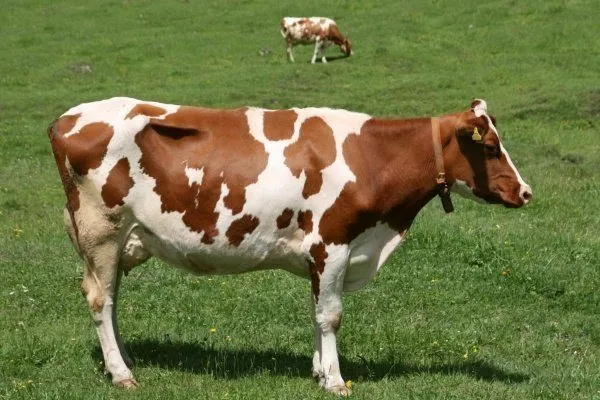
This breed of cattle originated in Scotland and was developed in the 18th century. These animals are distinguished by their red-and-white coat.
Ayrshire cattle have a well-proportioned frame, a strong constitution, and fine but strong bone structure. The breed is distinguished by a light, dry head with an elongated facial area and large horns. Adults can weigh up to 550 kg.
This breed is attractive for its high productivity and excellent milk quality. Ayrshire cows mature early, are hardy, and acclimate quickly.
Recommendations for choosing a breed
- For cold climates: Kholmogory, Tagil, Suksun
- For high milk yields: Holstein, Ayrshire
- For full-fat milk: Jersey, Red Danish
- For beginners: Yaroslavl, black-and-white
Comparison of dairy breeds by productivity
| Breed | Milk yield (kg/year) | Fat content (%) | Protein (%) | Weight of an adult (kg) |
|---|---|---|---|---|
| Ayrshire | 7000 | 4.3 | 3.5 | 550 |
| Dutch | 5000 | 4.0 | 3.5 | 650 |
| Holstein | 7500 | 3.8 | 3.0 | 700 |
| Jersey | 4500 | 7.0 | 4.2 | 400 |
| Danish Red | 4800 | 5.0 | 3.7 | 700 |
These cows are capable of producing up to 7,000 kg of milk with a fat content of up to 4.3%. The protein content can reach 3.5%. Due to the high fat content, the product may contain small fat globules.
Dutch cows
This variety was developed over three centuries ago. It is noted for its high milk and meat productivity, accelerated growth, and adaptability to various climates.
There are several branches of the Dutch breed: the Friesian, the Groningen, and the Maas-Rhine-Isel. The first variety is the most common. These animals are white with black spots.
An adult can weigh up to 650 kg. Their build is massive and their constitution is strong. The Dutch breed is distinguished by short legs and well-developed muscles.
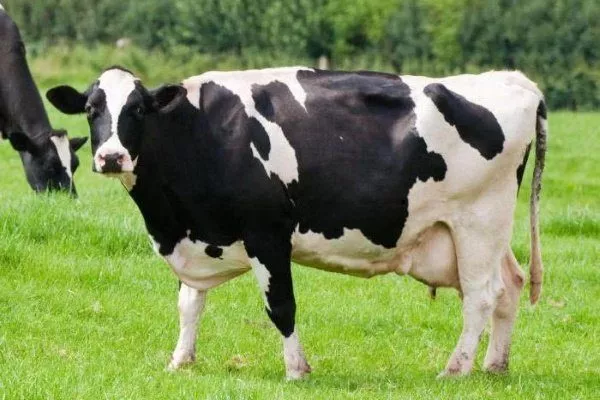
Dutch cows have large, cup-shaped udders. They can produce up to 4,000-5,000 kg of milk per year. Their milk fat content is approximately 4%, and their protein content is up to 3.5%. Read more about this breed of cows here. here.
Holstein breed
This variety is the most common dairy breed worldwide. It has been known since the mid-19th century. The breed originated in Holland but became popular thanks to breeding in the United States and Canada.
Holstein cows are distinguished by their robust constitution. They have a broad and deep chest, and a straight, long, yet wide hindquarter. Adults can weigh up to 700 kg.
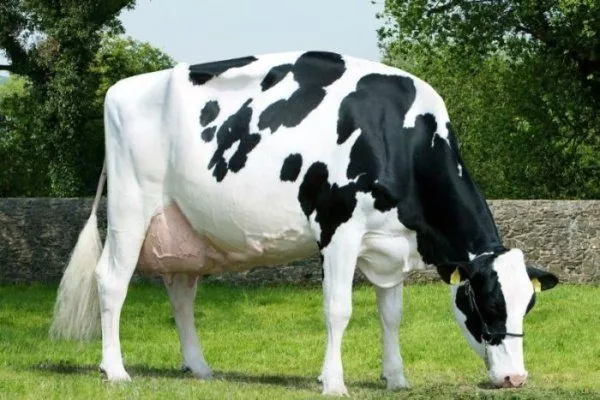
In Russia, a cow of this breed can produce 7,500 kg of milk per year. Milk yield depends on climate and feeding conditions. The average fat content of the milk is 3.7-3.8%, and the protein content is 3%.
Jersey breed
This variety is one of the oldest dairy breeds, developed as early as the 16th century through purebred breeding.
Jersey cows are red or brown in color with white markings. They have an angular build, a strong constitution, and dense muscles, but a light and fine frame. Their heads are light and small, with a shortened facial area. An adult can weigh up to 400 kg.
Jersey cows have many advantages, including high fat and protein content in their milk and good acclimatization.
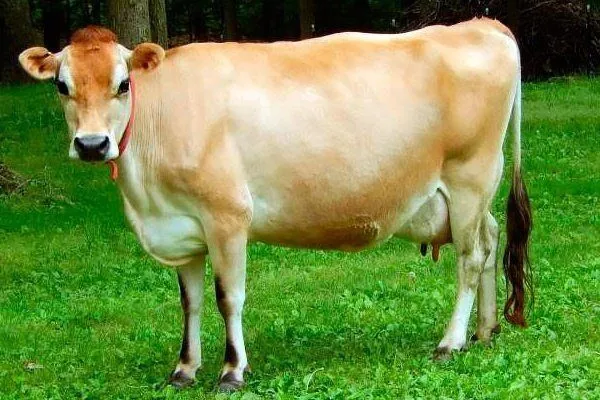
Despite their small size, the Jersey breed is renowned for its high milk production, producing up to 4,500 kg of milk annually. The fat content can reach 7%, and the protein content 4.2%. The milk may have a yellowish tint and large fat globules.
Red Danish cows
This variety was developed in the early 19th century by crossing several breeds—the Angler, Ballum, North Schleswig, and Shorthorn. The cattle have a red coat and white markings.
Danish Red cows are distinguished by their large size, strong constitution, low legs, and deep, wide bodies. This breed is characterized by a light head on a long, thin neck. An adult can weigh up to 600-800 kg.
In addition to high productivity and decent milk fat content, the Danish Red cow is attractive due to its early maturity and easy adaptation to any conditions.
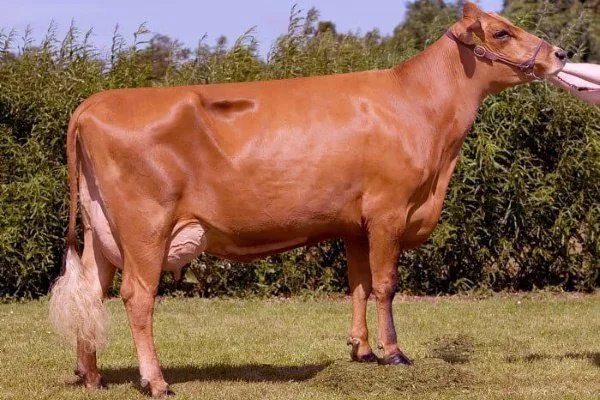
The Danish Red breed has a respectable milk production rate, reaching 4,800 kg per year. Milk fat content is up to 5%, and protein content is up to 3.7%.
Suksun cows
This breed was developed in the 19th century. It was created by crossing Danish Red and a local breed of cows.
Suksun cows are typically red in color, but come in a variety of shades. These cattle have a compact and strong constitution, a deep, narrow chest, a light head on a medium-length neck, a slightly elongated body, and strong skeletons. Adults can reach a weight of 500 kg.
The main advantages of this breed are its good adaptability to harsh climates, resistance to dangerous diseases, strong constitution and long reproductive function.
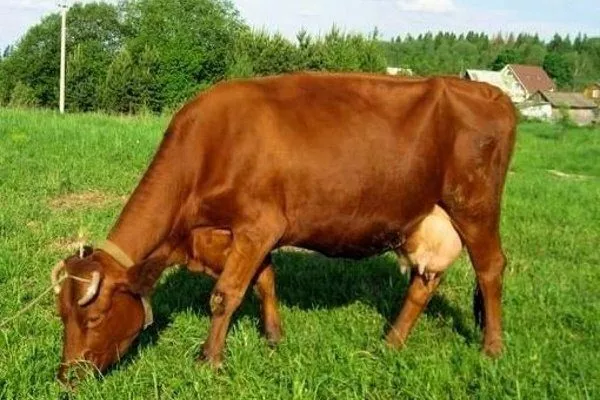
The Suksun breed's milk yield can reach 3,700 kg. Milk fat content can reach up to 4%, and protein content can reach 3.1%.
Tagil breed
This variety was developed in the Urals at the end of the 18th century. The breed comes in a variety of colors, but black or black-and-white cows are most common. Red and red-and-white specimens are also found.
The Tagil breed is characterized by a medium height, an elongated body, and a deep but narrow chest. These cows have a medium-sized head on a straight and long neck. The Tagil breed is characterized by underdeveloped muscles, and the legs are positioned incorrectly. An adult can weigh 500-700 kg.
The Tagil breed's appeal lies in its adaptability to harsh climates and its decent milk production. These cows milk easily and are capable of producing throughout their lives.
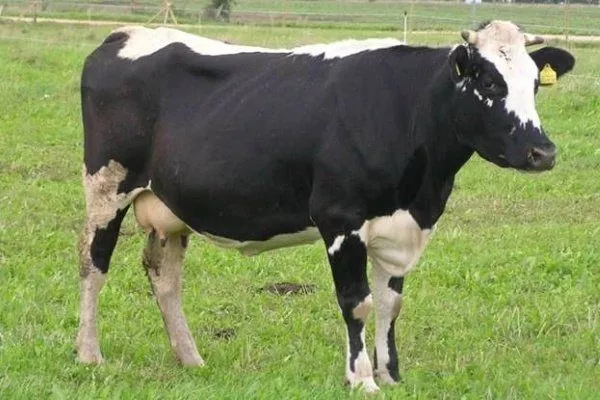
Tagil cows produce up to 4,500 kg of milk. Their milk can reach 4.2% fat content and 3.5% protein.
Kholmogory breed
This variety has been bred since the 18th century. Animals of this breed are strong and healthy. According to one theory, this is due to their upbringing in a harsh climate; another, to crossbreeding with a Dutch breed.
The advantages of Kholmogory animals include their adaptability to the harsh climate and high resistance to dangerous diseases.
Kholmogory cows are attractive for their muscular build, heavy, coarse skeleton, and lean, elongated heads. The animals are white with large black spots. A single animal can weigh up to 550 kg.
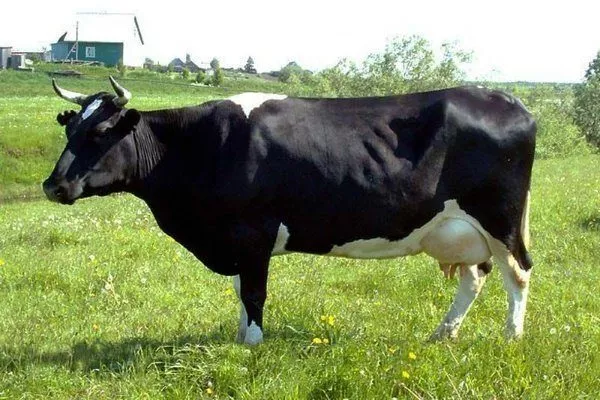
A Kholmogory cow can produce up to 5,000 kg of milk per year. Its average fat content is 3.7%, and its protein content is 3.4%.
Black and white breed
The color of these cows is clear from the name of the variety.
These purebred animals have a strong constitution, an elongated and proportionate body, and an elongated head with a long facial area. Adults can weigh up to 650 kg.
The breed boasts a number of advantages. These include excellent cattle health, rapid acclimatization to various conditions, and high milk and meat productivity.
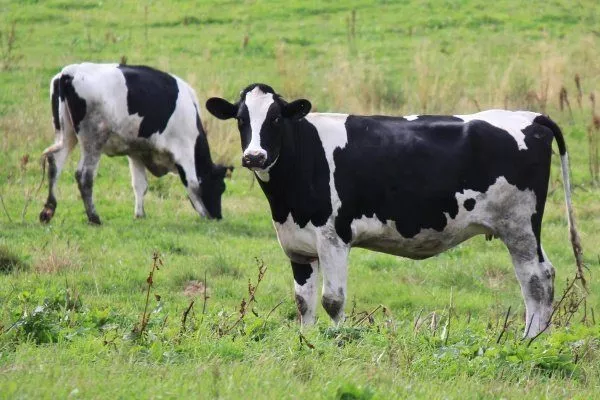
The Black-and-White breed is divided into two types: Siberian and Ural. The former is characterized by a small frame and yields up to 5,000 kg of milk per year. Its fat content is up to 3.9%. The Ural breed is distinguished by a dry, light frame and milk yields up to 3,800 kg. Fat content can reach up to 4%. The average protein content in milk is 3.2%.
Yaroslavl cows
In Russia, this breed is considered one of the finest dairy cattle. It was developed in the 19th century.
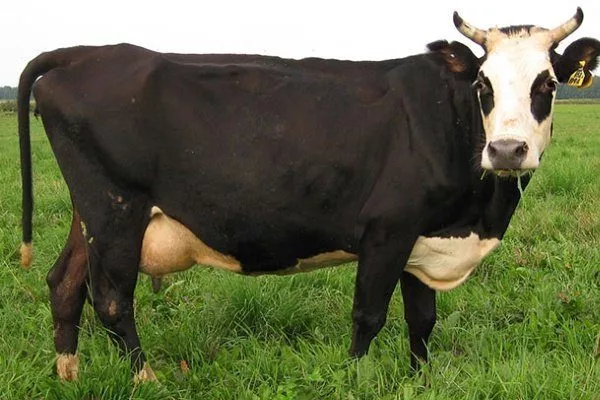
The Yaroslavl breed is characterized by a white coat and black markings. The animals have an angular build, strong bones and constitution, and a well-developed midsection. The head is distinguished by its lean, light appearance, elongated facial area, and light-colored horns. Adults can weigh up to 500 kg.
This breed's milk production is quite high, reaching up to 4,500 kg per year. The milk's fat content is up to 4.4%, and its protein content is 3.8%. These characteristics are the breed's main advantages.
Choosing a dairy cow requires special care. It's important not only to have the necessary documentation, but also to inspect the animal, which must be assessed based on a number of criteria. When choosing a dairy breed, the characteristics specific to each variety should be taken into account.