
Agronomists and farmers are interested in high potato yields, so they are actively breeding new varieties. The Uladar potato variety is relatively new. It is a high-yielding crop, which has earned it well-deserved popularity.
History of the variety
It was developed by Belarusian breeders in the early 21st century by crossing the Kolya and Zhivitsa varieties, and quickly received positive reviews from both scientists and agricultural exhibitions. The variety was added to the Belarusian register of agricultural crops in 2008, but has since spread to temperate climates far beyond the country's borders.
In 2011, the crop was added to the Russian agricultural registry, after which it began to spread throughout the CIS countries. Currently, the variety is more popular with farmers than gardeners, primarily due to its young age.
Description of the Uladar potato variety
Uladar refers to early ripening A high-yielding potato variety. Characterized by fairly large tubers and compact bushes. It is especially prized by farmers for its rapid maturation: the period from germination to harvest is 55-60 days. This allows for cultivation in cool climates, and in moderate temperatures, two harvests per year. This also allows for a good harvest from a small garden plot.
Escapes. Uladar potato plants grow 55-60 centimeters tall and grow fairly evenly, not loosely. The leaves themselves are bright green with wavy edges. A distinctive feature of this potato is its red-violet flowers, which are quite difficult to confuse with another variety.
The shoot structure facilitates crop care, watering, fertilizing, loosening the soil, and pest and disease control. To ensure the leaves receive sufficient light and the tubers have enough space, it is recommended to plant potatoes at a density of no more than 500 tubers per 100 square meters.
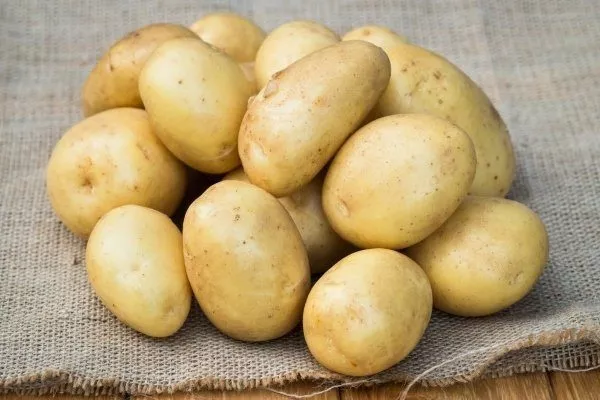
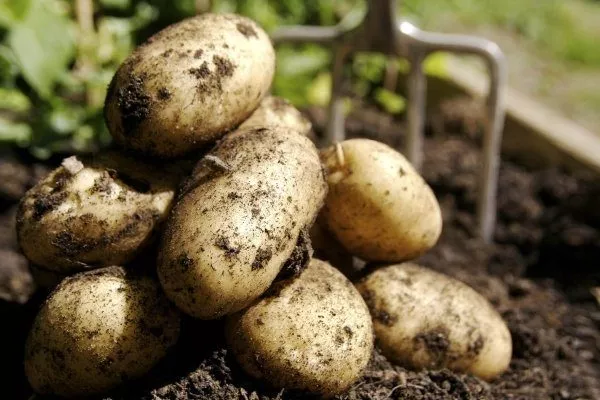
Roots. On average, a bush produces 8 to 12 potatoes weighing 100-140 grams. The skin is yellow, ranging from almost white to bright yellow, depending on the soil type and fertilizer. The skin is soft to the touch, without any characteristic roughness. The flesh is also yellowish and retains its color when heated.
The potatoes are round and similar in appearance, but sometimes oblong tubers are found. A pleasant bonus for consumers are the small eyes. Even if the root crop sprouts while stored indoors, the shoots can be easily cut out and eaten.
Characteristics and features
The Uladar potato is an early-ripening table potato variety. New potatoes can be harvested 40-45 days after planting, and the period to full maturity is no more than 75 days. This variety is characterized by its relatively dense roots, making it shelf-stable and resistant to mechanical damage.
The plant tolerates short-term drought well, making it a popular choice in temperate climates. It's not particularly well-suited to arid climates and requires regular watering.
Potato plants develop fairly strong roots that are not only tolerant of arid soils but also grow well, producing high yields in light and medium soils (based on texture). The robust root system allows the root crop to be grown in other soils as well. The variety is quite easy to grow.
| Disease | Sustainability |
|---|---|
| Potato cancer | Full |
| Nematode | Full |
| Scab | High |
| Tuber blight | High |
| Rhizoctonia | High |
| Leaf blight | Low |
Disease resistance
A bonus to the Uladar potato's low maintenance is its high disease resistance. Among the variety's advantages are complete immunity to potato canker and nematodes, as well as high resistance to scab, tuber blight, rhizoctonia, and other viruses. However, the leaves are still highly susceptible to late blight, and the variety lacks natural protection against the Colorado potato beetle.
Productivity and taste
This variety is an early-ripening, high-yielding potato. The maximum potato size is 180 grams. A single plant can yield up to two kilograms of potatoes. The average yield is 60 tons per hectare, with a maximum of 71.6 tons. Early harvesting typically yields lower yields, with yields reaching approximately 25-30 tons per hectare.
The tuber's characteristics include low starch (11.5-17.8%) and sugar (0.4-0.45%) content. Therefore, starch production from Uladar potatoes is not recommended. The potato has excellent taste and is considered a table variety. Due to its composition and structure, it does not overcook well but retains its flavor even after prolonged cooking. Experts note the potato's high shelf life (94%) and attractive marketable appearance (91-99%) due to its resistance to mechanical damage.
Advantages and disadvantages
The Uladar potato variety has received good reviews from experts and farmers due to its many advantages and few disadvantages. advantages can be attributed to:
- high productivity;
- fast ripening, allowing for planting and harvesting twice a season;
- good level of disease resistance;
- the firmness of the fruit ensures long-term storage;
- undemanding to growing conditions, compatible with most soils, drought resistance;
- pleasant taste;
- resistance to mechanical damage;
- uniformity of potatoes, pleasant appearance.
Features of planting and growing potatoes Uladar
To obtain a large potato harvest, all the rules must be followed. With early planting, the first roots can be harvested as early as early June, after which replanting can be done for another harvest in the fall.
Growing the Uladar potato variety doesn't require any special agricultural practices. However, it's important to remember that crop quality depends on moisture, soil composition (fertilizers), and pest control.
You can learn more about the size of the Uladar potato variety's bushes by midsummer by watching this video:
Preparing the site for planting
Before growing potatoes, careful soil preparation is required. Nitrogen is essential for tuber growth and the supply of nutrients obtained through photosynthesis. Potassium and phosphorus fertilizers are required for the tubers to fill out and ripen.
Farmers recommend adding both organic (humus, manure) and mineral fertilizers to the soil. Organic fertilizers are typically applied early (in the fall or early spring) when plowing the soil. Mineral fertilizers are applied during planting and growing season. Otherwise, some of the essential nutrients will be washed away by water. Immediately before planting the tubers, the soil should be watered until moist.
Preparing tubers
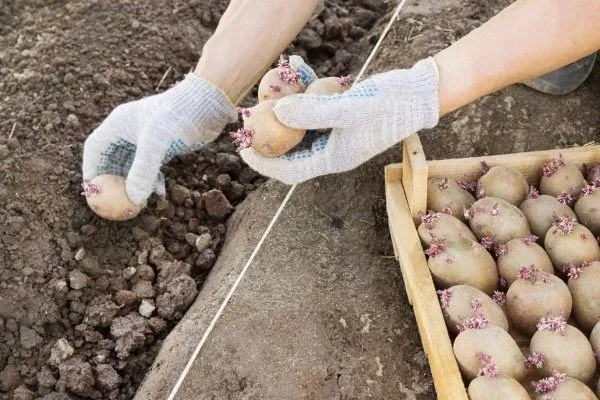
Before planting, potatoes are germinated to form sprouts. To do this, the tubers are transferred to a room with a temperature of 10-15°C. After 2-3 weeks, the potatoes are inspected for sprouts.
Next, measures are taken to combat root crop diseases. To do this, the potatoes are inspected during preparation for planting, any diseased tubers are discarded, and then soaked for 20-30 minutes in a weak solution of hydrogen peroxide or potassium permanganate.
A special feature of the Uladar potato variety is that it tolerates cutting well. If there are many sprouts, the fruit is cut into 2-3 pieces.
Each part should not be less than 30-35 grams, otherwise the sprout will not have enough resources to germinate.
Planting in the ground, planting scheme
The planting depth of tubers directly depends on the climate and soil moisture. They are planted in moist soil, when the soil temperature does not drop below 10°C. For humid climates, a depth of 5-6 centimeters is sufficient. In this case, the crop is planted using the ridge method.
In arid climates, the crop is planted at a greater depth – 10-12 centimeters. Due to the small size of the bushes, the distance between tubers is 25-30 centimeters, and between rows, about 60 centimeters for ease of care.
Fertilization
After planting, potatoes need to be fertilized. While nitrogen is added with compost beforehand, potassium and phosphorus are needed after the roots emerge. Therefore, the soil should be fertilized several times throughout the season. Nitrogen should only be applied if the plants are not large enough or have a yellowish tint. However, extreme caution should be exercised when applying this substance.
Excess nitrogen has a negative impact on crop yield.
Care
Care for the crop is the key to a good harvest. For potatoes to grow, they need to:
- water;
- weed;
- spud.
Potatoes are watered at least three times per season. However, this frequency can be adjusted. In humid climates, the crop can survive without watering at all, while in particularly arid regions, this procedure must be carried out at least six to eight times per season. Phosphorus or complex fertilizers can be applied during watering. Potatoes tolerate mild drought well, so care must be taken not to overwater.
Weeding is done 2-3 times. Weeds can take up some of the plant's nutrients, so they should be removed promptly. The first weeding is done when the stems reach a height of 5-10 centimeters and are significantly different from the weeds.
Hilling is done when the plants reach a height of 10 centimeters. The soil must be constantly kept loose by hilling to provide the tubers with oxygen. Mulching the beds also has a beneficial effect on the yield.
Read more, How to make a potato hiller independently from an old bicycle.
Protection from diseases and pests
After the first shoots emerge, during weeding or hilling, inspect the plants for diseases. If leaf curl is detected, the bushes are treated with a solution of potassium permanganate or hydrogen peroxide; however, due to the variety's characteristics, such problems are relatively rare.
- Collecting beetles by hand a few days after hilling.
- Treatment of bushes with special agents in case of large accumulation of pests.
- Repeat treatment after 20-30 days with different means.
Colorado potato beetle control when growing the Uladar variety should be systematic. A few days after hilling, the pests should be collected to prevent them from laying eggs. If there is a large infestation, treat the potatoes with a specialized product. Follow the instructions on the packaging. This product typically lasts for 20-30 days, after which the plants are re-treated due to their low resistance to the pests.
The bushes should be treated with different products, based on different active ingredients, due to the development of resistance to the preparations in Colorado beetles.
Harvesting and storage
Harvesting begins 60-65 days after planting. When the tubers are ripe, the foliage will fall off the bushes, but the tops will still be green. This is considered the optimal time for digging. For new potatoes, 40-45 days are sufficient, after which the soil can be prepared and the crop can be replanted.
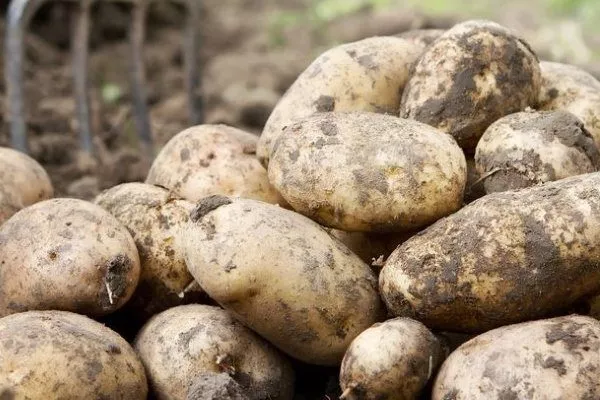
The harvested potatoes must be cleared of soil, dried, and aired outdoors. Next, they are sorted, removing damaged and defective potatoes. After this, the potatoes are stored in a cool, dry place out of direct sunlight.
Read the detailed article about harvesting and storing potatoes.
Reviews
The Uladar potato has received positive reviews from experts, farmers, and ordinary gardeners. It is rightfully considered one of the most productive varieties in Belarus and the CIS. It produces a quick harvest and is easy to grow and store, making it a popular choice among farmers and gardeners.