
Potatoes have long been a second bread for people around the world, including the CIS countries. However, harsh climates aren't always suitable for growing even this undemanding vegetable. The Veneta potato (also known as Vineta) thrives in poor soils and during dry periods. But even such a "patient" variety requires skill.
History of the variety
Veneta is a potato variety selectively bred in Morocco by German agronomists in the mid-20th century. The breeders' goal was to create a drought- and disease-resistant vegetable with an early harvest. For the most part, their vision was successful. The originator of this potato variety is EUROPLANT PFLANZENZUCHT GMBH.
The Veneta variety is easy to cultivate and produces high root yields. It only became popular in the CIS countries in the 2000s, but demand for it immediately became high.
Description of the Veneta potato variety
The Veneta variety is a unique, ultra-early table potato. It tolerates transportation well and can withstand both drought and temperatures down to zero degrees Celsius. Therefore, it is recommended for planting in regions with challenging climates.
The variety has undergone laboratory testing, which has confirmed its suitability for food, energy value, and excellent taste characteristics.
Escapes
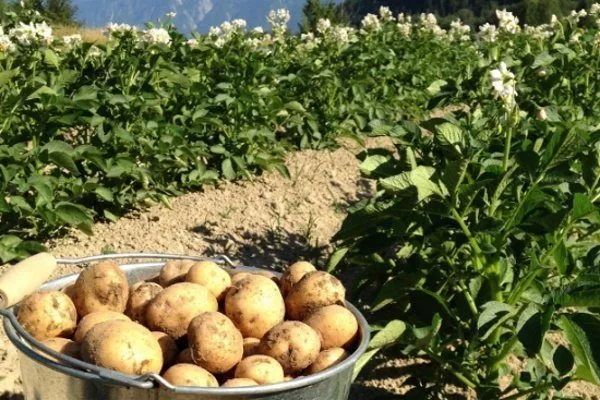
Veneta bushes are large, reaching 50-70 cm in height. The leaves are wide, bright, and light green, growing densely along the entire stem, with a faintly wavy edge. The blooms feature 3-7 large white flowers with yellow centers.
Roots
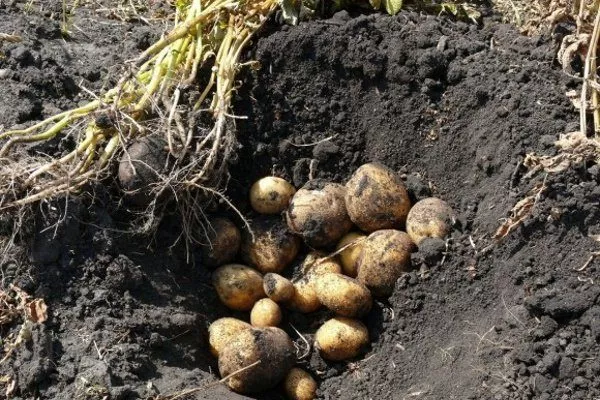
The potatoes themselves are relatively small, oval or oval-round in shape. The skin color of a mature tuber ranges from dirty yellow to light brown, with a faint "netting." The flesh is light yellow, and the tuber weighs between 60 and 100 grams.
It is free of defects such as cracks and dark gray or green spots. The eyes are small, almost invisible, and do not extend deep into the tuber, which helps the potato remain edible longer. Starch content: 13-15%.
Characteristics of the variety
| Parameter | Indicator |
|---|---|
| Ripening period | 40-45 days (young), 70 days (fully mature) |
| Yield per bush | 3 kg (12-17 tubers) |
| Tuber weight | 60-100 g |
| Starchiness | 13-15% |
| Shelf life | 87% |
| Drought resistance | High |
The Veneta variety possesses a number of properties that have made it one of the most popular, especially in the northern regions of Russia and the arid regions of Central Asia. These include:
- Fast ripening of the cropThe growing season lasts about 70 days, and after 40-45 days, young tubers can be dug up.
- Drought resistanceVeneta can go for long periods without watering.
- Shelf lifeIt is determined at 87%, and potatoes easily survive long-term storage.
- Appearance. Neat tubers, without physical defects and eyes, are well received by consumers.
- TransportabilityThe tubers withstand long-distance transport well. They are firm and resilient enough to withstand mechanical impacts and falls.
But the most important indicator of the Veneta variety's quality is its disease resistance. Once you plant your potatoes, you don't have to worry about:
- leaf roll virus;
- mosaics and spotting;
- scab;
- black leg;
- potato cancer;
- potato nematode;
- rotting of tubers;
- viruses A and Y.
Despite its resistance to most diseases, the Veneta variety is susceptible late blight.
Productivity and taste
Potatoes are characterized by high yields. A single plant can yield up to 3 kg (12-17 tubers). On average, 160-230 centners of the vegetable are harvested per hectare.
This variety combines high tuber survival and abundant yields with excellent flavor. When boiled, the potatoes don't become overcooked or turn grayish-white. They quickly develop a delicious golden crust when deep-fried or pan-fried. Veneta is ideal for any culinary experiment. It makes both mashed potatoes and chips equally well. Veneta potatoes retain a pleasant yellow color after cooking.
Advantages and disadvantages of the variety
The Veneta variety has the following strengths:
- high level of immunity;
- unpretentiousness to climatic conditions and soil nutrition;
- large volumes of harvest;
- short ripening period;
- neat appearance of tubers;
- ease of storage and transportation;
- good taste;
- retaining shape and color during cooking.
Features of planting and growing
Even with such an unpretentious variety as Veneta, it is important to take into account the vegetable's characteristics to ensure the harvest is as large as possible and your efforts are not wasted.
Preparing the site for planting
Sprouted tubers should be planted in late April or early May. Before planting, it's advisable to fertilize the soil with humus and dig it over in the fall.
This variety should not be planted where nightshade crops were grown. The soil will become suitable for Veneta after three years. However, soil grown after legumes, grains, and herbs will be favorable.
It is better not to use clay soil for planting Veneta, as it retains water for a long time. The Veneta variety does not like wet soil.For the same reason, lowlands are also unsuitable. However, it forms tubers well and germinates in:
- alumina;
- sandstone;
- sandy loam soil;
- loamy soil;
- mineral soil;
- cultivated peatlands.
A flat, unshaded area on a hill would be ideal.
Preparing tubers
Potatoes should be collected 3-4 weeks before planting. The tubers should be approximately the same size, but no smaller than 40 grams and no larger than 85 grams. Potatoes with sprouted eyes 1-2 centimeters tall will germinate best. It's important to ensure there's no mold or rot on the roots.
An overly large tuber will become suitable for germination if you cut it in half and dry the cut with wood ash.
You can strengthen the Veneta potatoes selected for planting by treating the tubers with solutions:
- boric acid;
- copper sulfate;
- wood ash;
- manganese.
Afterwards, place the potatoes in a bright, dry place to allow the alkaloid solanine to develop. It is a natural immune modulator in the vegetable.
If there's a need to accelerate the growth of already early-ripening potatoes, Poteytin, Epin, and Planriz are acceptable. Apply these products to the tubers one day before planting.
Planting in the ground, planting scheme
It's recommended to plant potatoes in dry, clear weather, with no risk of night frosts. The plot prepared for planting Veneta potatoes should be divided into rows. The distance between rows should be 50-70 cm, and the distance between the seedlings should be 25-35 cm.
The required hole depth is 7-10 centimeters. Carefully place the sprouted tuber inside, sprout-side up. Be careful not to damage the sprouts when filling them in. Seedlings will appear in 10-14 days.
| Soil type | Planting depth | Distance between tubers |
|---|---|---|
| Sandy | 8-10 cm | 25-30 cm |
| Loamy | 7-8 cm | 30-35 cm |
| Peat | 6-7 cm | 25-28 cm |
Fertilization
Mineral fertilizers are applied twice during watering throughout the entire tuber formation period: once before the potato plants bloom, and again after.
Before bud formation, potatoes are fertilized with potassium fertilizer to improve their quality. After flowering, superphosphate is added to the soil (30 g diluted in 10 liters of water). The dosage indicated is per potato plant. This fertilization promotes better tuber development.
Between these two treatments, add a solution of bird droppings and cow manure. This organic fertilizer will increase vegetable yield and pest resistance.
Care
Watering of Veneta potatoes is carried out three times:
- immediately after disembarkation;
- during the appearance of buds;
- after flowering.
It should be generous, about 50 liters per square meter. Watering time is important. It should be either early morning or late evening. Water should be applied at the roots, as drops falling on the leaves can cause sunburn (a lens effect). If the weather has been rainy, one of the waterings should be omitted. To determine moisture needs, you need to look at the soil condition, the main thing is not to let it become waterlogged.
In arid southern regions, on the contrary, the amount of watering can be increased.
Potatoes need water if the soil has dried out deeper than 8 cm.
The Veneta variety needs to be weeded regularly, starting from the first week after planting.
Tubers especially need oxygen, so loosening is done at least once every two weeks. The first time should be done before the seedlings emerge.
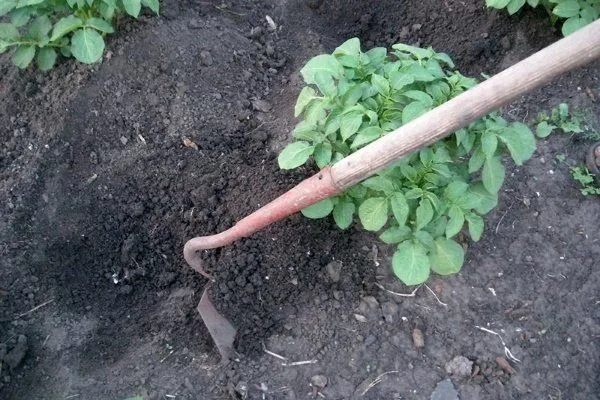
Hilling It's worth doing this at least twice: once after germination, and again when the sprouts are about 15 centimeters tall.
Protection from diseases and pests
To protect against insects, you can place onion skins or wood ash at the bottom of the hole dug during planting. To prevent Colorado potato beetles from infesting the potato plot, plant the following around the edges:
- legumes;
- geranium;
- marigold;
- garlic;
- mint;
- parsley.
Chemical defenses against this pest include insecticides. However, mechanical control of the Colorado potato beetle is safer for the harvest. Folk remedies can also be used. For example, spraying the bushes with an infusion of wormwood and wood ash.
To protect against fungus, Veneta potatoes should be treated with fungicides. These are also effective against late blight.
Harvesting and storage
The first new potatoes can be harvested 45 days after germination. The skin will become rough around the 75th day. A clear sign that the Veneta variety is ready for harvest is the yellowing of the tops.
Step-by-step preparation for storage
- Sorting (rejection of damaged tubers)
- Dry in the shade for 3-4 hours
- Clearing from soil (without mechanical damage)
- Placement in containers (nets/boxes in a layer of up to 1 m)
- Maintaining a temperature of +15…+18°C
After digging, the potatoes need to be sorted. Any tubers that are mechanically damaged should be set aside; they will be eaten immediately. Dry the remaining potatoes, remove any clods of soil, and place them in bags, boxes, or nets. potato storage A dry, dark, cool room is suitable, but the temperature in it should not fall below +15 degrees, it is desirable that it is at least occasionally ventilated.
The Veneta potato variety possesses all the necessary characteristics for both large-scale cultivation and planting in a small garden. It is highly resistant, produces abundant yields, and its tubers are easy to store. This variety is prized for its flavor and is suitable for any cooking method.