
One of the most popular vegetables in the world, a key ingredient in an incredible number of dishes, potatoes have firmly established themselves in the consumer basket. The "Melody" variety combines excellent flavor with the ability to retain its nutritional value for a long time. However, it's important to know how to care for this vegetable to ensure a bountiful harvest of high quality.
History of the variety
The variety was developed in Holland by C.MEIJER BV. Dutch breeders have created a potato that can be planted from related material over three seasons, even using the same soil.
Description of the Melodiya potato variety
The Melodiya variety is a mid-late table potato. Since 2009, it has been planted in Russia, primarily in the central regions. This variety is not universal or particularly hardy, but it possesses a number of rare advantages that make it valuable for gardening, and especially for commercial cultivation.
| Object | Ripening period (days) | Yield (c/ha) | Starch content (%) |
|---|---|---|---|
| Melody | 115-120 | 200-335 | 17-20 |
Escapes
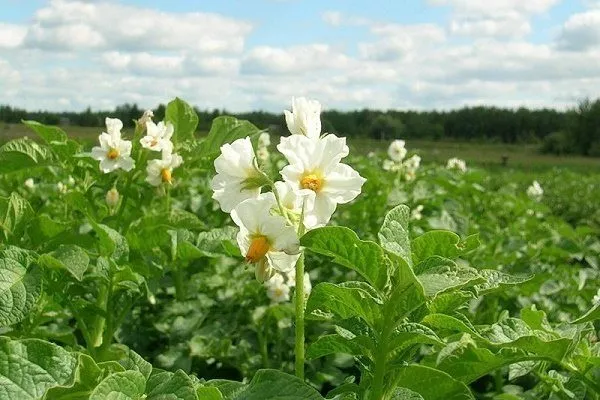
The bushes are about half a meter tall. The medium-sized leaves are closed, oblong, bright green, and have wavy edges. The 'Melody' variety blooms with 5-7 buds. Their color is white and light lilac at the edges, darkening to purple in the center and purple-red at the yellow center.
Roots
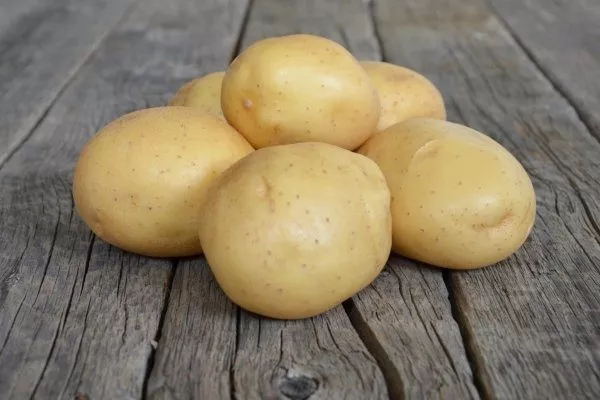
The tubers are large, with a net-like skin, pale yellow in color, oval in shape, and small, dark gray eyes. The average potato weighs 100-180 g and has soft, yellow flesh that cooks quickly. They have a high starch content of 17-20%. This makes them ideal for the industrial production of dried mashed potatoes.
Characteristics and features of the variety
The Melodiya potato variety has the following properties:
- long maturation period, from 115-120 days;
- large root vegetable;
- marketable appearance;
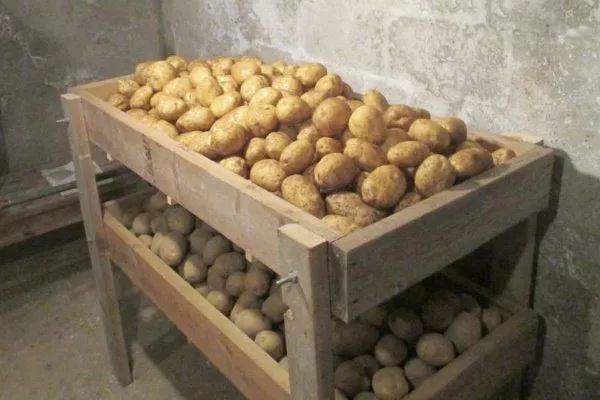
- shelf life of 95% – potatoes do not spoil for a long time, retaining their taste;
- transportability, tubers easily survive shaking and mechanical damage;
- A long dormant period of 8 months means that potatoes can be stored until June without the need to remove the sprouts.
- starchiness;
- drought-resistant;
- thermophilic;
- undemanding to soil nutrition;
- retains characteristics in the second and third generations.
This variety is especially valued for its strong immunity.It is not subject to:
- wrinkled and banded mosaic;
- golden cyst nematode;
- black leg;
- scab;
- Rhizoctonia;
- potato cancer;
- Late blight of potato tops and tubers – this disease most often affects potatoes, especially in rainy weather. The likelihood of infection in Melodiya is low, but it does occur.
The main danger for the Melodiya potato is the Colorado potato beetle, and the variety is also not completely resistant to the Y-virus.
Productivity and taste
The yield of potatoes directly depends on care and weather conditions. On average, it ranges from 200 to 335 centners per hectare. With proper care, this figure doubles to 636 centners (this is the amount once harvested in the Moscow region during variety testing). A single plant often yields approximately 2-3 kg of potatoes (7-11 large tubers).
Melodiya is renowned for its flavor and is considered one of the most delicious potato varieties. It's suitable for boiling and mashing, but is absolutely unsuitable for frying in vegetable oils, so it's not used in industrial potato chip production.
The Melodiya potato retains a pleasant yellow color when heat-treated.
Advantages and disadvantages of the variety
The melody became popular in Russia (primarily in the central regions), Ukraine, and Moldova. The following positive qualities are believed to have played a role in this:
- adaptability to a temperate climate;
- easily tolerates long rainy periods;
- high resistance to diseases and viruses;
- feels good in bright sunlight, easily tolerates lack of water;
- taste characteristics;
- high starch content.
Peculiarities of planting and growing Melodiya potatoes
The Melodiya variety isn't particularly demanding in terms of care, but as with any other endeavor, success requires following the rules—in this case, planting guidelines and the nuances of caring for the vegetable.
Optimal timing and choice of location
The Melodiya potato is a heat-loving variety. It can only be planted when the soil warms to 8 degrees Celsius. This usually occurs in mid- to late May.
- ✓ The site should be protected from northerly winds to minimize the risk of frost.
- ✓ The soil must have good drainage to avoid water stagnation and rotting of the tubers.
The planting site should be elevated and exposed to sunlight. No other nightshade crops, including other potato varieties, should be grown there beforehand. Favorable precursor crops include:
- legumes;
- winter crops;
- flax;
- medicinal and spicy herbs (annual and perennial);
- lupine.
Preparing the site for planting
In the fall, dig up the area you've chosen for potato growing and add organic fertilizer (compost or humus). The amount of organic fertilizer should be at least 4.5 kilograms per square meter. Potassium and phosphate fertilizers are also added.
- Conduct a soil analysis for acidity and nutrient content.
- Apply corrective amendments based on analysis 2-3 weeks before planting.
- Carry out deep plowing to improve the soil structure.
In the spring, before planting, amend the soil with ammonia fertilizer. Apply 15-25 grams per square meter, depending on the soil's depletion. If groundwater is available, dig trenches and form ridges for planting.
Preparing tubers
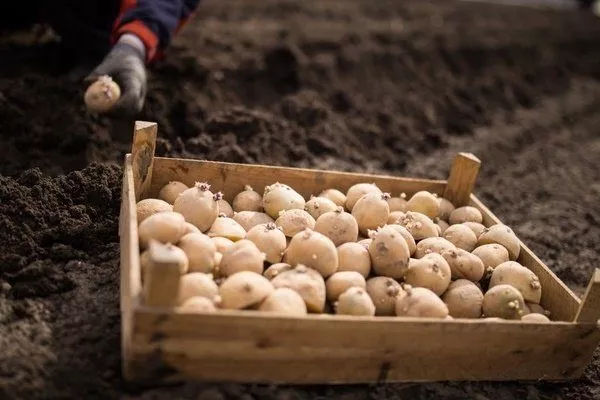
Before planting potatoes, select the seed material. From the tubers set aside from the previous harvest, select whole tubers without damage, darkening, or signs of fungus.
They should be left in a dry place for 3-4 weeks, and two days before planting, the potatoes should be placed in direct sunlight. Before planting, the sprouted tubers are treated with growth stimulants that have a suppressive effect on development. late blightThis could be Ecosil or Epin Extra.
It's best not to cut Melodiya potatoes into pieces for planting; whole tubers yield many times more. However, if necessary, ensure that each piece weighs at least 50 g.
Planting in the ground, planting pattern and depth
Depending on the soil type, you need to choose the type of planting for the Melodiya potato variety:
- black soil and sandy loam soil suggest smooth planting;
- heavy soils require the creation of ridges to make it easier for potatoes to sprout;
- Loose, loose soil requires the creation of trenches for planting vegetables.
When planting the Melodiya variety, the distance between rows is 70-80 centimeters, and between holes, about 35 centimeters. Planting depth also depends on the soil type: the heavier the soil, the closer to the surface the tuber is placed (5-7 centimeters), while in lighter soils, the deeper (10-12 centimeters).
The planting material must be placed with the sprouts facing upwards, pressing slightly into the ground.
Fertilization
Additional fertilizing of Melodiya potatoes is not necessary after flowering. Ideal times for fertilizing are during the first hilling and before bud break.
The following fertilizers are suitable for this variety:
- dolomite flour;
- chalk;
- potassium fertilizers;
- egg solution;
- nitrogen supplements;
- vitamin complexes;
- herbal infusions.
Fertilizing the Melodiya variety with bird or cow manure, as well as other fresh organic soil fertilizing options, is not permitted.
Care
Potatoes require regular watering, especially during the growing season. Watering is optional, depending on the soil condition and type. To avoid damaging the tops, water should be applied slowly to the stem, as this can expose the roots.
HillingHilling, or forming mounds over the base of vegetable bushes, is done at least twice. The first time, when shoots reach 10-12 centimeters in height, the mound should be 5-10 centimeters thick. The second hilling should be done three weeks later.
Weeding (cultivation) should be carried out simultaneously with the creation of embankments. Subsequently, weeding and watering are carried out as needed, depending on weed activity.
Potato roots require oxygen for normal development and mass gain, so loosening should be regular.
Protection from diseases and pests
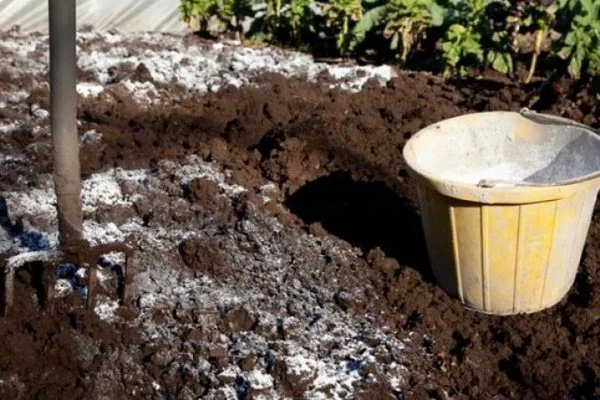
When planting, add wood ash to the holes. It:
- mineralizes the soil;
- promotes soil respiration;
- protects from insects.
To prevent late blight, you can use:
- Syngenta;
- Arcedil;
- Ridomil;
- Oxychom.
Or folk remedies:
- sprinkling the soil with lime;
- treating bushes with garlic infusion (100 grams per 10 liters);
- spraying with a kefir solution (1:10);
- use of solutions of potassium permanganate, boric acid and copper sulfate.
To prevent the spread of viruses, you must adhere to the following rules:
- select only healthy and strong tubers for planting;
- adhere to crop rotation rules;
- remove diseased bushes to prevent others from becoming infected;
- destroy insect pests, they carry viruses on their paws.
It is important to treat potato bushes with fungicides and antifungal agents before they bloom. The following medications are used for this purpose:
- Alirin;
- Quadris;
- Gamair.
To combat the worst scourge of potatoes – the Colorado potato beetle, you can use Prestige, Colorado, Regent, Taboo.
Harvesting and storage
The Melodiya potato variety's roots are dug up at 115-120 days. By this time, the tops have usually withered, and the potatoes have developed a thick skin. Before harvesting, the above-ground portion of the Melodiya plant should be trimmed off. This prevents harmful microflora from the leaves from contaminating the roots.
Ten days after this procedure, the potatoes can be harvested. They should be dug up and left in a light, dry, ventilated place to dry. Afterwards, clean off any stuck-on soil and place in a room intended for long-term storage. vegetable storage.
The Melodiya potato variety has strong immune properties and easily tolerates a variety of temperate climates. With careful care, Melodiya produces very large yields, and its flavor is particularly prized in the potato market. The vegetable tolerates long-term storage and transportation well, making it often grown commercially.