
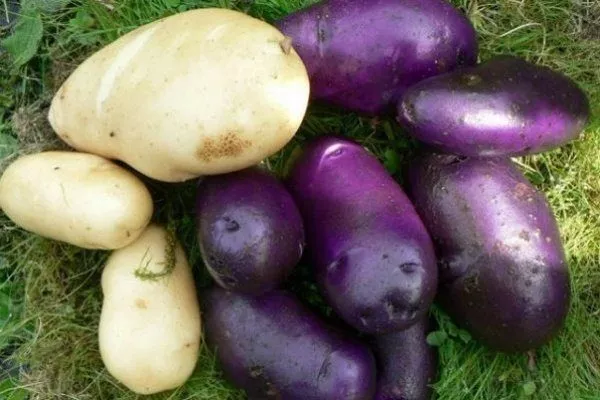
Dark potatoes are already interesting! Many gardeners enjoy growing exotic crops or simply something unique. The "Black Prince" variety is one such variety. Its main distinguishing feature is its purple skin. But is appearance really the only thing that makes dark potatoes so interesting? Let's find out if this variety has any other advantages beyond its distinctive appearance.
Breeding dark potatoes
| Object | Ripening period, days | Starch, % | Weight of tubers, g |
|---|---|---|---|
| The Black Prince | 90 | 12-16 | 70-170 |
| Purple Viking | 85 | 10-14 | 60-150 |
| Black woman | 95 | 14-18 | 80-180 |
| Chinese truffle | 100 | 15-20 | 90-200 |
Experts claim that dark potatoes came to Russia from South American countries, where this crop is grown particularly extensively. Today, in addition to the "Black Prince," our gardeners seeking exotic flavor in their gardens can choose from the following potato varieties:
- "Purple Viking"
- "The Black Woman";
- "Chinese truffle".
The exact origin of the "Black Prince" variety is unknown. There are only hypotheses. It is believed that this variety was developed by Dutch or Israeli breeders. It is also believed that several similar varieties are grouped under this name. "Black Prince" is not listed in the State Register of Crop Plants of the Russian Federation. Nevertheless, the variety is quite popular among gardeners worldwide.
Table 1
| Characteristics of the Black Prince variety | |
| Ripening category | mid-early |
| Ripening period, days | 90 |
| Starch, % | 12-16 |
| Weight of tubers, g | 70-170 |
| Number of tubers in one bush, pieces | 5-7 pieces |
| Yield, c/ha | up to 100 |
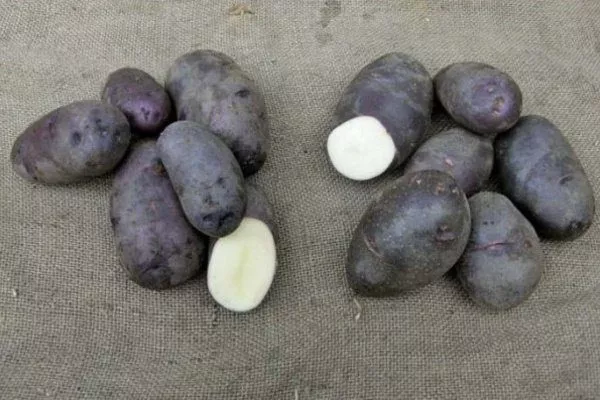
| Tuber shape | oval, slightly elongated |
| Peel color | dark purple |
| Pulp color | light beige |
| Consumer qualities | Good taste, balanced, not watery, after cooking the tubers retain a pleasant potato aroma |
| Shelf life % | 97 |
| Growing regions | cultivated in all regions |
| Attitude to diseases | resistance to potato cancer, golden nematode, and common scab |
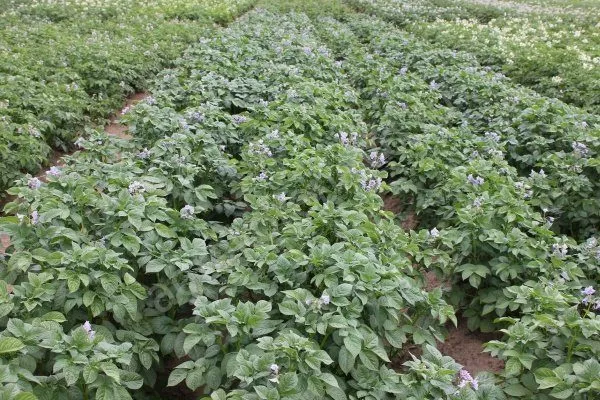
| Appearance of bushes | tall, upright, with moderately spreading branches |
| Appearance of leaves | small, light green in color, with wavy edges |
| Bloom | a corolla of large bluish flowers, low berry production |
| Degree of foliage | average |
The dark potato variety produces a low yield, with no more than seven tubers per bush. However, they are all large—the variety practically never produces small, unmarketable potatoes.
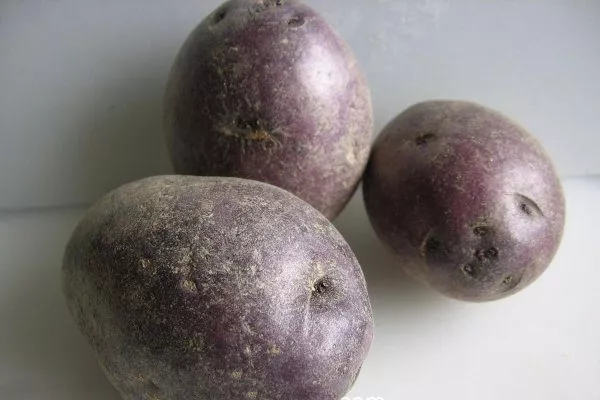
Since this variety isn't particularly productive, it's grown only as a complement to other potato varieties, planting it in a partial plot. The tubers of the "Black Prince" are quite attractive—even, unusually colored, with a moderately thin and smooth skin. The eyes are shallow, making them easy to peel.
Comparison with other varieties
To evaluate the consumer qualities and characteristics of the "Black Prince" potato, let's compare it with other popular varieties. Table 2 compares yield and shelf life, and Table 3 compares starch content.
Table 2
| Name of the variety | Yield, c/ha | Shelf life, % |
| The Black Prince | up to 100 | 97 |
| Queen Anne | 390-460 | 92 |
| Sifra | 180-400 | 94 |
| Mozart | 200-330 | 92 |
| Vector | 670 | 95 |
| League | 210-360 | 93 |
| Milena | 450-600 | 95 |
| Elmundo | 250-345 | 97 |
| Serpanok | 170-215 | 94 |
The starch content determines the taste of the tubers and their cooking properties. "Black Prince" potatoes don't darken when cut and don't overcook when cooked, becoming tender and crumbly. They can be used to make fluffy mashed potatoes, French fries, fried, stuffed, and baked.
Table 3
| Name of the variety | Starch content, % |
| The Black Prince | 12-16 |
| Santana | 13-17 |
| Desiree | 13-21 |
| Openwork | 14-16 |
| Lilac fog | 14-17 |
| Yanka | 13-18 |
| Tuscany | 12-14 |
| Artemis | 13-16 |
| Sheri | 11-15 |
| Svitanok of Kyiv | 18-19 |
| Cast iron pot | 12-15 |
Benefits of dark potatoes
Dark-skinned potatoes are of interest to cooks and gourmets. The tubers contain:
- minerals;
- vitamins;
- phenolic acids;
- antioxidants;
- anthocyanins;
- carotenoids.
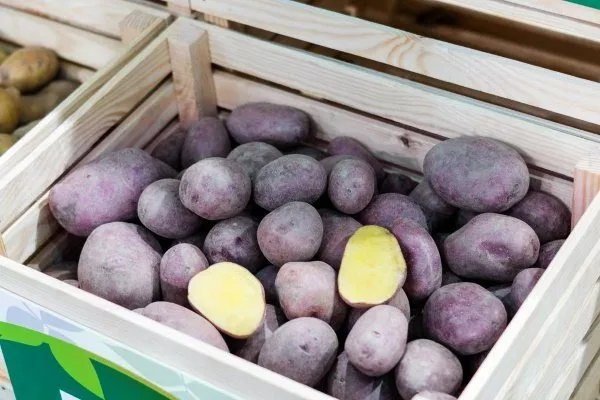
Benefits of Eating Purple Potatoes Daily:
- slowing down aging;
- improving the functioning of the gastrointestinal tract and cardiovascular system;
- restoration of vision.
But dark root vegetables also contain harmful substances. For example, solanine is a natural poison found in small amounts in all potatoes. If potatoes are stored improperly, the solanine concentration increases. Green spots should be trimmed off without hesitation.
Advantages and disadvantages
Planting dark-colored potatoes brings more moral satisfaction than actual benefit. They are not grown by agricultural holdings or large farms. Dark-colored potatoes are typically of interest to amateur gardeners and summer residents—they grow them more for the pleasure of growing them than for any agronomic or taste benefits.
Soil preparation
Preparing the soil for potatoes can be divided into two stages:
- Autumn. The soil for potato plantings is prepared in the fall. The soil designated for potatoes is dug over. It's recommended to apply fertilizer during the fall digging, which will eliminate the need for spring digging. Apply 10 kg of humus and 200-300 g of wood ash per square meter. Some gardeners sow green manure crops such as rye, oats, and the like, which are then plowed over in the spring.
- Spring. In April and May, dolomite flour or complex mineral fertilizers are added to the soil. The soil is then dug again. To increase yields, humus and ash are added directly to the holes.
- ✓ The area should be protected from northern winds to prevent the tubers from freezing.
- ✓ The soil must have good drainage to prevent water stagnation and rotting of the tubers.
If potatoes are planted in an area with heavy soils and frequent waterlogging, it is necessary to use the ridge method.
Preparing potatoes for planting
Rules for preparing potatoes for planting:
- Healthy, medium-sized, richly dark-colored tubers are selected for planting. Seeds are collected during harvest. In the spring, the tubers are sorted again, removing any diseased or overwintered potatoes.
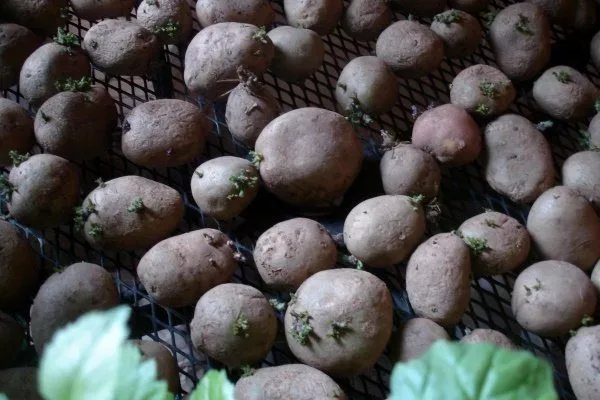
- Two to four weeks before planting, place the seed potatoes in a bright spot to germinate. The roots should be greened. Exposure to light causes them to accumulate a poison called solanine, which repels rodents.
- Treat the tubers with Fitosporin or a copper sulfate solution. You can also soak the tubers in a growth stimulant.
Timing and methods of planting
Exotic potatoes don't require any special planting techniques. This variety is easy to grow, accessible even to novice gardeners. Standard gardening practices are sufficient. Here's what to keep in mind when planting any potato:
- The planting site is chosen in a well-lit area, without drafts and protected from flooding.
- The optimal planting time is determined by soil temperature, which should reach 7-12°C. The planting time varies by region, and specific weather conditions must also be taken into account.
Planting methods:
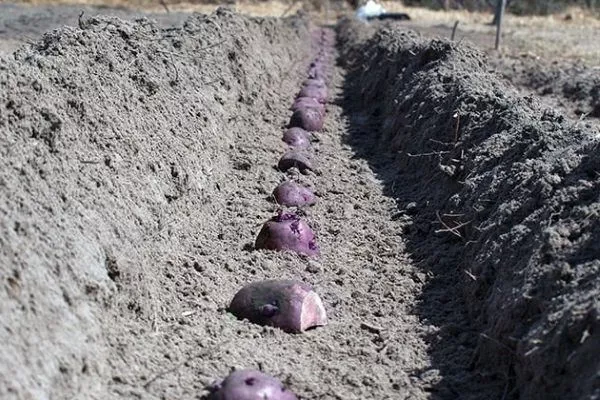
- Standard. In areas free from stagnant water, potatoes are planted in rows. The tubers are placed in holes or dug trenches. Planting instructions:
- the distance between tubers is 20-30 cm;
- hole depth – 10 cm;
- distance between rows – 70 cm.
- Comb. This method is used on waterlogged, heavy soils. Ridges 25-30 cm high are prepared manually or with a walk-behind tractor. Tubers thrive in these ridges and do not rot. The distance between ridges is 65 cm.
Care instructions
Purple potatoes require a standard set of agricultural practices to develop and form large root crops:
- Watering. This variety thrives on timely moisture. It requires ample watering for growth. Drip irrigation is the best option. The number of waterings depends on weather conditions. In favorable weather, three waterings may be sufficient:
- when seedlings appear;
- when buds appear;
- when the potato bushes finish flowering.
- Hilling and weeding. To improve soil aeration and ensure moisture retention, potato plantings are periodically hilling up – Rake the soil up to the seedlings. Hilling begins when the plants reach a height of 15-20 cm. After 20 days, the potatoes are hilled again. The soil is loosened, raked, and weeded at the same time.
- Top dressing. This variety is demanding regarding soil quality. Recommended fertilizing times:
- 1st feeding – Two weeks after germination, add diluted, semi-liquid mullein or urea – 1 tablespoon per bucket. Apply 500 ml of fertilizer to each plant.
- 2nd feeding – during budding. Add a mixture of 1 tbsp. potassium sulfate and 3 tbsp. wood ash. Consumption: 500-700 ml per bush.
Main pests and measures to control them
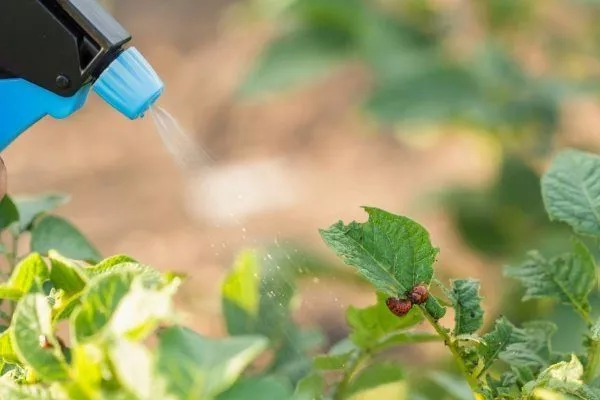
The most damaging pests to purple potatoes are Colorado potato beetles and wireworms—the larvae of the click beetle, which burrow into the tubers. In addition to chemical and biological treatments, agronomic measures are recommended for controlling all pests:
- mulching the space between rows with straw, sawdust or mown grass (read more about mulching the soil here);
- timely removal of weeds.
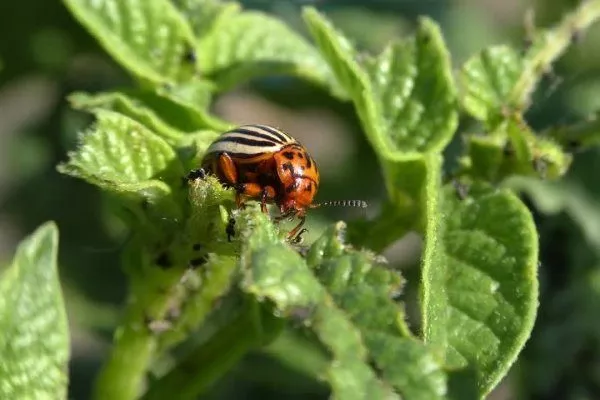
Table 5
| Potato pest | Control measures |
| Colorado beetle |
|
| Wireworm |
|
| Flying insects – potato moth and others. |
|
The most effective drugs against the Colorado potato beetle are Aktara, Regent, Corado, Prestige, Commander, Lightning, Apache, Tanrek, Taboo.
Dangerous diseases and measures to combat them
The variety is resistant to most potato diseases, but may be susceptible to late blight. 'Black Prince' is also susceptible to blackleg and ring rot. Disease control measures are listed in Table 6.
Table 6
| Potato disease | Preventive measures | Control measures |
| Late blight |
| At the first signs of late blight, the bushes are dug up and destroyed. |
| Ring rot |
| Treatment with complex insecticides - Sharpei, Sirocco, Tanrek and others. |
| Blackleg |
|
|
Pre-planting treatment of tubers will help prevent many diseases:
- Autumn seed treatment with "Maxim KS" – 0.2 ml per 1 kg. Or spring treatment – 0.4 ml per 1 kg.
- Treatment with any bacterial preparation. For example, "Fitosporin" – 0.4-0.5 kg/t, "Baktofit" – 3-5 kg/t, "Integral" – 2 l/t.
How to harvest and store crops without losses?
Harvesting purple tubers can begin 2-2.5 months after planting. Here's what you need to know:
- A week before harvesting, all the tops are mown down.
- Before storing the tubers, they are dried for 1-2 hours in the sun.
- This variety is convenient because it doesn't require sorting—all the tubers grow to the same size. "Black Prince" doesn't produce small potatoes.
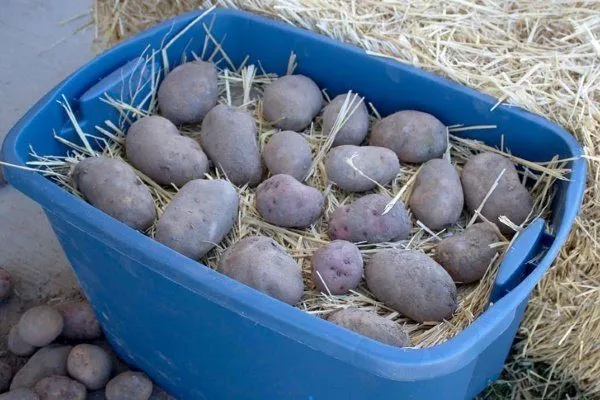
- After drying, the tubers are placed in boxes and stored in a dry, dark place. A small amount of sawdust can be sprinkled on top to protect the roots from excess moisture.
Reviews from gardeners
For farmers, dark potato varieties aren't particularly attractive—they have low yields, which is crucial for industrial production. However, hobby gardeners always enjoy experimenting with unusual vegetable varieties, including the dark "Black Prince" potato.
"Black Prince" attracts gardeners both for its appearance and its flavor. The variety thrives in cool and rainy weather, making it a favorite among vegetable growers in regions with cool summers.
Excellent variety. I like it. But my wife doesn't like the color.