
Feeding quail is crucial – with the right feed, the birds will be healthy, grow quickly, and provide the farmer with plenty of eggs and meat. The key is to adhere to daily feeding guidelines and enrich the feed with nutrients and vitamins.
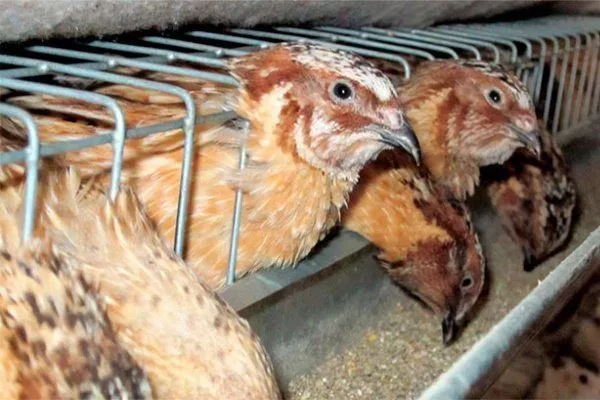
Types of food
There are many different types of food, so it's worth considering them by group.
Grain and leguminous feeds, cereals and seeds
Loose grains that are easy to mix together or feed separately. These include:
- Peas. Contains 21.5% protein and contains a good combination of many amino acids necessary for quail.
- Hemp seed. Useful in small quantities for adult quails.
- Corn. Increases quail productivity and helps chicks grow faster.
- Poppy seeds. They are fed to harlequin, Chinese and Japanese quails.
- Oats. Contains many useful microelements.
- Beans. They contain up to 25% protein and are rich in vitamins and carbohydrates.
- Soybeans. It has a high protein content—37-45%—and vegetable fat, but it is only suitable for feeding to poultry after it has undergone heat and moisture treatment. Therefore, it is better to use soybean meal or extruded soybeans.
- Millet. Contains a lot of fiber, which is essential for quails.
- Vetch. It contains 24.1% protein and is often used in a mixture with oats.
- Wheat. Often present in quail feed. Typically, forage or crushed wheat is used.
- Wheat groats. It is fed to quail chicks.
- Amaranth grainContains protein with twice as much lysine as wheat protein.
- MilletCan be temporarily fed to young and adult quails.
- Rice. It is superior to corn in terms of caloric content.
- Weed seeds. They are readily eaten by many species of quail.
- Sorghum and chumizaIf there is no millet, they can be fed to quails.
- Lentils. Similar in properties to peas.
- Barley. Contains a lot of fiber.
It's rare for a poultry farm to operate without grains, cereals, and seeds. They form a vital part of a bird's diet, so ensuring the availability and quality of such feed is crucial.
Animal feed
This type of feed must be included in the quail diet. It includes:
- Animal feed fatIt should be used in conjunction with plant-based fats. It has a higher energy value. Its content in the diet should not exceed 5%.
- Blood of slaughtered quails. It is often used as a protein supplement in feeding these birds.
- Blood mealCan be used as an additive to grain mixtures.
- Bloodworm. Sometimes they are fed to quail chicks in the first days of life.
- MealwormIt is a favorite delicacy of many birds.
- Meat and bone mealContains a lot of protein, calcium and phosphorus.
- Garden, earth, and earthworms. Readily eaten by most birds.
- MaggotSuitable for protein enrichment of quail feed.
- Fish of various typesIt must be pre-ground. It is rich in proteins, vitamins, and minerals.
- Fish oilAvailable in pure form or with various additives, it contains vitamins A and D3.
- Fish meal. Should be stored in the refrigerator and used for feeding only when fresh.
- Chicken and quail eggsHard-boiled and crushed eggs are given to chicks during the first week of life as protein food.
If the bird is limited in animal feed, then problems with the digestive system and a decrease in the quail's immunity are possible.
Vitamin feed
Quails also need vitamins for proper development, so the following vitamin-containing feeds and supplements are commonly used for them:
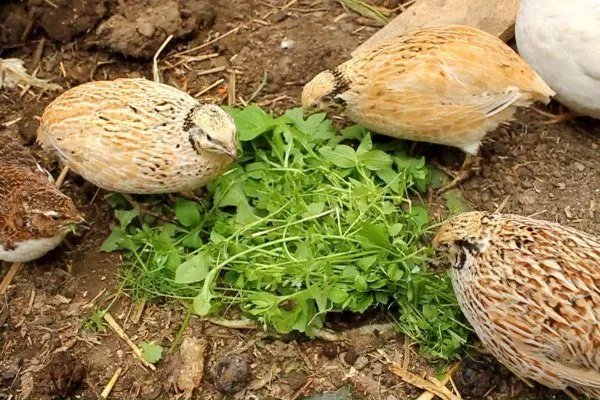
- Green juicy herbs. They are used fresh, among them it is worth highlighting nettle, dandelion, clover, and alfalfa.
- Cabbage. It is a valuable vitamin food.
- Onion-feather. It attracts quails with its taste, and they eat it willingly.
- Carrot. Suitable for quails of different ages due to the presence of a large amount of carotene.
- Herbal flourIt can be used as a substitute for succulent herbs during the winter.
- Pine needles and pine flourSuitable as vitamin supplements.
- Garlic. Reduces cholesterol levels in the blood of birds.
- ApplesSometimes they are fed to quails due to the lack of other vitamin-rich food.
The presence of vitamins in the bird's diet significantly affects its well-being and productivity.
Industrial waste
Some industrial waste is also used to feed quail. The most popular are:
- Oilcakes and meals. They contain a lot of vegetable fats, proteins, potassium, and phosphorus. Flaxseed, sunflower, hemp, and soybean meal and cake are suitable for feeding quail.
- BranThey are very useful for quails and are eaten with pleasure.
These bird feed ingredients are inexpensive and easy to use, so they are often used by many breeders.
Mineral feed
Minerals in poultry feed play an important role in digestion, ensuring the effective grinding of solid food in the stomach. Farmers recommend the following mineral feeds for quail:
- Bone meal. Can be used as an additional supplement to the birds' diet.
- ChalkOnly feed is used. It can be included in the quail's diet both temporarily and permanently.
- Sand. Quails need it to grind certain foods in their stomachs. Clean, coarse-grained river sand is considered the best.
- Table salt. It serves as a source of sodium and chlorine for poultry and is included in the feed at a rate of 0.2-0.3%.
- Sea and river shellsIn crushed form they are a good mineral feed for quails.
- EggshellUsed as a temporary mineral fertilizer.
Each of the above-mentioned feed types has its own unique characteristics. Selecting the optimal feed combination for poultry will determine its breeding efficiency, depending on many factors, including breed type, emphasis on egg production or meat yield, housing conditions, and so on.
Homemade recipes or how to make compound feed at home
Every farmer has their own secrets for raising any animal. There are many different recipes for homemade feed mixtures, but here are just a few of the most common:
Recipe 1
An example of simple compound feed:
- 400 g corn grits;
- 1 teaspoon of meat and bone meal;
- 100 g of barley groats or barley;
- 0.5 teaspoon vegetable oil;
- 50 g minced meat or fish;
- 50 g of cottage cheese.
Recipe 2
To this and subsequent mixtures, add 10 g of chalk. This recipe is more suitable for laying hens:
- 200 g corn;
- 200 g wheat;
- 80 g of 10% premix for laying hens.
Premix for laying hens:
- 90 g sunflower cake;
- 90 g soybean meal;
- 45 g meat and bone meal;
- 45 g of nutritional yeast;
- 30 g peas;
- 10 g vegetable oil.
Recipe 3
It is considered a classic recipe:
- 300 g crushed wheat;
- 170 g of cake;
- 150 g corn or barley;
- 70 g wheat bran;
- 30 g of fodder yeast and small shells;
- 20 g meat, bone and fish meal;
- 20 g peas;
- 20 g unrefined sunflower oil;
- 10 g premix;
- 2 g of salt.
Recipe 4
Recipe with mostly millet and semolina:
- 200 g millet;
- 200 g semolina;
- 100 g cabbage;
- 100 g beetroot;
- 50 g boiled potatoes;
- 50 g meat and bone meal.
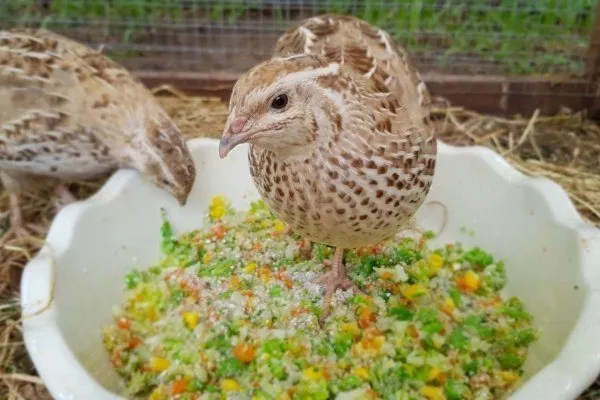
Meat and bone meal:
- 5 boiled eggs;
- 100 g cottage cheese;
- 50 g of fodder yeast;
- 10 g vegetable oil.
Recipe 5
Balanced feed:
- 100 g oatmeal;
- 100 g cottage cheese;
- 100 g millet;
- 100 g minced fish.
Recipe 6
A recipe rich in animal feed:
- 100 g corn grits;
- 100 g millet;
- 100 g cottage cheese;
- 100 g pea groats;
- 50 g meat and bone meal or fish meal.
Daily feed intake standards
Protein content in quail feed is of great importance, as it helps increase and maintain the bird's live weight, its productivity, and its ability to reproduce.
The crude protein requirements of quails of different breeds, directions and ages vary significantly.
It has been established that quails easily tolerate a small deviation in the percentage of protein in their feed.
Table 1. The need of quails of different ages for crude protein (%).
| A group of quails |
Authors of the research | |||
| young animals aged (days) |
laying hens
|
fattening
| ||
|
1-30 |
31-45 | |||
| 24 | 17 | 21 | 23 | Pigareva M. D. et al. |
| — | — | 21.6 | 26-27 | Romanyuk K. |
| 26 | 26 | — | — | Mazanovsky A. et al. |
| 25-26 | 25-26 | 23-24 | — | Fetz K. |
| 25-27 | 22 | 24 | 16-18 | Razzoni R. et al. |
| 26.5 | 28 | — | — | Vogt W. |
| 27.5 | 27.5 | 25 | — | Wilson W. et al. |
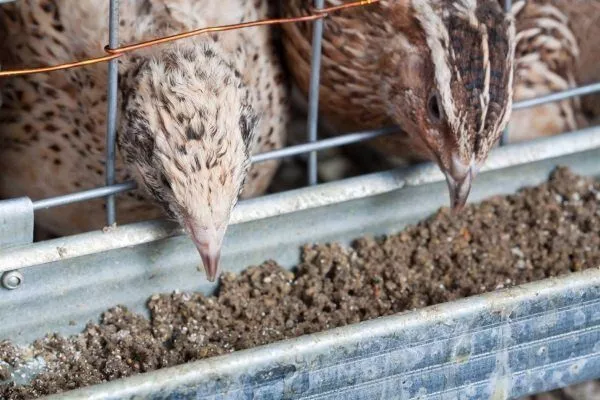 The completeness of protein depends on the composition of amino acids, so it is necessary not only to standardize the total content of crude protein, but also to carefully monitor the presence of amino acids in it.
Amino acids such as lysine, methionine, cystine, and tryptophan are especially important for birds. A deficiency in any of these significantly impacts the productivity of adult quail and the growth rate of chicks.
Table 2. The amino acid requirements of quails compared to the requirements of turkeys and chickens (% of feed).
| Amino acids | Japanese feed mixture | Authors of feed mixtures | Turkey poults up to 30 days old | Chickens under 30 days of age | |||
| E. House | R. Pokhra | V. Paplyuchuk | B. Lomashskaya | ||||
| Lysine | 2.10 | 1.35 | 1.30 | 1.00 | 1.90 | 1.50 | 1.15 |
| Methionine | 0.80 | 0.52 | 0.70 | 0.60 | 0.00 | 0.52 | 0 42 |
| Cystine | 0.40 | 0.39 | 0.40 | 0.40 | 0.40 | 0.48 | 0.36 |
| Tryptophan | 0.30 | 0.24 | — | 0.30 | 0.30 | 0.30 | 0.21 |
| Arginine | 1.20 | 1.56 | — | 1.70 | 1.80 | 1.60 | 1.26 |
| Histidine | 0.70 | 0.65 | — | 0.70 | 0.70 | 0.04 | 0.12 |
| Leucine | 2.10 | 1.85 | — | 2.00 | 2.30 | 1.60 | 1.47 |
| Valin | 1.50 | 1.30 | — | 1.50 | 1.50 | 0.90 | 0.89 |
| Tyrosine | 1.00 | 1.91 | — | 0.90 | 1.00 | — | — |
| Isoleucine | — | — | — | — | — | 0.80 | 0.78 |
| Threonine | 1.20 | 1.04 | — | 1.20 | 1.20 | 0.70 | 0.73 |
| Phenylalanine | 1.20 | 0.52 | — | 1.20 | 1.30 | 0.80 | 0.73 |
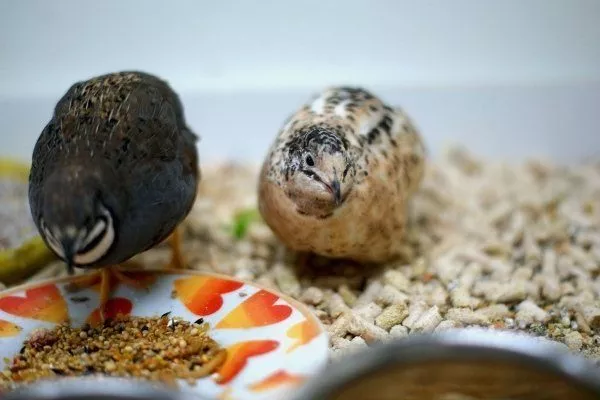
For feeding exotic quail, it's best to use grain mixtures supplemented with fresh greens and soft feed. The lack of animal feed in these quail's diet is compensated for by adding insects, their larvae, mealworms, and earthworms.
For adult birds
The standard feeding schedule for adult birds is three times a day. On average, an adult quail consumes 25 grams of feed per day.
This amount of feed should include approximately 60% grain and 40% protein. The bird's diet should also include greens and juicy vegetables. Vitamins A, D, and E are essential in quail's diet.
Table 3Quails' need for microelements.
| Elements | Units of measurement | Age of quails (weeks) | ||
| up to 6 | from 6 to 12 | adults | ||
| Calcium | % | 1.30 | 0.60 | 4.50 |
| Phosphorus | — | 0.75 | 0.60 | 0.70 |
| Magnesium | — | 0.02 | 0.04 | 0.04 |
| Potassium | — | 0.30 | 0.30 | 0.50 |
| Manganese | mg/kg | 90.0 | 90.0 | 90.0 |
| Selenium | — | 1.00 | 1.00 | 1.00 |
| Iodine | — | 0.40 | 1.20 | 1.20 |
| Zinc | — | 65.0 | 75.0 | 75.0 |
| Iron | — | 8.00 | 20.0 | 20.0 |
| Copper | — | 2.00 | 3.00 | 3.00 |
For quails
During the first four weeks of life, meat and egg-producing quail require approximately 20-26% protein. Wild quail require even more protein.
During the first week of life, chicks are fed at least 5 times a day, then 4 times, and from the fourth week they switch to the standard three times a day bird food.
In the absence of quail feed, from the age of two weeks, the chicks of many species of quail begin to be introduced into the diet of gravel and ground shells.
Find more information about quail feed Here.
Diet
Quail feed must contain amino acids, fats, carbohydrates, minerals, and vitamins. To ensure proper digestion and absorption of food, quails need gastroliths (ingested stones and minerals) to ensure proper grinding of food in the stomach.
Features of feed for laying hens
Quail laying feed must contain a carefully balanced supply of all essential nutrients. Proper concentrations will ensure good egg production.
The number of eggs laid directly depends on the protein content in the feed – it should be around 26%.
For improvement egg production Many knowledgeable poultry farmers recommend adding crushed eggshells to the feed.
Each laying hen receives up to 30 grams of complete feed per day. Hens typically lay eggs for up to eleven months, after which they are slaughtered for meat.
For quails
Feeding quail chicks It is customary to divide it into several periods.
First period – the first week of the chicks' lives. During this time, a sifted feed mixture containing 24-26% protein and quail eggs are fed. Chicken eggs are not recommended due to the risk of transmitting chicken diseases to the chicks.
Second period – 2-4 weeks. During this period, the basis of the feed is a feed mixture containing at least 20-24% crude protein and 290 kcal of metabolizable energy per 100 g of feed. The feed is divided into 4 daily portions.
Third period – 5-6 weeks. At this time, they are fed a feed mixture intended for adult quail, but the crude protein level is reduced to 16-18%, as the chicks may experience premature sexual development, which will adversely affect the future productivity of females of egg-laying breeds.
At this time, the proportion of crushed grain feed should be increased. Such supplements increase fiber content and improve the chicks' appetite.
At six weeks of age, quail chicks are introduced to adult feed. Grain feed is eliminated from the diet, and the proportion of succulent feed is reduced. The crude protein content of the feed at this time ranges from 21-24%, with a metabolizable energy of 280-290 kcal per 100 g of feed. This level of nutrient intake promotes the birds' full physical and productive development.
Fattening for meat
To fatten quails for meat, take:
- males and females of one month of age with physical defects;
- bird after finishing laying eggs;
- young animals that are raised specifically for this purpose.
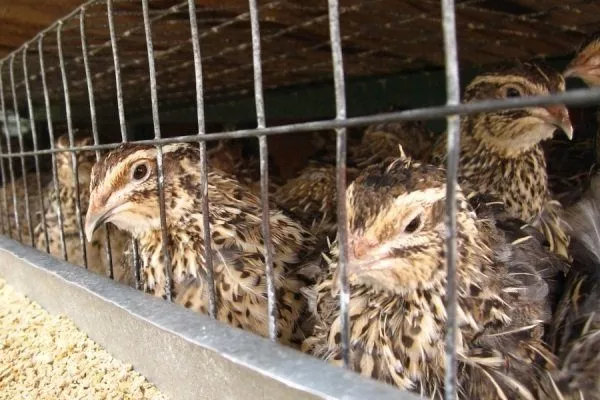
Meat feeding is introduced gradually. A sudden transition can lead to illness and even death of the birds. Quails are placed in cells With solid walls, place the quail in a shaded area. Males should be kept separately from females. When fattening, feed the quail the same as for adult birds, but increase the amount of corn and fat. A diet can be composed of 80% broiler feed and 20% cooked peas.
The transition to a new diet can be completed within four days. On the first day, you can feed the bird half the old feed and half the new. This gradually reduces the amount of old feed and replaces it with the new diet. Fattening continues for up to four weeks. During the final week, the standard feed weight (approximately 30 grams) is increased by approximately 8%. With the correct feeding rate, the fattened bird should weigh at least 160 grams and have a good layer of subcutaneous fat in the chest.
Table 4Standard for quail meat.
| Indicators | Characteristics of meat | |
| First category | Second category | |
| Carcass condition | Muscle tissue is well developed. There are deposits of subcutaneous fat on the chest and abdomen. | Muscle tissue is satisfactorily developed. Subcutaneous fat deposits may be absent. |
|
Processing of carcasses | The carcass is well bled, clean, and free of bruises and feather residue. A few stumps, light abrasions, and scratches are acceptable. | The carcass is well bled, clean, and free of bruises and feather residue. Minor stumps, abrasions, and scratches, as well as bone fractures, are permitted, provided they do not detract from the carcass's marketability. |
During this time, quail should be fed shredded carrots, which will impart a beautiful color to the flesh. Avoid fish and fish byproducts, onions, garlic, and pine needles, as they adversely affect the meat's flavor and aroma.
Vitamins and supplements
Since all vitamins are added to the feed in very small quantities, it is recommended to pre-mix them with the grain component of the diet. Mixing should be done gradually, gradually adding small portions of the filler to the vitamin. The resulting mixture is then mixed with the remaining volume of feed.
Among such useful additives to bird feed, it is worth highlighting trivit, tetravit, various premixes, chiktonit, and yeast.
| Additive | Benefit | Recommended quantity |
|---|---|---|
| Trivit | Vitamins A, D3, E | 1 drop per 1 kg of feed |
| Tetravit | Vitamins A, D3, E, F | 1 drop per 1 kg of feed |
| Chiktonite | Complex of vitamins and minerals | According to the instructions |
| Yeast | Source of B vitamins | 5% of the feed weight |
Quail nutrition depending on the season
Feeding domestic and ornamental quails should be complete in composition and quality, meeting the body's energy needs depending on the season.
The consumption of nutrients by the body of birds varies in different seasons of the year and in different environmental conditions; this must be taken into account when preparing feed mixtures and determining the daily requirement.
A characteristic feature of feeding quails in the summer is the presence in the bird's diet of mostly fresh greens, insects, earthworms, and the like.
In winter, fresh greens are replaced with grass harvested in the summer. Due to the lack of natural vitamins at this time, feed mixtures should be enriched with special additives.
Drinking regimen
The source of the water is an important factor in any animal's drinking regimen. If the water comes from a river, it should be boiled and allowed to cool beforehand. If using well water, it should be heated, otherwise the birds may catch a cold.
It is worth changing the water for birds once or several times a day, depending on its residue and contamination.
There's no need to boil tap water. It just needs to sit to allow the chlorine to evaporate. If you have any doubts about the quality of this water, it's worth filtering it.
Once a week, add a weak solution of potassium permanganate to the water bowls, alternating it with a selenium solution. For prevention, add vitamin C to the water every 10 days. One to two ascorbic acid tablets per liter is sufficient. However, it's best to add B vitamins separately. Otherwise, the nutrients will destroy each other during a chemical reaction in the water.
Nutritional Mistakes and Helpful Tips
Many novice quail breeders make common mistakes in their care, feeding, and breeding. Here are some tips to help you feed quail properly:
- Control of protein levels in feed. In the absence of special compound feed, it is necessary to increase the volume of protein feed and vegetables.
- Ecologically clean food. You shouldn't collect grass near roads.
- Compliance with feed storage conditions. Fish waste and minced meat should be stored at a temperature of -1 to -3°C for no more than six months.
- Features of using specialized equipment. To mix minced meat with the main feed for poultry, it is better to use a manual or electric meat grinder.
- Proper nutrition of poultry. It would be good to add a couple of tablespoons of dry milk to the food.
By following all recommendations for feeding quail, monitoring the bird's well-being and productivity indicators, you can easily achieve optimal efficiency in any breed, whether it be an egg-laying or meat-producing breed.