
To ensure a successful honey flow each season, it's essential to properly prepare your bees for winter. Experienced beekeepers follow this wisdom. But what should a novice beekeeper do? First, familiarize yourself with the specifics of bees' wintering, study their winter diet, and follow the advice of more experienced beekeepers.
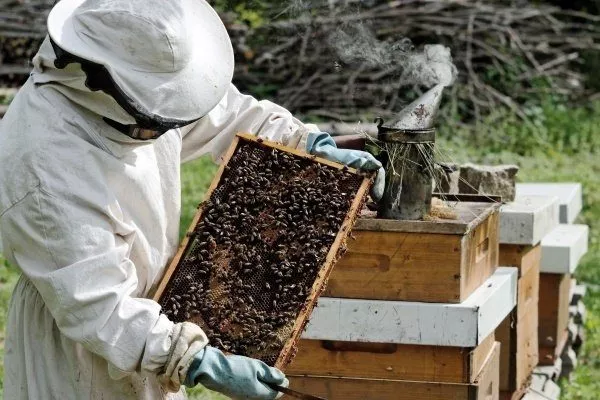
Autumn revision
A fall colony inspection is essential to ensure all worker bees are strong, resilient, and healthy by spring. While active measures should certainly be taken throughout the honey flow, a pre-winter inspection is an essential part of proper and timely winter preparation. More specifically, it's the very first step. This process uncovers any shortcomings that could hinder a successful wintering.
- ✓ Having a sufficient number of young bees to maintain the temperature in the hive during winter.
- ✓ The condition of the queen bee: her age and ability to lay eggs.
- ✓ Quality and quantity of feed supplies, including honey and bee bread.
- ✓ General health of bees: no signs of disease.
- ✓ Condition of honeycombs: their suitability for wintering.
The beekeeper must take into account the following nuances:
- To estimate the number of young worker bees, thanks to which the entire family will survive during the cold, the number of brood is taken into account.
- The most important factor is the queen's age, as it determines the ability to lay brood and, consequently, the increase in the colony's size.
- The quality of food supplies—honey and bee bread—is critical. If their quality or quantity is inadequate, the bee colony will be weakened, and many individuals will die.
- The condition of worker bees – their activity, performance, presence of diseases.
- Suitability of honeycombs for wintering.
To assess all the nuances, the beekeeper must carefully inspect the hives and insects. This inspection should be carried out in favorable weather conditions, as otherwise the bees' normal routine is disrupted.
Formation of a nest
| Object | Characteristic 1 | Characteristic 2 | Characteristic 3 |
|---|---|---|---|
| One-sided view | 3 kg of honey | Saving 1-2 kg of feed | Installing frames with honey |
| Two-way method | 20-22 kg of honey | Total product consumption | Installing frames with honey |
| Beard | 10-15 kg of honey | The most economical way | Used for weak bees |
Nest formation occurs during the warm season, before the onset of cold weather. This means before the insects begin to form clusters. The nest's characteristics, behavior, and movement patterns within the hive must be taken into account. There are three main methods:
- The single-sided method involves placing a frame of honey on one side, holding 3 kg of product. Next, a frame holding 1.5 kg of honey is installed, followed by three more frames, each filled with 2 kg of honey. Finally, a frame holding 2.5 kg of honey is installed, followed by two frames holding 3 kg of honey. This method saves 1-2 kg of feed (unlike the next method).
- The double-sided method: two frames with two kilograms of honey are installed. Two more frames with 2.5 kg of feed are then installed, followed by frames with 3-4 kg of feed on the outer side. The total consumption is 20-22 kg of product.
- The beard method is the most economical, requiring a central frame with a small amount of food. Further extensions are placed from the central part of the hive, each containing an even smaller amount of honey. This method results in a consumption of 10 to 15 kg. Additionally, wooden blocks are installed perpendicularly to serve as guides. This method is most often used for weak bees, but is rarely used by experienced beekeepers.
| Object | Characteristic 1 | Characteristic 2 | Characteristic 3 |
|---|---|---|---|
| Wintering bees in the wild | 0 degrees | Under the snow cover | First flight in early pregnancy |
| Wintering in a moss house | -2 to +2 degrees | Minimum consumption of feed honey | Wooden hives do not rot. |
| Wintering in multi-body hives | High performance | Simplified feeding | Only moderately weak families can survive the winter. |
| Wintering in sun loungers | Low labor intensity | Ease of preparation | Preparations begin at the end of summer |
Wintering bees in the wild
Some beekeepers leave their bee colonies to overwinter outdoors, practically in the open air, but they take climate conditions into account. In regions with increased snowfall and consistent frosts, bees have an easier time surviving in natural conditions. It's well known that under snow cover, the temperature always remains constant at 0 degrees Celsius (snow has low thermal conductivity). This makes for a favorable environment for insects. But there are some subtleties:
- The first flight of bees should be carried out early.
- In both boxes, the lower and upper entrances are left open. The upper entrances are where the bulk of the bees are concentrated, as they are the foraging ones. The lower entrances contain honey-poor combs, so they act as air cushions, increasing the space above the frames.
- If bees leave the hive, they die, but the damage is considered minor, since it is usually the sick individuals that fly out.
Wintering in a moss house
Living in a moss house during the winter, bees easily survive very windy and harsh weather without losing their colonies. Feeding is done similarly to feeding in a multi-hull hive, resulting in minimal consumption of feed honey. This, in turn, does not overload the bees' intestines, which has a positive effect on their health.
Wooden hives are also resistant to rot. The temperature in the moss house ranges from -2°C to +2°C.
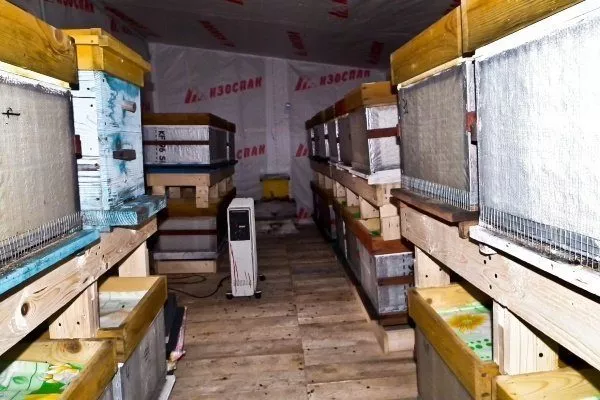
A mandatory condition is the distance of the groundwater from the soil surface.
Wintering in multi-body hives
Even moderately weak colonies can overwinter in a multi-box hive, but this method is more often used for large-scale honey production. This is due to the bees' higher productivity compared to frame hives. Feeding is also considered simpler.
A multi-body hive uses smaller frames, which reduces the amount of honey stored for the winter. However, there are some caveats: provision must be made for the cluster to transition to free frames. It's known that clusters lose their activity during freezing temperatures, so they don't move sideways. However, they easily rise upward, to where the food is warmed by oxygen. Therefore, there's no need to bend around the surface.
Wintering in sun loungers
The main advantage of overwintering in sunbeds is the low labor intensity, as there's no need to move heavy containers of honey. Therefore, preparing the sunbeds can be done by just one person. Another advantage is the ease of preparing the insects outdoors, as the process begins as early as late summer.
Peculiarities:
- Preparation consists of delivery to late honey plants and feeding the bees.
- Immediately after this, the family's condition is checked by removing the store add-ons.
- Since the hive's width is too wide, the beekeeper reduces these dimensions. He moves the frames away from the hive entrance, creating a kind of vestibule where the air will warm up. This ensures normal air exchange and temperature in the bee house.
- ✓ For wintering in the wild: provide protection from the wind and control the first flight.
- ✓ In the moss house: maintain the temperature from -2 to +2 degrees.
- ✓ In multi-body hives: ensuring the transition of the cluster to free frames.
- ✓ In sun loungers: creating a vestibule for warming the air.
Ventilation of hives
Without ventilation, the gas exchange process is disrupted. Fresh air is blocked, and carbon dioxide is unable to escape, resulting in significant vapor accumulation. This causes food to spoil, hives to rot, and bees to die. Therefore, installing a ventilation system is an essential part of the pre-winter preparation period.
Most often, the hive entrance is opened at the top and bottom, but insects tend to plug the upper openings with propolis, which prevents fresh air from entering. Strong drafts are also undesirable, as they are dangerous for the bees.
What needs to be done for balanced ventilation:
- If the top entrance is covered with propolis, you can make small holes at the top or slightly move the boards apart. This is important because the steam released by the cloud rises upward and accumulates, increasing overall humidity.
- In severe frosts, the entrances and holes freeze, so be careful to prevent this from happening. Removing ice can remedy the situation.
- The flight holes cannot be opened completely (to avoid a strong draft), so the damper must be adjustable.
Preparing feed for winter
To avoid harming the bees, the feed must not crystallize, so light-colored honey is selected. This is typically a product extracted from the main nectar flow, meaning it's a flower-colored variety. Light-colored honey contains minimal amounts of honeydew, which prevents insect mortality. Before storing winter feed, it should be tested for honeydew content. This can be done in two ways: by taking the honey to a laboratory or by doing it yourself.
Research using lime:
- Take equal parts honey and water, which should be distilled or well water, but be sure to be filtered. Combine and mix thoroughly.
- Add lime water in the same amount as the honey solution you got.
- Place the mixture on the fire and bring to a boil.
- Carefully inspect the liquid. If it contains brown flakes, it indicates an excessive amount of honeydew. This type of honey should not be used as insect food.
- If there is no color change or sediment, the honey is considered suitable for feeding.
Studies with wine alcohol:
- Combine purified water and honey in equal proportions (take 1 part of each component).
- Prepare 10 parts of wine alcohol having 96%.
- Combine all ingredients.
- Examine the liquid. As in the previous case, if honeydew components are present, a precipitate will form in the form of flakes and the color will change.
If honeydew is detected in honey products, all of it is destroyed. Harmful substances enter the food supply via the bees themselves, as they bring it back from the fields where they collect pollen. This is due to the chemical treatment of crops.
What and how to feed bees?
First of all, bees should receive natural honey, but if there is not enough of it or it is of poor quality, the food is replaced with other feed.
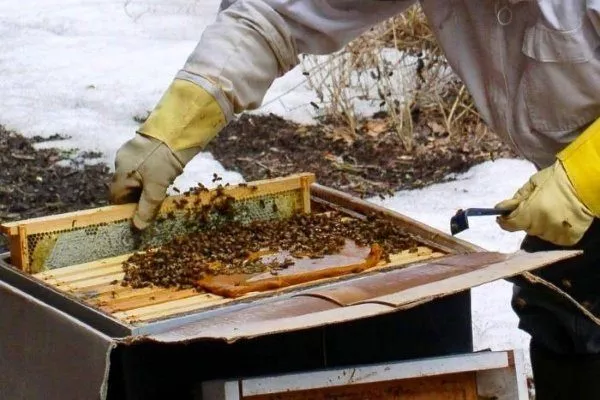
Sugar syrup
This food doesn't contain any vitamins or microelements, but it can still support the bees' vitality. It also helps keep the hive warm.
How to cook:
- Use enameled cookware, not iron, to prevent oxidation.
- Pour in 2 liters of water and boil for 5 minutes.
- Remove from heat and add sugar in the amount of 3.5-4 kg.
- Stir thoroughly until the sugar is completely dissolved.
- Cool until warm.
- Add vinegar essence (approximately 1.2-1.3 ml per 4 kg of sugar), but this is not necessary.
Feeding rules:
- For 1 hive, approximately 5 liters of syrup are needed per day.
- Feeding time is evening.
- The syrup state is warm (hot and cold are excluded).
- If the bees are fully recovered, the dosage is reduced to 300 ml.
- The hive must be well ventilated, otherwise condensation will form, leading to deterioration of the insects' condition.
Potato syrup
By adding potato juice, you can significantly improve the composition of the syrup, saturating it with useful substances.
Method of preparation:
- Peel the potatoes and wash thoroughly;
- pass the tubers through a meat grinder or grate them on the finest grater;
- squeeze out the juice;
- for 1 liter of sugar syrup add a maximum of 60 ml of juice;
- dilute the components only when warm.
How to feed:
- tie the container that you will place in the hive with gauze;
- pour the mixture into this glass container;
- put it in the hive;
- Make sure that the bees not only drink the juice and syrup, but also eat the starch sediment.
Dough made from sugar and honey
This recipe is used as a fertilizer. It's prepared and used as follows:
- take 4 kg of granulated sugar, grind it with a blender until it becomes powder;
- put a kilogram of honey on the fire (it should become liquid and warm);
- add powdered sugar, stir;
- achieve the consistency of the dough;
- add 100 ml of water;
- make a flat cake 2 cm thick from half a kilogram of dough;
- Place the dough on the frame.
Top dressing with bee bread
There are two ways to feed with bee bread:
- Bees place bee bread on the sides of the brood, that is, on the edge of the combs. When pollen flow is in full swing, these combs should be removed and replaced with frames filled with wax foundation. The bee bread elements are then placed in another box, allowing the bees to fill them with honey and seal them. After this, remove the frames and store them in boxes, where the temperature should be between 2 and 8 degrees Celsius. Feeding is done in early spring (when the bees need to gain strength).
- Preserving bee bread. Use a sharp knife to scrape off the surface of the cells containing the bee bread. Then, chop them and mince them. Wash the glass jars and dry them thoroughly. Place the bee bread in them and pour honey over them. Roll up the jars as usual. When feeding, place the jars in warm water until the mixture melts and becomes homogeneous. Place 300-400 grams of the product on plastic wrap, which is then turned over onto the frames and left to act as insulation. Feeding can be repeated after 7-10 days.
More information about feeding bees can be found in this article.
Treatment of bees and hives against diseases
Bees are often susceptible to diseases that can lead to their death during wintering. Therefore, it is important to treat the insects and hives during preparation. This is done after the last brood has emerged and the nest has formed. The most common diseases are: nosematosis And varroatosis.
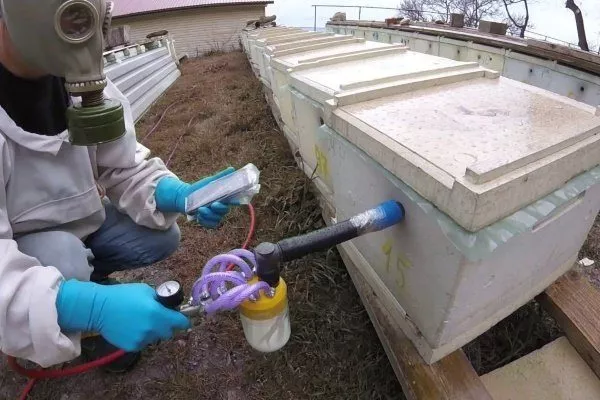
There are different processing methods:
- Complementary feeding with medications. This means adding a suitable medication to liquid feed (preferably sugar syrup). The bees consume it along with their food. A veterinarian should select the medication based on the suspected disease, although there are medications with universal action. Fumagilin has proven effective against nosematosis, and Apimax against varroatosis.
- Smoke cannon. To do this, smoke is introduced into the hive, closed for 20 minutes, and then opened. The downside is that this procedure must be repeated twice. Today, there are special products that heat-treat the hive using a special gun. Hives can be fumigated with Folbex, Phenothiazine, or Bipin.
- Liquid vapor. To do this, hang a plate in the hive, pre-applied with a liquid solution. The bees touch it, spreading the solution throughout the hive, creating a chain reaction. Alternatively, the plate releases vapors that the bees inhale. The following products are available: Nozemaline, oxalic acid.
Some chemicals can have a negative impact on your pet's health. Therefore, choose products based on natural ingredients.
When do they start preparing for winter?
Inspecting hives and beginning initial preparations should begin in late August, when the main honey flow has ended. If this is done in mid- to late fall, brood problems may arise because the weather will be unfavorable for flight, causing the bees to settle in the nest.
If the forecast calls for warm and dry autumn, then preparations can begin a little later, but still in a way that will allow for warmth.
Useful tips from beekeepers
Every experienced beekeeper can share their tips and secrets with a novice beekeeper to ensure a successful bee colony survives the winter. Here are some recommendations:
- Insulating hives is essential. A variety of materials are used for this purpose. Beekeepers often use readily available materials to save money: foam sheets (leftover from household appliances), polyethylene film, polyurethane foam, old bags, warm clothing, straw, and much more.
- It is important that there is enough food.
- To better conserve heat during the winter, all the hives are moved close together, that is, grouped. If they are placed very close together, there will be no exposed walls for the wind to pass through. Furthermore, less insulation material will need to be used (either several hives are covered individually, or a single structure, albeit a larger one).
- Bee houses are insulated not only from the outside but also from the inside. To do this, insulating frames are installed on both sides of the cluster, with warm fabric or any other insulating material placed on top. Straw, felt mats, or leaves are placed underneath the glue.
- The outer side is covered with a suitable material. Small nails and glue are used for this.
- In autumn, supplementary feeding is essential to ensure that the queen does not lose her functionality and the worker bees remain active.
- If you add vinegar to sugar syrup, be careful with the dosage, as too much acid will result in under-inversion of the sweet mixture, which will prevent the syrup from sealing properly.
- The relative humidity in the hive should be between 70 and 75%.
- Avoid drafts. If the apiary is located outdoors, the hives should be insulated with windproof materials.
- Before installing the hives, thoroughly dry and ventilate the areas.
- During the fall inspection, ensure the queen is alive and ready to reproduce. A lack of brood and eggs in the combs is cause for concern.
- If the bees are exhausted after the last honey harvest, be sure to increase the number of offspring.
- During a very hot autumn, it's important to artificially create unfavorable weather conditions for the bees. To do this, create a draft or shade by opening the hives. This is because bees replace themselves before wintering. If this doesn't happen, they will remain unprepared and will have a hard time surviving the winter.
- Strong families are placed at the bottom, weak ones, as well as nuclei with additional queens, are placed at the top.
- Entrance holes may be opened after the bee colony members have completely calmed down.
Some helpful tips from an experienced beekeeper on raising brood and preparing for winter in the following video:
Don't be intimidated by all the rules for preparing your hive for winter, even though there are countless of them. In reality, the process won't take much time or effort, but the bees will be strong, efficient, and resilient in the spring. This guarantees a bountiful honey harvest.