
The vendace is a freshwater lake species belonging to the salmon family, the whitefish order, and a subspecies of the European vendace, surpassing the latter in size. Moreover, the vendace grows twice as fast as the vendace. More about the characteristics of this unusual fish below.
How to recognize a vendace?
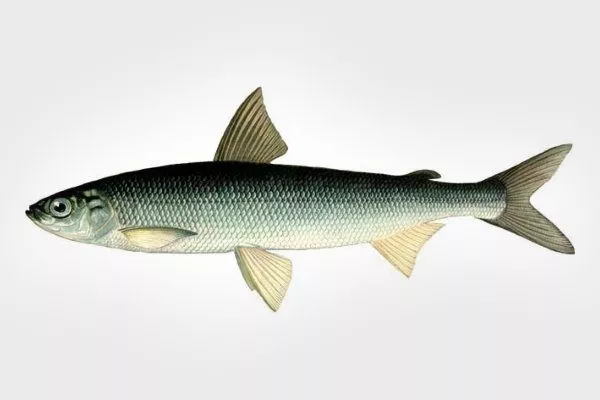
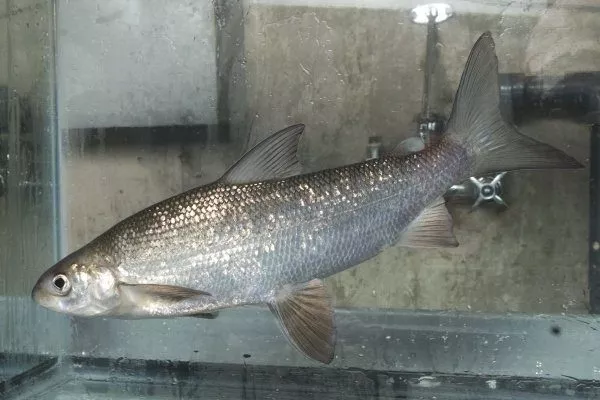
The elongated and slender body of the vendace resembles that of a herring, reaching 46 cm in length and weighing a maximum of 1.5 kg. Its appearance resembles whitefish or vendace.
The back is dark gray with a bluish or greenish tint, the sides have a silvery sheen, and the belly becomes lighter, turning white. The scales are loosely attached to the body and are easily peeled off. The caudal fin is dark gray. The pelvic, pectoral, dorsal, and anal fins are translucent, gray-brown in color. Like all salmon, it has a small adipose fin.
Habitat
This active fish flocks in schools and prefers to live at depths of three to five meters in cool, calm water. It is most often found in lakes and reservoirs located closer to northern latitudes.
Its native habitat is Lake Ladoga and Lake Onega, from where it migrated to Lake Peipus, Lake Seliger, and other lakes in Karelia. It later appeared in the Ural and Siberian waters, where it was released in the 1930s.
It prefers quiet coastal areas with rocky bottoms and clear water. Therefore, it doesn't live near large cities; people hunt for it farther from "civilization."
What does it eat?
Schools of predatory small fish typically go hunting in the evening, searching for zooplankton. As the vendace grows, their diet becomes more varied, adding crustaceans and other bottom-dwelling species. They also enjoy snacking on the fry of other species, such as smelt, rudd, and bleak.
Spawning
The fish matures late, in its third or fourth year. This is a very prolific species, with female vendace laying up to 3,000 eggs. Spawning begins in late November or early December, when the water temperature drops to 4–5°C, and lasts no more than 3–5 days.
To spawn, the fish migrates to higher water levels—to depths of 1.5–3 meters—preferring areas with sandy and pebble bottoms. The eggs, which are small and yellow, are not buried in the substrate. The eggs develop over 140–160 days, and the larvae hatch on average on the 15th day.
Commercial value
The vendace is renowned for its fatty, tasty meat, rich in nutrients and prized for its high culinary qualities. Therefore, it is widely commercialized, especially in the Urals. There, it is caught in large quantities by fishing teams that purchase licenses to catch a certain number of individuals, and is also bred artificially. The juveniles are released into natural waters in the spring, and the full-fledged fish are caught in the fall.
Beneficial properties of vendace
Any fish is an essential part of a healthy diet. Ripus is no exception. This valuable fish is distinguished by its high fat content (up to 6.5%) and omega-3 fatty acids. Its mineral composition is also impressive, rich in magnesium, phosphorus, zinc, fluorine, chlorine, nickel, and other minerals.
Of the vitamins, a large portion is niacin, or vitamin PP. It can be safely included in the diet of those looking to lose weight, as 100 g contains only 75 kcal.
It has a beneficial effect on the body's major systems—the cardiovascular, immune, nervous, and internal organs. Fatty acids, in combination with phosphorus, help the body better absorb calcium.
Culinary uses
Housewives love to cook this fish, and there is an explanation for this:
- it is easy to clean;
- it contains few bones, about 10%;
- When heat treated, fish retains all its beneficial properties.
It's delicious fried, boiled, or steamed. Ripus is an ideal filling for pies and dumplings. Incidentally, in Finland, it's the main ingredient in Finnish pie, the country's national dish. It's also smoked, salted, pickled, and dried.
Its caviar is no less important in cooking. It is also very tasty and healthy.
Fishing
When going fishing for vendace, you should remember:
- More active biting is observed at night, since at this time the fish prefer to go in search of food.
- It should be caught in quiet places of lakes with sandy and rocky shallows, as well as in deep water.
- The most successful fishing occurs when the first solid ice forms, which continues until the spring floods. In cold-water lakes, fishing is possible year-round.
- When winter fishing, avoid drilling several holes close together to prevent the lines of two fishing rods from getting tangled, otherwise the angler (or anglers) will spend a lot of time untangling their gear.
Since vendace live in schools, once hooked, you can get a good catch in 2-3 hours. They usually bite on the "rise," meaning they take food from the bottom and begin to rise without any resistance. But if you sit too long and don't hook them in time, the fish will make a "farewell" gesture with its tail, safely escaping the hook.
Fishing begins at maximum depth, gradually decreasing it, and “probing” the entire water column, since the vendace can rise higher in search of food.
Equipment for winter vendace fishing
Many anglers take a tent with them when fishing for vendace in winter. It won't add much warmth, of course, but it will provide protection from the wind. Before you start fishing, you need to make a hole, so leaving an auger at home can ruin the whole project.
Experienced fishermen say that for successful fishing, you need to illuminate the ice holes; then the vendace will bite better. Therefore, such experts always use a light, preferably an LED one. They lower it under the ice. The light attracts the plankton they hunt.
Please note: fishing with lights is prohibited, so what experienced fishermen recommend is not always legal. Whether or not to break the law is your choice. We recommend following government regulations.
In ice fishing spots, a whole tent city springs up on the lake. Each tent has its own light source. Therefore, when choosing a fishing spot, it's best to move away from your neighbors, and especially avoid setting up in the center. The more light, the more dispersed the fish become, which negatively impacts the bite. Therefore, it's best to set up a little further away from others.
If you're planning a night of fishing, it's a good idea to buy a gas stove to stay warm. However, keep in mind that heat can melt ice, so you should only fish on firm ice and place a rubber mat or a layer of straw under your feet. This will protect your shoes from getting wet. A chair or stool is also recommended for comfort.
Remember, fishing is prohibited during spawning.
Choosing gear
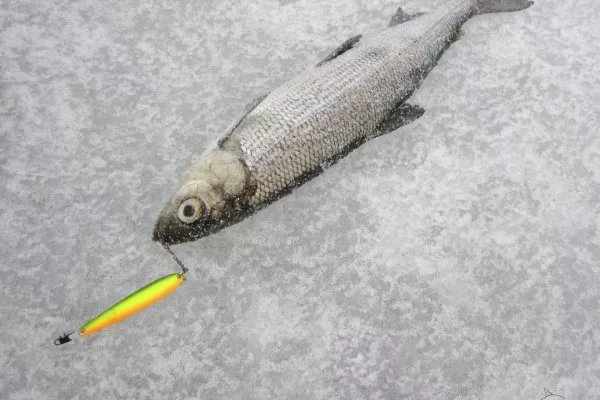
A regular, small ice fishing rod with a stiff tip is suitable for fishing. Since the fish swim at varying depths, they are caught vertically, and a single jig (a hook soldered to a lead or tin pellet) is not enough. Several jigs are tied to the line (anglers attach up to 10 at a time), spaced 60-100 cm apart.
The fishing line should be long and fairly stiff to prevent it from twisting. The optimal thickness is 0.25. Since fish don't grab the bait but rather suck it in with the water, it's best to choose thin and light hooks, with sizes #10 and #12 being ideal. Lower the line very slowly, which is achieved by using a light weight (up to 1.5 g), and a nod equipped with a feather helps detect even the slightest bite.
What to catch vendace with?
This predatory fish responds well to bloodworms, insect larvae, and burdock flies. Some anglers have good success with small pieces of lard. Therefore, it's best to use several types of bait and experiment with what the fish prefers to snack on. When baiting, leave the hook point exposed. Avoid using plant-based baits.
- ✓ Using boiled bloodworm as a base for bait.
- ✓ Mixing bait with sand to increase its attractiveness.
- ✓ Opening feeders at different depths to create a bait column.
Before fishing, the fish are well baited. The best bait is considered to be boiled bloodworms (freshwater amphipods), crushed and mixed with sand. Once the bait settles to the bottom, several feeders filled with the crustaceans are lowered in. Each opens at a different depth, creating a column of bait.
After feeding, the fish begin to respond. However, feeding should be done sparingly, as once sated, the vendace loses interest in food, no matter how tempting. They are also easily attracted by a beaded hook without bait.
Breeding and growing of vendace
Over the past few decades, the vendace population has declined significantly due to environmental degradation, uncontrolled fishing, and poaching. Furthermore, this species is considered endemic, as it occupies a limited range.
During the spawning season, vendace fishing is prohibited. Therefore, vendace are the subject of artificial fish farming and acclimatization. They have been acclimatized, for example, in the Ural reservoirs, where they thrive. Interestingly, Ural vendace reach sexual maturity earlier, in their second year.
In artificial conditions, it is grown in ponds. The eggs used for seeding are in the final stages of development, delivered from hatcheries and placed in baskets. The baskets are placed in the pond at a depth of 1.5-2 meters, with a distance of 50 cm between them.
Next, the eggs undergo further incubation. Clean, fine gravel or small stones are placed in the bottom of the baskets, and the top is covered to prevent other fish from getting into them. After some time, the larvae hatch from the eggs. They leave the baskets and go to their natural habitat in the pond. The area should be free of vegetation and away from water outlets.
When artificially grown, vendace grows from one egg to 60 g in one summer. To obtain a commercial stock per 1 hectare of water body, the following is required:
- 3 thousand larvae;
- 1500 fry;
- yearlings, that is, the young of the current year, 200 pieces.
If the yearlings are left for the second summer to fatten up, then for the winter they are transferred to wintering ponds, where they live alongside yearling carp.
Interesting facts
There are certain facts about the vendace fish that are useful to know:
- Freshly caught vendace smells like fresh cucumber, just like smelt. The typical fishy odor appears after 2-3 hours.
- This fish spoils very quickly, its maximum shelf life is only 1 day.
- Why is vendace called the "royal" fish? Pleshcheyevo Lake, on the shores of which stands the city of Pereslavl-Zalessky, once owned by the royal family, once held plentiful fish. Fish from this lake could only be caught for the royal Lenten table; the rest of the population was forbidden from fishing. Violating this law was punishable by death. Hence its nickname, the "royal fish."
- By the way, the coat of arms of the city of Pereslavl-Zalessky still depicts the vendace, a close relative of the whitefish.
- It is very popular in Finland and is a key ingredient in many traditional Finnish dishes.
- The vendace feeds on the chub, so where it is found, there is most likely also the vendace.
So, the importance of vendace is clearly underestimated. Russians are wary of unfamiliar fish species, but in the Urals, for example, it's very popular; it's healthy and has incredibly tender meat. And winter fishing for vendace is a favorite pastime for many experienced anglers.