
Whitefish is a valuable commercial species of the salmon family. It has a unique appearance and comes in many varieties, which are presented in this article. It can also be bred and raised in a pond on a private plot for sale and profit.
External appearance of the fish and its characteristics
The whitefish's body is covered with small scales and is slightly compressed at the sides. The fish is characterized by a very small mouth, and the upper jaw lacks teeth, which quickly disappear elsewhere and are always very poorly developed. This fish is quite rare, and some of its subspecies are listed in the Red Book. Whitefish are prized for their excellent taste.
There are many varieties of this fish species, and it's difficult to distinguish them by appearance. All whitefish have a common feature: a large flat head, a silvery body, and black fins. Many fish lack spots on their bodies and fins. Females have larger scales than males. The appearance of each subspecies can vary depending on climate, temperature, and habitat conditions.
Whitefish has white meat, despite being a member of the salmon family (red fish). Whitefish is a fish that contains only the spine and ribs, which makes it even more prized.
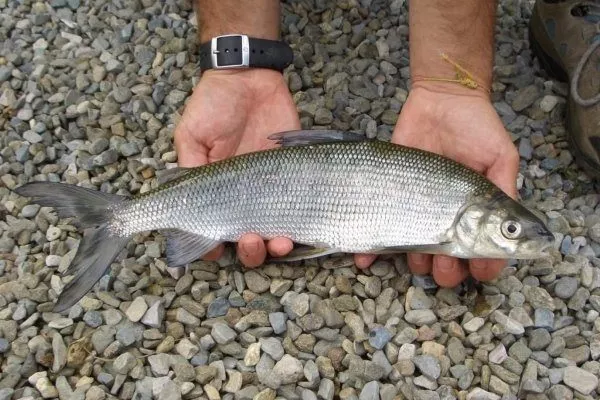
Whitefish can live up to 20 years, although 7-10 year-olds are most often caught. Body length, depending on the subspecies, ranges from 10-15 centimeters for small specimens to 50-60 centimeters for larger specimens. Common whitefish in the catch weigh around 1 kilogram, but trophy fish can reach 12 kilograms.
Habitat and distribution
Whitefish are considered a commercial fish, which is why they have become acclimated to water sources in many parts of Russia and the former Soviet Union. They are successfully caught in the Gulf of Finland, Lake Ladoga, Lake Onega, Lake Peipus, and other local lakes. Whitefish are also widespread on the Kola Peninsula, where they prefer to inhabit large lakes such as Lovozero, Lake Seydozero, Lake Umbozero, and Lake Pankunjavr.
The fish is also found in most bodies of water located in the Arctic Ocean basin, from the White Sea and the Barents Sea to Chukotka. It inhabits the Penzhina and Anadyr rivers, the Baltic Sea basin, and the Curonian Lagoon. In the Transbaikal region, whitefish are found, spawning in early spring.
Whitefish mostly prefer rivers, but also inhabit seas and lakes, where they survive the winter cold. All whitefish species prefer cold and temperate climates in the Northern Hemisphere.
Whitefish are deep-sea fish that live on the bottom. When hauled up in nets, they sometimes swell considerably, like most deep-sea creatures.
Beneficial properties and harm
Whitefish has a variety of beneficial properties. It's rich in fat, which contains many vitamins and helps normalize the functioning of many organs in the human body. Unlike animal fat, it's harmless to health. It's easily digested and ideal for those suffering from gastrointestinal issues.
Whitefish is prized in cooking, cosmetology, and medicine. It is recommended for women trying to conceive, as it contains folic acid. Regular fish consumption helps provide the body with the nutrients necessary for pregnancy.
Due to its unique composition, health professionals recommend consuming fish in moderation for people suffering from:
- high blood pressure;
- inflammation of the stomach;
- thyroid diseases;
- tuberculosis;
- occlusion of veins;
- inflammation and damage to the mucous membranes of the large intestine;
- varicose veins.
Fish is beneficial for people with nervous system disorders – the product is rich in iodine, which has a beneficial effect on the endocrine system.
People with individual intolerances or allergic reactions to seafood may be harmed by fish. Lightly salted or smoked whitefish is not recommended, as it can cause helminth infestation.
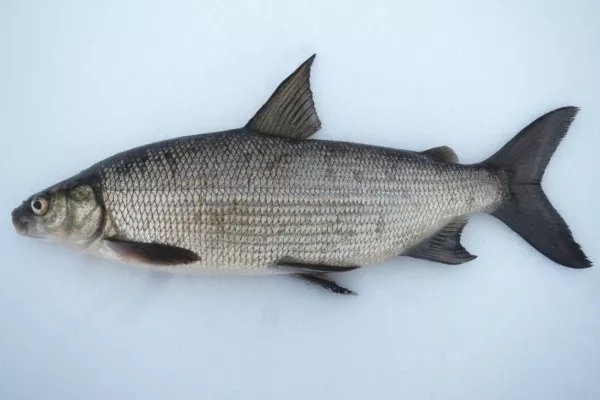
Types of whitefish
Whitefish require clean, cool waters for their survival. Whitefish are divided into several distinct species, each characterized by a limited range and the presence of polymorphic specimens:
- Muksun. A fish with a predominantly delicate, pinkish flesh. A freshwater, semi-anadromous fish, muskeg prefers to migrate to other spawning areas during the spawning season. Found in Siberian waters, it is a permanent resident of the Arctic Ocean.
- Nelma. Like the muksun, it inhabits the Arctic Ocean. It is also found in the estuaries and deltas of northern rivers. This species is listed in the Red Data Book of the Russian Federation, so catching, keeping, and transporting it is prohibited by law.
- Omul. A fish with two subspecies: the Arctic and Baikal omul. The Baikal omul prefers waters originating from the Arctic Ocean, while the Arctic omul inhabits rivers such as the Khatanga, Pechora, Indigirka, Yenisei, Kolyma, and Lena.
- Peled. A lake and river fish, sometimes called "cheesy whitefish," this is a valuable species of whitefish of interest for commercial production.
- European vendace. A small fish of the whitefish family. Particularly common in the Baltic Sea basin.
- Siberian vendace. A small fish that prefers freshwater. It is also known as "vendace" or "kilts."
- Whitefish is anadromous. A subspecies of whitefish, capable of developing into many different forms, distinguished from other varieties by the shape of the head and the lower position of the mouth. Characterized by a large, humped snout.
- Ussuri (Amur) whitefish. The fish is found in the middle and lower reaches of the Amur, in the Amur estuary, in the southern part of the Sea of Okhotsk and in the Tatar Strait.
- Whitefish. A river fish found from the Yenisei to Chukotka, from Alaska to the Atlantic coast of North America.
- Tugun. This subspecies cannot be found anywhere except in Siberia.
- Chir. A fish that prefers freshwater rivers located beyond the Arctic Circle.
| View | Habitat | Nutritional Features | Average weight | Life expectancy |
|---|---|---|---|---|
| Muksun | Arctic Ocean, Siberia | Plankton, small crustaceans | 1-2 kg | 10-12 years |
| Nelma | Arctic Ocean, mouth of the northern rivers | Small fish, insects | 3-5 kg | 15-20 years |
| Omul | Rivers of Siberia, Baikal | Zooplankton, small fish | 0.5-1.5 kg | 8-10 years |
| Peled | Lakes and rivers of Siberia | Zooplankton, small crustaceans | 0.3-0.7 kg | 6-8 years |
| European vendace | Baltic Sea | Plankton, small crustaceans | 0.1-0.3 kg | 4-6 years |
Nutrition
Whitefish are predatory fish accustomed to caution, so they won't easily jump at the bait. In large bodies of water, whitefish are classified as coastal, deep-sea, and pelagic.
Fish often prefer the eggs of not only other fish but also their own kind. They feed on various insects, crustaceans, mollusks, and larvae. They will never pass up fry, young fish, smelt, and other small fish.
Spawning
Whitefish spawn in November, settling in shallows where reeds grow abundantly. Sometimes the spawning process doesn't end until late March. After the larvae hatch from the eggs, they feed primarily on zooplankton. Depending on their preferred spawning location, whitefish are divided into three groups:
- River whitefish. Prefers to spawn within its permanent river, but may occasionally move upriver.
- Lake whitefish. It spawns and lives within the waters of one lake.
- Lake-river whitefish. They spend most of their lives in lakes. During the breeding season, female whitefish migrate upstream along the rivers that flow into their lake.
In Russia, both lake and sea whitefish are found. The advantage of living in saltwater is that whitefish gain significant weight, as freshwater bodies lack sufficient nutrients for this purpose. Because of this, females swim from one spawning site to another, moving upstream along rivers that flow into the sea.
Whitefish fishing
Whitefish fishing is prohibited during the spawning season. Bauntovsky and Volkhov whitefish are also listed in the Red Book, so their fishing is also prohibited. Below, we'll discuss whitefish fishing when it's legal.
Immediately after the thaw, fishermen head out to fish. The main artificial bait for whitefish is the jig, which has been modified specifically for this species.
When May arrives, during the grayling spawning season, whitefish are targeted, as they prefer to feed on grayling eggs. During this period, tackle that takes this factor into account is considered more suitable. That is, the best bait at this time is caviar or a lure that imitates it.
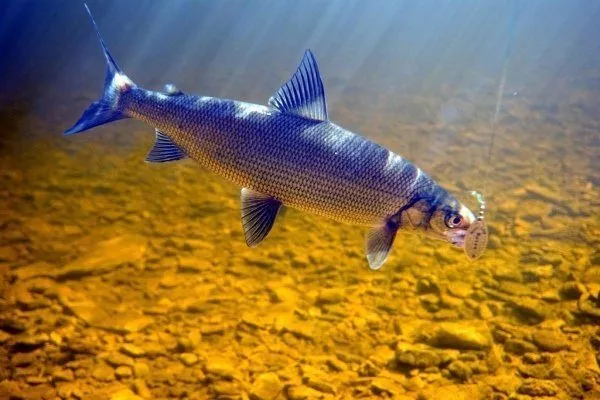
Please note that catching European grayling is prohibited by law!
- ✓ Consider the fishing season
- ✓ Consider the size and weight of the fish
- ✓ Take into account the depth of the reservoir
- ✓ Consider the type of bait
Tackle
There are several types of tackle used for whitefish fishing. Experienced anglers know which tackle is most effective and choose the one that's most convenient:
Float fishing rod
Despite the fact that whitefish are predatory, they are often caught using a float rod. This is especially effective in the spring, when the predator can readily take any bait, including worms.
This is because whitefish are quite hungry after winter. Therefore, anglers use a standard telescopic rod up to 5 meters long, equipped with monofilament line for larger fish. Many anglers prefer braided line up to 0.2 mm thick, as well as a small float.
Particular attention is paid to the color of the bottom of the float to make the fish less wary. The hook is selected based on the size of the fish biting in a given section of the river.
Fly fishing
Whitefish are also caught using fly fishing—this method is suitable for both winter and summer fishing. The rig consists of a rod up to 600 centimeters long and weighing up to 15 grams. It is attached to the tip of a leader. Two nymphs are attached 30 centimeters away from the leader. These nymphs are either tied manually using red yarn or purchased ready-made.
To catch whitefish with a fly, you first find their location in the water column. Without a fish finder, this will be impossible or too difficult. But if you're lucky, you can mark the depth and fish from that depth. Typically, the line is lowered to the very bottom. Then, in search of fish, the line is gradually raised from the surface, as whitefish can live at any depth.
Spinning
Spinning for whitefish using jigs and similar techniques is considered an exciting pastime. A powerful rod, reel, and reliable braided line are essential. Silicone lures or deep-diving wobblers are used as bait. Whitefish have small mouths, so bulky and bulky lures are not suitable. Slender, compact lures are preferred.
It's been observed that whitefish readily take light-colored or brightly colored lures. However, it's best to experiment to determine which lure color resonates best.
Donk fishing
This fishing technique is suitable for fishing in late autumn. At this time, whitefish often come close to the shore. Bottom tackle consists of a sturdy rod equipped with monofilament line and a reel with a high gear ratio. A sinker is required.
The main bait used is maggots. Whitefish are caught from the bottom of the reservoir, along which a bait is dragged. Whitefish will be attracted to a slow-moving bait that doesn't make long pauses. Bottom fishing offers several options. Artificial red lures are most commonly used. Whitefish are found in deep water in late autumn, so anglers target deep spots such as pits.
Winter fishing
Whitefish spawn almost immediately before the waters freeze over, making fishing for them useless during this period. This can also be very dangerous for anglers, as the thickness of the first ice on fast-flowing rivers can be uneven.
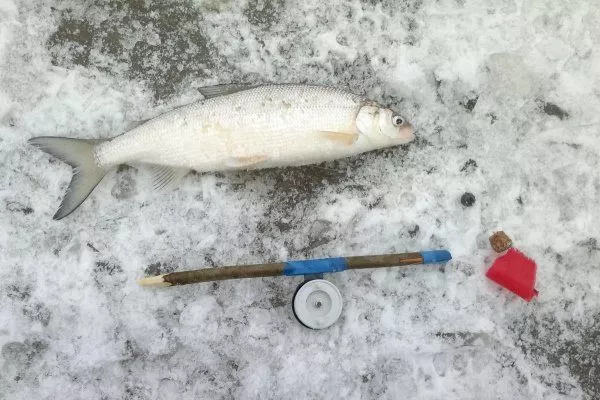
The fish begin to show activity in mid-January, and the best time for fishing is considered to be the period of the “last ice”, where whitefish are hunted in the holes below the riffles and in other clearly deep places of the reservoir.
Spoons or jigs are used for fishing. Spoon fishing rods are rigged with balance weights, flies, jigs, flies, and amphipods. Rods with a nod and jig are used with large jigs in red or any dark shade.
Bait and groundbait
Various imitations of invertebrates, fish fry, and other fish eggs are used as artificial bait. When using bottom rigs, worms, invertebrates, and shellfish are preferred, as these are part of the whitefish's diet.
The fish respond well to flies imitating various insects with light-colored elements, as well as medium and large jigs. Whitefish is a tasty fish, popular among anglers.
Breeding and cultivation
If your garden already has a small pond, you can successfully use it for fish farming. However, if you don't have one, you'll have to build one yourself. First, you need to choose the right location for the pond: it should be in partial shade, in a low-lying area.
Shading can be artificial, since nearby trees will not only pollute the pond with their leaves, but also damage the shoreline with their roots.
To build a pond with your own hands, follow these instructions:
- Dig a hole at least 1 meter deep, and the length and width are determined by personal preference.
- The soil at the bottom of the pit is carefully compacted and cemented.
- After the solution has hardened, a special polyethylene film designed for artificial ponds is placed on the bottom of the pit. This film facilitates quick and easy cleaning of the pond from debris.
- Next, fill the pond with water. First, pour out 1/3 of it to smooth out the liner, then add soil and river sand to the bottom, and plant aquatic plants. Only then is the remaining water released.
At the final stage, it's acceptable to decorate the pond's banks with ornamental shrubs, grass, and trees. It's not advisable to stock the pond immediately after construction. Allow the water to settle for a while to develop its own temperature and microbial environment. To speed up this process, leave some wilted grass on the bottom of the pond or empty a few buckets of water from the natural reservoir.
There are several methods of fish farming. They depend on the fish species and its feeding habits:
- Extensive. No special feed is required. The fish feed on the existing food supply. The advantage of this system is the minimal investment required to produce commercial fish. This method is ideal for southern regions and large bodies of water, where the natural food supply allows whitefish to be raised alongside other herbivorous fish.
- Semi-intensive. The system is based on the fish's protein requirements. This deficiency can be replenished by feeding the fish natural foods. Fish farmers can also supplement their energy needs with special carbohydrate supplements. This method of farming allows for a more thoughtful use of natural food, thereby accelerating fish growth for marketability.
- Intensive. The food supply is created artificially through land reclamation, feed, and fertilizer additions. Special ponds are constructed for this system.
The quality of feed and water directly affects the growth rate of fish. Furthermore, development slows after puberty, making young specimens of particular interest to backyard fishermen. Whitefish are raised for no more than two years, by which time they have reached the appropriate size and marketable weight.
Properly equipped breeding ponds are also essential. Whitefish require oxygen levels in the water of at least 9. They also require lower levels of nitrogen and organic matter.
Whitefish are an interesting species characterized by a long lifespan. Breeding them in your own pond is an option, providing a good income from selling fish products. With the right approach to pond construction and proper conditions, whitefish development and survival will be excellent.