
Many potato growers are increasingly turning to the productive and early-ripening Bellarosa variety. And for good reason, as it boasts exceptional resistance to pests and diseases, is easy to grow, and requires no special conditions or care. To ensure a good harvest, all you need to know are a few rules and secrets.
| Variety | Resistance to late blight | Scab resistance | Blackleg resistance |
|---|---|---|---|
| Bellarosa | High | High | High |
| Other varieties | Medium/Low | Medium/Low | Medium/Low |
A little about the history of the variety
Bellarosa has been around for over 18 years. It was developed in 2000 by German breeders, but they initially believed that Bellarosa could only be grown in Eastern Europe. However, after a short period of time, breeders realized that the potato grows well in other countries as well. In Russia, this variety is most actively grown in the Urals, specifically in the south, northwest, and central regions.
Description of the variety
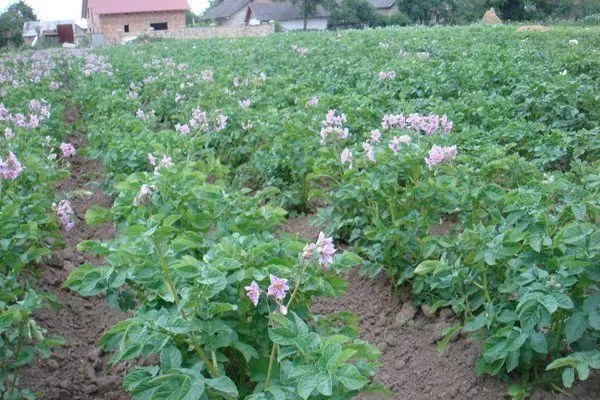
One of the distinctive features of Bellarosa is that the harvest appears healthy, and during the flowering period, the crop also serves a decorative function on the site.
Escapes
This variety sprouts evenly, reaching a maximum height of 80 cm. Bellarosa's stems are thick and sturdy, and the leaves are succulent with slightly wavy edges. During flowering, red-purple flowers appear on the bushes.
Fruit
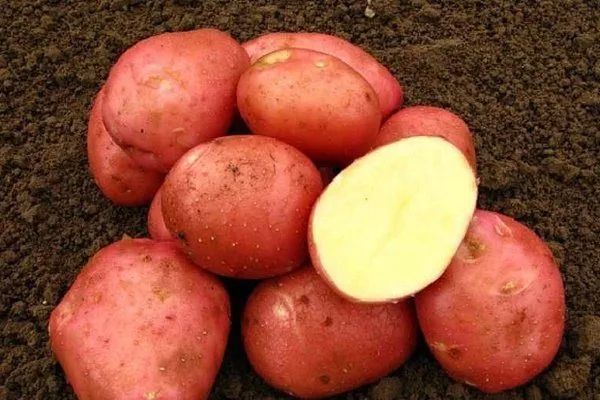
When the plant finishes flowering, potato tubers begin to emerge from the roots. Typically, there are no more than 10 tubers per plant. The tubers are usually uniform in size, weighing approximately 200 grams. However, some are quite large, weighing around 800 grams.
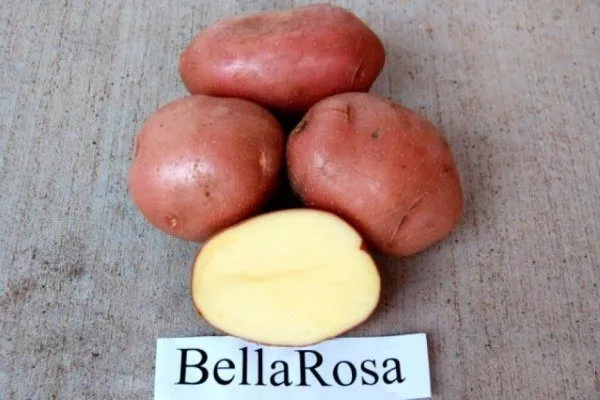
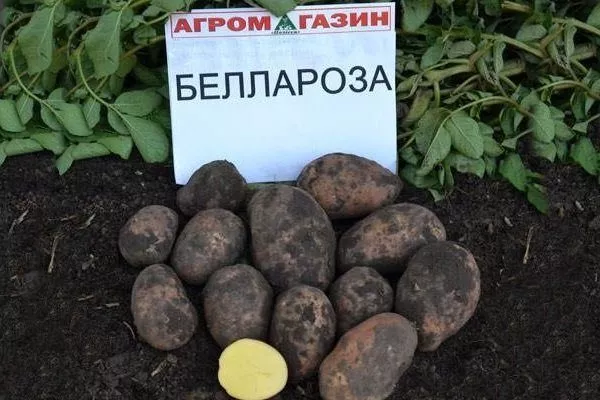
The potato is oval or slightly round, with a pinkish-red skin with a rough, medium-thick surface. The tubers bear very small buds called eyes. The fruit itself, beneath the skin, is light yellow or cream-colored. Another distinctive feature of the Bellarosa potato is its slightly sweet flavor.
This variety is suitable for both boiling and frying: its starch content is 15%. Bellarosa does not darken during cooking, unlike other potato varieties.
Characteristics of the variety
The main characteristics of the variety:
- Early maturity. Potatoes are ready to harvest just 60 days after planting. The tubers can be dug up as early as 40-45 days.
- In southern Russia, Bellarosa can be grown twice a year, and therefore harvested twice. The first fruits are harvested in early July, and potatoes are immediately planted again in the same spot, with the second harvest occurring in early autumn.
- The harvest is large – 30 tons per hectare.
- Can grow in almost any type of soil.
- Bellarosa is resistant to dry weather. Even with prolonged periods without rain, potatoes develop normally in dry soil.
- The harvest can be stored for a long time.
Advantages and disadvantages
The Bellarosa variety has many advantages and benefits over other potato varieties:
- High yield.
- Early maturity.
- Long-term harvest storage. Early varieties typically don't store well and quickly deteriorate. This is another important advantage of Bellarosa. If stored properly, losses will be negligible.
- Easy to grow. Potatoes are often not watered at all, receiving water only during rainfall.
- Disease resistance, including late blight. Bellarosa is resistant to diseases such as blackleg, rhizoctonia, and scab.
- Pleasant taste.
- Potatoes are resistant to mechanical damage. This variety has a fairly thick skin, so the tubers don't spoil when harvested.
Despite its many advantages, this variety also has several disadvantages that you should be aware of when growing Bellarosa:
- The plant can suffer from pests such as the Colorado potato beetle and wireworms. Therefore, it's important to carefully inspect the potatoes for insects.
- Bellarosa is sensitive to low light. Insufficient light will result in small yields.
How to prepare a plot and seed potatoes?
Preparation for planting potatoes should begin in the fall. Fertilize the soil with compost or humus at a rate of 7 kg per square meter of plot. In the spring, dig the soil and add fertilizer to promote growth and protect the future crop from insects. For this purpose, ammonium nitrate, potassium sulfate, or ammonium sulfate should be added.
- ✓ No mechanical damage.
- ✓ No signs of disease (spots, rot).
- ✓ Presence of sprouts 1-2 cm long.
Experts recommend growing potatoes in areas previously occupied by cucumbers, greens, cabbage, or beets. Nightshade crops are the worst predecessors for potatoes.
Fourteen days before planting, place the selected tubers in wooden boxes or simply on the floor indoors, preferably in a single layer to prevent seed spoilage. Store the potatoes before planting in full sunlight and at a temperature of 15 degrees Celsius (59 degrees Fahrenheit) to allow sprouts to develop.
Landing
When planting Bellarosa, the distance between beds should be about a meter, and between each hole – 40 cm. Maintaining this distance is necessary because the tubers can grow to large sizes.
- Select healthy tubers without damage.
- Place the tubers in one layer in a bright room at a temperature of +15 degrees.
- Wait until sprouts 1-2 cm long appear.
Before planting, add one teaspoon of phosphorus and potassium fertilizer to each hole. Place the tubers 10 cm deep on top of the fertilizer, which has been pre-mixed with soil, and cover with soil.
Plant fertilizing
Since Bellarosa is an early variety, it requires fertilizers high in magnesium for vigorous growth. Dolomite flour is suitable for this purpose.
And also, as the plant grows, other fertilizers are added to the soil:
- Immediately after the first sprouts appear, you can add chicken manure or fertiliser.
- Before flowers appear, the soil should be fertilized with a solution of ash and potassium sulfate.
- During the period of active flowering, a fertilizer such as a mixture of superphosphate and mullein is suitable.
It's important to remember that fertilizing should only be done after thoroughly watering the potatoes. Otherwise, the plant's roots may be damaged.
Care
Caring for Bellarosa potatoes is not difficult: they need to be loosened and spud.
Loosening the soil helps the plant obtain more oxygen and water. During this procedure, it is also recommended to remove all weeds around the potato plants with a hoe. Loosening should be carried out when the potato plants are in the active growth phase and are no more than 15 centimeters tall.
Typically, during the entire growth phase of the bushes, loosening is carried out at least three times, but this depends on the frequency of rainfall. This loosening breaks up the soil crust formed after rainfall, which prevents oxygen from reaching the plant's roots. The first loosening should be done seven days after planting the Bellarosa. The second time – when the first shoots appear.
When the bushes reach a height of 15 cm, instead of loosening the soil, begin hilling. This procedure also helps the plant receive more air and moisture. When hilling, rake the soil toward the bush so that the height of the plant prevents it from bending toward the ground. This creates a small mound of soil around the bush.
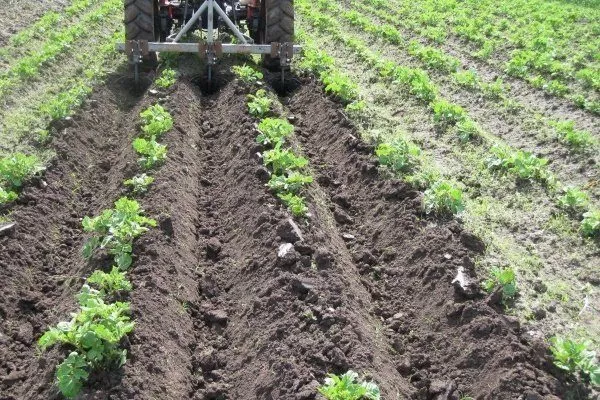
How to make a hiller so you don't have to loosen the soil by hand – read here.
Why doesn't Bellarosa bloom?
Sometimes this potato variety fails to bloom, leaving gardeners worried about the potential for a healthy harvest. Usually, the lack of flowers indicates a disease. But this isn't always the case with Bellarosa. This early-ripening variety typically matures before insects arrive and is also protected from disease.
The lack of flowers may be because the bushes simply aren't having time to bloom. If this is the case, it won't affect the harvest in any way.
Another reason could be that the bushes dropped their buds due to unsuitable air temperatures – above 22 degrees.
Insect infestations can also prevent flowers from growing on potato plants. The only pests commonly found on Bellarosa are the potato ladybug and ground beetle.
Diseases and pests
Bellarosa is highly resistant, so it's immune to diseases common to other potato varieties. Furthermore, any mechanical damage to the tubers quickly heals, sealing the skin.
If on the plant pests appearFor example, if the Colorado potato beetle is present, the bushes should be treated with Fitoverm, Agravertin, or Boverin. Tabu is also effective against the Colorado potato beetle, aphids, and wireworms.
Harvesting
Since in warm regions it is possible to harvest twice a year, potatoes planted in May are harvested at the end of June, then planted again and harvested a second time in September.
This means you can begin harvesting two months after planting. A sign that the potatoes are ripe is yellowed tops. Experts recommend cutting them off at 15 cm above the ground seven days before digging. This will help the tubers ripen further and strengthen the skins to prevent damage during digging.
After harvesting, the potatoes should be sorted, removing any diseased or damaged ones, and then air-dried (not in the sun, but in a well-ventilated area) for 6-7 days. After this, select seed potatoes for planting next season and store them in a suitable location.
The harvest can be stored for up to 8 months if stored properly. The air temperature should be 4 degrees Celsius, and the room should be well-ventilated.
You can see what the Bellarosa potato variety's harvest looks like and learn more about how to harvest it in this video:
Bellarosa receives only positive reviews. This is not surprising, as this variety has virtually no flaws. It's easy to grow, undemanding in terms of soil quality and moisture, and very easy to care for. You only need to follow a few rules to get a good harvest of delicious potatoes.