
Planting and caring for potatoes is a labor-intensive and sometimes thankless task. Not every variety produces a good yield. Unlike the Picasso potato, this variety guarantees large volumes of mature root vegetables if watering, fertilizing, and hilling practices are followed, as well as careful selection of planting material.
History of the variety
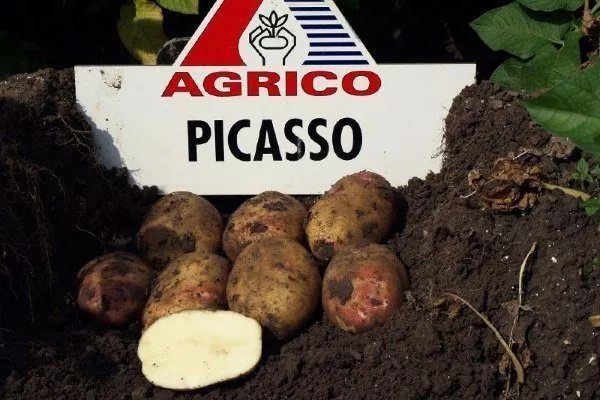
The Picasso potato was selectively bred in the Netherlands by AGRICO UA. It has been included in the State Register of Russian Potato Varieties since 1995. This potato is planted and cultivated primarily in the central regions of the country.
The variety has a local name - "Limonka".
Description of the Picasso potato variety
The Picasso variety is a late-ripening table potato. Its main features are its high yield and distinctive appearance.
Bushes
The Picasso variety's shoots are medium-tall and dark green. The leaves are large, spreading, and have a ruffled edge. The buds are small, white, and have yellow pistils, with 5 to 12 flowers per bush. The foliage is vigorous, dense, and spreading. Flowering occurs quickly.
Roots
The tubers have a distinctive coloring, which is the source of the variety's picturesque name. Picasso potatoes are yellow with large pink eyes that extend shallowly into the root.
The combination of two colors – pink and yellow – was characteristic of many works by the famous Cubist artist Pablo Picasso.
The flesh is light yellow. Starch content is 8-13%. The potatoes are oval and large in shape.
Characteristics and features of the variety
The Picasso variety is characterized by the following properties:
- long ripening period – 110-130 days;
- drought-resistant;
- peculiar appearance of tubers;
- low starch content;
- good consumer qualities;
- shelf life 88-90%;
- high yield;
- demanding for soil fertilization.
The variety has excellent immunity and is resistant to the following diseases:
- scab;
- leaf curling;
- viruses X and Yn;
- Cancer;
- nematode;
- fungal diseases.
Moderately resistant to late blight, and can be affected by the Y NTN virus.
Productivity and taste
A single Picasso potato plant yields 8-20 tubers. Tuber weight varies from 70 to 150 grams, but is typically 125 grams. One hectare often yields 200-320 quintals of Picasso potatoes.
This variety received high marks for its flavor. It doesn't fall apart when cooked and is suitable for frying, soups, and salads. Due to its low starch content, this potato doesn't make good mashed potatoes or dry potato flakes.
You can learn more about the root size and yield of mature Picasso potato plants by watching this video:
Advantages and disadvantages of the variety
The Picasso potato variety has positive characteristics for farmers and gardeners:
- large harvests;
- long shelf life;
- interesting presentation;
- easily tolerates high temperatures;
- good immunity.
Negative characteristics for consumers include:
- demanding in terms of feeding;
- lush tops make it difficult to weed and collect pests;
- The long ripening period makes the variety unsuitable for regions with short summers.
Features of planting and growing Picasso potatoes
This easy-to-grow variety is particularly well-suited to dry and hot climates. Following the planting and care recommendations for Picasso potatoes can significantly increase the likelihood of a good harvest.
Optimal timing and choice of location
The planting time for the variety is determined by the local climate. Picasso potatoes require frost-free conditions and moist soil during planting.
- Conduct a soil test for pH and nutrient content.
- Apply organic fertilizers in the fall.
- In spring, apply mineral supplements according to the soil analysis results.
The location should be well-lit. Black soil is ideal.
You cannot plant potatoes where cucumbers and nightshades were recently grown.
Preparing the site for planting
The area for planting the Picasso potato variety is dug twice. The first time is in the fall, with the addition of organic fertilizers. The second time is in the spring, during which the soil is fertilized with mineral supplements.
Preparing tubers
A month before planting, select the seeding material. Choose healthy, strong tubers. Root crops can be sprouted without sprouting, but this will reduce the yield.
- ✓ The tuber size should be at least 50-60 mm in diameter.
- ✓ Presence of 5-9 healthy eyes on each tuber.
- ✓ No signs of disease or damage.
To ensure successful sprouting, potatoes are placed in a bright place with a temperature above +10 degrees Celsius.
Typically, 5-9 eyes appear on the tuber, growing to about 2 centimeters in height. To stimulate growth, it is recommended to treat the seed with nutrients.
To boost the vegetable's immune system, 2-3 days before planting, you can soak sprouted potatoes in a solution containing boric acid and copper sulfate.
It is possible to cut the seed tubers of the Picasso variety, but in this case the crop will have a weakened immunity.
Planting in the ground, planting pattern and depth
The distance between rows is 70-80 centimeters. Due to the spreading nature of the tops, a minimum of 50 centimeters should be left between the holes in the rows. The depth of the holes is 10-15 centimeters, depending on the soil type. In light, sandy soils, sprouted tubers can be planted deeper, while in hard, heavy soils, the depth of the holes should be no more than 10 centimeters.
Fertilization
The first fertilizing occurs when root crops are planted. Dolomite flour or wood ash can be added to the hole, but humus or manure are of minimal benefit. They can burn the sprouts.
Afterwards, apply nitrogen, organic, or mineral fertilizers of your choice. Fertilize the potatoes after the first sprouts emerge, when buds appear, and during flowering.
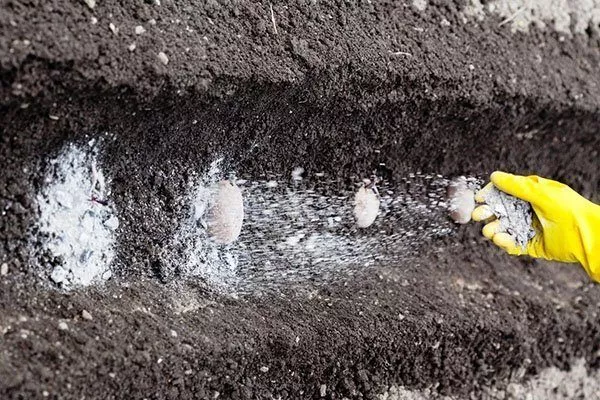
After the potatoes have finished flowering, it is no longer recommended to fertilize them.
Care
Watering is done using the drip method once a week. Each plant requires 4-5 liters of water. It is slowly applied to the roots. During severe drought, the frequency of watering can be increased. After flowering, watering is reduced to once every two weeks.
Loosening should be done the day after watering. Weeding should be done simultaneously or as weeds emerge.
The first hilling should be done when the young potato plants reach 7 centimeters. Mounds of earth are formed around the sprouts twice more before buds appear. The final hilling should be done at the budding stage.
More has been written about when and how to hill potatoes. here.
Protection from diseases and pests
Selecting healthy tubers for planting, regular loosening and hilling are the best prevention of many potato diseases.
To protect against late blight, fungicides are used, which should be sprayed on the bushes before the buds set. If, however, signs of late blight If these appear, it is recommended to use the drugs Ridomil or Oxyhom.
The Colorado potato beetle does not like the Picasso potato variety. For additional protection against this pest, you can plant garlic around the potato patch.
Harvesting and storage
Picasso potatoes are dug up in mid-September, preferably in dry, sunny weather. By the end of August, the tops will already be yellowing and should be cut off. This will allow the roots to become stronger.
After digging, the potatoes are sorted, dried for several hours, and cleaned of soil. The Picasso variety is best stored at 4 degrees Celsius in bags or nets.
When storing in bulk, care must be taken to ensure that its height does not exceed 1 meter.
Reviews
The Picasso potato variety is ideal for warm regions with long, dry summers. In such climates, the root crop yield is highest. The variety has proven to be a good storage variety, and its excellent flavor is also noted. Picasso potatoes are ideal for private farms, as they allow for large yields from small plots of land.