
Potato diseases are classified based on the pathogen, including bacterial, fungal, and viral. Each type has its own unique symptoms and causes, as well as prevention and treatment methods.
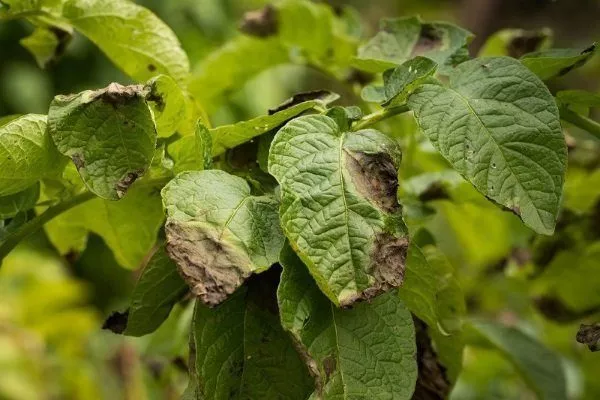
Bacterial
Bacterial diseases are caused by highly infectious bacterioses. Bacterial diseases develop in damaged areas of the plant—tubers, stems, and leaves.
| Disease | Signs | Prevention |
|---|---|---|
| Brown bacterial rot | Wilting in 2-3 days, dark ring on the stem cut | Treatment with Rizoplan before planting and 2-3 times per season |
| Wet rot | Rapid rotting, stench, softening of tubers | Sorting of the harvest, reduction of humidity and temperature in the storage |
| Ring rot | Curling of leaves, white ring on the cut of the tuber | Treatment with copper sulfate before planting, moderate use of nitrogen |
Infection results in root rot and subsequent death during storage and growth. Statistics show yield losses of up to 50%.
Brown bacterial rot
This disease is very similar to common wilt, but can be accurately identified by specific symptoms. Brown rot typically affects the tops and tubers. The bacteria may not manifest itself during the first year after infection, but quickly becomes apparent the second time the plant is planted. The bush will begin to wilt rapidly, within just 2-3 days. The bacteria prefers a moist, acidic, and warm environment.
Main external features:
- leaves turn yellow and wrinkle;
- the plant withers with a drooping top;
- the color of the stems turns brown;
- The bottom of the stem may rot, dry out, or split.
What to do to confirm the diagnosis:
- Cut the stem crosswise and inspect the cut. If the infection is present, a dark ring will appear, and if you press on the stem, a dark, slimy fluid will ooze out.
- If you place a cut stem in water, you will notice the formation of a white liquid.
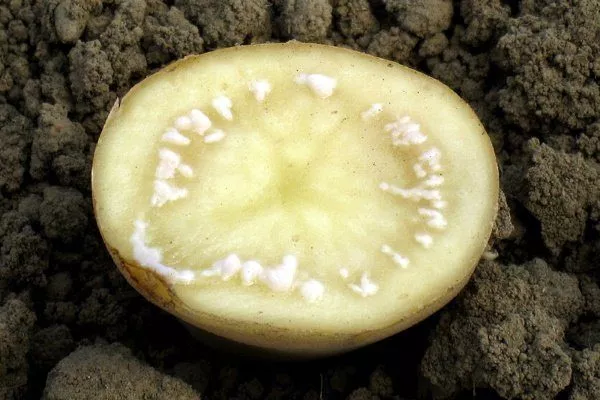
- Dig up the tuber and cut it open. A distinctive feature is the formation of a dark ring (with ring rot, the ring is light).
- Squeeze the cut fruit and you will see dark mucus.
- If you notice hardened skin during storage, the potatoes are infected with brown rot. Do not plant such root vegetables.
Standard control methods are used. As a preventative measure, apply Rizoplan to the area before planting. It destroys putrefactive microflora. During the plant's growth period, spray the area with the same product 2-3 times.
Learn what brown rot is, how to identify the disease, and what measures can be taken to prevent it from this video:
Wet rot
The main cause is excessive moisture. Wet rot is localized in the tuber and progresses during storage, affecting other root crops.
Main features:
- very rapid rotting;
- strong stench;
- softening potatoes;
- transformation of tubers into a wet brown mass.
Prevention and control measures:
- If tubers with these symptoms are found, immediately sort the entire crop. Remove not only the softened tubers but also any that came into contact with them.
- Dry the room, eliminate humidity and lower the air temperature slightly.
- As a preventative measure, additionally equip the storage area with a ventilation system.
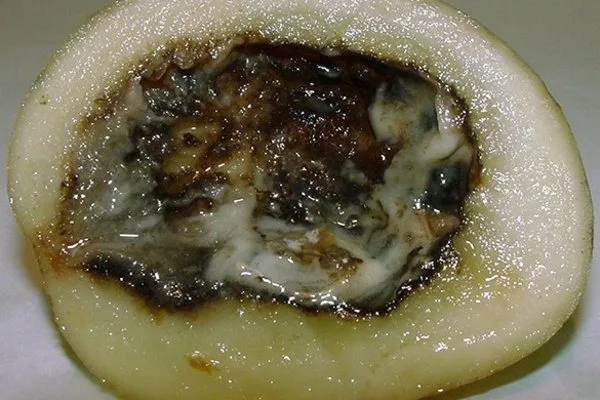
Ring rot
This disease has two varieties: ring rot and pit rot, and is also known as tracheobacterial wilt. They share the same pathogen, but their symptoms differ. The bacteria thrive in dry environments, spreading rapidly to healthy root crops, and is most often detected during drought.
Symptoms of the ring type:
- curling of leaves towards the central vein during the end of flowering;
- yellowing and wilting of leaves;
- tuber suppuration;
- oiliness and viscosity of the yellow mass;
- In the initial stages, when the fruit is cut, a white ring is found.
Signs of the pitted type:
- formation of putrefactive spots under the skin;
- the color of the spots is cream with a transparent border;
- peel cracking;
- the presence of pits (dents) at the last stage of development.
How to fight and prevent development:
- The incidence of disease can be reduced by using copper sulfate or Bordeaux mixture. These agents are applied to the tubers before planting.
- Since this rot can develop due to overfeeding with nitrogen, it should be applied sparingly. To mitigate the effect, nitrogen is mixed with potassium.
- When cutting potatoes before planting, be sure to dip the knife in a disinfectant solution. This will prevent infection of healthy plants.
Blackleg
This disease is considered the most common, as the pathogen adapts to absolutely any conditions. This is because there are three types of blackleg: one prefers cold, another prefers warmth, and a third thrives in any environment.
It lives on many plants, including tomatoes, cabbage, watercress, and radishes. Therefore, it's not recommended to plant potatoes near such crops.
Potatoes can become infected during the growing season, but spread to other tubers occurs while the crop is being stored. If the summer is dry, the bacteria doesn't manifest itself during the early stages of growth, so the tubers rot during storage. If the plant is infected later, completely rotted fruits are found when the crop is dug up.
Characteristic features:
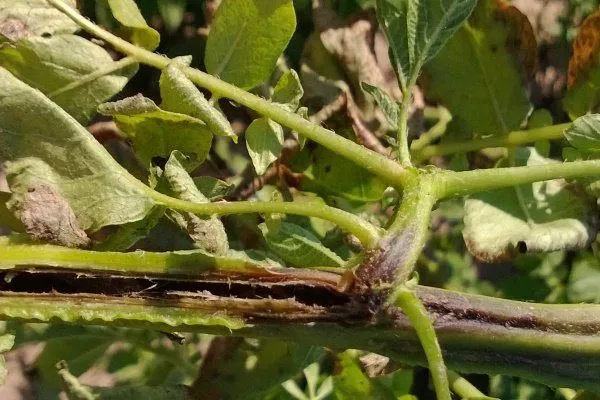
- blackening of the base of the stem followed by rotting;
- plant growth arrest;
- curling of upper leaves;
- bending of lower leaves upwards;
- change in the top of the tops;
- the appearance of brown spots on the leaves.
As the stem rots, its color gradually changes: initially light, it then darkens. The color can be not only black, but also purple or brown. When the stem stem has rotted, it can be easily pulled out of the soil.
Treat and prevent using standard methods. Additionally, you'll need to lower the soil's acidity.
Mixed internal rot
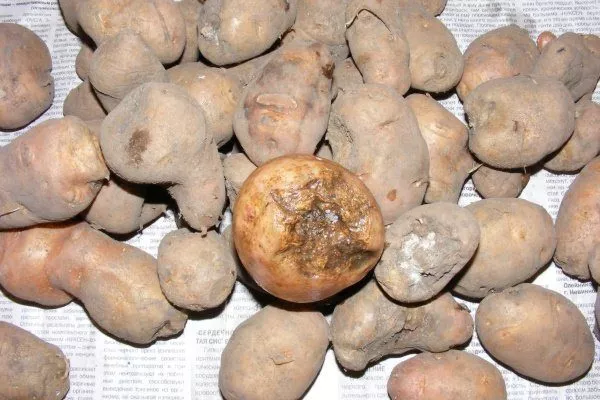
With mixed bacterial infection, the tuber rots completely. The disease most often occurs during storage.
A peculiarity is that potatoes can simultaneously harbor two infections of different etiologies: bacteria (any pathogen) and viruses. The main cause is damage to the integrity of the potato skin, which allows pathogenic microorganisms to penetrate.
Bacterial wilt
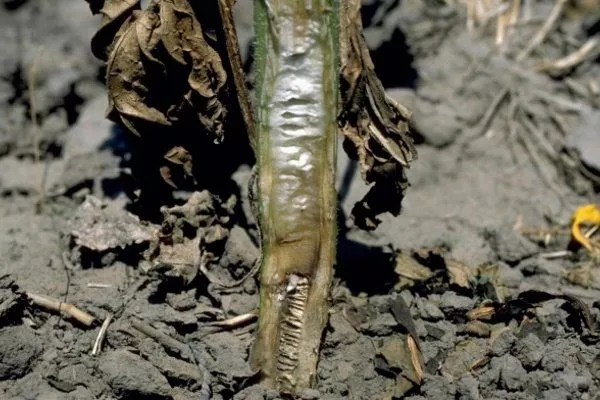
The causative agent is Ralstonia solanacearum (Smith) Yabuuchi et al. The favorable environment is +20°C. Infection occurs due to mechanical damage to tubers, roots, stomata, and stolons. The bacterium is transmitted by insects and wind.
Features of signs:
- sudden wilting;
- wrinkling and yellowing of foliage;
- root rot;
- If you make a cross-section, you can see a brownish mucous exudate.
Viral
In viral diseases, the culprit is a viroid. Potatoes are affected by approximately 20 different pathogens, which are virtually impossible to eradicate. This is due to the virus remaining latent within the plant.
- ✓ Use only healthy planting material.
- ✓ Regularly remove weeds and control insect vectors.
- ✓ Disinfect garden tools after each use.
- ✓ Avoid planting potatoes near other nightshade crops.
Such microorganisms are transmitted by insects (cicadas, thrips, aphids).
In garden plots, the viroid is spread by tools (knives, hoes, shovels). During storage, containers and infected tubers are the culprits. Yields are reduced by at least 80%.
Striped mosaic
The disease occurs as a result of infection with the Y virus and other pathogens. Each viroid has its own specific symptoms, but in general, the following are common symptoms of banded mosaic:
- mosaic or striped leaf spot;
- necrosis of spots (death of these areas);
- dark streaks or spots are found on the underside of the leaves;
- brittleness of stems when broken;
- spotting of tubers when cut;
- leaf fall;
- drying out of leaf petioles, causing them to droop, forming an acute angle with the stem.
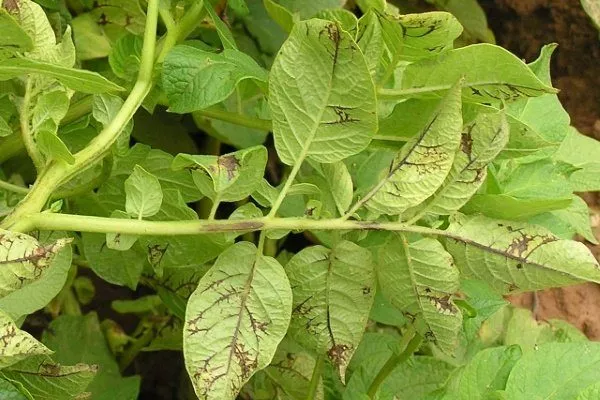
The signs spread centripetally or vertically – from the edges to the center or from the bottom up.
Viral common mosaic
Common mosaic disease is characterized by mottling on the leaves, which may periodically disappear or merge into a single spot. The disease attacks the foliage, preventing tubers from developing. Consequently, they are small or fail to form at all. Yields are reduced by 90%.
Symptoms are identical to those of the previous disease. The viruses are found in nightshade crops, sow thistle, clover, and any weeds.
Wrinkled mosaic
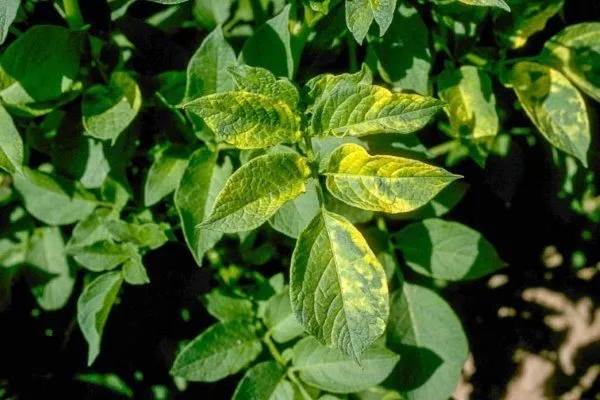
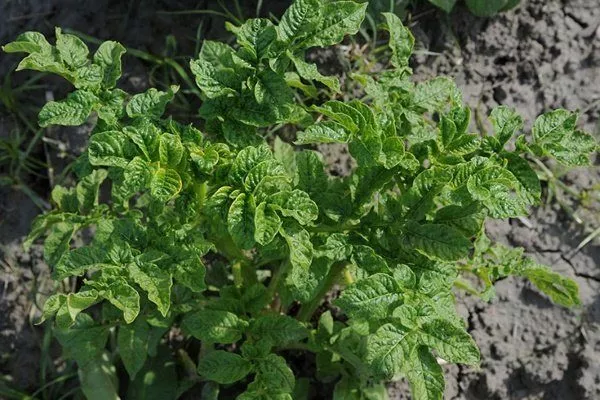
The disease is widespread in southern regions. It is caused by Potato virus Y (PVY). During the initial infection, symptoms may be mild or absent. Symptoms intensify over subsequent years.
Distinctive features viral infection:
- Plants stop growing and internodes become shorter.
- The leaves are small and wrinkled. When viewed from the underside, necrotic spots can be seen. The edges and tips are rounded downward.
- The stems become brittle and begin to fall off.
- Potato varieties that are not resistant to viruses fall to the ground.
- No flowering.
Gothic Tubers
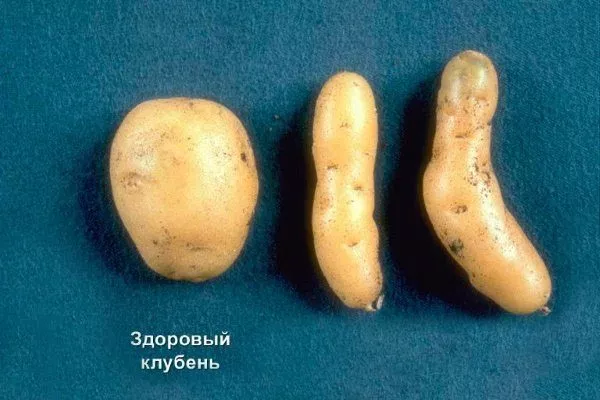
For a long time, scientists were unable to identify the causative agent of this disease because it is almost 100 times smaller than other viruses. It's called the spindle viroid, or Gothica.
This pathogen is characterized by its high sociability, which means it quickly invades the plant upon the slightest contact. It most often lives on nightshade crops, but it also attacks other plants.
Infection is possible at any stage of the potato life cycle. The pathogen is resistant, so once it penetrates the soil, it can survive for two months. However, in dry potato tops, it can survive for up to two years. In high humidity or in water, it can survive for 45 days. It also adapts to garden tools, so disinfection is the best solution to prevent the spread of the viroid.
Symptoms:
- excessive number of eyes on tubers;
- the elongation of the root vegetable in the Gothic style;
- small size of leaves;
- the surface of the potato is bumpy;
- the eyes are located in pits;
- the skin becomes cracked and spotted (especially during drought);
- The leaf petioles grow closer to the stem, which creates an acute angle between them.
Tuber necrosis
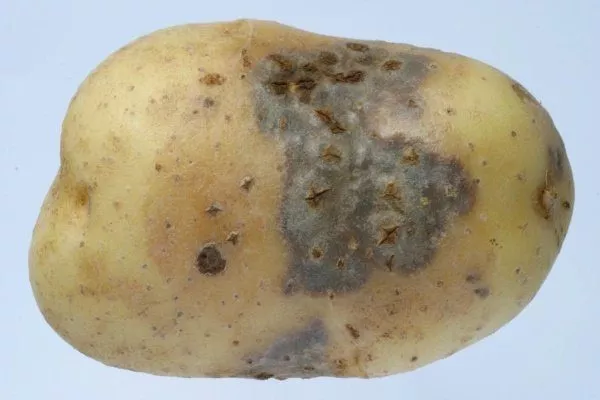
Tuber necrosis occurs with TRV infection. The root crops are affected, so there are no signs on the tops. A cross-section of the tubers reveals the following:
- arched stripes of a dark shade;
- rings;
- necrotic spots with rot;
- rottenness of the edges;
- filling of cream-colored spots with a mucous structure.
Leaf curl
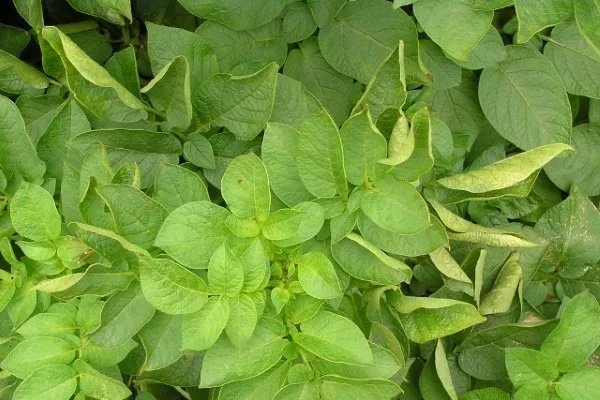
Leaves curl for many reasons—herbicide use, bacterial infections, and, more often, viruses. A harmless cause is poor agricultural practices (excessive moisture or drought).
The main symptoms depend on the cause of the leaf curling. These may include yellowing of the foliage, the formation of dark spots, stunted growth, or damage to the tubers.
Fungal diseases
Potato fungal diseases are among the most serious and dangerous, destroying both the tops and tubers. Infection occurs through insects, from infected plants to healthy ones, and under improper growing conditions.
Mushrooms prefer cool, moist environments and thrive in shaded, dense plantings.
Some fungal diseases, such as late blight, alternaria, and fusarium, are discussed in this video:
Dry rot
The disease is characterized by damage to the root crop. It most often occurs in warm, dry conditions. If the tubers are affected while they are still growing, the area should be reclaimed after at least 7-8 years.
The process of education dry (fusarium) rot:
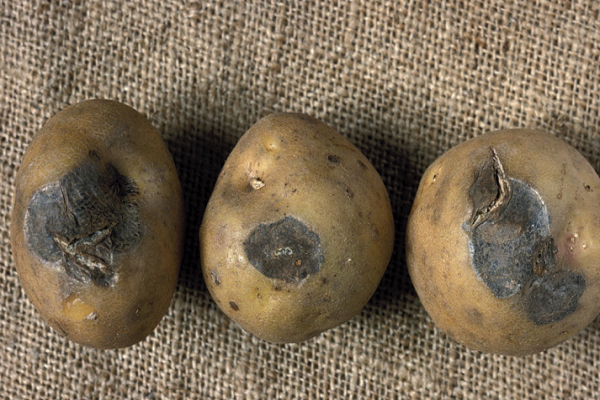
- Initially, a dry spot forms on the surface.
- Beneath it, a mycelium appears with spores that are actively maturing.
- Next, the pulp dries out.
- After this, the fruit spoils.
To prevent dry rot, in addition to standard methods, it's necessary to treat the tubers with fungicides before planting. These include Prestige and Maxim.
Potato cancer
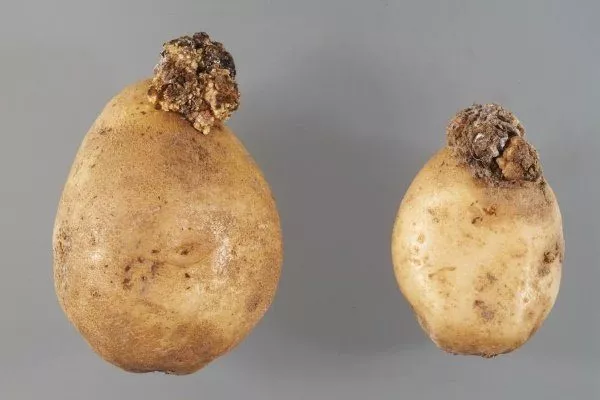
Potato cancer affects tubers and the above-ground portion of potatoes, spreading rapidly in high humidity. It enters the soil through manure, animals, shoes, and gardening tools.
If a canker infection occurs, the entire crop and soil must be destroyed, as the fungus remains viable for a long time. It is extremely dangerous to human life. Planting potatoes in the affected soil is prohibited for five years.
Symptoms:
- the appearance of tubercles on root crops in the area of the eyes;
- formation of growths of arbitrary configuration;
- spread of formations to stems and stolons;
- blackening of the plant surfaces in the affected area;
- slipperiness.
It is impossible to destroy cancer, so the tops along with the tubers are burned, watered with kerosene, formalin or bleach.
Late blight
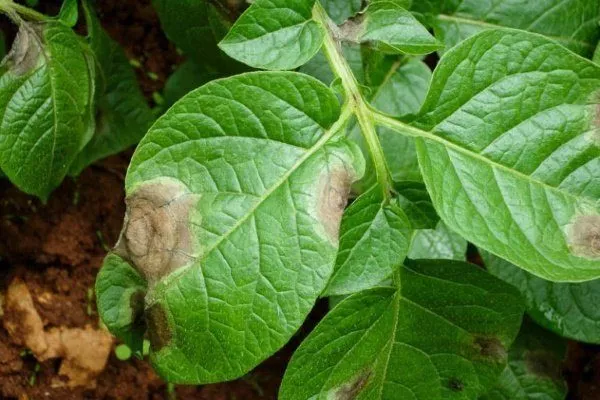
This fungus is the most dangerous because it spreads rapidly through spores and is frost-resistant. Rain is a favorable environment, but drought inhibits spore formation. Characteristic features:
- formation of dark-colored spots on the leaf area;
- drying of the tops;
- the appearance of a brown tint on the stems;
- white coating on leaves.
Methods of getting rid of:
- Potatoes are not susceptible to late blight if mustard is planted nearby. If you don't need mustard, you can plant it 2-4 weeks before the potatoes. As soon as the seedlings emerge, thoroughly dig the soil over, including the mustard, and then plant the potatoes.
- You can use mineral fertilizers with potassium and phosphorus.
- Drugs used for prevention: Agat, Ridomil.
More information about late blight on potatoes can be found in this article.
Rhizoctonia
The main pathogens are fungi, deuteromycetes, and actinomycetes. Features manifestations diseases:
- Sclerotia may appear, which look like pieces of dirt.
- If the affected plant has already been sent into storage, then rot will form during this period.
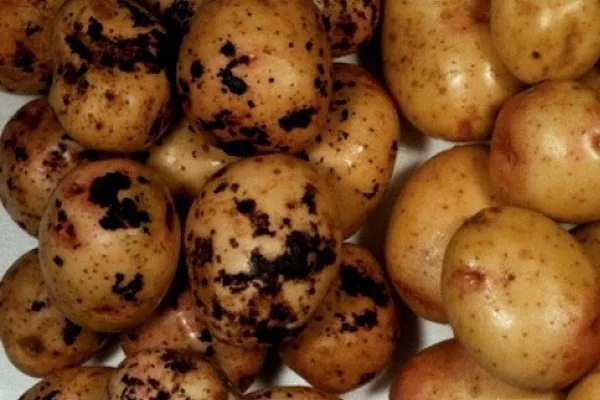
- The root part and shoots become covered with brown or black spots and ulcers up to 2 cm in size. Over time, these areas die off.
- A thin black mesh may form over the entire surface of the root crop.
- The stolons decompose to a mushy state, forming weeping ulcers.
- If the infection is early, the shoots die.
- If the disease progresses during flowering, rhizoctonia appears as a white stem with a felt-like coating.
How to get rid of:
- Follow the general preventative measures for potatoes.
- Treat the seed material with borax or boric acid.
- Spray tubers with biological agents before planting (Baktofit, Agat-25, Planriz).
- Chemical preparations: TMTD, Maxim, Titusim, Tecto.
Alternaria
The fungus prefers young shoots during hot and dry weather. As the fungus progresses, it also attacks tubers. The main cause of infection is a lack of mineralization. Spores are spread during windy weather, spreading across the field and landing on shoots. Fruit can only become infected during digging, as they come into contact with contaminated soil.
Signs:
- chaotic arrangement of brown spots on the leaf area;
- the same spots are observed on the tubers.
Treatment and prevention:
- For 7 days, treat the bush 4 times a day with Bordeaux mixture (1%).
- Use copper oxychloride twice a day for a week.
- The drug Arcerid (follow the instructions).
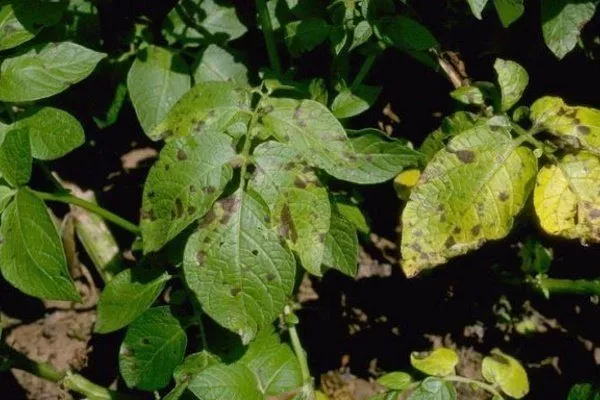
More information about such a potato disease as Alternaria - read here.
Fomoz
With Phoma blight, the fungus penetrates stolons, stems, and roots. If the disease is detected during storage, the mycelium multiplies, infecting the entire crop. Weeds and other vegetation left in the garden provide a favorable environment.
How to identify:
- Shapeless, elongated spots appear on the plant. They are most often covered with brown spots.
- Growth slows as the fungus encircles the plant.
- The richness of the foliage color disappears.
- The tops begin to wither.
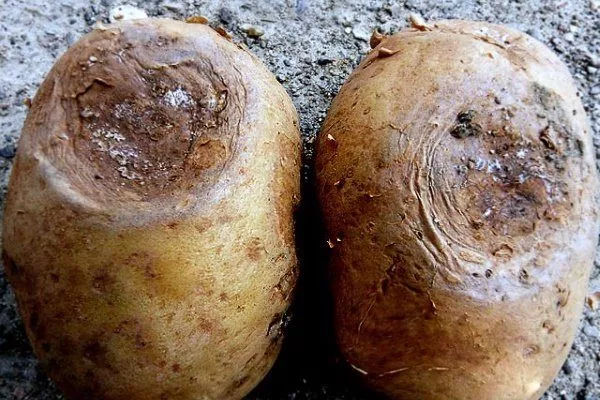
- The tubers are affected by ulcers up to 6 cm in size, after which cavities are formed.
The root vegetables are unfit for consumption, so they are discarded. However, it is crucial to preserve the soil. To do this, treat the tubers with a Fundazol solution before planting, and follow all preventative measures.
Scab
The most common potato disease is scab, which affects the fruit and tops. It is divided into several types.
| Variety | Disease resistance | Ripening period |
|---|---|---|
| Nevsky | Resistant to late blight and scab | Mid-early |
| Luck | Resistant to viral diseases, rhizoctonia | Early |
| Zhukovsky early | Resistant to scab and late blight | Early |
To get rid of scab, follow standard preventative measures. Additionally, tubers can be treated with products such as Ditan, Maxim, Prestige, or Mancozeb before planting.
Common scab. Potatoes with thin skins and red fruit are susceptible to infection. If potatoes are planted at a sufficient depth, infection is unlikely, as the fungus cannot survive without oxygen. To prevent infection, enrich the soil with boron, manganese, and other minerals.
Symptoms:
- formation of dry ulcers on tubers;
- the color of the scabs is brownish-red;
- The ulcers are of average size.
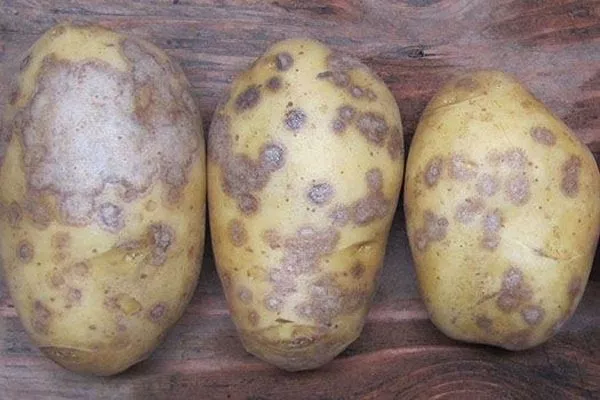
Silver scab. Potatoes infected with this fungus should not be consumed. The infection prefers a moist and warm environment. Symptoms:
- drying out of tubers;
- the formation of sunken spots on the skin, the color of which is silvery.
Black scab. The scientific name is rhizoctonia. Symptoms are similar to those of silver scab.
Powdery scab. The only scab fungus that attacks not only the tuber but the entire plant. Symptoms:
- formation of white spots on the stems and root system;
- increase in size of spots, their darkening;
- ulcerative lesion of tubers, color - red, diameter - 5 mm.
Fusarium wilt
The infection is caused by spore-forming fungi. The mycelium resembles spider web threads, containing canodia. The localization is the soil.
Symptoms:
- discoloration of the upper leaves;
- twisting of leaves along the vein;
- yellowing of the tops followed by falling off;
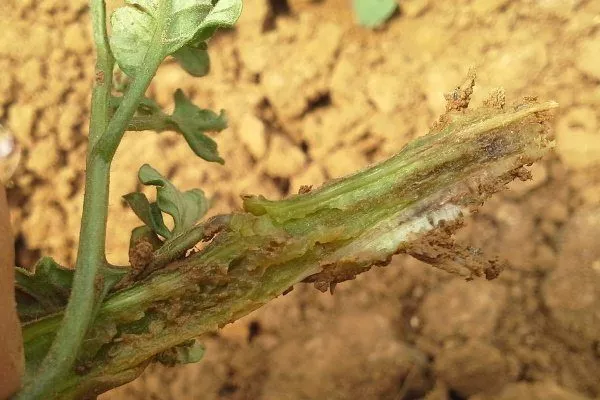
- coloring of the stem in a brown shade;
- stem and tuber rot;
- formation of a putrid odor on the tubers.
Verticillium wilt
The fungus penetrates through the root system by means of insects and mechanical damage.
Signs:
- growth retardation;
- root death;
- formation of brown strokes of a slightly depressed elongated shape;
- the presence of a pink or gray coating on the stems and leaves;
- the cut has a brown tint.
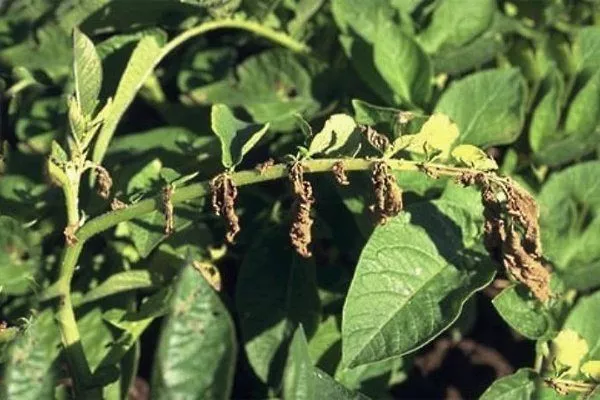
Powdery mildew
Infection occurs with various types of fungi, usually on foliage and young shoots. Initially, the plaque is white, but as the spores (which have a brown tint) spread, the plant darkens.
Characteristic manifestations:
- the formation of a powdery coating that is sticky to the touch;
- deformation of root crops;
- growth retardation;
- death of affected areas.
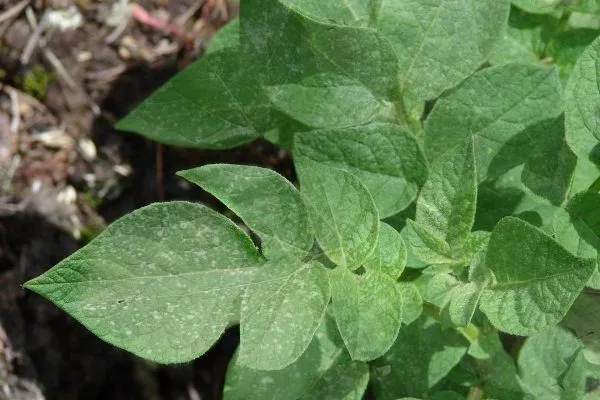
Macrosporiosis
Another name for this disease is spotted dryness. It is caused by Macrosporium solani Ellis et Martin. Infection occurs during harvest through mechanical damage. It can also be transmitted through foliage. It is most commonly found on nightshade crops. Tubers and stems can also be affected.
Early stage symptoms:
- formation of spots up to 1.5 cm in size;
- color of spots – gray, brown, dark brown;
- formation of a weak plaque with a black tint;
- clearly defined boundaries of defects;
- dryness of the tops.
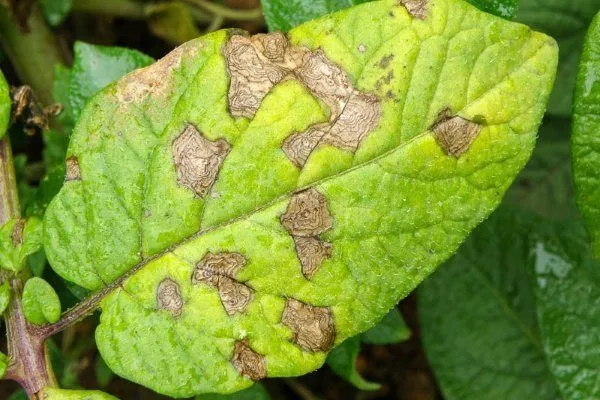
Signs of late stage infection:
- rounded rashes along the edges of the leaves;
- the color of the spots is dark brown with an olive tint of a velvety type;
- rolling leaves into a tube.
Stem form of the disease:
- spots on stems of an oblong shape;
- at a late stage, the rashes merge together;
- stem ringing with spots;
- stem death.
Tuberous form:
- formation of brown, gray spots on the tubers;
- presence of plaque;
- hardening of the affected area.
- ✓ Water your potatoes regularly, avoiding overwatering.
- ✓ Carry out hilling to improve soil aeration.
- ✓ Remove diseased plants to prevent the spread of infection.
- ✓ Use mineral fertilizers to strengthen plant immunity.
By closely monitoring your potatoes at every stage of growth and storage, you can spot the first signs of disease early, preserving your harvest. Don't neglect pre-planting treatment; allow potatoes to germinate for a month before planting. This will help prevent disease.