
Guinea fowl are a bird that produces delicious meat and eggs, and boasts a beautiful appearance. Their meat contains 15% more hemoglobin than chicken, and their eggs have thick shells and a long shelf life. Furthermore, they don't require any special care. These factors have made them popular among farmers and hobbyists.
Description of the breed and characteristics
The common guinea fowl can be recognized by the following signs:
- about the size of a chicken;
- the body is oval, the build is dense;
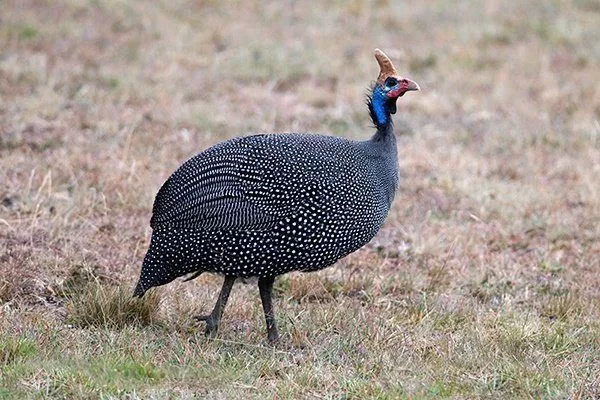
- the plumage is thick, blue, cream, grey or light brown: grey and blue feathers have white spots, and cream feathers have shiny inclusions;
- beak pink;
- paws are grey, sometimes can be pink;
- the tail is small, directed downwards;
- the neck is long, at the top, near the head, there are no feathers on it, in this place there is rough skin of a light blue color;
- on the head there is a growth that looks like a horn and exactly the same one is located on the chin, which makes the bird look like a turkey;
- the female and male have the same color and differ only in the size of the head - the female's is much smaller, and she also holds it upright;
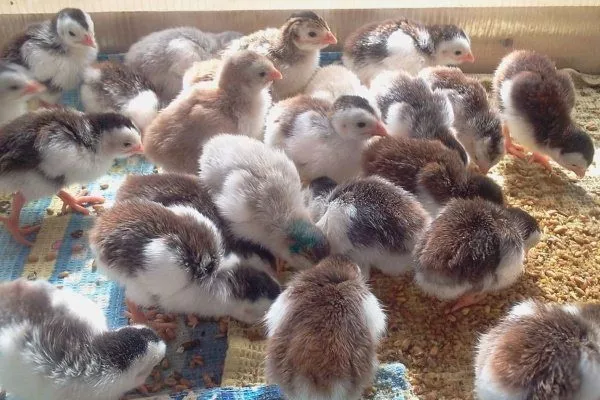
- The chicks have brown down all over their bodies except their bellies (where it is lighter), and they have red paws and beaks.
Guinea fowl are very shy by nature, reacting loudly to the approach of people they haven't yet gotten used to. Among themselves, they are very friendly and sociable, often conversing with one another.
The birds are also very hardy – they tolerate both cold and heat well.
Specifications:
- the weight of an adult is from 1.7 to 3 kg;
- the bird grows up to 53-58 cm in length;
- they start laying eggs at about 30 weeks;
- the egg-laying period lasts approximately 7-8 months (from March-April to October);
- in one cycle, a laying hen produces approximately 100 pear-shaped eggs, weighing 45 grams each;
- The color of eggs can range from brown to gray-blue;
- The eggshells are very thick and strong, which is a definite advantage during transportation.
Maintenance and care
Guinea fowl don't require any special housing conditions. A pen, a run, and a winter poultry house are set up according to the following guidelines:
- Guinea fowl need a lot of freedom, so it is better for them to live in a large enclosure – 1 sq. m for 2 birds;
- It is advisable to make a roof over it from a transparent material to prevent precipitation from getting inside;
- the fence is constructed from a mesh with small cells, into which the bird’s head cannot fit;
- a 2 m high fence is installed around the enclosure and a walking yard is set up;
- In the walking area, it is best to plant bushes and build small houses, as well as install baths with ash and sand for cleaning feathers;
- In winter, the birds live in poultry houses similar to hen houses, and are walked on warm bedding near the house;
- in the poultry house, perches are made at different heights, but not less than a meter from the floor;
- a 10-15 cm layer of straw, sawdust and hay must be laid on the floor to prevent the birds from catching a cold;
- The poultry house needs to be cleaned once every 30 days;
- In winter, additional lighting is installed; it must be on until 10 pm;
- the aviary/winter poultry house and the walking yard are connected by a manhole if necessary;
- Nests for laying eggs are arranged in a secluded place at the rate of 1 nest per 6-8 laying hens.
- ✓ Optimal stocking density: no more than 5 heads per 1 sq.m to prevent stress and aggression.
- ✓ Humidity level in the poultry house: should be maintained between 60-70% to ensure healthy respiratory tract of the birds.
Often birds do not want to lay eggs in a designated area, so they need to be collected from the floor of the enclosure or around the walking yard.
We invite you to watch the video to see what guinea fowl look like. It will also teach you how to set up an aviary, an indoor poultry house, and what the access hole to the outdoor yard should be like:
Common guinea fowl are kept in flocks – 5-7 females and 1 male.
Adult birds have their feathers trimmed on one wing by 10 cm twice a year to prevent them from trying to fly away.
Guinea fowl are kept for 1-2 years. In the second year, only those that have demonstrated maternal instinct and high productivity are selected. There is no point in keeping them for the third year, as the laying rate of the hens drops significantly. egg production.
Feeding rules
The basic diet of common guinea fowl includes:
- Cereals. Can be substituted with boiled potatoes and porridge.
- Vegetables. During harvest season, you can give zucchini, watermelon, and melons.
- Compound feed. At the rate of 130-150 grams per day per bird.
- Greens. 50 grams per day per individual.
Basic rules and features of feeding:
- Guinea fowl are fed 4 times a day.
- Crushed shells or chalk should be added to food to provide calcium.
- In winter, fish oil, milk, and meat scraps should be included in the diet to maintain good health. They also make mashes with warm broth made from grass, cereals, or potatoes.
- In addition to clean water, it is useful to give birds a weak solution of potassium permanganate to drink.
- Birds love to eat insects, especially Colorado potato beetles, but they don't damage the garden beds and are generally tidy. This is another advantage of keeping them, especially for those with their own gardens.
For more information on feeding guinea fowl, look for here.
Breeding chickens
There are several ways to breed guinea fowl. Let's look at each one.
The natural way
The brooding period for chicks occurs from mid-spring to early summer. This type of breeding involves the following stages:
- Fertilization. Mating occurs only during free range. Birds will not mate in the aviary.
- After fertilization, the female begins to lay eggs.
- In order for her to begin hatching them, during the egg-laying period she is placed in a separate room and is not allowed out for a walk.
If the female continues to go out for a walk, she will continue to lay eggs and will not incubate them.
- A single clutch contains up to 8 eggs. The bird incubates them for 25 days. Since guinea fowl are not very caring mothers, their eggs are often placed under the nest of a hen or turkey.
Despite the fact that guinea fowl have a brooding instinct, they can abandon their eggs at the slightest fright.
Incubator method
For incubation, select eggs that are no more than 5 days old and which:
- medium in size;
- free from contamination;
- without growths.
- ✓ Eggs must have a regular pear shape without any deformations.
- ✓ The shell should be free from visible damage and have a matte finish, which indicates its good quality.
The material should be stored in cardboard trays with the pointed end down in a dark, cool place – no more than +10 °C and humidity up to 80%.
Test the eggs by gently tapping them against each other. If a rattling sound is heard, there are microcracks and the material is not suitable for incubation.
When hatching chicks using an incubator, the following rules are observed:
- The device is installed in a room where the temperature is no more than +18°C.
- Turn it on and select a temperature of 38°C several days before the start of incubation.
- A few hours before laying, bring the eggs into the same room to warm them up, and then place them horizontally in the incubator, if the incubator is manual, and if it is automatic, then with the base facing up.
- For the first 14 days, the temperature is maintained at 37.8°C, and then reduced to 37.5.
- Turn the eggs six times a day until day 24 (if using a manual incubator). This is necessary to prevent the embryos from sticking to the shell wall.
The chick survival rate is at least 90%. More information about incubating guinea fowl eggs is available here. Here.
After hatching, the chicks are placed in a box lined with paper on the bottom and covered with mesh on top. Initially, additional heating is required to maintain a certain temperature regime:
- first 3 days – 35 °C;
- 4-11 days – 31 °C;
- 12-21 days – 27 °C;
- 22-30 day – 21 °C;
- from one month of age – 18 °C.
Also, additional light is installed, which is necessary for the chicks to develop and grow:
- for up to 30 days it must be turned on 20 hours a day;
- up to 10 weeks – 16 hours;
- 10-13 weeks – 12 hours;
- 14-27 – 8 hours.
Then the daylight hours increase again:
- 28-43 weeks – in order to bring about the onset of puberty, the daylight hours are extended from 8 hours to 16 hours;
- from the 43rd week – 17 hours;
- from 51 to the end of egg-laying – 18 hours.
From the age of 3 weeks, the chicks can be taken for walks.
Feeding
Basic rules for feeding young animals:
- At first, chicks may have trouble finding food and water, so food is presented on a wooden board and gently tapped to attract their attention, and water is poured into a saucer. To encourage the birds to drink, you can gently dip their beaks into the water.
- Newborn chicks are fed every 2 hours with chopped hard-boiled eggs mixed with porridge, millet and cottage cheese.
- From day 3, chicken feed and greens are added.
- From the age of one week, feeding occurs every 3 hours.
- From the second week, salt, fish oil and yeast are introduced into the diet.
- From the third - boiled potatoes and other vegetables.
- From the age of one month, chicks are usually transferred to four meals a day.
- From 3 months they begin to eat like adults.
Guinea fowl eggs and meat are in high demand, and care is simple, almost like that of chickens. By investing a little time in understanding some of the specifics of breeding, farmers can achieve high productivity and profitability from their birds.