
When choosing pigs for raising and breeding, farmers focus on ensuring the meat and fat are tasty and the piglets are affordable to raise and care for. Karmal pigs fit this description perfectly, as they are completely unpretentious in terms of food and housing, yet very prolific. And the taste of Karmal meat and fat is incredible.
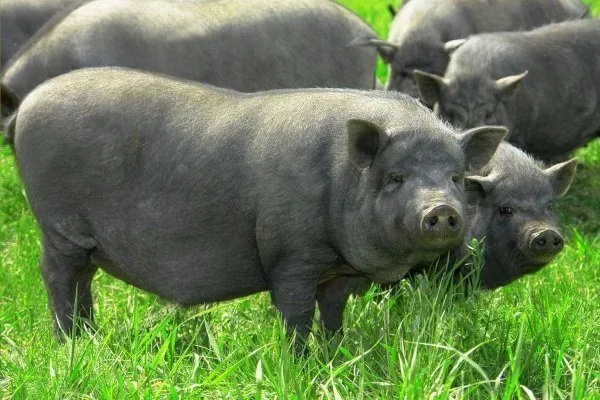
In fact, Karmaly is not a breed of pig, but a hybrid of two breeds.
The history of the hybrid's emergence
Karmals were created by crossing two breeds of pigs: the Korean herbivorous and MangalitsaThis hybrid has inherited all the best qualities from its ancestors:
- animals rarely get sick;
- they have a large mass and grow quickly;
- insensitive to cold and heat;
- unpretentious in food;
- the sow gives birth to many piglets at once (about 22);
- Karmals are very kind and curious, not at all aggressive.
There are two types of Karmal pigs: common and royal. The common pig was created by mating a Vietnamese boar and a Korean pig, while the royal pig was formed through a more complex process. Piglets of this breed were produced only after a generation. First, a Mangalitsa pig was mated with a Korean boar, and then, when their piglets were born and raised, they were crossed with Vietnamese boars. The meat of this hybrid is considered a delicacy and is much more expensive than the common pig.
Description and characteristics of the hybrid
As we have already noted above, Karmals are very kind, they are absolutely not aggressive, and they do not attack other pigs or people, and do not harm birds.
Karmal pigs are large, with a broad chest and thick, curly fur. Newborn piglets are usually black, red, or gray, with stripes. Their thick fur helps Karmal pigs survive even in very cold climates. In severe frosts, these pigs readily play in the snow and stay warm.
Young piglets have long legs. They are very curious and active. As adults, pigs and boars are not as plump as other breeds and appear quite graceful.
Karmaly pigs have large hams, a short but strong neck, strong legs, a muzzle extended forward, and small ears.
Pigs are very neat and well-behaved. They need a designated area to run free, protected by a regular fence, as they don't tend to escape or dig.
Karmals produce more meat. They have a broad back, rump, and chest. The pigs' productivity depends on the type of Karmal you raise. Standard Karmals weigh approximately 150 kg at eighteen months, while Royal Karmals weigh up to 220 kg.
Measurements and weighing of a male Karmal at 11 months are shown in the following video:
Advantages and disadvantages
As we've already mentioned, karmals have many advantages, making them quite popular in agriculture. In addition to the benefits already described, there are also the following:
- High survival rate of pig offspring.
- Sows take good care of their piglets.
- The thick curly fur of the Karmal protects them from the cold.
- Pigs eat any food: dry, steamed, juicy.
- These pigs have a lot of meat with a thin layer of fat. It tastes much better than regular pork, as it's very tender and juicy.
Breeding Karmal piglets is very profitable. The cost of purchasing and caring for a piglet pays for itself within the first year.
Unlike other pig breeds, there is no need to spend a lot of money on expensive feed or building a special pigsty with heating, and there is virtually no need to treat piglets, as they have very strong immunity.
Selling karmal meat will yield significantly more profit than selling regular pork. Therefore, choosing this type of pig will yield a much better result.
Care and maintenance conditions
Karmal pigs require a fenced-in exercise area. Don't worry about them breaking the fence and escaping; this breed is very docile and friendly. Sometimes they'll stand on their hind legs near the fence just to see what's going on behind it; Karmals are very curious.
These pigs are family animals and love to be close to their fellow pigs. Karmals usually choose a leader for their herd. Therefore, to herd the animals into the barn, you must first send the leader there.
A pig pen needs to be installed feeders and drinking vessels. In the summer, karmals should have access to fresh grass. It's also important to remember that these pigs dislike dirt, so a water tank for bathing should be provided in their enclosure.
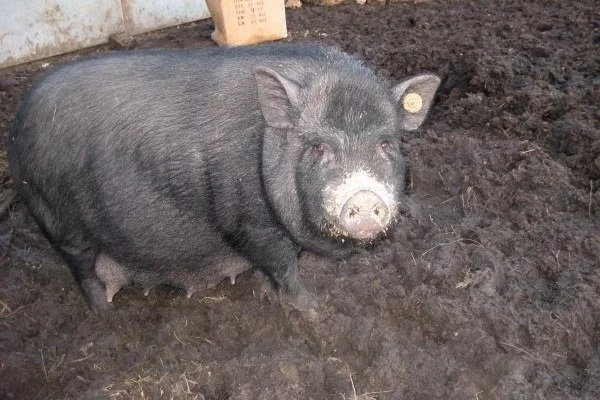
Necessary conditions for keeping individuals of this hybrid:
- In winter, pigs need to walk; thanks to their wool, they won’t freeze.
- A regular wooden barn is suitable for keeping pigs, but it is better to keep piglets in a building where there are no drafts.
- Karmals sometimes develop parasites despite their strong immune system. Preventative measures are essential. They also receive vaccinations against viral infections (depending on the region).
- When the piglets are two months old, they are castrated.
Feeding the Karmals
Karmals thrive on virtually any diet: porridge, potatoes, beets, silage, and food scraps. Unlike other breeds, Karmals require significantly less special feed and compound feed. For example, compound feed should make up no more than 70% of an adult pig's daily ration to ensure their meat remains tasty.
Besides all this, karmals really love grass from the garden or meadow, so it is necessary to give it to pigs, especially in the summer.
These animals' diets may also include raw or cooked vegetables, apples, acorns, and grains. Because the Karmals' ancestors were herbivores, feeding them expensive feed is completely useless and, in some cases, even harmful. To improve the taste and aroma of pork, fresh herbs and dairy products are added to the animals' diet.
Despite their unpretentious diet, feeding karmals fishmeal and soy is highly discouraged, as this will degrade the quality of their meat.
Piglets can be given soft grass as early as two weeks old. And from three weeks on, you can add porridge and grated carrots to their diet. Boiled potatoes can be introduced from the beginning of the fourth week. It's also worth gradually introducing adult food, but it's important to do so in the correct ratio: 5% fish (make sure there are no large bones), 5% legume meal, 20% vegetables, and 70% feed.
It's also important to follow the sequence of introducing adult foods into the diet. Puréed vegetables (carrots, beets, and pumpkin) are added first, followed by cereals, then boiled and mashed potatoes, and finally, food.
- ✓ Feed ratio: 70% compound feed, 20% vegetables, 5% fish, 5% legume flour.
- ✓ The sequence of introducing adult food: vegetables → cereals → potatoes → feed.
It's also important for pigs to have enough calcium in their diet, as it boosts immunity and is essential for building bones. However, regular feed doesn't contain enough calcium. Therefore, experts recommend adding chalk to the diet of piglets. It contains approximately 38% calcium, which helps pigs stay healthy, improves metabolism, and enhances fertility. It also prevents rickets in young piglets.
However, moderation is also essential when using this supplement: the dosage depends on the animal's health, age, and size. On average, an adult pig is fed 20 grams of chalk per day.
How to choose piglets when buying?
The best time to buy piglets is spring, as this is the period when you can feed the piglets grass and vegetables.
When choosing a piglet, you need to be careful and pay attention to even the smallest details:
- The animal's chest should be broad, the back straight, the legs strong and long, the hooves shiny, and the ears small and pink.
- The tail should be dry and not close to the body; it is usually curled into a ring.
- Even a very small piglet should not be bald; it is covered with thick fur, usually striped. No bald spots are allowed on the animal's body.
- Make sure that the karmal's eyes react to your movements; they should sparkle vividly.
- The piglet should be very active and slightly fussy, this indicates its good health.
- The piglet's head is usually heavy, which means that the pig will mature early.
- When choosing a piglet, you need to feed it and watch how it eats. The animal should eat quickly and with gusto.
- The two jaws of a piglet must be the same size, otherwise the animal will not eat well.
- Don't think that a fat, large piglet at a young age is a good choice. It was most likely specially fed milk with added sugar to prepare it for market. Such a piglet will not want to eat regular food, but only sweets.
- If you pick up a piglet, it should squeal loudly. If its cry is quiet and muffled, it indicates that the animal is weak or has an illness.
How to breed Karmals?
Karmal pigs can be bred in any region and under any climate, as they are resistant to cold, heat, and various diseases. They can easily and happily spend the entire day in the cold, playing in the snow, without catching a cold. This is all thanks to their thick fur, which they inherited from the barbecue.
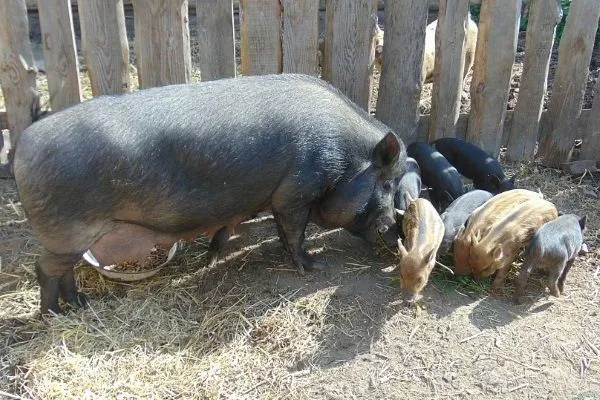
Karmal sows mature at 4 months, but it's best to mate them around 7-8 months. This trait is why Karmal sows are considered to be the most fertile breeds. Gestation in this hybrid lasts about 4 months. After giving birth, the sow requires no human assistance. Karmal sows are very intelligent and care for their offspring well. The only necessary step is to build a small structure for the piglets in the barn.
A sow can give birth to piglets with a variety of colors. A litter can include piglets ranging from black to reddish in color with bright stripes.
Karmal offspring always produce more females than males.
After giving birth, the sow produces a large amount of milk, enough for all her piglets. From birth, they develop immunity to various diseases, and they are also very active.
Once a sow has given birth to piglets, within a month she is ready to mate again and produce more offspring. This characteristic makes karmal pigs a constant source of meat and, consequently, income for farmers.
To breed these pigs, you only need one boar. However, it's important to remember that males reach sexual maturity slightly later than females.
Karmal boars can also be mated with pigs of other breeds in order to improve their quality characteristics.
You can see what one-month-old piglets look like, what size they are, and what color they can be in the video:
Caring for piglets
Karmal piglets don't require any special conditions or care. However, if they are fed a proper and balanced diet, their meat will eventually be tasty and juicy.
If piglets are fed only grains and vegetables, their meat will be tasteless. If they are fed fish, their meat may also have a fishy odor. Soy, fishmeal, and fish oil cake also significantly impair the taste of pork. Dairy products, on the other hand, will make the meat tasty and juicy, and the piglets will be healthy and grow faster.
Before the cold weather sets in, piglets need vitamin and mineral supplements. To determine the correct dosage, consult a specialist.
Newborn piglets don't require vaccinations against infections due to their high immunity. However, these measures should be taken when they reach sexual maturity. Carmal piglets also require deworming. Worms in these animals cause weight loss and allergies. Many types of helminthiasis can even be transmitted to humans. Therefore, preventative measures are essential. These medications are available in the form of injections, powders, and solutions.
If you purchased the product in powder or suspension form, mix it with feed, then dilute it slightly with water and distribute it among the feeding areas. On the day of this procedure, reduce the feed amount by a third. For small piglets, you can dilute the feed with milk or broth. Weaker piglets are best fed separately, in groups of up to 30. Other animals should be dewormed individually.
Sometimes pigs may vomit during this procedure. To prevent this, do not give the animals water before or after the procedure. Feeding can be done 7 hours after deworming.
Avoid giving medication to pigs on the tongue, as this will greatly reduce the effectiveness of the drug. Furthermore, there's a risk of it being aspirated into the lungs, which could cause death.
Experts also recommend adding machine oil to the piglet's bathing tank; it will protect the animals from a variety of diseases.
Taste characteristics of lard and meat
Karmaly pork tastes like tender veal. The pork contains thin layers of fat, making it ideal for bacon.
The fat layer on the meat of the Karmal pig is thin and easy to separate. The fat skin is soft and thin, white in color. The meat of the young pigs is very soft and pliable, as well as tasty and aromatic.
Karmal meat contains a huge amount of B vitamins, as well as numerous essential minerals and amino acids. Every 100 grams of pork from this hybrid contains 66% histidine, 44% valine, 52% threonine, and tryptophan. This makes Karmal meat not only incredibly tasty but also beneficial for the human body.
Raising and breeding this hybrid pig, like the Karmal, on a farm is a very profitable solution, as you'll be able to produce delicious meat for yourself and for sale, with a price significantly higher than that of regular pork. Moreover, due to the low maintenance nature of this pig breed, you won't have to spend all your income on their upkeep.