
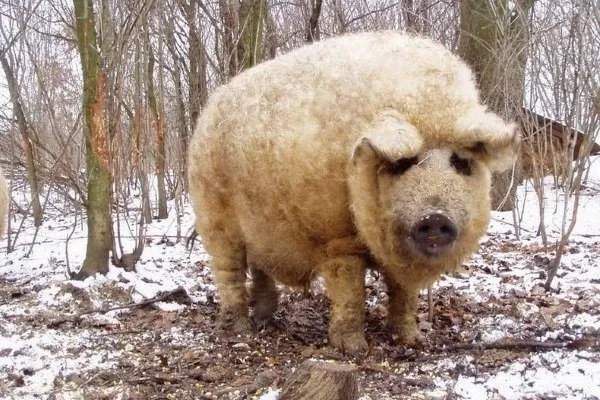
Currently, there are a large number of pig breeds adapted to different climatic conditions. Among them, the Hungarian Mangalitsa stands out. Its distinctive appearance and ability to withstand low temperatures make it the best breed for countries with long, cold winters.
History of the breed's origin
The Hungarian Mangalitsa is a long-established breed, with an estimated date of origin around 1833. It is known for certain that, from 1860 onward, Hungary became famous for its new breed, whose distinctive feature was its remarkably warm, curly fur.
The creation of the breed is attributed to Archduke Joseph. He crossed the Carpathian wild boar with two Hungarian pig breeds, Bakonyi and Szalontai, and an imported Serbian breed, Sumadia. The resulting unique curly-coated, or as it is also called, downy pig was particularly prized for its ability to produce large quantities of lard.
The breed quickly gained popularity. In Hungary alone, the population of these pigs exceeded 30,000. Hungarian Mangalitsa pigs also began to be bred in Ukraine. Central Europe actively purchased the fatty meat. But by the mid-20th century, lard and pork had fallen out of favor, as meatier breeds were needed for bacon and ham. In Hungary, the Mangalitsa population declined to 7,000.
In the 1990s, producers of the deli meats ham and lomo reported a shortage of high-quality raw materials. It was then that the forgotten breed of amazing downy pigs was rediscovered. The Spanish company Jamones Segovia, SA, took up breeding the Hungarian Mangalica pig.
Since 2000, the Hungarian Mangalica breed has been recognized as a national treasure of Hungary. The pigs are actively bred and promoted.
In the CIS countries, Hungarian Mangalitsa is grown by a few small farms, which typically generate huge profits. Their meat and lard are purchased by upscale restaurants.
Description and characteristics of the Hungarian Mangalica breed
Pigs of this breed are medium-sized (up to 85 centimeters in height), have a dense frame, and a large head. The snout is elongated and slightly curved upward, the snout is rounded, and the ears are large and can be erect or drooping. The legs are straight, short, and powerful, with black hooves. The belly is large, and the back may be arched.
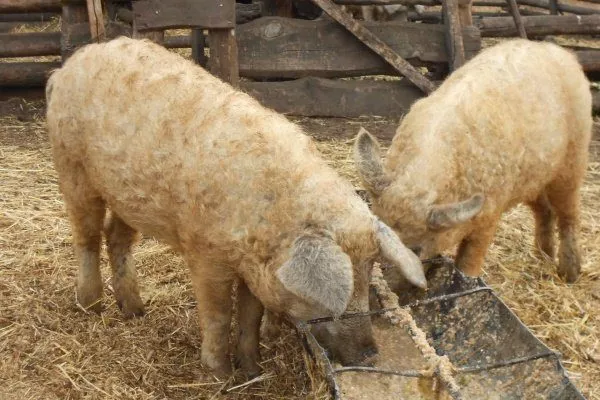
The first thing that catches your eye when looking at a Hungarian Mangalitsa is, of course, its fur. It's thick and long, with an undercoat. During the spring shedding, this undercoat falls out, curling the fur into stiff ringlets. Most Mangalitsas are a dirty white. Besides pigs of this color, there are also black, red, and mixed colors. This depends on the subspecies.
Nowadays, producers often sell hybrid piglets, sired between a Mangalica and a sow of another breed. These pigs will also have a coat, but not the other characteristics necessary for successful breeding. Therefore, it's important to know the other external characteristics of the Hungarian Mangalica:
- the tail is thickened at the base;
- the eyes and the fur around them, nipples, lips, snout, anus, and the inside of the tail are dark in color, regardless of the subspecies;
- white tassel;
- Welman's spot (a dark mark at the base of the ears no more than 5 centimeters in diameter), such a mark serves as confirmation of the purity of the breed;
- no more than 10 nipples.
A Hungarian Mangalitsa boar can reach 300 kilograms in weight, and a sow can reach 200 kilograms. In their first year of life, young animals can reach 150-160 kilograms. The record weight of an adult is half a ton.
| Subspecies | Color | Size | Rate of weight gain | Endurance |
|---|---|---|---|---|
| White Mangalitsa | Light grey to white with fawn highlights | Average | Average | High |
| "Martin" | The upper part is dark, the lower part is light | Less than the rest | Below average | Very high |
| Red Mangalitsa | Bright, without spots or tan marks | Larger than its relatives | High | High |
Varieties
The main difference between the breeds is their color. Currently, there are four color variations of Hungarian Mangalica pigs and three subspecies:
White Mangalitsa. The most widespread subspecies, it accounts for three-quarters of the world's current population of Hungarian Mangalitsas. Their coloring can range from light gray to white, with fawn shades, yellow, and red, while their skin is gray or black.
"Martin". The top of the head, ears, snout, jaw, back, sides, and outer legs of the "swallows" are dark. The belly, lower jaw, half of the sides, and inner legs can be white, gray, yellow, or reddish-brown.
This subspecies is often smaller than the others, with shorter and coarser fur, but it is more resilient.
Red Mangalitsa. These pigs have a vibrant coloring; purebred specimens have no spots or tan markings. Red pigs are larger than their relatives and gain weight faster. This subspecies is considered endangered. The sale of red piglets to private individuals is prohibited.
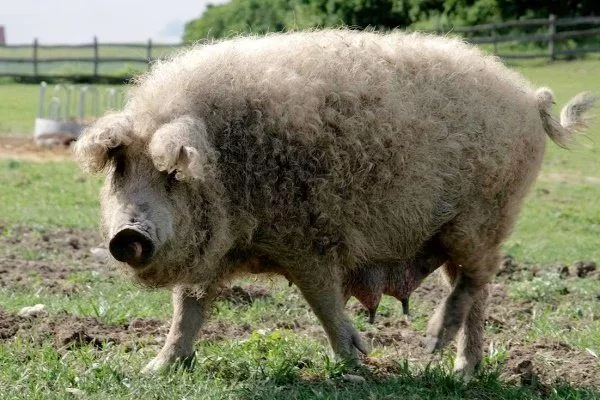
Hungarian breed of pigs, the White Mangalica
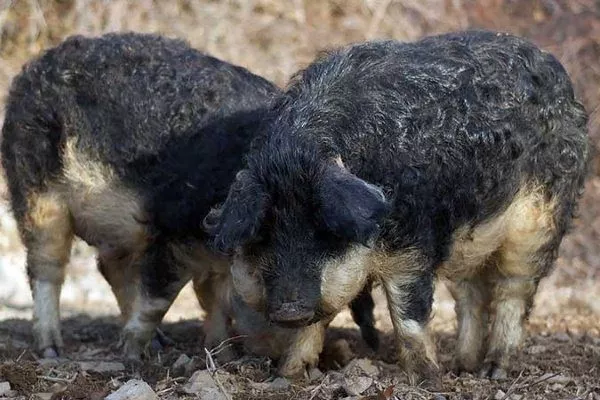
The Hungarian Mangalica "Swallow" breed
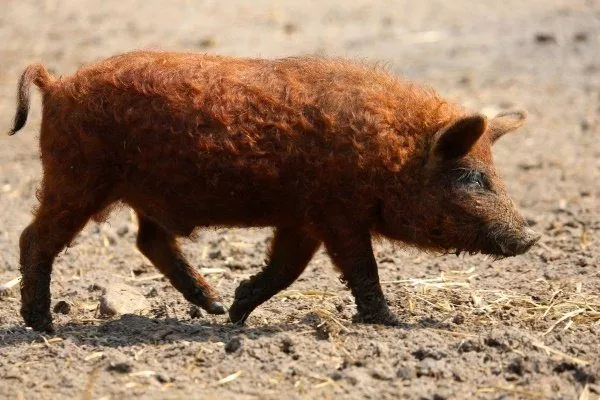
Hungarian Red Mangalica pig breed
Before the decline in the population of these pigs in Hungary, there were individuals that retained the coloring typical of wild boars, or a grey-brown coloring.
Advantages and Disadvantages of Breeding Hungarian Mangalitsas
Let's consider the main advantages and disadvantages of this breed:
| Advantages | Flaws |
| endurance | high price |
| high demand | late puberty |
| high prices for meat and lard | often small litters |
| rapid weight gain | there is a high probability of acquiring a hybrid piglet |
| excellent immunity | the need for large pastures |
| ability to adapt | |
| friendly character | |
| able to remember the way home (the pig is able to return from the pasture on its own) | |
| wool protects against insect bites |
How to choose piglets and what is their price?
The key to success in breeding Hungarian Mangalitsas is choosing the right purebred piglets. While hybrid piglets may look similar, their meat and fat will lack the valuable characteristics of Hungarian Mangalitsas. Therefore, when purchasing pigs, it's essential to request a pedigree and read reviews of the supplier farm.
- ✓ Availability of pedigree
- ✓ Activity and appetite
- ✓ Clean mucous membranes
- ✓ Large chest and straight legs
- ✓ Characteristic features of the breed
- ✓ Striped coloring in babies
Don't rely on the buyer; it's better to go and select the animals yourself, as the piglets' health can only be verified by inspecting them in person. It's best to visit several farms; many characteristics will only become apparent through comparison.
It is especially important to remember that the acquired babies should not be close relatives, otherwise the pigs will degenerate.
A genuine Hungarian Mangalica piglet costs at least 15,000 Russian rubles, with the average price ranging from 15,000 to 20,000 rubles. It's recommended to purchase several piglets, as lack of companionship can cause the animal to become bored, which can affect its appetite and weight gain.
When purchasing a piglet, pay attention to how actively the piglet feeds and whether its mucous membranes are clean. The piglet should have a large chest, straight legs, the previously described characteristic features of the Hungarian Mangalitsa piglet, and a striped coat similar to its wild relatives, but with a color pattern characteristic of the piglet's subspecies (white, black, red, or "swallow").
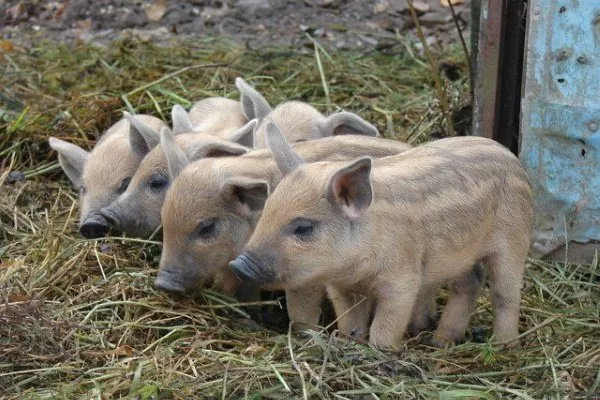
A healthy piglet will squeal loudly when you pick it up.
Avoid buying piglets that are too plump or large. Excessive weight gain at a young age is usually the result of feeding them sugary milk. After this, it's difficult to transition these piglets to a regular diet.
A Hungarian Mangalitsa cross will most likely also be covered with wool, but its meat is tougher, its fat layer is less, its character is not as friendly, and its intelligence and memory are lower.
Doubts about the purity of the breed are cast on individuals of any subspecies that have a pink belly, lack the black markings characteristic of all Mangalitsas, have brown tips to their fur, or have ears that are too large or too small.
Pigs with white spots on the skin and brown coloring, with yellow or black hooves with yellow stripes, will be obvious culls.
The color shades can change during the life of a pig, this process is influenced by nutrition and environment.
Conditions of keeping in a pigsty
The Hungarian Mangalitsa is known for its resilience and adaptability. Even in freezing temperatures, it can survive without a pigsty. Therefore, many owners don't build housing for this breed of pigs, but simply dig a hole in the pen. However, in this case, the Hungarian Mangalitsa's body will use its stored fat to stay warm. For the pig to gain weight well, however, the following conditions are still necessary:
- insulated pigsty for the winter;
- pen in front of the pigsty;
- a drinking bowl with clean water;
- regularly changed straw bedding in the pigsty and in the pen;
- a grazing field fenced off from other animals;
- canopies for protection from bad weather in the paddock and on the pasture;
- additional heating for piglets and pregnant sows, it is also important to protect them from drafts.
This breed, thanks to its high immunity, does not require vaccinations.
The Hungarian Mangalitsa has a good memory. Therefore, it is capable of returning home on its own from grazing, and there is little need for shepherds, especially if there are no predators nearby. These predators, incidentally, include stray packs of dogs.
Every fall and spring, pigs should be given deworming medication.
Feeding and diet
Hungarian Mangalitsas are omnivorous, feeding primarily on grass. In summer and spring, they eat grass, and in autumn and winter, they eat hay. However, to promote weight gain, the following can be added to their diet:
- potato;
- corn;
- pumpkin;
- beans;
- zucchini;
- beets;
- acorns;
- chestnuts;
- cereals;
- cane;
- silage;
- red clay;
- chalk;
- bone meal;
- seaweed.
These pigs will not refuse food scraps, snails, insects, and frogs.
Hungarian Mangalitsas should not be overfed, as this breed is prone to obesity. This can lead to poor meat quality and death.
Hungarian Mangalitsas can be fed commercially prepared feed, but they still need fresh grass or hay. The choice of feed depends on the animals' age.
Owners who care about natural meat can prepare their own feed. To do this, mix corn, bran, chalk, bone meal, wheat, oats, and corn meal.
Reproduction
Representatives of this breed reach sexual maturity at one year of age. By this age, the sow must gain at least 100 kilograms to successfully bear a litter. The strongest and healthiest piglets will be born during the second litter. The sow gives birth to 3-7 piglets during her first litter; in subsequent pregnancies, she can carry up to 12 piglets, occasionally 14.
- Insulation of the sow room.
- Preparing a heat lamp for piglets.
- Providing the sow with vitamins and minerals.
- Separation of the sow from the main herd.
From mating to farrowing takes 110-120 days. Before farrowing, a separate, insulated room for the sow is necessary. Hungarian Mangalitsas have excellent maternal instincts, so they will care for and protect their offspring.
Hungarian Mangalitsas can go into heat as early as 5 months. However, at this age, the sow is not yet fully developed and will not be able to bear a litter. Such sows should be separated from the males and kept away until they reach the required weight.
Raising offspring
It is recommended to prepare a heat lamp for the birth. Piglets are born with short fur, but drying it on their own will be difficult. For the first week, they feed on their mother's milk. Two days after birth, the piglets are given intramuscular iron injections to prevent anemia.
On the fourth day, the piglets' tusks are broken off to prevent them from injuring the sow during feeding. Two weeks after birth, those raised for meat are castrated to promote weight gain and reduce aggression. This procedure is mandatory for piglets with inguinal hernias.
In the second week of life, piglets are given steamed bran, roasted barley, and essential vitamins and minerals. At one month, they can begin to feed roughage. The full transition to adult food occurs at four to five months of age. The disappearance of the "baby" stripes on the piglet's skin signals the beginning of weaning.
The tails of Hungarian Mangalitsa kittens are not docked; they are one of the characteristic features of the breed.
The taste characteristics of the meat and fat of the Hungarian Mangalica
The meat and fat of the Hungarian Mangalica are ideal for many meat delicacies, making them highly prized. It has a marbled texture and a delicate flavor. Furthermore, this breed's meat boasts a number of beneficial properties:
- anticarcinogenic properties;
- high content of zinc and iron;
- low cholesterol;
- vitamins A and B group.
The fat layer of Hungarian Mangalica is 55-65 millimeters thick and has streaks, which makes the fat of this breed unique.
Reviews
You can learn more about the first litter of Hungarian Mangalica pigs and the rules for raising piglets by watching this video:
The Hungarian Mangalitsa is one of the most promising breeds. Its meat is considered premium. Therefore, there's no doubt that breeding this breed will pay off. Keeping them is also profitable because they are extremely undemanding in their diet and can withstand any climate.