
When buying a cow, you need to know the characteristics that identify an animal with high and consistent productivity. You should also consider the purpose for which you're buying the cow. Depending on this, you should select a breed appropriate for your needs—dairy, beef, or a combination. Below are some criteria for selecting cows and examples of the best cows.
Criteria for selecting a dairy cow
Dairy cow It's best to choose based on a comprehensive set of criteria. Milk yield can be determined based on visual indicators. Let's look at ways to evaluate the milk yield of dairy cows.
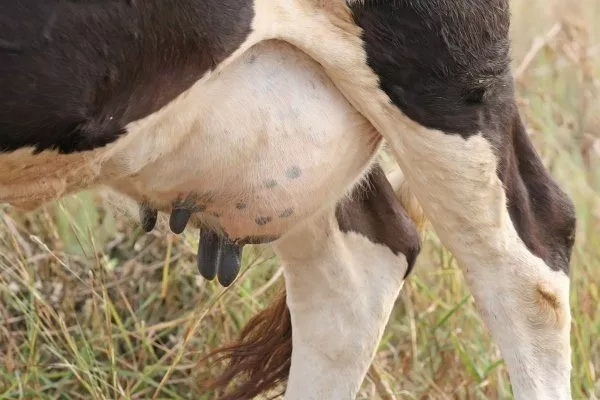
Table 1 shows the milk productivity of some popular dairy breeds.
Table 1
| Breed | Average annual milk yield, kg | Milk fat content, % | Milk flow rate, kg/min | Disease resistance | Feed consumption, kg/day |
|---|---|---|---|---|---|
| Istobenskaya | 3700-4000 | 3.4-5.5 | 1.6-1.8 | High | 25-30 |
| Red-and-white | 5000-6500 | 3.9 | up to 1.8 | Average | 30-35 |
| Jersey | 4300-5700 | 5.3-7 | up to 1.8 | High | 20-25 |
| Ayrshire | 6000-7000 | 3.8-4.3 | up to 2.0 | High | 30-35 |
| Red steppe | 3500-4500 | 3.2-5.3 | 1-1.2 | High | 25-30 |
| Yaroslavskaya | 3500-6000 | 3.4-3.7 | up to 1.6 | Average | 25-30 |
| Kholmogorskaya | 3500-8000 | 3.6-4.0 | 1.1-1.3 | High | 30-35 |
| Holstein | 5500-7500 | 3.6 | up to 2.5 | Average | 35-40 |
| Black and white | 5500-8500 | 3.4-4.2 | 1.2-1.4 | High | 30-35 |
Exterior
When choosing a dairy cow, pay attention to the animal’s external characteristics:
- Head. The head should be light, small in size, and elongated, but not wide or oversized. Massive heads with shortened muzzles are a hallmark of meat breeds.
- Withers. The withers should be straight, high, and of moderate width. In beef breeds, they are wide and level, and fairly low. A sharp withers is typical in cows with poorly developed muscles.
- Breast. Usually length, width is not the most important indicator.
- Dewlap. Small and narrow. In meat breeds, the fold at the base of the neck is significantly wider.
- Neck. Thin, long, folded.
- Back - straight. If it's sagging or humped, it's a defect.
- Small of the back – level with the back, without depressions, it goes into the croup.
- Back. Wide hips, coxal joints and ischial tuberosities.
- Belly. Moderately toned, not sagging.
- Legs. Strong. Fault: close hocks.
- Suit. It doesn't matter. It's only important for breeding farms.
- Skin and hair. The coat is smooth and shiny. Not dull, but harsh and tousled. There is little subcutaneous tissue. The skin is dry, thin, and fairly flexible. Beef cattle have thick, loose skin.
Udder analysis
The amount of milk produced can be judged by the shape of the udder. What you need to know:
- A large udder does not necessarily mean high milk yield. Excessively large, irregularly shaped udders are often found in cows producing low milk yields.
- A cup-shaped udder with evenly developed lobes indicates high milk yield.
- Nipples should be small. It's undesirable for them to be rough.
- The back wall of the udder should protrude slightly between the hind legs.
- The bottom of the udder should be parallel to the ground and reach the hocks.
- The front wall of the udder should be pushed forward, smoothly flowing into the line of the abdomen.
- A dairy cow has well-developed veins in her udder.
- When palpated, the udder should be loose and granular, without compaction.
- You shouldn't take a cow with an excessively large udder, as it will hinder the animal's movement.
Age
The age of a cow is determined by the rings on its horns and by its teeth:
- In older cows, the rings on the horns may be worn away. The absence of rings can also occur after a prolonged illness.
- A cow grows 32 teeth during its lifetime – 24 molars and 8 incisors. The incisors change at specific ages: central incisors at 14-20 months, middle incisors at 18-28 months, middle outer incisors at 24-36 months, and corner incisors at 35-45 months.
- Wear on the incisors varies from cow to cow, depending on the type of feed consumed. Permanent incisors begin to wear at 3-5 years of age. By 7-10 years, they become rounded, and by 8-11 years, they become square. At 15 years, the teeth become rounded again. After 16 years, the incisors are almost completely worn down. Stumps remain in place of the teeth, which eventually fall out.
Before purchasing a cow, it's essential to milk it to ensure it's flowing properly. If it's not flowing properly, the animal may be developing mastitis.
Physiology
The health condition of a cow is assessed by the following signs:
- the mucous membrane of the eye should not be red or bruised;
- there should be no purulent discharge in the nose;
- the nose should be moist;
- skin - smooth, without ulcers and abscesses;
A weakened animal is characterized by restless behavior, has no appetite, and the lower jaw appears slightly shortened.
It is necessary to measure the temperature, pulse and respiratory rate - the indicators depending on age are summarized in Table 2.
Table 2
| Physiological indicators | Age | |||
| six months | year | 1.5 years | more than 1.5 years | |
| Pulse, beats per minute | 70 | 59 | 57 | 67 |
| Respiratory rate, breaths per minute | 31 | 20 | 18 | 21 |
| Temperature, degrees Celsius | 38.7 | 38.4 | 38.3 | 38.3 |
Milk yield forecasts for the last lactation
The estimated annual milk yield can be calculated based on the pattern of milk yield changes throughout lactation. This can be useful for assessing the milk production of a purchased cow. To perform the calculation, use the data in Table 3.
Table 3
| Daily milk yield by month of lactation, l | Estimated milk yield for 305 days of lactation, l | |||||||||
| 1 | 2 | 3 | 4 | 5 | 6 | 7 | 8 | 9 | 10 | |
| 5 | 6 | 6 | 5 | 5 | 4 | 4 | 3 | 2 | — | 1200 |
| 6 | 7 | 7 | 6 | 6 | 5 | 5 | 4 | 3 | 1 | 1500 |
| 8 | 9 | 8 | 7 | 7 | 6 | 5 | 4 | 4 | 2 | 1800 |
| 9 | 10 | 9 | 8 | 8 | 7 | 6 | 5 | 5 | 3 | 2100 |
| 10 | 11 | 11 | 10 | 9 | 8 | 7 | 6 | 5 | 3 | 2400 |
| 11 | 12 | 12 | 11 | 10 | 9 | 8 | 7 | 6 | 4 | 2700 |
| 12 | 14 | 13 | 12 | 11 | 10 | 9 | 8 | 6 | 5 | 3000 |
| 13 | 15 | 14 | 13 | 12 | 11 | 10 | 9 | 7 | 5 | 3300 |
| 14 | 17 | 15 | 14 | 13 | 12 | 11 | 10 | 8 | 6 | 3600 |
| 16 | 18 | 16 | 15 | 14 | 13 | 12 | 10 | 9 | 7 | 3900 |
| 17 | 19 | 17 | 16 | 15 | 14 | 13 | 11 | 10 | 8 | 4200 |
| 18 | 20 | 19 | 17 | 16 | 15 | 14 | 12 | 10 | 9 | 4500 |
| 19 | 22 | 20 | 19 | 17 | 16 | 14 | 13 | 11 | 9 | 4800 |
| 20 | 23 | 21 | 20 | 18 | 17 | 15 | 14 | 12 | 10 | 5100 |
| 21 | 24 | 22 | 21 | 19 | 18 | 16 | 15 | 13 | 11 | 5400 |
| 22 | 25 | 24 | 22 | 20 | 19 | 17 | 15 | 14 | 12 | 5700 |
| 24 | 27 | 25 | 23 | 21 | 20 | 18 | 16 | 14 | 12 | 6000 |
| 25 | 28 | 26 | 24 | 22 | 21 | 19 | 17 | 15 | 13 | 6300 |
| 26 | 29 | 27 | 25 | 23 | 22 | 20 | 18 | 16 | 14 | 6600 |
| 27 | 30 | 28 | 26 | 25 | 23 | 21 | 19 | 17 | 14 | 6900 |
| 28 | 31 | 29 | 27 | 26 | 24 | 22 | 20 | 18 | 15 | 7200 |
Let's say a cow in her fourth month of lactation yielded 15 liters of milk during the control days. According to the table, such a cow would produce 3,900 liters of milk.
When purchasing a dairy cow, make sure she is pregnant. A heifer should be inseminated between 18 and 20 months of age. Late insemination is undesirable. Early pregnancy can cause the heifer to stop growing and develop, while late pregnancy can cause the animal to become lethargic.
Overview of Dairy Cow Breeds
Dairy breeds are the leaders in milk production. They are the most economical dairy cows. Today, about fifteen dairy breeds are bred in Russia, each with its own distinctive appearance and milk yield. But they all share one thing in common: to achieve high milk yields, the cows' feed requirements must be met and appropriate living conditions provided.
Let's look at the most popular dairy breeds in Russia and their characteristics to help you make the right choice for your farm.
Holstein
Many breeders consider the Holstein breed to be the most productive. Holstein milk yield is the benchmark against which other dairy breeds are compared. Holsteins were developed in the United States, and their ancestors originated in Holland. Today, this dairy breed is raised throughout the world. Feeding and rearing conditions have a decisive impact on milk yield.
Holsteins, being a dairy breed, remain good meat producers. Bulls, compared to beef breeds, have a lower meat yield. Cows weigh 600-700 kg, and bulls 1,100 kg.
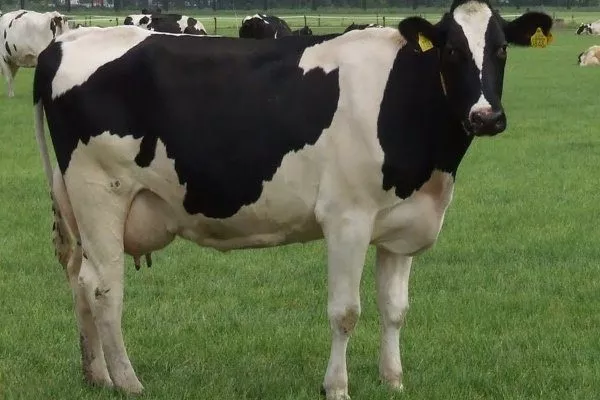
External characteristics of Holstein cows:
- The height of a cow is 140-145 cm, a bull – up to 160 cm. The maximum height is 180 cm.
- Color: red-piebald, black-piebald, blue-piebald.
- The head is small and neat.
- The body is long.
- The chest is wide and deep.
- The sacrum is wide.
- The back is long.
- The croup is straight.
- Legs are short.
- The udder is bowl-shaped and large.
Blue-and-white cows are extremely rare; they appear due to a combination of white and black hairs. The most common color is black-and-white; these cows produce the highest milk yields. Red-and-white cows produce less milk. They were previously culled entirely, but today they are considered a separate breed – they produce less milk, but their milk is richer in fat.
The Holstein breed produces 7,500-8,000 liters of milk per year. Milk yields vary by color:
- black and white – 7300 l/year, fat content – 3.8%;
- red-and-white – 4100 l/year, fat content – 3.96%.
Advantages of the Holstein breed:
- high milk yield;
- high quality milk;
- good meat productivity – carcass yield is 50-55%;
- precocity.
Flaws:
- They are very demanding when it comes to feed. If their diet is not nutritious enough, milk fat content can drop to 1%, even if they are fed sufficient amounts. In winter, they need hay—grain and legume—as well as vitamins. In summer, they need grazing on lush meadows.
- They react poorly to stress – milk production and weight decrease.
- High standards for cleanliness are required. If the barn is dirty, the cows may become sick.
Ayrshire
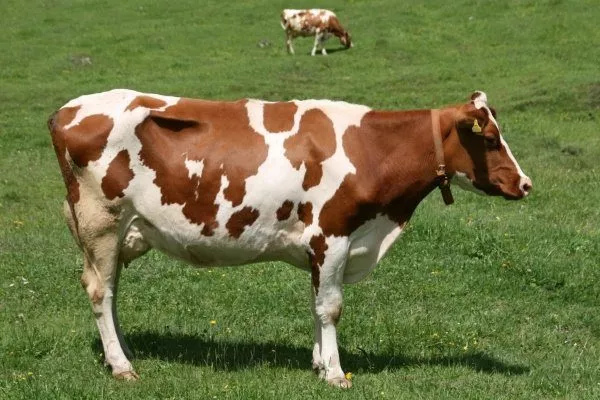
A European breed. The cattle are dehorned, not polled. Cows weigh 540-600 kg, bulls 800 kg. External characteristics:
- height at withers – 130 cm;
- light skeleton;
- chest - deep;
- head - neat, small;
- addition is proportional;
- legs - short, correctly positioned;
- udder – average;
- color - red-piebald.
Productivity:
- for milk – 5000-7000 l/year, fat content – 4.2%;
- meat yield – 50-55%.
Advantages of the Ayrshire breed:
- high quality milk;
- easily adapt to difficult climatic conditions;
- simple content;
- good health;
- offspring appears early.
In Australia, Europe, and other countries, Ayrshire cattle produce up to 9,000 liters of milk per year. Achieving such figures requires Western breeding technologies.
Flaws:
- difficult character, timid;
- can't stand heat;
- too mobile.
Black and white
This dairy breed was developed in the USSR in the mid-20th century. "Pestrushki" cattle have become widespread across the region, second only to the Red and Simmental breeds in numbers. The breed has several types: Altai, Siberian, Ural, and Great Russian.
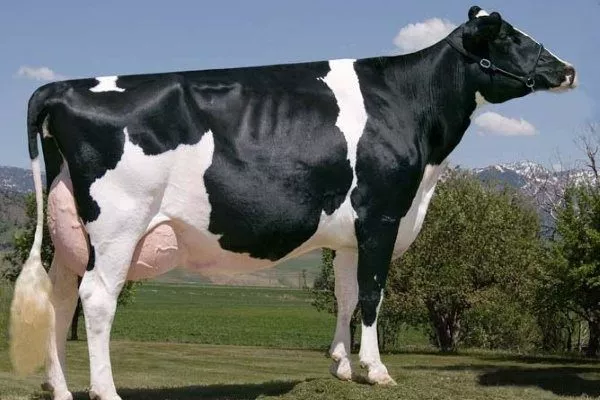
External signs:
- height – up to 132 cm;
- color - the base is black, and on it there are randomly located bright white spots;
- the body is powerful and proportional;
- elongated body;
- head is medium-sized, elongated;
- horns - gray, dark at the tips;
- the chest is medium-sized – reaches 75 cm in width;
- back and lower back - straight;
- legs - powerful, straight.
Cows from the central regions weigh 600-650 kg, and bulls up to 1,100 kg. Ural cows have a leaner constitution, and Siberian cows are smaller than their black-and-white counterparts. Siberian cows weigh 550 kg.
Milk yield depends on diet and housing conditions. Average milk yield is 7,600-8,000 liters per year. Fat content is 3.5-3.7%, protein content is 3.0-3.2%. The meat yield after slaughter of a Black and White cow is up to 60%.
Advantages of the breed:
- good immunity;
- valuable meat;
- rapid adaptation to different climatic conditions;
- medium early maturity;
- diet with a minimum of concentrates;
- high quality products – fatty milk and lean meat.
Breeders are working to eliminate the breed's shortcomings, and they are faced with the following tasks:
- eliminate differences between different types of breed;
- increase meat yield;
- increase milk yield, fat content and protein content in milk.
Kholmogorskaya
The breed was developed in the Arkhangelsk region by crossing local breeds with Dutch ones. Cows weigh 480-590 kg, and bulls up to 1000 kg.
External signs:
- height at withers – 130 cm;
- elongated loose body;
- back - straight;
- the back and lower back are wide;
- color – black and white, less often – black or red-and-white, very rarely – red;
- neck – long, thin;
- chest circumference – 196 cm.
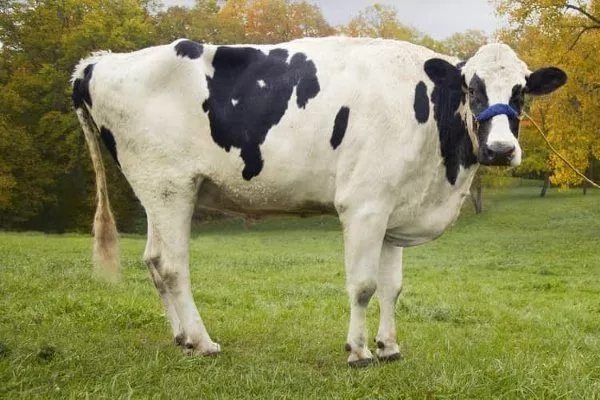
Milk productivity is 3,600-5,000 l/year. Fat content is 3.6-3.9%. Meat yield at slaughter is 45-52%.
Advantages of the Kholmogory breed:
- combination of high milk and meat productivity;
- early maturity;
- tolerate cold climates well;
- good meat yield from bulls.
Yaroslavskaya
These are typical dairy cattle. Cows weigh 350-450 kg, bulls 700-900 kg, and a maximum of 1200 kg.
External signs:
- height – 125-127 cm;
- the body is dry, angular, the skeleton is well developed;
- the facial part of the head is elongated;
- narrow and deep chest;
- wide croup and thin, short legs;
- the udder is cup-shaped, medium-sized;
- Color: mostly black with a white muzzle, rarely red.
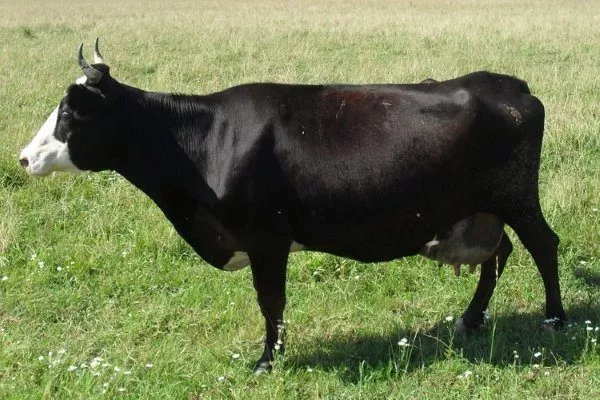
Milk productivity – 5000 l/year. Fat content – up to 4%. Meat yield – up to 60%.
The breed is responsive to food, When the diet is improved, milk yield immediately increasesBut this is also a downside: if you feed a cow low-grade concentrates, productivity will immediately drop. resistant to diseases, including leukemia.
Dutch
All the most milk-producing breeds were obtained by crossing with Dutch cowsThe weight of cows is up to 800 kg, bulls – 1200 kg.
External signs:
- height – up to 132 cm;
- well-fed body and straight back line;
- The color is variegated, with large spots, black and red.
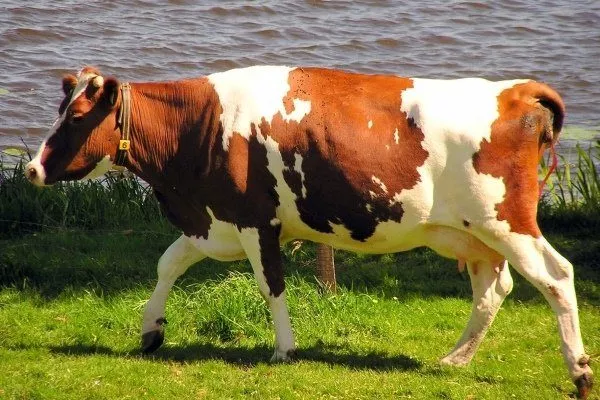
Milk productivity: 4500 l/year. Milk fat content: 3.8-4%.
Advantages of the Dutch breed:
- good meat yield – 60%;
- high milk yield;
- early maturity;
- high quality milk.
Flaws:
- increased requirements for cleanliness;
- insufficiently high immunity – there is susceptibility to infections;
- demanding nature of food;
- instability to stress.
Jersey
The most low-maintenance breed. Cows weigh 370-400 kg, bulls 560-760 kg. Likely originated in England or France.
External signs:
- height at withers – 120 cm;
- the back of adults is concave;
- the body is tapered;
- tail - raised;
- head - small, with a narrow forehead;
- neck - thin, folded;
- the udder is large, cup-shaped.
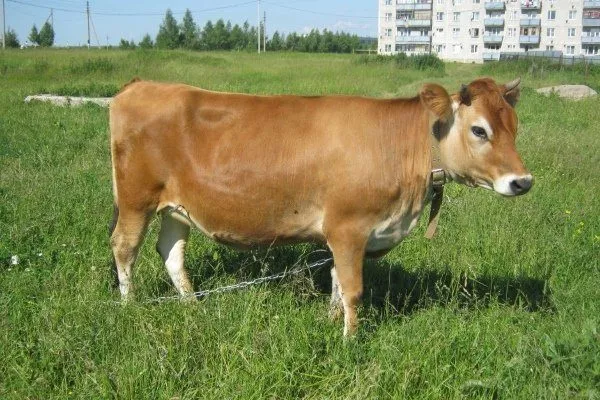
Milk productivity is 3,000-4,500 liters per year. There are record-breaking cows with yields of up to 10,000 liters. Fat content is 5-7%.
Advantages of the Jersey breed:
- high milk productivity;
- high nutritional value of milk – lots of calcium and protein;
- feed consumption is reduced due to compact body structure;
- almost never get mastitis;
- no problems with legs – due to light weight;
- do not trample pastures.
Flaws:
- little meat production due to flat ribs and chest;
- the hind limbs are positioned incorrectly;
- increased timidity.
Red steppe
Red steppe cow Capable of goring a rival with its horn. A cow weighs 400-650 kg, bulls – up to 900 kg. Slaughter yield is 53%.
External signs:
- height at withers – 127.5 cm;
- long body;
- narrow and long lower back;
- short, correctly positioned legs;
- uneven topline – there are pronounced differences between the sections of the spine;
- color – red, white markings are possible on the forehead, belly, udder, legs;
- croup – medium length;
- The udder is small, round, the teats are cylindrical.
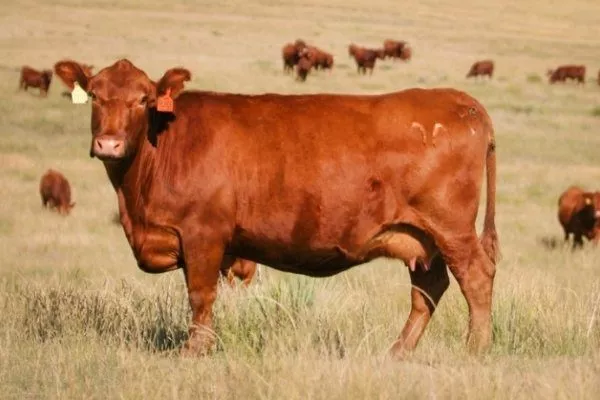
Milk production depends on the climate in the breeding area. If the forage is succulent and plentiful, the Red Steppe cow can produce over 5,000 liters of milk per lactation. In arid regions, milk yields are no more than 4,000 liters. Milk fat content is 3.6-3.7%.
Advantages of the breed:
- easily adapts to different climatic conditions;
- quickly gains weight on lush grass, and during periods of drought it eats dry grass, maintaining the gained weight;
- easily tolerates heat in summer – over 30°C, and cold winds in winter;
- strong immunity.
Disadvantages of the breed:
- light weight;
- thin bones;
- There are udder defects.
Criteria for selecting a beef cow
Beef cows are selected based on several criteria, the most important of which is appearance. What should you pay attention to when choosing? beef cows:
- torso - strong and short;
- head - large;
- withers - more massive and longer than the milk one;
- neck - muscular;
- back and chest - wide;
- legs - short, set wide apart;
- skin - thick, covered with thick fur;
- udder - large, nipples - weak, in the milked position, placed close to each other.
What else do you need to know when choosing a beef cow?
- Age. It affects productivity. Peak milk production occurs between calvings 2 and 6. It's not advisable to buy older cows.
- Health status. Signs of a healthy animal include vigor, a firm gait, soft, shiny fur, and clear, non-inflamed eyes. There should be no coughing or hardening of the udder.
- Number of calvings. In private farms, cows are kept for up to 10-12, rarely up to 18 calvings.
If you look at beef cattle from the side, the body shape is close to a rectangle, and in dairy cows it is close to a triangle, the sharpest point of which is directed towards the head.
For meat production, the most important characteristic is weight. However, choosing a meat breed based on weight alone isn't enough. Meat profitability—the percentage of carcass weight that meat produces—is also important. Data for popular meat breeds is in Table 4.
Table 4
| Breed | Total weight of cow carcass, kg | Total weight of the bull carcass, kg | Average profitability for meat, % | Growth rate | Disease resistance |
|---|---|---|---|---|---|
| Limousine | 500-600 | 1000-1100 | 68-70 | Fast | High |
| Hollowayskaya | 350-500 | 600-850 | 58-62 | Average | High |
| Russian hornless | 500-600 | 900-1250 | up to 80 | Fast | High |
| Aberdeen Angus | 600-800 | 800-1000 | 60-70 | Fast | High |
| Kazakh white-headed | 400-550 | 600-900 | 55-60 | Average | High |
| Kalmyk | 400-550 | 600-1100 | up to 60 | Average | High |
| Hereford | 600-800 | 1000-1350 | up to 70 | Fast | High |
When selecting young meat cattle, the following criteria are taken into account:
- ability to acclimatize;
- female productivity;
- meat quality and yield;
- growth rate.
Beef Cow Review
Beef breeds differ from dairy breeds in that they gain weight faster and produce a higher meat yield. Their meat is of higher quality. Beef breed cattle have large bodies with well-developed muscles.
Hereford
Herefords – the most common beef breed in the world. Bulls weigh 900-1200 kg, cows – up to 850 kg. Slaughter yield is 60-70%. There are three types of beef cattle:
- red horned;
- red polled;
- black.
Meat producers often choose polled cows because they are easier to handle. Herefords are known for their robust build.
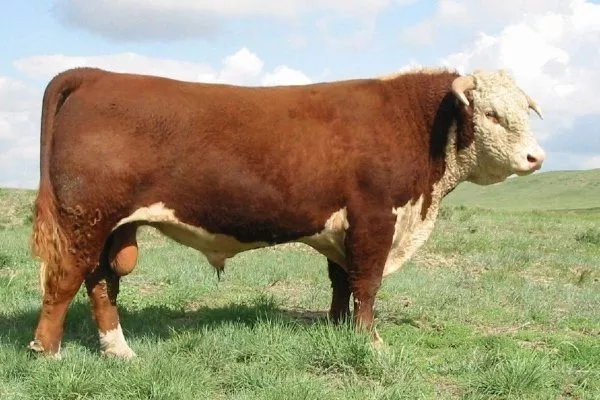
Their external features:
- neck - short, head large and strong;
- short legs;
- poorly developed mammary glands.
Advantages:
- adapts to different climatic conditions;
- easy calving;
- low calf mortality;
- high meat yield;
- early maturity and rapid weight gain;
- they live a long time – up to 18 years, they are not picky about food;
- produce valuable marbled meat;
- They produce valuable skins, which are used to make shoes and haberdashery.
Disadvantages of Herefords:
- The females produce little milk. They cannot be milked. Their milk production is only sufficient to feed the calves for the first few months of life.
- They are demanding in terms of cleanliness and care.
- They consume enormous amounts of feed. Providing feed can be difficult in winter.
- They do not tolerate drafts and humidity well.
Aberdeen Angus
Aberdeen Angara cows And the bulls are polled—they have no horns. Cows weigh 500-550 kg, and bulls 750-950 kg. Their color is usually black, less commonly red.
External signs:
- height at withers – 120-150 cm;
- heavy but small head;
- the muzzle is short, the back of the head is very narrow;
- muscular and short legs, strong, correctly positioned;
- wide body, heavy and deep;
- the upper line of the back is straight;
- There is practically no neck - the head immediately merges with the shoulders.
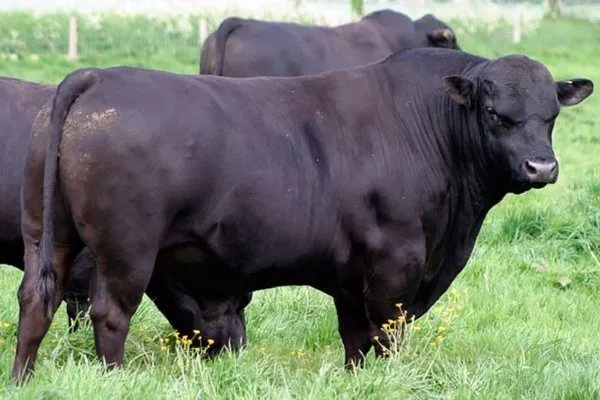
These are very large and docile animals that show no signs of aggression. Slaughter is at 1.5-2 years of age. Meat yield is 60%.
Advantages:
- rapid growth;
- valuable marbled meat;
- good growth on any feed;
- genes transmit meat qualities;
- adapts well to the Russian climate;
- tolerates cold weather easily.
Charolais
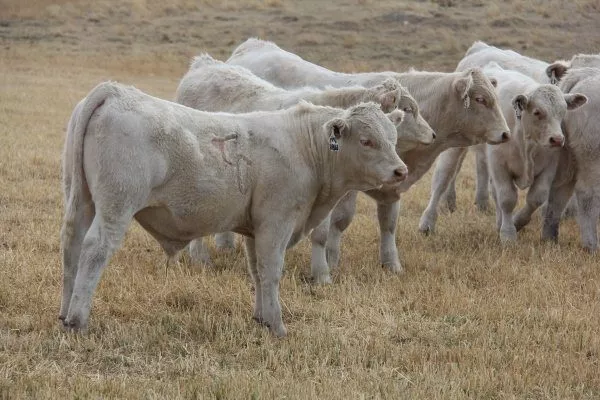
An ancient French breed. Considered the largest breed in the world, they were formerly used as draft animals. They possess large muscle mass and are one of the most sought-after beef breeds. Cows weigh 900 kg, and bulls 1100 kg. Cows lack powerful muscles and resemble ordinary central European cows in appearance. Their meat yield is 65%.
External signs:
- height at withers – 155 cm, bulls – 165 cm;
- small and short head with a wide forehead;
- round elongated horns;
- the neck is thick and short, with a pronounced crest;
- wide and deep chest;
- the back and lower back are straight;
- legs are short, set wide apart, powerful;
- color – creamy white, red, black;
- The udder is small and of regular shape.
Advantages:
- strong legs and hooves are important for large cattle;
- high meat yield.
Flaws:
- the presence of horns - animals have to remove their horns to avoid conflicts in the herd;
- difficult calvings.
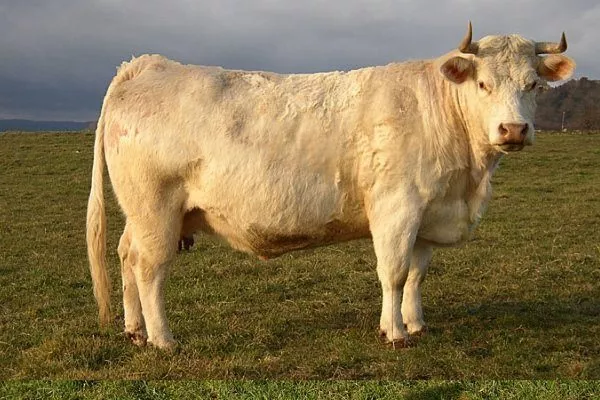
Ukrainian meat
Three-quarters of the breed's ancestry is foreign. Charolais, Simmental, and Kian cows, as well as a local breed—the Gray Ukrainian cow—all contributed to the breed's development.
Breed characteristics:
- tall, the height of cows is 130 cm, bulls – 150 cm at the withers;
- The weight of cows is 550 kg, bulls – 1200 kg.
Advantages:
- unpretentious in terms of maintenance and feeding - they can eat foraged food;
- grow quickly;
- thick skin – used for making leather shoes and other products;
- high meat yield – up to 64%.
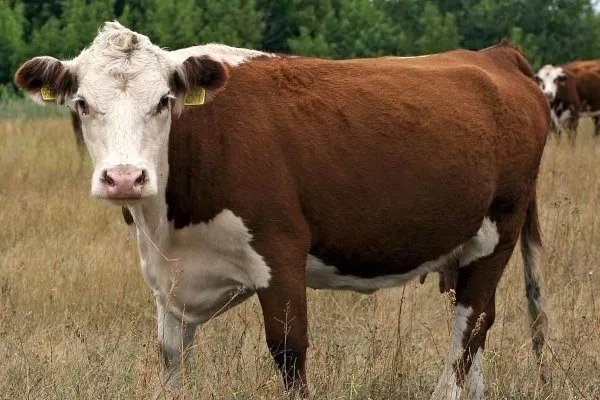
Kazakh white-headed
It weighs less than its ancestor, the Hereford. Bulls weigh up to 850 kg, cows up to 500 kg.
External signs:
- elongated, barrel-shaped body;
- strong and light skeleton;
- straight back line;
- The color is different shades, but the head, tail, dewlap, legs, and belly are white.
Flaws:
- increased fat content of meat;
- a narrow skeleton does not allow achieving maximum meat productivity;
- the marbled effect of the meat is lost;
- cows are aggressive after calving.
Selection criteria for combined cows
When choosing a cow of a mixed breed, you need to decide what the breeding goal is and what the emphasis will be. Some breeds produce excellent meat, while others produce nutritious and delicious milk. And vice versa. It's important to study the characteristics of each individual breed before deciding which option is best.
Exterior
If the focus is on milk production, special attention should be paid to the udder:
- Dimensions – the udder should be quite impressive, but not drooping, not hanging between the legs, almost reaching the ground.
- Udder shape - cup-shaped. Milk veins - well developed.
- Optimal nipple length – 6-8 cm.
Exterior signs of a high-yielding cow:
- elongated body;
- strong build;
- small head with an elongated muzzle;
- horns - thin, short;
- neck - in folds;
- withers - rounded, hanging low;
- dorsal, lumbar and posterior parts - straight line;
- legs - long and strong;
- thin and shiny skin;
- tail - thin and long;
- The sacrum and rib cage are wide.
More signs when choosing meat and dairy cattle:
- A healthy animal should not hunch over, and its back should not sag.
- Pointed or forked withers indicate poor muscle development.
- A wide sacrum indicates easy calving.
- A sagging belly is a bad sign. The belly should be large and barrel-shaped.
When choosing a cow with good meat productivity in mind, you need to pay attention to the following characteristics:
- the body is strong and shortened;
- head - large, horns - pointed;
- withers – longer and more massive than in dairy cows;
- broad back and chest;
- neck - muscular;
- the skin is thick, covered with thick fur;
- The udder is large, but the teats are poorly developed.
Age
It's important to determine the cow's age. A cow produces good milk until she's six years old. It's not profitable to breed a cow older than that. Cows that are too young have low milk yields. Cows produce the most milk after calving four or five times. A cow will produce a lot of milk for several years, then her daily milk yield will gradually decline. Some high-yielding cows produce their maximum milk yields until calving fifteen or seventeen.
Depending on whether the buyer is focusing on meat or dairy productivity, the previously outlined selection criteria are applied for meat and dairy breeds, respectively.
A farmer explains to beginners how to choose cows based on their appearance and udders. Watch the video to learn why you should milk a cow yourself before buying it:
Meat and dairy cows
Cows that produce both meat and milk have always been prized, especially by small-scale farm owners. On larger farms, beef and dairy breeds are more in demand, while on private farms, versatility is more prized. Combined breeds are further divided into two categories:
- meat and dairy;
- dairy and meat.
Simmental
The breed originates from Switzerland and is the most prominent representative of the dairy and meat breeds. They were brought to Russia in the mid-19th century. After crossbreeding, which continued until 1980, numerous Simmental offshoots emerged:
- steppe;
- Volga region;
- Ukrainian;
- Siberian;
- Sychevskys;
- Far Eastern.
The animals are large, cows weigh 600-700 kg, bulls – up to 1200 kg.
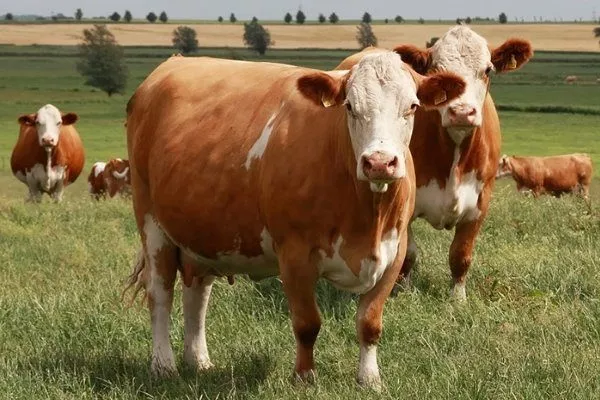
External signs:
- height at withers – 140 cm;
- the chest is wide and the back is straight;
- legs - medium;
- neck – short;
- horns - set wide apart;
- color - fawn-motley, with shades of red or ginger;
Simmental cows are also very large, but only 5 cm shorter than their bulls. Even their calves are large, weighing 46 kg at birth.
Productivity:
- milk – 4000 l/year, fat content – 4%;
- The meat yield in adults is 68-70%, in young animals – 55%.
Advantages:
- rapid weight gain;
- high productivity in all respects;
- endurance and good health;
- calm disposition, obedience;
- unpretentiousness in food and maintenance.
Flaws:
- lots of bones in the carcass;
- There is an incorrect structure of the hind legs - because of this the animal walks slowly;
- Due to the large weight, the animals' backs may bend;
- There is a pronounced inverse relationship between milk and meat productivity – therefore, farmers keep their beef herds separate from their dairy herds, preventing crossbreeding.
Kostroma
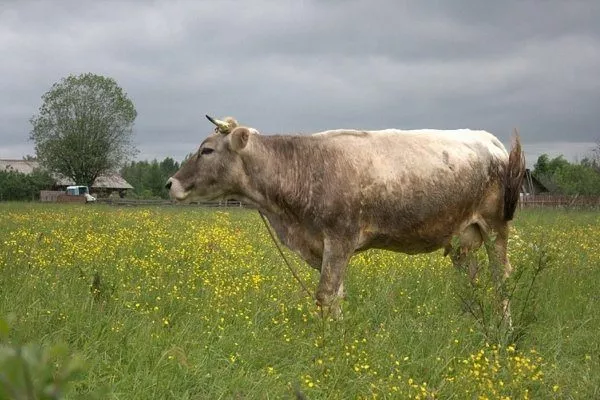
This is one of the best combined breeds in Russia. It has a very interesting history – it was developed during the war. It was registered in 1945. Breeders created the breed for rapid meat and milk production. Its ancestors are Algauz, Swiss, and local Central Russian cows.
Cows weigh 500-700 kg, bulls gain up to 900 kg.
External signs:
- color - gray, red;
- strong, stately build;
- short legs.
Productivity:
- for milk – 4000-7000 l/year, fat content – 3.8-3.9%;
- meat yield – up to 65%.
Advantages:
- resistance to leukemia;
- live long and have strong immunity;
- high lactose content in milk – up to 5%;
- high productivity – daily weight gain up to 1300 g;
- low cost due to unpretentiousness in feed.
Flaws:
- low milk yields – in practice, it is rarely possible to obtain more than 5000 l/year, and the use of compound feed does not produce a positive effect;
- the breed is not adapted to heat – it is not recommended to breed in regions south of Tambov and Lipetsk;
- In large herds, milk production decreases.
Shvitskaya
The breed was developed in the 14th century in Switzerland. It is considered one of the top five dairy and meat breeds in Europe. Cows weigh 800 kg, and bulls 1,200 kg.
External signs:
- height at withers – 130 cm;
- the body is stocky, the legs are set wide apart;
- color - brown, different shades;
- coat – short, thick, with undercoat.
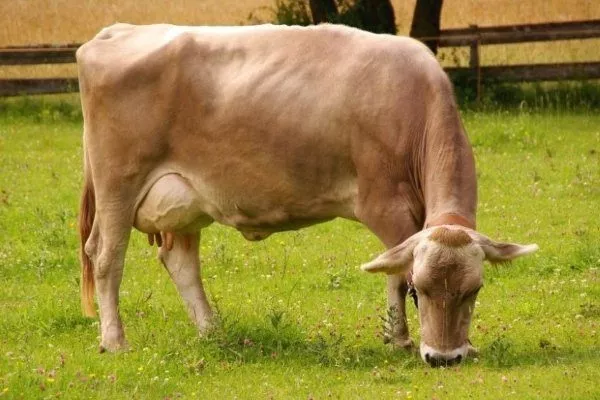
Productivity:
- milk – 3700 l/year, fat content – 3.8%;
- meat yield – 58–60%.
Advantages:
- high productivity of meat and milk;
- hardy, almost never get sick;
- gain weight quickly;
- calm, balanced disposition.
Flaws:
- require high-calorie feed in large quantities;
- low milk productivity;
- The udder is small, non-standard, and not suitable for machine milking.
Red Gorbatovskaya
The breed was developed in Russia by crossing Tyrolean cows with local cattle. Cows weigh 600 kg, bulls 900 kg.
External signs:
- height at withers – 120 cm;
- the body is elongated, with a wide back;
- the udder is small, well developed;
- The color is red, with white inclusions.
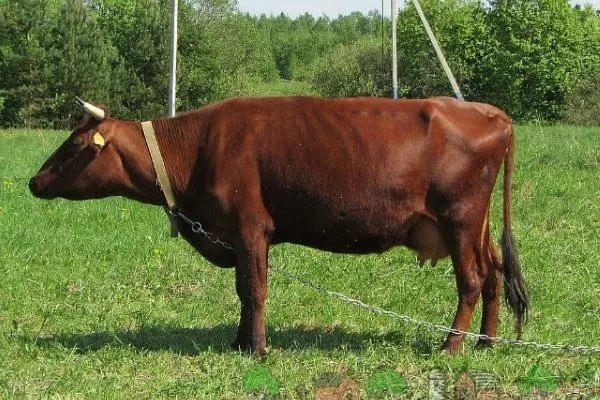
Productivity:
- milk – 3000 l/year, fat content – 4.2%, sometimes up to 6%;
- meat yield – 55%.
Advantages of the Red Gorbatov breed:
- good immunity to leukemia, tuberculosis, brucellosis;
- quickly adapts to different climatic conditions;
- undemanding to food;
- calm disposition.
Flaws:
- the udder is often not suitable for machine milking;
- low milk yield compared to dairy breeds.
Alatau
The breed was developed in the foothills of Kazakhstan in the 1950s. Cows weigh 600 kg, bulls 900 kg. External characteristics:
- height at withers – 130-150 cm;
- legs - short, powerful and strong;
- neck and chest - small;
- dense constitution and sagging butt.
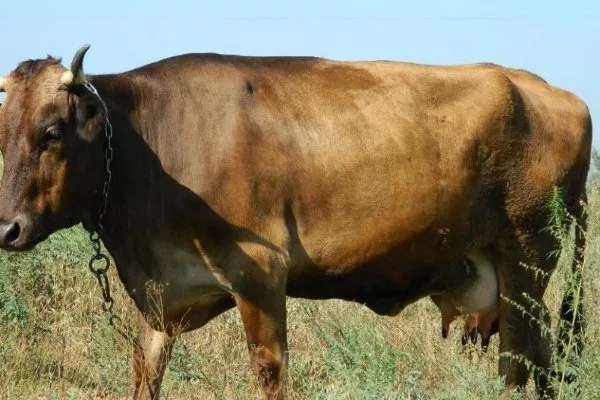
Productivity:
- for milk – 4000-5000 l/year, fat content – 3.9-4.0%;
- meat yield – 60%.
Alatau cows are able to gain weight even on poor pastures with high soil salinity.
Advantages of the Alatau breed:
- easy to care for;
- good milk yield;
- They gain weight well by feeding on natural food;
- resistant to diseases - the breed inherited this trait from the local Kyrgyz-Kazakh cattle;
- easily adapt to difficult climatic conditions;
- gains weight quickly;
- hardy;
- tasty meat;
- calm disposition.
There are no disadvantagesKyrgyz-Kazakh cows are incredibly hardy and have excellent immunity.
Yorkshire
The Yorkshire breed was developed in the English county of the same name. Cows weigh 500 kg, bulls 800 kg.
External signs:
- height at the withers – 140, for bulls – 160 cm;
- color - red-motley, shades of varying intensity;
- physique – strong, proportional;
- back – straight;
- sides - barrel-shaped;
- neck – short, massive.
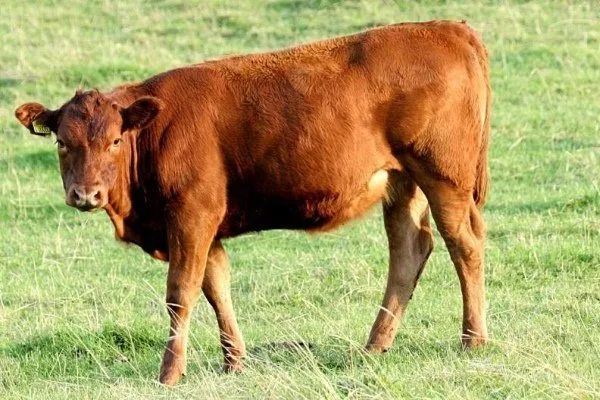
Productivity:
- for milk – 4500-5000 l/year, fat content – 4.4-4.6%;
- meat yield – 45-50%.
Advantages of the Yorkshire breed:
- calm and friendly disposition;
- rapid weight gain – in this respect, they surpass all combined breeds;
- rapid puberty – insemination can be performed at 14 months;
- they are unpretentious in food - in addition to grass, they eat branches, bark, leaves;
- The breed is suitable for increasing the herd.
Folk signs of cow productivity
The most difficult and responsible task is choosing a dairy cow. Folklore has long held beliefs about choosing a nursing cow:
- Udder - not sagging, the shape should resemble a full barrel.
- Character – calm, balanced. How to test? Offer a cow a piece of bread. A suitable cow will react melancholically to the treat – she will begin to slowly, waddling toward the food. Now the buyer needs to approach the udder and try to milk the cow.
- The taste of milkIf the milk is sweet, the cow is healthy and its milk is nutritious. A sick animal's milk tastes bitter.
- Streams of milk should be thick and the color should be rich white.
- Hollow between the horns – the deeper it is, the greater the milk yield.
- If there is a lot of wax in the ears – the milk will be fatty.
- Low-hanging forelock – a sign of high milk yield.
- The end of the tail is rounded and yellowish. - a sign of fatness.
You need to choose a cow with a clean udder and a fit body - these signs indicate that the owner took good care of her - washed, cleaned, and fed her properly.
Cow after purchase
Once a cow has been purchased, it needs to be given maximum attention. The animal needs to get used to its new home and new owner. Treat the cow kindly and show her every kindness. There's even a popular belief: to help a purchased cow quickly get used to its owner, give it a piece of bread from the stove.
Choosing a cow is a crucial step, determining the prosperity of your farm and the success of your business. Take a sequential approach—first, decide on the type of cow you'd like to raise and the breed, and then proceed to assess the productivity and appearance of your candidates.