
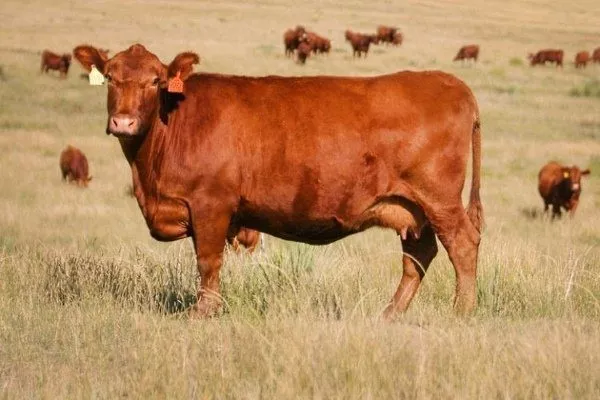
Red Steppe cows are dairy cattle. The main requirement is to produce sufficient milk. The breed is popular and widespread in the former Soviet Union—Russia, Kyrgyzstan, Kazakhstan, Ukraine, Moldova, and Uzbekistan.
History of breeding
This is considered the first breed developed in Ukraine. As early as the 18th century, attempts were made to improve Ukrainian cows using the imported Red Ostfizlyandskaya breed, which was later replaced by the Wilstershskaya breed, and even later by the Angelskaya. By the late 19th century, numerous dairy cows with uniform characteristics were appearing in Ukraine. It was during this time that the Red Steppe was registered. The breed we know today has undergone a complex process and has undergone numerous changes. It was formed through selective breeding by crossing several cattle breeds. To improve cow endurance and milk yield, various genetic material was crossed, specifically combining genes from the following breeds:
- Angelynskaya;
- Gray steppe;
- Ukrainian gray;
- Red Ostfizsland;
- Simmental.
The Red Steppe breed is widespread in Ukraine and southern Russia. Moreover, selective breeding is still ongoing. Today, Red Steppe cattle are crossed with bulls from various breeds because they carry excellent genetic material that can be used to improve the qualities of other breeds, such as:
- physique;
- udder shape;
- milk productivity.
Detailed description of the breed
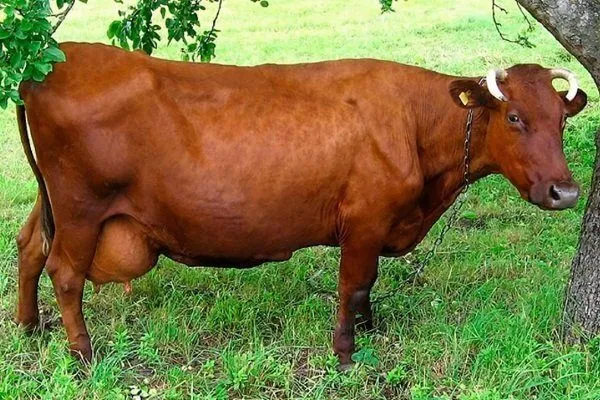
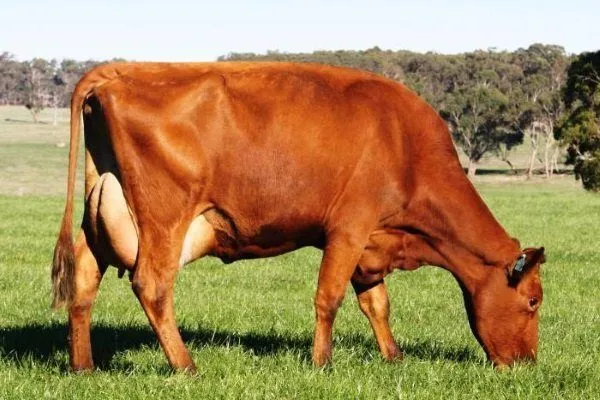
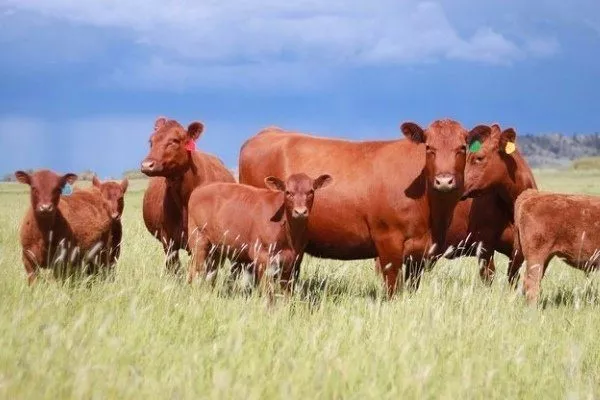
Horned animals are easily identified by their coat color—it is red or reddish-brown, varying in intensity. Reddish-brown spots and white markings on the forehead, belly, udder, and extremities are permitted. In adult bulls of this breed, the upper and lower parts of the body are darker.
These are fairly large animals. Their light and thin skeleton, coupled with their underdeveloped muscles, is a disadvantage, making them prone to injury and dislocated legs when walking on uneven pasture terrain.
Their body is somewhat angular and elongated. Their abdomen is voluminous, which is typical of all dairy breeds, as their ribs are widely spaced. Unlike other breeds, the Red Steppe's abdomen does not sag, even during pregnancy.
The head is small, narrow, and even graceful, with a dark-colored nose. The neck is long and heavily folded. The horns are light gray and point forward. This poses a hazard to livestock and humans. During a fight, a cow or bull can rip open the other and cause serious injury. Therefore, it is recommended to dehorn calves whenever possible.
The skin is smooth and elastic. If the cow loses weight, the skin will not sag. Weight loss and gain are common in cows, depending on weather conditions. The skeleton is quite light and fragile, and the muscles are rather underdeveloped.
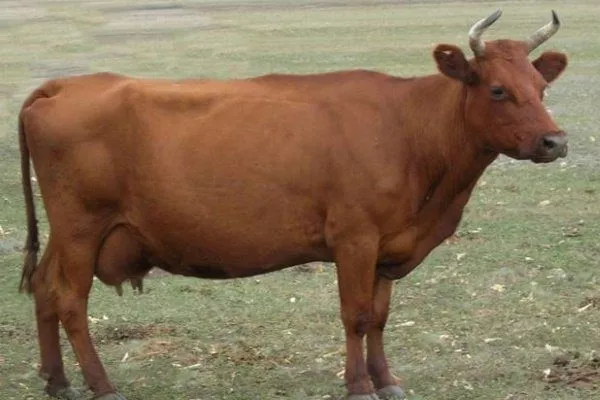
The cow's udder is small, round, and well-developed, with cylindrical teats. Cows are easy to milk by hand because the udder is glandular, meaning it's soft to the touch. An irregularly shaped udder is quite common. As milk accumulates, the udder stretches significantly, so much so that after milking, its volume decreases several times, and small folds form on the udder. The teats are suitable for both hand and machine milking; the front teats are approximately 6.5 cm long, while the rear teats are 5.7 cm long.
External indicators
The Red Steppe is a fairly recognizable breed, with distinctive exterior features including:
- withers at a height of 125-132 cm;
- the chest circumference reaches 190 cm;
- the oblique length can reach up to 160 cm;
- chest width according to measurements from 37 to 42 cm.
- the body is angular and slightly elongated, the muscles are weak;
- the neck is narrow, sinewy with pronounced folds, the head is slightly elongated;
- The metacarpus girth is 17-19 cm.
- legs are strong and straight, chest is narrow;
- The udder may be unevenly developed and of medium size.
Weight of cows
Average weight may vary depending on the gender and age of the representative:
- in males it does not exceed 900 kg;
- for cows - 500 kg;
- a newborn calf does not exceed 40 kg;
- The heifer's weight is even less - no more than 30 kg.
Productivity
Milk yields are above average, considering this is a dairy breed. However, farmers note that the cow's climate greatly influences milk yield. For example, if a cow grazes on lush, green meadows, she will produce up to 5,000 liters of milk per year. In arid regions, milk yield will not exceed 4,000 liters. Milk yield can be increased, but to a maximum of 10,000 liters, if she is provided with high-quality feed and well-maintained.
The record for milk yield for these representatives is 12 thousand liters during the lactation period.
Cow milk is nutritious, with a high protein content (up to 3.6%) but low fat content (up to 3.7%). However, some cows can produce milk with up to 5% fat, but this is the exception.
Factors affecting milk yield
- ✓ Pasture quality: grass density increases milk yield by 20-25%.
- ✓ Temperature conditions: at +30°C and above, productivity drops by 15-20%.
- ✓ Age of the cow: maximum milk yield is observed after 3-4 lactations.
- ✓ Frequency of milking: switching from 2 to 3 milkings per day increases milk yield by 12-15%.
Can the Red Steppe be slaughtered?
Although the breed is considered a dairy breed and is used exclusively for milk production, individuals with characteristics of dairy and beef breeds are often found among the Red breed. Therefore, they also play a significant role in the meat industry, despite their modest size and weight.
With a standard diet, the meat yield of bulls is no more than 50%. However, if they are specifically fattened using an intensive feeding system, the yield increases slightly, but not enough to warrant raising them solely for meat.
It's also believed that beef from the Red Steppe breed doesn't have any distinctive flavor characteristics, although it is juicy and quite pleasant. Quality indicators directly depend on the feeding method and the age of the animal.
Thus, the meat of cows kept free-range in the warm season and fed on hay in the winter has superior taste characteristics.
Comparative indicators of meat productivity
| Indicator | Normal feeding | Intensive fattening |
|---|---|---|
| Slaughter yield, % | 48-52 | 53-55 |
| Daily weight gain, g | 600-800 | 900-1100 |
| Meat category | II-III | I-II |
Content
Although the breed is unpretentious and easily adapts to external climatic conditions, it is necessary to adhere to certain rules for its care.
Basic care
In winter, calves and adult animals are kept indoors without tethers, as they are less adapted to cold than heat. Heating the barn is not necessary, but for newborn calves, the room temperature should be above 12°C. The cows themselves usually keep them warm, and all necessary care is provided. Animals are kept individually or in a herd. If a herd is maintained, the breeding bulls are isolated from the cows and calves.
Calves are raised in groups in which the young animals are grouped according to age:
- 6-9 months;
- 1-1.5 years;
- 1.5-2 years.
In the calf barn, the floor is covered with deep, permanent sawdust and straw bedding. They should be provided with ample space to move around, allowing them to exercise actively both outdoors and in the pen.
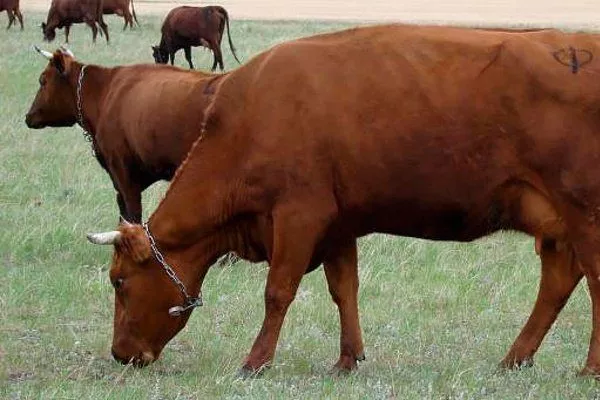
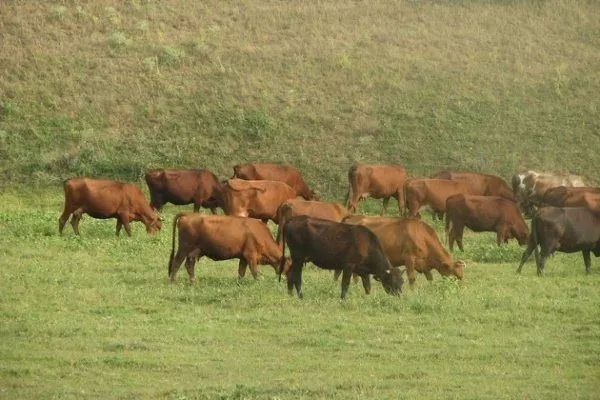
During the warmer months, the herd is released to graze freely on a pasture located 2 km from the farm. A watering hole must be provided beforehand to prevent the animals from suffering from thirst.
Major care businesses:
- regular vaccination of livestock;
- preventive examinations;
- hygiene maintenance - cows are regularly combed, their udders are washed before milking, and they are massaged;
- Before starting free grazing, hooves and horns are trimmed.
Dry period
Every cow is given a period of dry-off, when she is not milked. This period lasts from 40 to 70 days. The length of this period depends on the cow's health and body condition. Weak, thin animals require a longer dry-off period—a maximum of 70 days.
For a well-fed cow with average productivity, 40-60 days is sufficient. Milking time should not be shortened. Constantly milking a cow from calving to calving will negatively impact her reproductive function, health, and milk quality.
Breeding
Red cows are fertile—on average, there are about the same number of calves per 100 females. Heifers breed for the first time (on average) at one and a half years.
The selection of a breeding bull is approached with great care; he must be free of hereditary defects in body structure. If a cow has any conformation flaws, a bull without genetic defects is always selected to mate her. This will reduce the risk of producing low-quality calves.
If a cow has udder defects, it is not used for breeding livestock.
Nutrition
Although the animals are not picky about food, to increase milk yield they need to be fed with high-quality feed.
In summer, they are perfectly content with lush, fresh vegetation; in winter, cattle are fed hay with the addition of compound feed. Root vegetables, silage, and concentrated feeds are also a good addition to their diet.
Do not feed animals:
- low-quality products - rotten, spoiled, spoiled;
- cold, including drinking cold water.
Feed for calves must also be of high quality, otherwise they may develop croup defects and incorrect leg positioning.
Diseases
Schedule of mandatory treatments
- Quarterly deworming (albendazole 10% 7.5 mg/kg).
- Treatment against ticks before putting out to pasture (acaricidal solutions).
- Vaccination against leptospirosis (once a year, in spring).
Red cows have a strong immune system and rarely suffer from leukemia or respiratory diseases. They are vaccinated against foot-and-mouth disease, anthrax, and blackleg (emcara).
Annual prophylaxis is administered against parasites that infest the digestive system or lungs. In the summer, animals are checked for ticks and botfly larvae, which develop within the skin, and bites are treated.
Another common problem among females of this breed is mastitis, which can develop during machine milking. To prevent this, gently massage the udder after each milking.
What do you need to know about caring for a newborn Red Steppe calf?
The newborn calf is immediately placed in a special cage. The temperature should be no lower than 12 degrees Celsius, and there should be no drafts and a thick layer of straw on the floor. Calves are fed maternal colostrum 4-5 times a day, 0.5-1 liter per serving, which can be increased to 2 liters as they grow. Feeding is done through a special nipple, the hole in which is designed specifically for newborn calves.
A 2-day-old calf can already be given warm water (2-3 liters per day).
Feeding standards for calves
| Age (days) | Milk, l/day | Concentrates, g/day |
|---|---|---|
| 1-5 | 4-5 | — |
| 6-15 | 5-6 | 100-150 |
| 4:30 PM | 4-5 | 200-250 |
The first weeks of life are the most critical for calves, so they require particularly careful care. Manure should be removed several times a day, and all drinking and feeding containers should be scalded with boiling water. Once the baby reaches 10 days of age, solid food can be introduced into the diet, as an option - boiled hay.
Advantages and disadvantages of the breed
When choosing a breed, don't rely solely on milk production. The Red Steppe breed is popular in private farms for good reason. It has many more advantages than disadvantages.
Advantages
Among the advantages, experts note:
- These animals are highly adaptable and easily adapt to various climates. They thrive best in hot southern regions. Not only do they thrive in the scorching sun, but they also gain weight on meager food rather than lose weight. However, they still require care. They will appreciate the provision of shade shelters where they can find refuge and respite from the heat.
- They are distinguished by their environmental hardiness. The animals are not afraid of cold winds or rain, and they can withstand summer heat when the thermometer rises above 30°C. They can also graze in the blazing sun without water.
- They reproduce well, quickly increasing their population.
- All individuals, regardless of age, have high immunity to various diseases, including leukemia.
- The animals are unpretentious in food and maintenance.
Flaws
However, along with significant advantages, some disadvantages can also be identified:
- A significant drawback of cows is the irregular shape and uneven distribution of their udders. Machine milking prevents milk from being completely expelled from the teats, which can lead to mastitis. To reduce the risk of developing the disease, daily massage after milking is essential, which also helps increase milk yield.
- The second drawback, as described above, is the poorly developed musculature of the lower limbs. Therefore, red steppe cattle should not be grazed on hilly areas; their legs are completely unsuited to wandering on uneven pastures.
What do you need to know when buying representatives of the Red Steppe breed?
If you're considering purchasing a calf of this breed, you should first pay attention to its weight, which should be fully appropriate for its age. A newborn bull should weigh between 35 and 40 kg, and a heifer between 25 and 30 kg. However, a six-month-old bull can reach 120-140 kg, and a heifer, 80-90 kg.
When choosing a cow, the rearing conditions and the availability of a complete set of veterinary documents (animal passport, vaccination certificate, and any illness records) are important factors. Before purchasing, carefully inspect the animal; its demeanor alone speaks volumes—it should be well-groomed and lively. If purulent discharge is visible from the eyes and nose, it's best to discard the animal.
When purchasing an adult animal, you need to pay attention to the udder, its shape, appearance and condition.
The purchase of young and adult animals of this breed will cost 50,000-80,000 depending on the region.
Farmers' reviews
In Russia, Red Steppe cattle are the second most numerous breed. Breeders continue to work with these cattle. Because they produce good milk yields even on poor forage, they can be bred in drought-stricken areas. They are undemanding in their diet, adapt easily to various climates, and have a strong immune system, making them suitable for farmsteads.
Here are some reviews from real farmers about the Red Steppe breed:
Thus, the Red Steppe breed of cattle produces good milk yields even on the meager forage of steppe regions, and they can be bred in arid areas. And due to their low feed requirements and their tolerance of climatic conditions, the breed is ideal for keeping on private farms.