
The Aberdeen Angus breed of cattle confidently ranks first in the popularity rankings. This polled breed is a beef cattle breed and is relatively easy to manage. Breeding this productive and early maturing breed is a profitable endeavor, producing valuable "marbled" meat.
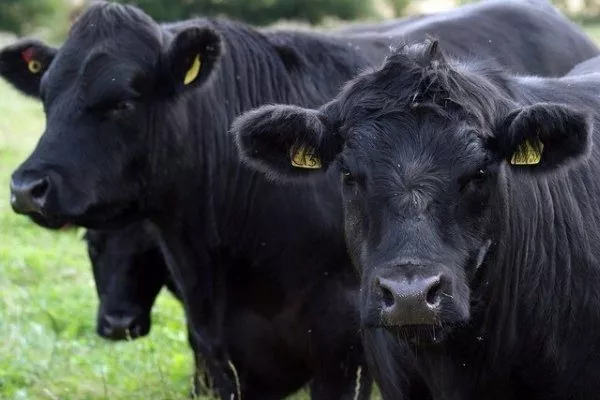
From the history of the breed
The Aberdeen Angus breed was developed in Scotland in the 19th century. Its name comes from the Scottish counties of the same name. By the end of the 19th century, 8,500 Angus cattle were exported to the United States.
Red Angus were developed in the mid-20th century. However, American breeders refuse to recognize them as a breed.
In North America, Black Angus cattle breeding became widespread, and their meat became the ideal raw material for the famous American steaks. American farmers quickly formed the Angus Breeders Association and subsequently established a herdbook, which only included animals that met certain requirements.
Where are they common?
Angus cattle are raised on a large scale in:
- Russia;
- USA;
- New Zealand;
- Japan;
- Canada;
- Great Britain;
- Argentina.
The huge black cows are very hardy – Scotland is not the warmest country, so the animals tolerate low temperatures and drought well.
The breed was brought to Russia in 1958. Since then, their numbers have gradually increased. Today, they are raised not only for meat but also used for breeding, improving the characteristics of local Russian breeds. Areas of distribution of the breed in Russia:
- Caucasus
- Stavropol Krai
- Altai
- Krasnoyarsk Krai
- Volgograd Oblast
- Voronezh Oblast
- Orenburg region
The breed is actively grown in Kazakhstan and Ukraine.
Characteristics of the Aberdeen Angus breed
The main distinguishing feature of Aberdeen Angus cattle is the exceptional taste of their meat. Aberdeen meat has a unique texture, with fine layers of fat evenly distributed throughout. Aberdeen beef is the only meat that does not deteriorate over time. It doesn't need to be eaten fresh—it only becomes more delicious as it ages.
Advantages of the breed:
- They are distinguished by high meat production. The meat has excellent taste qualities – thin layers of fat give it a unique "marbled" texture.
- Large and heavy. They gain weight and increase in size quickly. To prevent obesity, it is important to ensure proper nutrition for the cattle.
- Polledness (hornlessness). This is a dominant trait, actively passed on by Angus cattle when crossed—in almost 100% of cases.
- Rapid weight gain. Calves are born small, weighing 22-23 kg for heifers and 25-26 kg for bulls. Heifers are inseminated at 14-15 months. By two years of age, bulls reach the size required for slaughter.
- They easily acclimatize to difficult climatic conditions.
- When crossed, they convey the breed's advantages well - meat qualities, early maturity and hornlessness.
- Fertile. They retain reproductive capacity throughout their lives. Calf mortality is virtually zero—they have strong immune systems and excellent health. The females are excellent mothers.
- They live a long time. The average lifespan is 28-30 years.
- Calving is easy. The calves are small, so problems during calving usually do not arise.
- High productivity.
Constitution and exterior
Signs that will allow you to unmistakably determine that you are looking at a representative of the Aberdeen Angus breed:
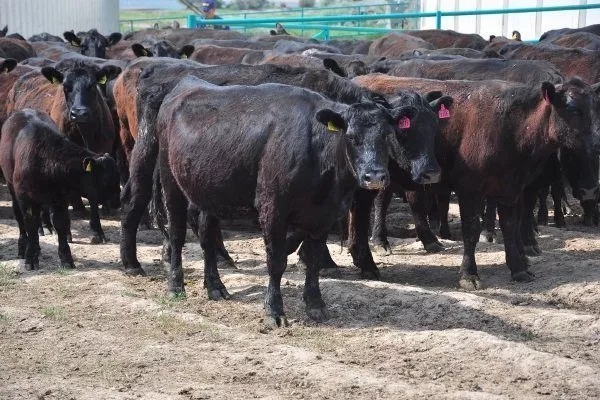
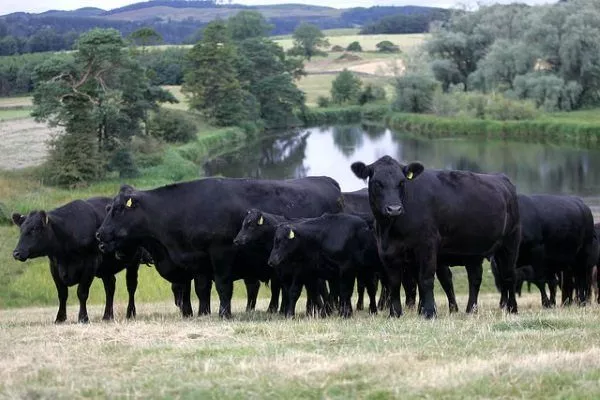
- No horns. Moreover, this applies to both cows and bulls. The absence of horns only complicates life in the wild, but in domestic breeding, this characteristic is simply a distinctive feature and a dominant trait of the breed.
- Black suit. There are also Red Angus cattle, whose breed is denied by American farmers.
Appearance features:
- Head. Powerful and heavy, yet compact in size. The animal has a very harmonious appearance—Aberdeens are truly the elite of the cattle breed. The forehead is slightly forward—as if the Angus are angry—and the back of the head is narrow. The muzzle is neat and short.
- Torso. They have a broad, deep, and heavy body—they appear very powerful and strong. The backline is almost level, without any arches.
- Legs. They are forced to carry a lot of weight, so they are quite powerful and muscular—it's visible to the naked eye. Their legs are thick and muscular. Their legs are short, and they stand firmly and evenly on the ground.
- Neck. It's almost invisible—the head seems to flow directly into the shoulders. This feature adds visual power and strength to the exterior.
- Lumbar region and cross. The legs are round in shape, with well-developed muscles.
- Wool. Shiny. Provides good protection from the scorching sun and wind.
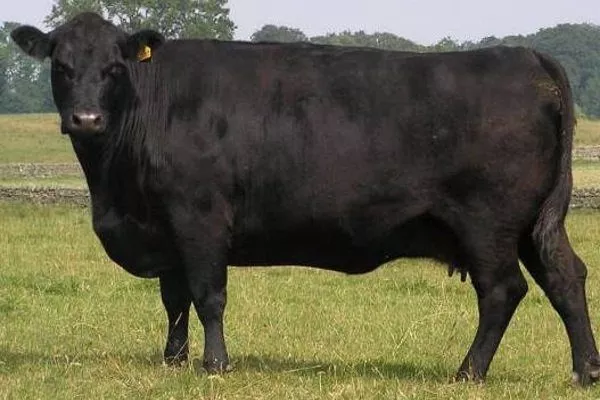
When Angus cattle are well fed, they are rounded and look powerful and muscular.
The animals' muscles are clearly visible through the thin, loose, and elastic skin. Angus cattle are distinguished by their fine bone structure, which accounts for no more than 15-18% of the total carcass weight. Other parameters are listed in Table 1.
Table 1
| Parameter | Breed standard |
| Oblique body length, cm | 135-140 |
| Height at withers, cm | 120 |
| Chest width, cm | 46 |
| Chest depth, cm | 67 |
| Live weight of cows/bulls, kg | 450-500/900-1000 |
| Slaughter yield, % | 62-67 |
| Average milk yield per year, l | 1700 |
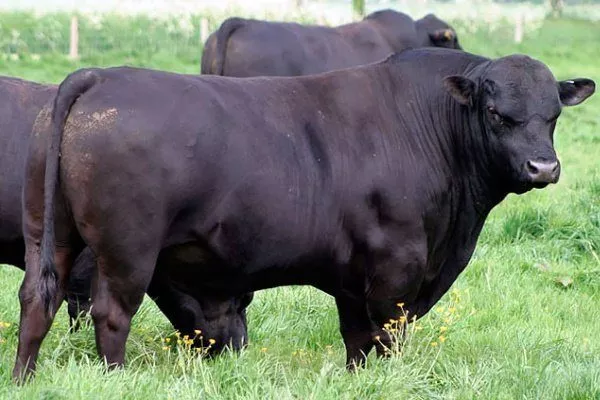
Aberdeen bulls are large and powerful animals, their appearance can even be intimidating. However, these sturdy black beasts have a very docile nature and are not known to display aggression. Only bulls, during puberty, can be quite ferocious.
Are there any disadvantages?
The breed sounds magnificent, but does it really have any flaws? Yes, but they're minor compared to its strengths:
- Weak legs. This creates a contradiction: a well-fed animal simply has difficulty carrying its body. Despite well-developed leg muscles, the leg strength is insufficient to support the fattened carcass, and the animal begins to fall on its feet. This is why Aberdeen cattle shouldn't be overfed. Bulls will be slaughtered anyway, so weak legs aren't as important, but cows should definitely not be allowed to become overweight!
Obesity in cows leads to difficulties in transferring weight during pregnancy and complications during calving. - Arched back. Connoisseurs of cattle conformation claim that the carp-like back somewhat detracts from the attractiveness of Angus cattle. However, this doesn't affect the quality of the meat in any way! This disadvantage even has its advantages – their structural features allow the cattle to easily adapt to environmental conditions.
- They require large pastures, making the breed more suitable for farms and hunting grounds.
Productivity
Cattle breeders raise Black Scottish cows solely for their meat—that prized marbled beef. What you need to know about Angus cattle productivity:
- The carcass yields 60% pure meat, which is an extremely high productivity.
- The female weighs on average 500-600 kg, and if she is deliberately fattened – 700 kg.
- Bulls reach 1,000 kg in weight. They are slaughtered young, while the meat is still soft and tender. The ideal age for slaughter is 1.5 to 2 years.
- In six months, the calf gains weight by 152-158 kg – from 22-28 (calf weight) to 180 kg.
Meat tasters can determine the age of an animal's slaughter by its taste. It's been observed that Aberdeen meat becomes tougher with age, but improves in all other respects.
Angus cattle are the clear leaders in early maturity and meat production among beef cattle. Cow weights by age are presented in Table 2.
Table 2
| Periods of life | Floor | Weight, kg |
| at birth | heifers | up to 20 |
| bulls | up to 23 | |
| 7-8 months | heifers | 160-180 |
| bulls | 180-200 | |
| 16 months | fattening bulls | 450-460 |
| adult | cows | 500-700 |
| bulls | 750-1000 |
While nursing for up to 8 months, calves gain 800-900 grams per day. A single cow produces 1,600-2,000 liters of milk during lactation. Lactating cows are typically not milked; the milk is used to feed the calf. After 8 months of "milk feeding," the calf will weigh approximately 230 kg.
Content requirements
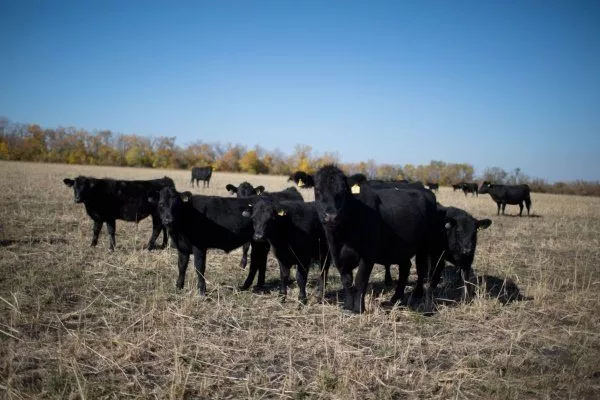
Aberdeen sheep need only natural food to grow and develop—they need extensive pastures, natural or artificial meadows. They tolerate both cold and heat well, so as long as there's no snow or frost, they can graze outdoors.
Angus cattle can be free-ranged year-round.
Recommended walking conditions:
- It is desirable to have bushes and trees growing around the perimeter of the pasture - then the animals can wander around, chewing grass, without any supervision or care.
- If there are no trees nearby, it is recommended to create a sun shelter so that the animals can take shelter under it during the hours of the high solstice.
- The herd owner's primary responsibility is to provide the cattle with water and mineral supplements; the cows will find everything else themselves. If there's no natural body of water, watering troughs should be provided.
- When keeping animals in a barn, it is important to keep everything clean - remove manure and any garbage.
Thanks to its natural content, the meat of cattle acquires a special taste - subtle and refined.
If Angus cattle have water and feed, they can stay outside even in cold weather. During the winter, they can be herded into barns, where they are kept untethered. Insulation is not necessary—the animals rely on their own body heat to keep warm.
Experts explain the specifics of outdoor raising of Aberdeen Angus cattle. The video shows a special feedlot for the herd:
Nutrition
The diet of Aberdeen cattle, which graze outdoors most of the year, consists primarily of green fodder. Since there is no food outside in winter, the cattle are fed high-quality feed:
- silage;
- hay;
- roots;
- crushed grain;
- compound feed.
It's important to maintain proper feeding standards to prevent cattle from becoming obese. Cattle of this breed have a high feed conversion rate. For an animal to gain 1 kg of weight, it needs to consume 6.5 kg of feed units, which can be:
- dry oats – 6.5 kg;
- or meadow grass – 32.5 kg;
- or hay – 13 kg.
Mineral fertilizers:
- bone meal;
- defluorinated phosphate;
- tricalcium phosphate;
- diammonium phosphate and others.
To ensure that the meat has the excellent taste typical of this breed, do not use concentrates for feeding.
Constantly confined to pastures, gentle Angus cattle can display mistrust of their owners, simply forgetting their existence. Cows sometimes attempt to escape the herd—this must also be taken into account when breeding Aberdeens. Another problem is their maternal instinct. A female may attack a person if she believes her calf is in danger. Even the absence of horns in Angus cattle won't help an unsuspecting person.
Fattening
The best meat comes from castrated bulls. Castration is performed while they're still young. Thanks to castration:
- meat fibers become thinner and meat becomes more tender;
- Bulls can graze in the same herd with cows; there is no need to organize a separate pasture for them;
During fattening, the basis of the diet is:
- crushed grain;
- hay;
- compound feed - however, it does worsen the taste of meat;
- premixes – vitamin and mineral.
Feeding standards for cattle during fattening, providing an average daily weight gain of up to 800 g, are given in Table 3.
Table 3
| Indicator | Age, months | |||||
| 9-10 | 11-12 | 13-14 | 15-16 | 17-18 | 19-20 | |
| Live weight at the end of the period, kg | 245 | 290 | 335 | 380 | 425 | 470 |
| EKE | 5.9 | 6.3 | 6.6 | 7 | 7.4 | 8.1 |
| Exchange energy, MJ | 59 | 63 | 66 | 70 | 74 | 81 |
| Dry matter, kg | 6.4 | 6.8 | 7.2 | 7.7 | 8.2 | 9 |
| Crude protein, g | 800 | 820 | 848 | 920 | 965 | 1059 |
| Digestible protein, g | 525 | 560 | 565 | 605 | 632 | 677 |
| Crude fiber, g | 1570 | 1700 | 1870 | 2090 | 2370 | 2491 |
| Starch, g | 768 | 813 | 879 | 980 | 1066 | 1170 |
| Sugar, g | 390 | 398 | 400 | 416 | 430 | 472 |
| Crude fat, g | 180 | 194 | 207 | 230 | 240 | 263 |
| Table salt, g | 31 | 34 | 36 | 40 | 42 | 46 |
The farmer explains how the farm organizes the fattening of bulls for meat and the specifics of their feeding:
Breeding
Raising Angus cattle is a profitable business, as their young have a high survival rate. Calves are born strong and have strong immune systems. Nursing on their mother's milk, they receive a full range of minerals and vitamins.
At 14 months, cows are ready for insemination. They can produce calves every year. Aberdeen cows often give birth to two calves at a time. They are caring mothers:
- the calf is fed daily – up to 8 months;
- looks after the offspring;
- protects her calf from any danger.
Cows with calves can be safely released to free range – the females will take care of the protection of the young.
A cow's pregnancy lasts nine months. Labor proceeds smoothly. Farmers typically keep one or two bulls to improve the herd.
How does calving take place?
The room must be dry and clean. Stock up on:
- two towels;
- gauze;
- with soap;
- iodine;
- with threads;
- bandage;
- 100 g vegetable oil;
- warm water;
- solution of potassium permanganate;
- sheets;
- burlap;
- with a straw bundle.
As soon as the cow begins to show restlessness and look around, wash the hindquarters and genitals with potassium permanganate. Make the solution a light pink. Place dry straw near the cow.
Less than an hour later, the calf is born. It is placed on a clean sheet. The umbilical cord breaks naturally; if it hasn't, it must be cut, leaving 10 cm from the calf's belly. The cord is then tied with thread and treated with iodine.
Diseases
Genetically, Black and Red Angus cattle are identical. However, it is believed that Red Angus cows are less cold-resistant. However, there is no scientific evidence to support this claim. Aberdeen cattle are carriers of four recessive genetic diseases. These diseases manifest when both parents carry the gene. Statistically, even under these conditions, only one out of four calves is affected.
To identify carriers of bad genes, DNA testing is carried out on individuals.
Genetic diseases:
- Contracture arachnodactyly. There is a deterioration in the mobility of the hip joints.
- Arthrogryposis multiplex"Crooked joint disease." Breeders call calves with this condition "twisted." The joints have poor mobility, and the leg muscles are atrophied.
- Neuropathic hydrocephalusIt's also called hydrocephalus. Calves have a large, misshapen head.
- Dwarf characteristics.
- Notomelias. Extra limbs.
- Osteoporosis. Brittle bones.
Calves with such genetic diseases are culled as they are unsuitable for breeding. A cow's gestation period lasts nine months. Parturition is uneventful. Farmers typically keep one or two bulls to improve the herd. Purebred Aberdeen Agnus cows should be purchased from breeding farms. Insemination material can also be obtained from breeding farms.
Breeding farms in Russia that have breeding stock:
- "Paris Commune" - in the Volgograd region;
- "Avryuz" - Bashkortostan;
- OOO "Sputnik" - in the Leningrad region, Vsevolozhsky district, Lepsari village;
- State Unitary Enterprise "Ekskh" "Dyatkovo" - in the Bryansk region and many others.
Caring for calves
Calves are raised during the weaning and post-weaning periods. The most critical period in the life of any breed of calf is the first two weeks. Angus calves produce very strong offspring, with virtually zero mortality. Conditions for calf care during the first 14 days:
- The calf nursery should be located in a room with good ventilation and lighting.
- The barn where the calves are kept must have a constant temperature.
- There should be no drafts. Calves' body temperature regulation is still poorly developed, and temperature changes will negatively impact their health. Angus calves, with their strong immune system, are rarely susceptible to illness, unlike calves of other breeds.
- The nursery must be kept clean to prevent infectious diseases.
Calves receive all their nutrients and immune support from colostrum, a nourishing fluid released by the cow after calving. Immediately after birth, the calf should suckle from the udder.
Please note the following points:
- For the first time, the calf should drink 1-2 liters of colostrum.
- The frequency of feedings should be 4-5 times a day.
- If the calf is weak, it should eat more often – 5-6 times 1 liter, then – 2 liters.
- The daily requirement for colostrum is 8-10 liters.
- On the fifth day, the calf is given boiled water. Its temperature should be the same as fresh milk – 37°C.
- From the 7th day, to develop digestion, calves are given high-quality, fine-stemmed hay.
Calves are weaned at 6-8 months of age. They enter the post-weaning period. Calves need adequate sunlight to produce vitamin D, which is essential for bone growth. Gradually, calves transition to an adult diet, grazing alongside the cows and having access to nutritious green fodder.
Comparison with "competitors"
Angus differ from other breeds:
- Good health and low mortality among calves.
- They rarely get sick, and even genetic diseases affect only 25% of calves if both parents have the disease gene.
- They can graze in the open air all year round.
- Calves are suckling – up to 8 months, instead of 3.
- Calves are born small—only 16-23 kg, compared to 20-30 kg in other breeds. Therefore, birth is easy and without complications, even for first-calf heifers.
- Calves can graze with their mother from the first day of life.
- They are distinguished by their high early maturity.
Main competitors:
- Herefords. This is the most common breed. Like Angus, they easily tolerate harsh conditions and can graze year-round on pasture. They differ from Angus in that they have a more robust front end. The breeds are similar in many ways: Herefords are also noted for easy calving, fertility, low calf mortality, longevity, and high feed conversion. Most importantly, they also produce excellent marbled meat.
- Simmentals. Another popular beef breed, Simmentals are also large and muscular, like Aberdeens. Simmentals are also noted for their high milk production. Their meat is free of excess fat, but its flavor is inferior to that of Angus and Hereford cattle.
- Limousines. Like Aberdeen cattle, they are known for easy calving and good weight gain, and their meat is low in fat. However, they are extremely demanding in terms of feed and housing conditions and are considered conditionally suitable for year-round grazing.
- ✓ Disease resistance
- ✓ Adaptation to climate conditions
- ✓ Meat productivity
- ✓ Feeding requirements
- ✓ Ease of calving
Table No. 4 shows a comparison of the economically useful qualities of Angus, Simmental, Hereford and Limousin cattle:
| Breed | Average weight of bulls, kg | Average weight of cows, kg | Daily weight gain of calves, g | Slaughter yield, % |
|---|---|---|---|---|
| Aberdeen Angus | 900-1200 | 500-700 | 1000-1200 | 62-67 |
| Herefords | 1000-1200 | 600-750 | 900-1300 | 60-65 |
| Simmentals | 1200-1400 | 750-800 | 1200-1400 | 55-60 |
| Limousines | 1000-1200 | 650-700 | 1100-1300 | 58-63 |
Table 4
| Indicators | Bulls | Cows | ||
| Herefords | ||||
| Height at withers, cm | 140-150 | 135-140 | ||
| Weight, kg | 1000-1200 | 600-750 | ||
| Daily weight gain of calves, g | 900-1300 | 850-1100 | ||
| Angus | ||||
| Height at withers, cm | 130-150 | 120-140 | ||
| Weight, kg | 900-1200 | 500-700 | ||
| Daily weight gain of calves, g | 1000-1200 | 850-1100 | ||
| Simmentals | ||||
| Height at withers, cm | 150-160 | 140-145 | ||
| Weight, kg | 1200-1400 | 750-800 | ||
| Daily weight gain of calves, g | 1200-1400 | 900-1200 | ||
| limousines | ||||
| Height at withers, cm | 145-155 | 135-140 | ||
| Weight, kg | 1000-1200 | 650-700 | ||
| Daily weight gain of calves, g | 1100-1300 | 900-1100 | ||
The Aberdeen Angus breed is a true treasure in livestock farming. This breed is one of the few that requires no special care—the animals are happy to live in their natural environment year-round. They require minimal supervision, and herd maintenance is minimal. By raising Angus cattle, you obtain a valuable product—unique, succulent meat that is highly prized.