
Holstein-Friesian cows are primarily dairy cattle, but with proper feeding and care, they can produce quite a substantial amount of meat. Maintaining and feeding these cows is challenging, but their high milk yields make them highly prized.
History of origin
The Holstein-Friesian cow was created by crossing Friesian cattle with bulls originally from Germany. In the 1st century, in Frisia, which is now located in the following areas:
- North Holland;
- Groningen;
- Friesland.
Settlers from Germany arrived there with their cows. Friesian cows at the time were light-colored, while the settlers' cows were black. The cows and bulls bred, producing new calves, which were called Holstein-Friesian.
Hysterical records show that animals were raised to weigh up to 1,500 kg live. There were differences in weight within the same breed, but this depended on the soil composition and the quality of the grass.
In the Middle Ages, Holstein cows were widely crossed with other breeds to obtain even more meat and milk.
Almost every dairy breed of cow was at one time or another crossed with Holsteins. The exception is cattle from Jersey and Guernsey, as crossbreeding with imported cattle was prohibited by law in those areas.
Habitat of Holstein-Friesian cows
Today, Holstein-Friesian cows are popular in the following cities:
- Voronezh;
- Volgograd;
- Lipetsk.
Although the following cities have consistently cold winters, this breed has adapted to living in:
- Altai;
- Krasnoyarsk Krai;
- Khakassia.
As for red-and-white cows, they are most common in Ukraine and Kazakhstan, while black-and-white colors are most common in Belarus.
Description and appearance
The Holstein-Friesian cow was once considered a dairy and beef breed, but today it is more commonly considered a dairy breed. This is because its meat yield is significantly lower than that of beef cattle.
Holstein-Friesian bulls have a vicious character.
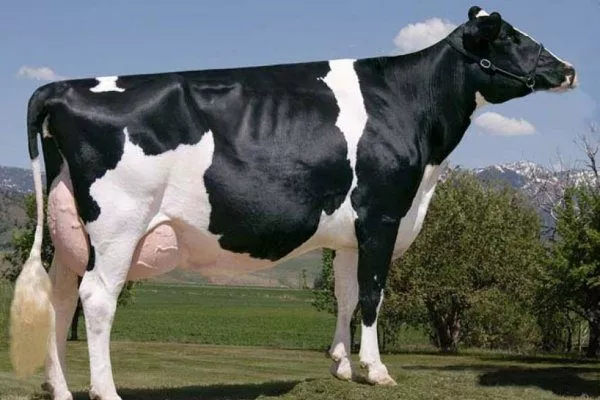
An adult bull stands 160 cm tall, while cows of this breed reach up to 145 cm at the withers. In some cases, bulls have reached as much as 180 cm. As for cattle color, it can be:
- black and piebald;
- red-piebald;
- bluish-piebald.
The latter color is extremely rare. The blue color is caused by the blending of black and white hairs. From a distance, the cow appears bluish, but in reality, she is mottled black and white. The most common color of Holstein-Friesian cattle is black and white. Black-and-white cattle are known for their higher milk yield than red-and-white cattle. Red-and-white cattle, while producing less milk, have a higher fat content than black-and-white cattle.
What criteria can be used to distinguish Holstein-Friesian cows?
- the head is light and level;
- elongated body;
- there is a small hump on the neck;
- the chest is deep and wide;
- the sacrum is wide and the back is long;
- straight croup;
- legs are wide and positioned correctly;
- The udder is bowl-shaped, large in size, with clearly visible veins.
- ✓ The shape of the udder should be cup-shaped with evenly developed lobes.
- ✓ The presence of clearly visible veins on the udder indicates high milk productivity.
Milk production can be determined by the shape of the udder and the prominence of the veins. If the udder is large and irregularly shaped, the cow will not produce much milk. A good udder, which produces a lot of delicious milk, is cup-shaped, with evenly developed lobes. The teats are small and soft. Some of the udder protrudes between the hind legs, with the bottom parallel to the ground and hanging down to the knee joints.
Care and maintenance
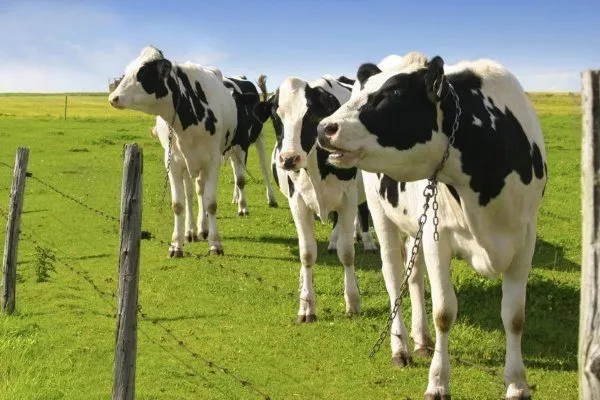
Holstein cows require comfortable conditions, fresh air, and a clean barn. Proper care improves their immunity and resistance to disease. Therefore, it's essential to build barns with good ventilation and thoroughly clean the barns for these animals.
In winter, they live in warm, untied quarters. The farmer must provide pens with bedding, and in northern regions, sheds with insulated walls are built. The animals are very particular about cleanliness, so their stalls must be cleaned twice a day.
Holsteins won't eat or drink if the dishes are dirty, nor will they eat unwashed vegetables or drink water contaminated with straw. Improper care will negatively impact milk production and yield.
If milking is done using a machine, the udder is completely milked within 3 minutes. After the milking process is complete, the udder must be checked for any remaining milk. It is important not to allow any milk to remain, otherwise it may cause mastitis.
Feeding
Feeding is tailored to each individual, as they are very picky eaters. From the second month of life, when calves stop drinking colostrum, they begin to feed themselves. They are given washed and peeled vegetables (400 grams per day) and concentrates. They are also fed oatmeal, 100 grams at a time.
From 4 months of age, hay and grain should be added to the calf’s diet; by the age of six months, the calf eats the following per day:
- 3 kg of hay;
- 1 kg of root vegetables;
- 7 kg silage;
- 1 kg of concentrates.
At six months, a heifer weighs 155 kg, and a bull 180 kg. After this age, calves are transitioned to a regular cow diet. Cows should receive an adequate amount of both dry and wet feed.
Feeding norms for cows during the lactation period:
| Type of feed per 100 kg of live weight | Name |
| Dry food – 3 kg | concentrates, green fodder, bone meal |
| Juicy – 10 kg | vegetables, haylage, silage and grass |
| Coarse – up to 2 kg | straw and hay |
During the first lactation period, the heifer should be fed as follows:
| Feed | Quantity |
| Hay | 4.5 kg |
| Straw | 3 kg |
| Haylage | 8 kg |
| Silage | 7 kg |
| Compound feed | 200 g |
| Syrup | 700 g |
| Salt | 50 g |
In summer, animals feed on fresh grass, but before grazing, they should be offered 1.5 kg of hay. The same amount should be given before bedtime. When milking, the heifer is fed compound feed; if the cow's milk production increases, the portion can be increased.
After three lactations, the cow's milk production levels out and she becomes productive, at which point her feeding schedule changes. To increase the fat content of her milk, she is fed compound feed and sunflower meal. For higher milk yields, she is offered:
- potato;
- molasses;
- carrot;
- beets.
- ✓ Inclusion of sunflower meal in the diet to increase the fat content of milk.
- ✓ Using molasses and root crops to stimulate milk production.
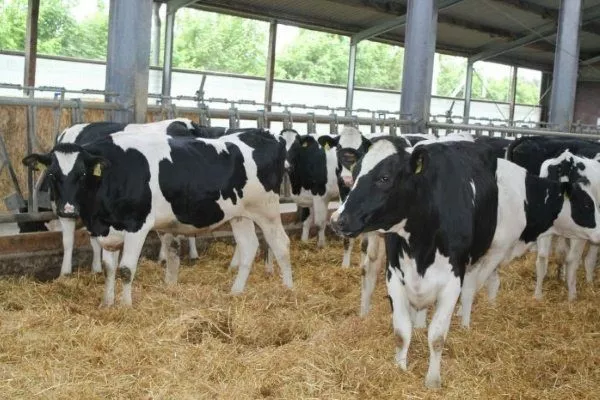
To ensure proper functioning of the gastrointestinal tract, cows are fed as follows:
| Feed | Quantity |
| Hay | 12 kg |
| Silage | 30 kg |
| Haylage | 7 kg |
| Straw | 3 kg |
| Roots | 15 kg |
| Vegetables | 6 kg |
| Oilcake | 1.5 kg |
| Bran | 1 kg |
| Syrup | 700 g |
| Salt | 70 g |
In summer, feed is replaced with lush, fresh grass, which a cow can consume up to 100 kg per day. The amount of straw and hay remains the same. If milk yield increases, the feed ration is revised.
Breeding
These cows are designed to expend maximum energy to produce large quantities of milk. Recently, difficulties have arisen with importing this breed to Russia. These difficulties have not produced the desired results:
- low milk yield;
- problems during childbirth;
- metabolic disorder.
Chenery published a stud book listing the Holstein-Friesian breed of cattle. Soon after, the cows began being bred in 12 American states.
Productivity
The productivity of this breed of cows directly depends on its country of origin. For example, in the US, cows produce a lot of milk, but have low fat and protein content. If the animal lacks nutrients, milk fat content can drop to as low as 1%, even with proper feeding.
Breeders cross Holstein-Friesian cows with Zebu bulls to produce higher milk fat content. The result is a black-and-white coat, with milk fat content reaching 5%.
The average milk yield for English cows is 10,500 liters per year, but this is achieved through supplements, specifically hormones that stimulate milk production. However, this milk is low in protein, fat, and protein.
Russian-European cows have slightly lower milk yields – up to 8,000 liters per year. At Russian dairy farms, a black-and-white cow produces 7,300 to 7,500 liters per year, with a fat content of 3.8%. Red-and-white cows, on the other hand, produce only 4,000 liters per year, with a fat content of almost 4%. The slaughter yield is 50%, which is quite respectable for a dairy cow.
The amount of milk produced during lactation varies. After birth, colostrum is produced, which differs from milk in consistency and color. The calf must receive colostrum, which is no more than 5 liters per day. After this, the cow is milked three times a day.
After a month and a half, the cow produces milk, which not only feeds the calf but is also used for drinking and sale. This period lasts four months, after which the cow is bred again. During pregnancy, milk production gradually decreases, and three months before calving, the cow is no longer milked.
For this breed of cows, the milking regime is important if milk a cow If you feed your cows at the same time every day, their milk yield will increase. The cow's habitat also affects milk yield; Holsteins especially prefer warmth and moderate humidity. For this reason, cows in Cuba produce the most milk.
The breed cannot be considered early maturing, as it can only bear its first calf at two years of age. A female can have 14 pregnancies and births. The gestation period lasts 285 days, and the lactation period can last up to 305 days.
A newborn calf weighs between 40 and 50 kilograms, and the heifer can carry only one calf. Under proper feeding and housing conditions, it will weigh 360 kg live at one year and three months. After this age, keeping bulls is unprofitable, as their weight stagnates or even decreases, so it is at this age that bulls are slaughtered.
Caring for calves
During the first few days after birth, calves are weak and susceptible to various illnesses, so they require special care. Within 14 days, they adapt to life and the environment. All handling of calves must be done with clean hands.
Calves should be kept in a warm room, as sudden temperature changes can make them sick. The stall should be cool in the summer and warm in the winter. Maintaining optimal humidity and temperature is also important.
Pros and cons
These animals aren't particularly hardy; they don't tolerate heat well, which means their milk yield decreases. Breeders have been working on their weather resistance for many years, but they're still improving their cows today.
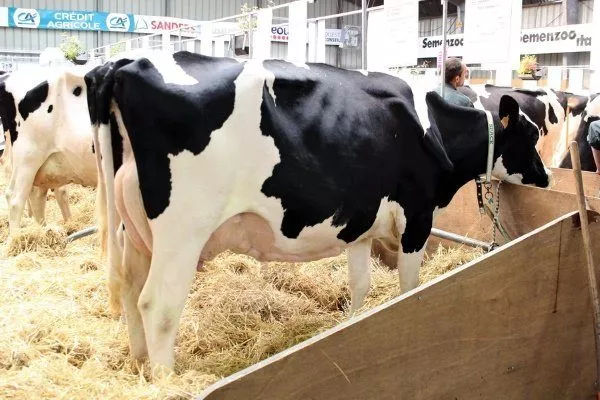
Advantages of Holstein-Friesian cows:
- high milk yield;
- normal fat content of milk;
- cleanliness.
As for the disadvantages, they are as follows:
- difficulty in feeding;
- difficulty in care and maintenance;
- susceptibility to infectious diseases (udder diseases, inflammation of the mucous membranes).
Farmers' reviews
Below are reviews from farmers who keep Holstein-Friesian cows in their private yard.
There aren't many Holstein-Friesian cows left because they're expensive and aren't adapted to all weather conditions. As for productivity, it all depends on the country where they live, the quality of feed, and the cows' management. Their meat yield is lower than that of beef breeds, but higher than that of some dairy animals.