
To ensure a cow produces a high milk yield, her owners must master milking techniques. Proper milking increases milk yield, improves milk quality, and prevents mastitis.
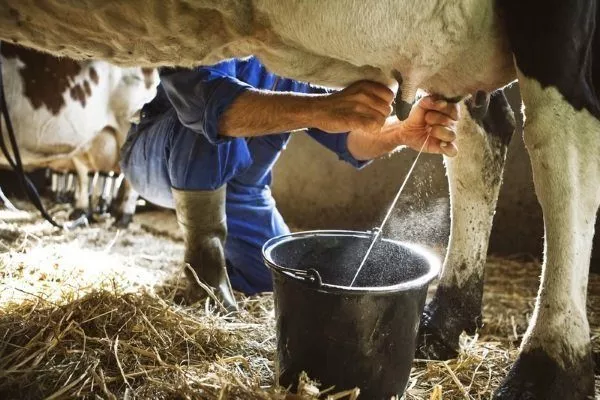
Hand milking
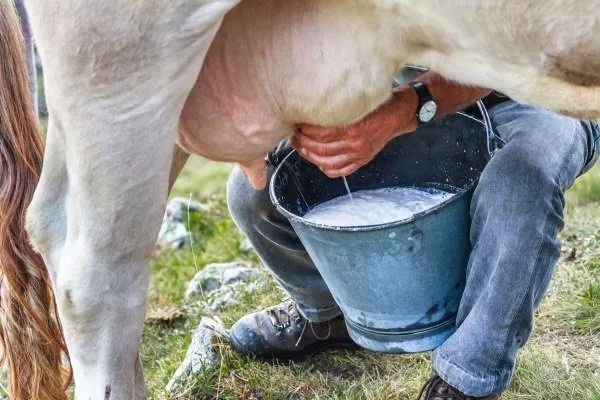
If you don't have a milking machine, use the tried-and-true method of milking the cow by hand. The process is simple, but it does require time and diligence, and, most importantly, proper technique.
Preparation
Milking will be easier if you establish a trusting rapport with the animal right away. Cows are very sensitive to people; they recognize their milker by their voice, appearance, and smell. Here are some rules to follow to help you milk successfully:
- Don't scare the cow, don't come up behind her, walk so that she can see you - otherwise she might get scared.
- Be sure to pet her, say a few sweet words, call her by name.
- Tie the cow. If necessary, tangle the hind legs. Secure the tail.
To prevent bacteria from the udder and the milker's hands from getting into the milk, follow hygiene rules:
- remove manure from the stall;
- ventilate the room;
- prepare a clean bucket and mug;
- put on clean work clothes and a cap or scarf on your head;
- wash your hands;
- Wash the udder with laundry soap – this will soften it.
Milk quality control
- ✓ Check the first streams for flakes (a sign of mastitis).
- ✓ Use a separate container for “dirty” milk (the first 100-200 ml).
The udder should be washed with water at 40°C—this matches the cow's body temperature. Using hot water may cause the milk to curdle.
Take a clean, dry towel and dry the washed udder. Make sure your hands are dry as well. Sit on a low stool and place the bucket under the udder. For added security, you can support the bucket with your feet.
Massage
To stimulate milk letdown, it's recommended to massage the udder with gentle stroking movements. The massage should last about a minute. With enough time and dedication, you can milk every last drop of milk. Massage triggers the cow's production of a hormone that relaxes the teats. Failure to massage the udder before milking will result in decreased milk yield.
Udder massage technique
- Circular movements at the base of each lobe (10 sec).
- Stroking from top to bottom with light pressure.
- Imitation of calf sucking (pushing the nipples upward).
Massaging the udder reduces milking time and increases milk yield by 15%.
After milking, they do a massage again, which:
- prevents mastitis, a disease that is a major problem in dairy farming;
- enhances ovarian function, which promotes successful fertilization;
- For heifers that have not given birth, massage begins several months before calving, and stops a month before calving.
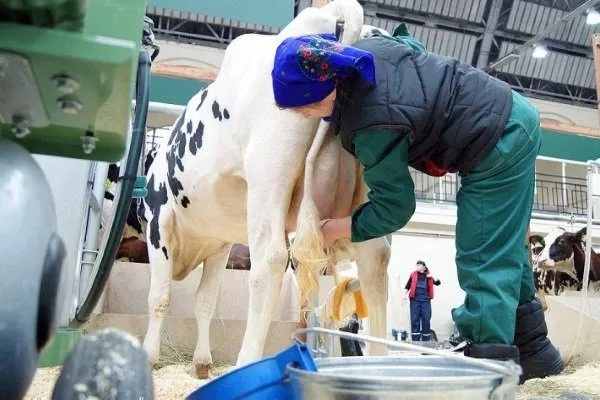
Milking technique and rules
There are two types of hand milking:
- with two fingers - "pinching";
- with a whole palm.
To prevent excessive friction, you can lubricate your hands with Vaseline - it will make milking easier.
The choice of equipment is the milker's business, it is important to follow these rules:
- Do not bend the teats during milking;
- milk should not get on your fingers;
- the first portion is milked not into a bucket, but into a specially prepared mug - this will reduce the number of bacteria in the milk;
- You need to express it until the very end - so that not a drop remains, otherwise mastitis cannot be avoided;
- the nipples are squeezed at a frequency of 70-100 movements per minute;
- Each nipple needs to be milked.
To increase milk yield and avoid mastitis, milking should be done at the same time every day.
Each teat is milked, as the udder is divided into lobes separated by a septum. Milk does not flow from one lobe to another. Remember the milking order: first milk the front lobes, then the back lobes.
Milking with two fingers
This technique is only suitable for young cows with short teats. It's less convenient than full-fist milking, but it's sometimes necessary. Pinch milking technique:
- While squeezing the nipple with your fingers – index and thumb – perform downward movements.
- Manipulations should be gentle and smooth – the animal should not experience pain.
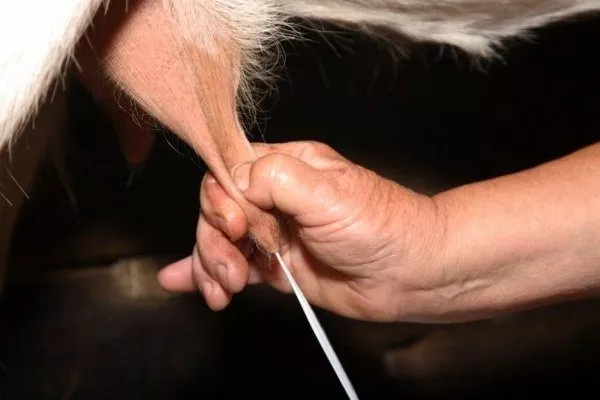
The pinching technique can provoke stretching and trauma to the teats, which can cause the cow to become irritable and even aggressive.
Milking with a fist (full palm)
Milking with a fist (full hand) is used more often; it is more convenient for the milker and less traumatic than milking with a pinch. Technique:
- Take a nipple with both hands—each should fit entirely in your fist. The base of the nipple should be between your index finger and thumb.
- Pulling the nipples downward, squeeze their bases. First, just the top two, then all at once.
- The milk stream is pushed toward the outlet using a wave-like motion. Bending or pulling the nipples is strictly prohibited. The stream should hit the bottom of the bucket strictly vertically.
- Each stream must be squeezed out completely - the milk must not be allowed to flow back.
- They rub the udder, moving their hands from top to bottom, then from the edge to the center. The remaining milk is milked out.
- Wipe the udder with a dry, clean cloth and generously lubricate it with Vaseline to soften and soothe the skin. Untie the horse, if tied, and remove any leg restraints.
It doesn't matter which nipples you milk first. You can milk them diagonally. Some mothers find it awkward to milk both hands at once. In that case, you can milk them one at a time, in any order.
After milking, you can treat the cow with something tasty to strengthen her trust in the milker and in the process itself.
A milkmaid will explain and demonstrate how to properly prepare for milking and how to milk a cow clean without harming her:
Machine milking
Using milking machines is cost-effective if you have at least a few cows.
Their advantages:
- The process is accelerated - this is an invaluable quality if there are a lot of cows.
- Labor costs are reduced – the cost of milk falls.
- Hygiene standards are observed. When using milking machines, the suction cups must be clean, and the milk collection container must be tightly sealed to prevent debris and hair from getting into it.
- Milking improves the quality of the product because the udder is massaged during milking. Milking continues until the last drop.
- Electricity consumption is low – the devices are economical.
Comparison of milking machines
| Parameter | Household | Industrial |
|---|---|---|
| Vacuum (kPa) | 42-48 | 50-54 |
| Cycles/min | 50-60 | 60-70 |
| Resource (hour) | 2000 | 10,000+ |
How to choose the right device?
Milking machines are differentiated by technical specifications, design, and application. All machines are categorized by functionality as follows:
- Industrial. They have a powerful engine and can milk several cows at once. They are large and equipped with automatic controls.
- Household. Designed for 1-2 cows, their advantage is the ability to be precisely adjusted to suit each individual cow.
Milk collection using any machine follows the same procedure. First, you need to check and prepare the machine:
- When the engine is turned on, the pump starts, creating a vacuum in the vacuum line.
- Wait 5 minutes until the pressure rises.
- Listen for noise - if there are any extraneous sounds, turn off the device and troubleshoot.
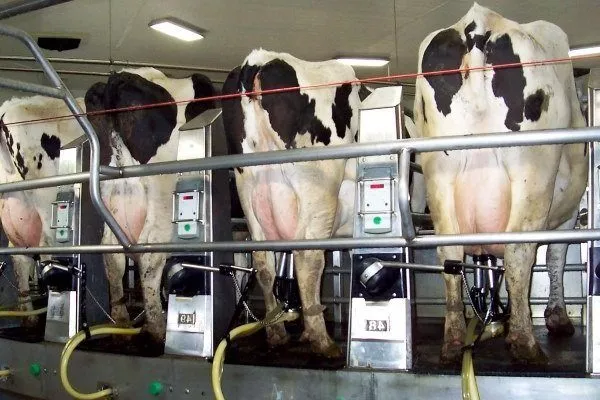
Adaptation to machine milking
- ✓ Start with 2-minute sessions for the first 3 days.
- ✓ Use pheromone sprays to relieve stress.
How to train a cow to use the machine?
Before using a machine, consult a veterinarian to ensure there are no contraindications. Cows previously milked by hand should be acclimated gradually. Avoid sudden changes, as they will become frightened and their milk yield will drop. The first thing to acclimate a cow to is noise. Humming is the main drawback of machine milking. Here's how to acclimate:
- When you milk the cow by hand, turn on the machine and let it hum.
- First-calf heifers should be trained a couple of months before calving. To do this, turn on the device and stroke their udders and teats.
Habituation should be reinforced during hand milking—in the morning, midday, and evening. This process takes place in the room where milking is to take place.
Animals frightened by the noise of the device should be calmed and offered a tasty treat—salted bread. The noise is turned off temporarily. Once the cow has calmed down and eaten, the device is turned back on, and the cow is given more bread. What you need to know:
- Machine milking is contraindicated if the udder or teats are damaged.
- You cannot use hand and machine milking alternately, as milk yield will decrease.
The process of milking with a machine
For milking, use a pre-cleaned apparatus. Milking procedure:
- The cow's udder is washed, wiped dry, and massaged.
- When the cow calms down and milk starts flowing, the milking machine is turned on.
- Once the pressure reaches the required values (specified in the instructions), attach the cups. Care must be taken to prevent air from getting inside the cups.
- Milking lasts 5 minutes. Once the milk begins to be sucked in, the pressure is reduced. The pulsation rate should not exceed 60 strokes per minute (the vacuum in the manifold is 37-41 kPa).
- When the jets decrease in intensity, the collector is pulled down slightly and then returned to its place - this will allow the residual milk to be milked out.
- When the udder softens and becomes flabby, turn off the device. If you wait a little, the cups will fall off on their own.
- They check the condition of the teats, pour out the milk and wash the milking machine.
An educational video demonstrating machine milking. A specialist explains the intricacies of the technique:
How often is a cow milked?
The owner decides how often to milk a cow per day. The animal's age and health are taken into account. The minimum milking frequency is twice a day. Here's what you need to know when introducing a cow to milking:
- First-calf heifers are milked 4 times a day during the first two weeks.
- Then the number of milkings is reduced to 3 per day.
The intervals between milkings must not be exceeded. If the regimen is two milkings a day, the interval should be no more than 12 hours; if three milkings a day, no more than 9 hours.
High-yielding cows should be milked three times a day, this will allow:
- maintain milk volumes at a high level;
- avoid milk stagnation.
What kind of mistakes are there?
At first glance, milking doesn't seem complicated; the main thing is to keep the cow from getting angry or frightened. But there are small things that can hinder milk production.
Mistakes in hand milking
Most errors are related to the milking regime and technique:
- Violation of the usual milking regime can lead to mastitis, sepsis, and death.
- Incomplete emptying of the udder. Milk remaining in the teats reduces its quality.
- Approach the cow from the left. You should approach from the right.
Machine milking errors
If the cow is not ready for milking, the device will quickly extract the cisternal milk, and then the milking process will continue in vain. This continues until the device's movement triggers the reflex again.
"Idle milking" causes pain and inhibits milk flow. Retaining milk in the udder reduces milk yield and damages the udder, leading to inflammation and mastitis. During milking, it is prohibited to inhibit milk flow by conditioned reflexes.
- rough treatment;
- painful irritation of the nipples;
- change of place and time of milking.
Whether milking by hand or machine, it's important to maintain hygiene, complete all preparatory procedures, and follow the milking technique precisely. For large-scale milk production, a milking machine is indispensable. If you have just one or two cows on your farm, hand milking is sufficient.