
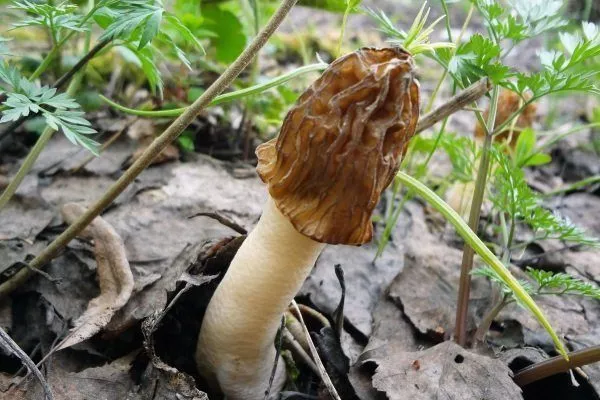
The morel cap is an edible, large, and fleshy mushroom. Its color can vary depending on its age. Its name comes from its resemblance to morels, and the small cap sits loosely on the stem. This type of mushroom can be found in mixed and deciduous forests.
What else is the morel cap called?
The name "morel cap" comes from the mushroom's cap's resemblance to a true morel. Besides this name, it is also known by other names:
- cap;
- cap;
- tender morel;
- conical cap;
- Czech verpa.
Description and features
The morel cap has a unique shape and appearance, making it impossible to confuse it with other types of mushrooms.
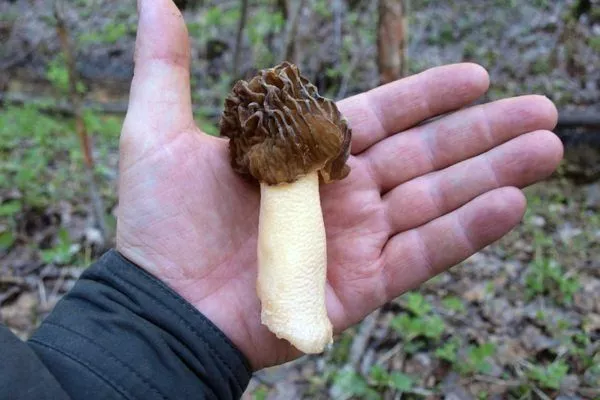
- hat A small mushroom shaped like a cap. It's covered in vertical folds and wrinkles, literally nestled on a stem, and can be easily removed without cutting it with a knife. The cap reaches five centimeters in height and up to four centimeters in width. Its color depends on its age: young mushrooms have a brown or chocolate-colored cap, while older mushrooms have a yellow-orange color. The color also depends on where the mushroom is growing.
- Leg The stem is curved and smooth, reaching a maximum length of 10 centimeters and a thickness of only 2 centimeters. It is often flattened laterally. When young, the stem is solid, but as the mushroom ages, a cavity forms that widens. The stem and cap are connected only at the base, and the contact is superficial. The stem is cream or white with visible scales; with age, it darkens.
- Pulp and spores. The flesh of the morel cap is white and thin, reminiscent of cotton wool, with a pleasant mushroom aroma and a mild flavor. The spores are smooth and elongated.
Where and when do morel caps grow?
This mushroom can be found in flooded soils with a temperate climate in the northern zone. These mushrooms grow in moist soil exclusively in the spring. In dry soil, the morel cap will not survive; it will dry out and die. This mushroom can be found near:
- stream;
- reservoir;
- a ditch filled with water.
As for the forest, this type of mushroom can be found in:
- birch;
- linden;
- aspen forests.
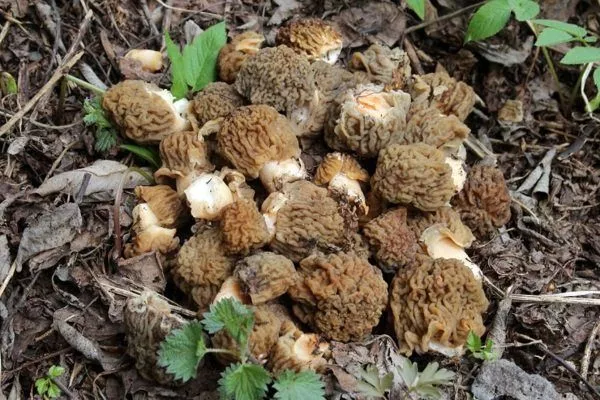
They most often grow in large groups and are rarely found singly. They are found from the Northern Caucasus to Karelia. In Russia, morels are harvested in the same way as champignons or butter mushrooms, and Russians love them.
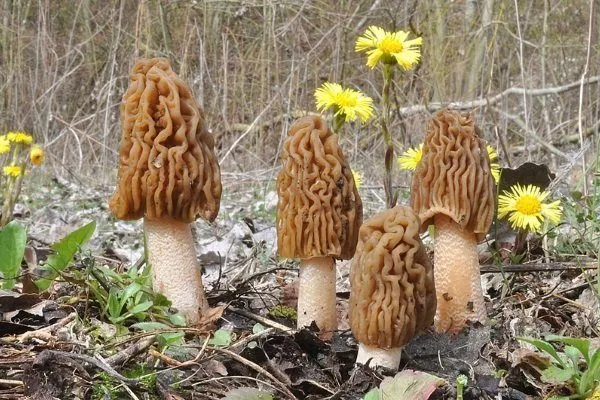
Mushroom pickers should go into the forest to pick mushrooms and look for:
- linden;
- aspen;
- birch;
- poplar;
- alder.
Mushrooms grow near trees that have lived at least 30 years, while they are much less common near young trees.
As for soil, they don't grow just anywhere, but prefer sandy loam soils covered with leaves and black soil. During dry periods, cold weather, and excessive moisture, the mushrooms die. In northern regions, rotten mushrooms are very rare.
Edibility of the mushroom
Morel mushrooms, although considered edible, should not be eaten raw. Many mushroom lovers eat morel caps, but this should be done with caution. Mushrooms should first be boiled for a long time before being fried, baked, or pickled. This is necessary because mushrooms contain a poison, albeit in small doses, which is released during cooking and remains in the water. The water should be changed 3-4 times during the cooking process.
Varieties of Morel Cap
Morel caps have no varieties.
Composition and value of the product
In several countries, the morel cap is considered inedible because it causes poisoning and allergies. However, experts in our countries claim that when prepared properly, the mushroom poses no danger; in fact, it's beneficial, containing the following vitamins:
- A;
- B1;
- B2;
- D;
- WITH.
And other useful substances:
- phosphorus;
- potassium;
- calcium.
This type of mushroom appears first, in early spring, and immediately after winter it is very useful to replenish the body with useful substances.
The benefits and harms of mushrooms
Any mushroom can be both beneficial and harmful to a person. Let's figure out which is more beneficial. Benefits:
- the mushroom contains many vitamins and microelements;
- metabolism accelerates;
- blood pressure stabilizes;
- the body's water balance is normalized;
- the inflammatory process (if any) is reduced.
Now about the harm:
- Morel caps contain a minimal amount of poison, but if the mushroom is boiled before consumption, all the poison will remain in the water;
- Morel caps should not be consumed by children under 14 years of age;
- Although mushrooms have a lactogenic effect, it is still better to avoid them completely during pregnancy and lactation;
- If you have low hemoglobin and poor blood clotting, it is also better to forget about these mushrooms;
- Individual intolerance is possible.
The mushroom's flesh is rich in nutrients, comparable in content to premium mushrooms. When properly prepared, the mushroom is even considered a true delicacy.
What can be confused with a morel cap?
The morel mushroom is somewhat similar to morels and gyromitra, so it is necessary to carefully examine the mushroom and not get confused.
They can be distinguished by the following criteria:
- The morel cap has a cap that is simply placed on the stem, while the morel cap is firmly attached;
- the morel cap is longer and the stem is shorter, while with the morel cap it is the other way around;
- The color of morels is always darker than the morel cap.
| Characteristic | Morel cap | Morels | Lines |
|---|---|---|---|
| Hat shape | Cap | Conical | Wide and low |
| Attaching the cap to the stem | Superficial | Dense | It grows together in some places |
| Color | Brown/chocolate (young), yellow-orange (old) | Darker than a morel cap | — |
| Taste | Weakly expressed | — | Less pronounced and more delicate |
| Growing conditions | Wet soil, spring | — | — |
As for morels and morel caps, they have the following differences:
- The morel cap has an elongated and not wide cap, while the morel cap has a wide and not very wide cap;
- The cap of the stitches in some places, especially at the top, grows together with the stem, but at the bottom it lags behind it, which cannot be said about the stitch cap;
- The taste of morels is weaker and more delicate than that of morel caps.
- ✓ Check the shape and attachment of the cap to the stem
- ✓ Pay attention to the color of the mushroom
- ✓ Consider taste
- ✓ Ensure the mushroom is growing in the right conditions
Application in nutrition
The mushroom's flesh is quite brittle, so it should be peeled carefully before cooking. The mushroom has a pleasant aroma and flavor, and a delicate texture. Before stewing or frying the mushroom, it's a good idea to boil it for 15 minutes first, then cook it.
How to grow a mushroom yourself?
First, you need to choose a suitable location. It should be sunny and elevated. Loamy or sandy loam soil is best. To ensure easy care and harvesting, allocate ample space: 1.5 meters wide and any length.
To ensure that mushrooms take root well, a clear sequence must be followed:
- Small pieces of rotten apples are placed on the surface.
- Next, directly on the soil where the mushrooms will grow, burn cardboard or paper and scatter the ashes over all the beds.
- Then the soil is watered.
- The next step is sprinkling with pre-prepared mycelium.
- Cover with a 5 cm layer of forest litter.
- Sprinkle spruce branches from the very top (chopped straw will also work).
Care is as follows: keep the soil constantly moist, and remove the covering the following spring. The mushrooms emerge from the soil the following spring after sowing. One square meter yields about two kilograms of mushrooms. Once the mushrooms have been harvested, the beds are covered again and watered periodically. Each year, the beds should be sprinkled with the same apples and the paper or cardboard burned. If everything is done correctly, the mushrooms can bear fruit for about five years in a row.
The morel cap, while unattractive in appearance, is an edible mushroom, even considered a delicacy in some ways. This mushroom can be grown at home, but it requires some effort and careful attention to detail.